
Brian A Russ retweetledi

When well-intended policies create unintended harm — a lesson in system dynamics.
Rating systems are designed to help patients choose better care, increase transparency, and incentivize hospitals to improve. But when you change one part of a complex system, the ripple effects can be profound — especially when reputation and reimbursement are on the line.
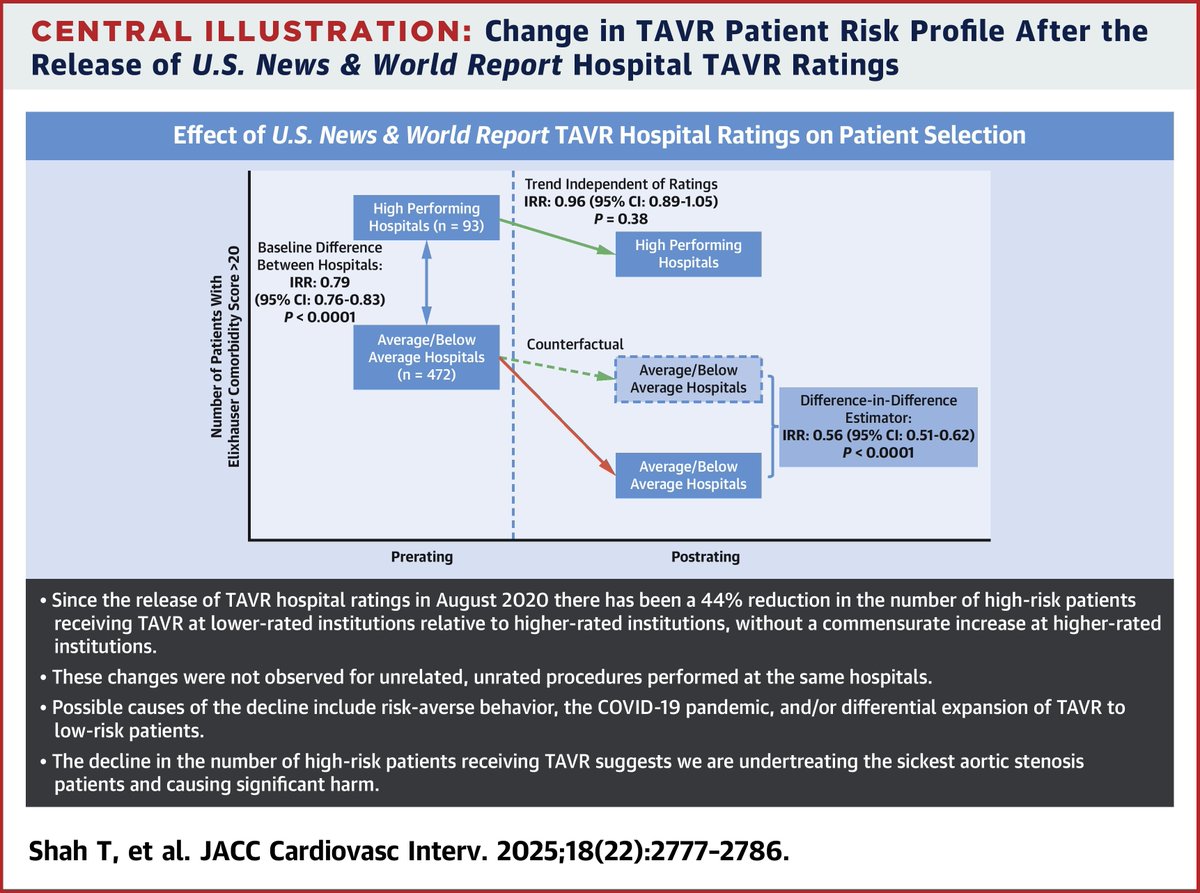
A new analysis in @JACCJournals reveals that after U.S. News & World Report began rating TAVR programs in 2020, lower-rated hospitals became significantly more risk-averse — performing 44% fewer high-risk TAVR procedures, with no compensatory increase at higher-rated centers.
This is the paradox of public ratings: a tool meant to improve care may instead discourage hospitals from treating the sickest patients, simply to protect a score.
It is a reminder that:
1. Metrics shape behavior.
2. Imperfect risk adjustment means patients — not systems — absorb the cost.
3. Those “too sick” for surgery must not become invisible casualties of policy design.
This is an opportunity to rethink and redesign — rather than to blame.
Perhaps the question should be: How do we build systems that reward treating the hardest cases — instead of penalizing them?
jacc.org/doi/10.1016/j.…
English