Stack

523 posts

Stack banner
Stack

Stack

@stackapp

Learn. Buy(Soon). Track. Peptides.

Austin, TX Katılım Aralık 2025
8 Takip Edilen3.4K Takipçiler
Stack retweetledi
Jesse Morse, M.D.
Jesse Morse, M.D.@DrJesseMorse·
Right now I’m focused on 2 things: Peptides & NFL/Fantasy Football (injuries) @stackapp Peptide Certification Course should be live in 2 weeks, the super important meetings regarding peptides are coming up on July 23 & 24th. I’ll be physically in attendance. @InjuryExpertz content is rolling out slowly, with new videos dropping daily, newsletters weekly and articles regularly and the 2026 Injury Draftguide ready on August 1 The 2nd half of the year is here, it’s go time baby!!!
English
8
3
76
20.5K
Crémieux
Crémieux@cremieuxrecueil·
Holy
Crémieux tweet media
English
82
26
2.7K
85.6K
Stack retweetledi
Jesse Morse, M.D.
Jesse Morse, M.D.@DrJesseMorse·
I appreciate the shout out regarding education on peptides. Earlier this year, I made it a mission of mine to be one of the industry leaders in Peptide education. Within the next few weeks, I am going to take that to the next level with launching of the @stackapp Peptide Certification Course. Think of it as a medical school-level course (initially) designed for physicians and practitioners. To bring all the doctors (and mid-level providers) up to speed on peptides since they didn’t get any peptide-specific training in medical/NP/PA school, residency or fellowship. Unless someone went way out of their way to get peptides training, they likely have very limited knowledge and experience with (prescribing) peptides. The course is 12 modules walking you through the basics of peptides, pharmacology, studies/evidence, what labs to check, which ones to stack, protocols etc There is also some regenerative medicine / stem cells and ozone therapy sprinkled in. Finally the last few sections provide protocols, examples of sample/mock patients and how to integrate peptides into your practice. This will be the GOLD standard peptide course going forward. Shortly after launch it will be made available for non-doctors/practitioners. Oh I forgot to mention it will be (eventually) available in over 30 languages and updated monthly as new information arises. If you’re interested in joining the waitlist, please click the link in the tweet below.
Daily Peptide@DailyPeptide

Regulators… mount up. I asked who the peptide side of X actually trusted for information. No gatekeeping, no bias, just the community’s answer. The people spoke. Here’s the roster. Ranked only by how many times each name came up. Not an endorsement, just trying to help anyone who doesn’t know where to start with peptide.

English
13
7
112
34.6K
Stack
Stack@stackapp·
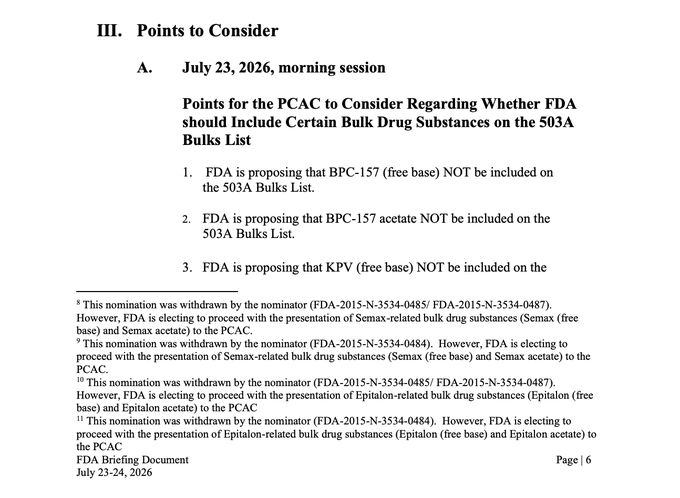
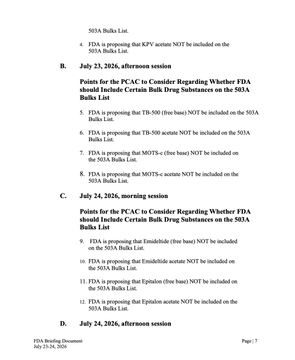
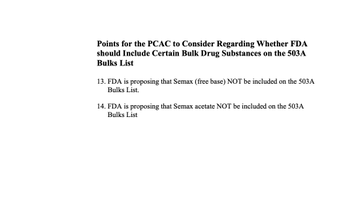
The FDA just posted the July 23-24 peptides meeting briefing and is proposing that all 7 peptides up for review stay OFF the 503A Bulks List Do you think this will stand?
Stack tweet mediaStack tweet mediaStack tweet media
English
4
1
19
4.5K
Crémieux
Crémieux@cremieuxrecueil·
Check this out if you want to see what this could result in intergenerationally: x.com/cremieuxrecuei…
Crémieux@cremieuxrecueil

A lot of people really don't know that elites give their kids HGH so they'll be taller! Fewer people realize that this environmentally-transmitted advantage can be transmitted to future generations genetically. How? One of my favorite recent papers detailed this. The way this works is simple, but I need to introduce some background first: richer people have better genes. What makes a set of genes "better" or "worse" when it comes to the attainment of a high level of social class is the degree to which the genes produce phenotypes that are conducive to social class attainment. So, for example, if being extroverted leads to earning a higher income as an adult, any genes that promote an extroverted personality will come to be associated with social class over time. In the Western societies most of the people reading this live in, genes that promote educational attainment are also broadly associated with social class attainment. And importantly, these associations are not simply reflections of social class: the genes that affect traits that are relevant to socioeconomic status work within and between classes, and within and between families, too! Here's an illustration of how genetic variants associated with educational attainment are stratified in four different cohorts located in the U.S., U.K., and New Zealand: In these studies, individuals with more genetic variants positively related to educational attainment compared to their parents tended to be upwardly mobile. Individuals with more relative to their siblings also tended to outperform their siblings. And this happened to similar degrees regardless of people's social class backgrounds! At the phenotype level, this finding has replicated for almost a century now. It first started being noticed in the 1920s, and the findings are substantially the same then and now, for most groups. The genetic finding above replicated in another cohort based out of Minnesota. In it, it was shown that when a kid had greater cognitive and noncognitive skills than their parents, they tended to move up; on the other hand, when those things were worse, they tended to move down. The same was true when it came to their genes. But this finding also rang true when comparing siblings: the one with better genes, better skills, etc. tended to move up, whereas the one with worse genes, worse skills, etc. tended to move down: This isn't a law-like finding and there are some qualifications. Firstly, social class of origin didn't seem to be a meaningful moderator. Secondly, there's a big difference between education and the labor market. When it comes to education, if a child has worse skills than their parents, they tend to move down, but downward mobility is much smaller than the upward mobility difference when kids are better than their parents. So for example, when the parent has greater skills than their child, 45% of the kids are educationally downwardly mobile compared to 27% who move up anyway. When the child has greater skills than their parent, 59% are educationally upwardly mobile compared to just 7% who are downwardly mobile. On the labor market, where most parents can't compensate for their kids nearly as much, there's symmetry: when the kid has worse skills than their parent, 58% end up in worse occupations compared to 22% who do better; when they have better skills than their parent, 64% end up in better occupations compared to 24% who do worse. Account for measurement error, and this becomes more dramatic, but I digress. Now, if we were to replicate this across all times and places, it's likely that some of the genes and even some of the traits we associate with success might not be associated with them in all of the possible different times and places. This happens because societies differ. So for example, a von Neumann-level intellect in an uncontacted Brazilian tribe might not be heralded as a genius worth remembering for all time, and he certainly won't work on any atomic weapons. He might not even end up as, say, the village chief. That might go to his brother, Strongarms von Neumann who, incidentally, is highly-valued for his incredibly strong arms. Unfortunately for UncontactedTribalJohn von Neumann, he didn't end up with the miraculous strength his society values. As I've noted before, in many societies, there's limited evidence for an association between traits like IQ or personality and socioeconomic status, but as time goes on and those nations have developed, the association in many places has also grown. So something has happened. In some cases, it's trivial: aging happens. If IQ is relatively age-independent among adults, but socioeconomic status is strongly age-dependent as it is basically everywhere, less developed countries will show a weaker IQ-SES association because the age structure means there's more randomness in socioeconomic status and the relationship is attenuated. This also happened in recent history across much of the West, when the Baby Boom occurred, which is why it's no coincidence that inequality declined with the Baby Boom, because lots of young people means lots of noise in status attainment. Now let's get to the meat, let's touch on how HGH improving a kids' height can lead to taller future generations! The paper that describes how this happens deals with a different subject, but you can easily generalize. In it, Abdellaoui et al. showed that if there's a shock to a person's socioeconomic status, they really can translate that shock intergenerationally through genetics. This doesn't have to do with epigenetics. It has to do with sorting on the mating market: when people assortatively mate on status-related traits, they aren't sorting themselves into couples based on their underlying genes, but on the appearance of those genes in the real world. So, if someone manages to earn higher status than expected given their genes, we should expect them to be able to find a mate with status that's closer to what you'd expect for a person with better genes. In other words, you can trade status for the genetics of status, keeping status in the lineage for generations to come. To show this, Abdellaoui et al. used birth order as an instrument for greater gene-independent socioeconomic status attainment. Their justification was sensible: "It is known that earlier-born children receive more parental care and have better life outcomes, including measures of SES such as educational attainment and occupational status. On the other hand, all full siblings have the same ex ante expected genetic endowment from their parents, irrespective of their birth order. This is guaranteed by the biological mechanism of meiosis, which ensures that any gene is transmitted from either the mother or the father to the child, with independent 50% probability.... We can therefore use birth order as a 'shock' to social status." The size of this shock in Great Britain was fairly large. The controlled cross-sectional birth order effect in terms of the impact of one additional elder sibling translates to a 7.9% lower chance of attending university, 0.077 standard deviations lower income, 0.27 points lower fluid IQ on a 13-point test, 0.7 centimeters smaller stature, 0.043 points worse self-reported health on a 4-point scale, and 0.19 points higher BMI. Birth order effects also showed up in Norway. In both studies, a harmful birth order effect on a person's own status predicted worse genes in that person's spouse. Accordingly, this means that people really are exchanging status for a "higher-quality" spouse! The studies had different mediator variables available, but here's how those birth order effects were visibly statistically mediated in each country: In both countries, the biggest mediator was education! Through improving a person's odds of obtaining a university education, being born earlier improves the likelihood that they'll meet a high-quality spouse. Notably, in Norway, income didn't seem to be a mediator, and the effect of birth order on spousal genetic quality was about twice as large. This likely speaks to differences in how institutions affect social status in the two countries, suggesting that even within Europe and between two developed countries, the genetics of social status can operate in directionally similar, but quantitatively dissimilar fashions. The implications of these findings are considerable, even though this finding only represents part of the total genetic stratification of social class in these societies, for various reasons. For one, this confirms the supposition that advantage can be intergenerationally transmissible for more than environmental reasons. It also makes it possible for models like Fisher's to be more plausible in a sense because even though "the genetic theory seems to require very high levels of genetic assortative mating", this paper's social-genetic assortative mating model shows that "Persistence will be increased if, in addition to genetic assortative mating, high SES itself attracts 'good genes'." The previously-mentioned differences between Britain and Norway also tell us that genes are not exogenous inputs, they're endogenous outcomes; for example they're "not a confound for wealth, but a mediator." The way this translates to the HGH example is exactly as @snuppydogg has described. His cousin got a height boost, and he's going to cover it up by marrying a taller woman! And likely because he's taller than he would have been, he'll have an easier time making that happen. Why? Because height leads to higher incomes, more respect, more sexual attractiveness, and people like to assortatively mate—even on traits like height! So the HGH bonus? Well, it might've started environmental, but in a lot of ways, it's going to be passed on genetically!* To learn more, see: cremieux.xyz/p/intelligence… (also: x.com/cremieuxrecuei…) * If everyone does this, maybe it washes out. If there are height-attractiveness thresholds, that won't be the case, but I don't know about that. Regardless, right now, everyone doesn't do it, so it's pure gain for the kid!


English
6
2
106
41.6K
Stack
Stack@stackapp·
@cremieuxrecueil Will you check Sig when u get the chance? Appreciate you
English
0
1
1
358
Stack retweetledi
Jesse Morse, M.D.
Jesse Morse, M.D.@DrJesseMorse·
If you own a telemedicine company, please reach out to me.
English
12
2
22
26.4K
Steve Will Do It
Steve Will Do It@stevewilldoit·
Hi guys . I am Looking for long-term partnership with a peptide company that is FDA-approved peptides. Not research-use-only stuff . Plz email my team if interested: marybeth@stevewilldoit.com lloyd@stevewilldoit.com
English
135
37
715
295.8K
Rahul Modi | Peptide Coach
Rahul Modi | Peptide Coach@rahulmodifit·
the amount of people i’ve run into taking MT1 or MT2 at this music festival is actually blowing my mind. the funniest part is i could usually tell before they even mentioned it. then they come up, ask if i’m natural, we start talking about my physique, and somehow the conversation always ends up on peptides, testosterone, bloodwork, and optimization. what surprised me wasn’t how many people are using peptides. it’s how many people are using them with almost no understanding of what they’re actually taking. wrong dosing. no bloodwork. no long-term plan. just advice they got from a friend or social media. it’s honestly made me realize this space is growing way faster than the education around it. also… i don’t think MT1 or MT2 will ever make it into my stack. i’m already indian. i think i’ve got the melanin part covered. this weekend has been a reminder that peptides aren’t niche anymore. education is what’s trying to catch up.
Rahul Modi | Peptide Coach tweet media
English
5
1
15
5.6K
Rahul Modi | Peptide Coach
Rahul Modi | Peptide Coach@rahulmodifit·
@DrJesseMorse @stackapp How will you make this standardized and recognized? I feel like the there should be a nationally recognized certification/license. Are you also the only one working on something like this?
English
1
0
0
157
Crémieux
Crémieux@cremieuxrecueil·
Unfortunately, no amount of deregulation is sufficient to catch up to China. There's another missing ingredient in the form of figuring out how to fund pharmaceutical R&D, and the U.S. is not willing to match recent NRDL successes in this domain.
Alex Tabarrok@ATabarrok

The Trump administration has some useful ideas to speed clinical trails but are they radical enough for us to catch up with China? marginalrevolution.com/marginalrevolu…

English
31
15
546
45.1K
Stack retweetledi
Jesse Morse, M.D.
Jesse Morse, M.D.@DrJesseMorse·
Sexual Wellness Peptides How do you use them? This section/module includes: PT-141 Melanotan I & II Kisspeptin HCG Gonadorelin Oxytocin Testosterone (TRT) Enclomiphene Learning the Peptides isn’t enough. You have to know exactly which pathway in the body they work, and which ones are used in which situations. Which labs need to be monitored, and what is a traditional protocol. Which ones can be stacked? Contraindications? That’s why, during our Peptide certification course, we decided to apply these different peptides, protocols, stacks, and labs to ‘mock’ patients. Watch the example below. Clip taken from @stackapp Peptide Certification Course. If you’re interested in taking the course, click the link below to join the waitlist. It will be available very soon.
English
9
8
130
34.7K
Stack
Stack@stackapp·
It’s almost time
English
0
0
2
593
Stack retweetledi
Jesse Morse, M.D.
Jesse Morse, M.D.@DrJesseMorse·
Peptides Are Here. Is Your Clinical Practice Ready? If you’re prescribing GLP-1s, BPC-157, AOD-9604, or any of the 75+ peptides now reshaping regenerative and longevity medicine — you need structured, evidence-based clinical education. Not hype. Not theory. Protocol. I’m launching the STACK Peptide Certification Course — a physician-level, CME-accredited program designed by clinicians, for clinicians. What you get: ✓ 12 comprehensive modules✓ 100+ videos covering mechanism, dosing, patient selection, monitoring & safety✓ 75+ peptides systematically reviewed✓ CME credit (joint providership accreditation in progress)✓ Clinical protocols you can implement immediately Why now? The FDA Peptide Compounding Advisory Committee meets July 23-24. Regulatory clarity is coming. Practitioners without foundational knowledge will be caught flat-footed. Those with structured training will lead their markets. We’re launching in July 2026. Whether you’re in regenerative medicine, sports medicine, concierge/longevity practice, or functional medicine — peptide therapy demands clinical rigor. This course is that foundation. Join the waitlist. Get early access, exclusive pricing, and module previews as we build. Link in comments 👇
English
17
18
175
28.5K
Carter Jenkins
Carter Jenkins@carterwhoosh·
Just now, @Isaacbklein and I launched Whoosh, an entirely compliant Telehealth platform that will focus on Peptide Therapy. While today, peptides carries a bit of a social stigma, we believe it will play a large role in the future of health, wellness and medicine. We want to help lead the charge and focus where others may not. One thing to make clear: we are in no way against the current landscape. Unfortunately, in the regulatory environment as it stands today, many of the most impactful, life-changing compounds are not widely accessible. Currently, I am using many peptides I am unable to distribute through our platform. We believe that will change, that is what we are positioning for. We will always advocate for the best peptides, whether we are able to prescribe them or not. Additionally, as regulatory continues to shift, we will continue to expand our offerings - looking ahead to a larger Recovery suite, Cognitive enhancements, more effective weight loss protocols, and much more. With that being said, we are setting out to be the option for those who want personalized protocols, pharmacy-grade therapies, US APIs, and physician-guided care. Zero compromises on quality or support, while always keeping accessibility in mind. We intend to break down the barriers and stigma with clean access and tested, accepted administration methods beyond the needle. We intend to be at the forefront of complaint offerings, focusing on the upcoming peptides, from BPC-157, TB-500 to Semax, DSIP, Epitalon and GHK-cu. We intend to push boundaries with microdosed tadalafil and GLP protocols for cardiovascular, longevity and cognitive benefits. It is time self-administration shakes the stigma and sits alongside your other daily efforts (gym, stretching, supplements). In order to do this, we must offer a pathway without the friction of reconstitution, endless-delays, zero guidance and zero oversight. This is not an indictment on RUO, in fact, optionality and overall societal shift will benefit the entire ecosystem. While right now you will not be able to source everything from Whoosh, all we hope is that when we do serve what you are looking for, you give us a shot. We are on the same mission as everyone reading this: to optimize our individual health and to heal the masses. Learn more about us and our team here: whooshwellness.com Use code FFWHOOSH30 for a 30% site wide discount today.
Whoosh@whooshwellness

Physician-prescribed, pharmacy-grade peptides, delivered right to your door Whoosh is a licensed telehealth platform built around recovery, performance and longevity We take the guesswork out of peptides. whooshwellness.com

English
23
11
131
30.6K