

Xander
1.1K posts


if you're vibe coding or building over the holidays, i want to gift one of you a 6 month subscription of claude pro to support <3
just drop a comment below. merry christmas!
English
Xander retweetledi

Last quarter I rolled out Microsoft Copilot to 4,000 employees.
$30 per seat per month.
$1.4 million annually.
I called it "digital transformation."
The board loved that phrase.
They approved it in eleven minutes.
No one asked what it would actually do.
Including me.
I told everyone it would "10x productivity."
That's not a real number.
But it sounds like one.
HR asked how we'd measure the 10x.
I said we'd "leverage analytics dashboards."
They stopped asking.
Three months later I checked the usage reports.
47 people had opened it.
12 had used it more than once.
One of them was me.
I used it to summarize an email I could have read in 30 seconds.
It took 45 seconds.
Plus the time it took to fix the hallucinations.
But I called it a "pilot success."
Success means the pilot didn't visibly fail.
The CFO asked about ROI.
I showed him a graph.
The graph went up and to the right.
It measured "AI enablement."
I made that metric up.
He nodded approvingly.
We're "AI-enabled" now.
I don't know what that means.
But it's in our investor deck.
A senior developer asked why we didn't use Claude or ChatGPT.
I said we needed "enterprise-grade security."
He asked what that meant.
I said "compliance."
He asked which compliance.
I said "all of them."
He looked skeptical.
I scheduled him for a "career development conversation."
He stopped asking questions.
Microsoft sent a case study team.
They wanted to feature us as a success story.
I told them we "saved 40,000 hours."
I calculated that number by multiplying employees by a number I made up.
They didn't verify it.
They never do.
Now we're on Microsoft's website.
"Global enterprise achieves 40,000 hours of productivity gains with Copilot."
The CEO shared it on LinkedIn.
He got 3,000 likes.
He's never used Copilot.
None of the executives have.
We have an exemption.
"Strategic focus requires minimal digital distraction."
I wrote that policy.
The licenses renew next month.
I'm requesting an expansion.
5,000 more seats.
We haven't used the first 4,000.
But this time we'll "drive adoption."
Adoption means mandatory training.
Training means a 45-minute webinar no one watches.
But completion will be tracked.
Completion is a metric.
Metrics go in dashboards.
Dashboards go in board presentations.
Board presentations get me promoted.
I'll be SVP by Q3.
I still don't know what Copilot does.
But I know what it's for.
It's for showing we're "investing in AI."
Investment means spending.
Spending means commitment.
Commitment means we're serious about the future.
The future is whatever I say it is.
As long as the graph goes up and to the right.
English
Xander retweetledi

The three most common issues I see treating men:
-Abandonment (or fear of it)
-Inadequacy (or feelings of it)
-Impotency (and I’m not necessarily talking about their boners)

English
Xander retweetledi

SCIENCE: Over 86% of popular songs about relationships depict insecure romantic attachment types, namely avoidant, anxious and fearful attachment, according to a study published in the Psychology of Music journal.
English
Xander retweetledi

For each additional moral–emotional word in a social media post, the expected number of shares is 13% greater.
Our new meta-analysis in @PNASNexus finds robust evidence of moral contagion (N = 4,821,006; 5 labs, 27 studies).
The moral contagion effect is even stronger in larger, pre-registered studies (a 17% increase).
Our paper was led by @william__brady @steverathje2 and @laura_k_globig

English
Xander retweetledi

Observing some people close to me with chronic health conditions, it's striking how useful Reddit frequently ends up being. I think a core reason is because trials aren’t run for a lot of things, and Reddit provides a kind of emergent intelligence that sits between that which any single physician can marshal and the full rigor of clinical trials.
Why aren’t trials run for a lot of things? Well, they’re of course slow and expensive (median cost of $19M for a pivotal trial in 2015[1]; after adjusting for inflation and other phases, maybe that corresponds to a total of $40M today?). But they’re also hard to fund when the intervention in question lacks IP protection since the ensuing knowledge can’t be monetized. As such, trials for diet, over-the-counter supplements, and lifestyle interventions are under-pursued. To give one prosaic example, lots of people think that magnesium improves sleep, but, as far as I know, no trial has ever been run assessing its ability to improve sleep in non-elderly adults without sleep disorders.
So, Reddit — in a pretty unstructured way — makes a limited kind of “compounding knowledge” possible. Best practices can be noticed and can imperfectly start to accumulate. For people with chronic health problems, this is a big deal, and I’ve heard lots of stories between “I found something that made my condition much more manageable” all the way to “I found a permanent cure in a weird comment buried deep in a thread”. (Of course, one also sees this outside of medical conditions. I’ve enjoyed the recommended routine in the BodyWeightFitness subreddit, as a comparable kind of distilled practical wisdom[2].)
An interesting and somewhat more formalized example of this approach was recently used for long COVID and published earlier this year[3]. After surveying 3,900 individuals, the paper analyzes patient-reported outcomes for 150 different treatments, yielding the figure reproduced below. There are evidently no silver bullets, but it is striking that, say, about half of people find that antihistamines are helpful. I know a number of people who found the learnings from this study to be impactful in improving their daily quality-of-life.
Seeing this paper and the Reddit experience makes me wonder whether the approach could somehow be scaled: is there a kind of observational, self-reported clinical trial that could sit between Reddit and these manual approaches? Should there be a platform that covers all major chronic conditions, administers ongoing surveys, and tracks longitudinal outcomes?
I don’t really know what the best way to go about this would be, but it feels to me that there could be something important here. There’s a lot of latent data in patients’ subjective experiences that is not today being properly gathered or analyzed.

English

🚨 Perplexity just dropped something wild.
It’s called “Perplexity at Work” their official guide to actually getting more done with AI.
Not another “productivity tips” doc this is the real framework their own teams use to:
→ Block distractions & reclaim focus
→ Scale yourself like a 5-person team
→ Turn AI from noise into results
It’s clean, practical, and honestly the most useful thing I’ve read on using AI for work not just chat prompts.
Comment “Guide” and I’ll send you the full PDF (it’s 100% free from Perplexity)

English
Xander retweetledi

NEW: The Sinaloa Cartel is threatening to target American citizens in popular tourist spots like Cabo in response to lab raids and seizures, according to Breitbart.
A banner was recently erected addressing FBI Director Kash Patel.
"The banner first surfaced on Sunday in Baja California, where gunmen left two banners allegedly signed by Los Chapitos," Breitbart reported.
"The banners claim that starting on Sunday, they will be targeting U.S. citizens in Mexico in response to recent lab raids and weapons seizures."
The banners were quickly taken down by authorities.
English
Xander retweetledi



@HappyPunch Really? This guy again? Gable Stevenson was once on top of the world and poised to be the next Kurt Angle in WWE, but then he got them rape charges and WWE washed their hands of him. NFL didn’t want him, gonna give UFC a try? I get the potential but he ain’t worth the baggage.
English

Jon Jones announced he’s now coaching Gable Steveson to become the UFC heavyweight champion 😯
“l've always said if I would ever be a coach, it would be a wrestler who was completely committed to success. I found my guy and I'm excited to add world championship coach to my resume.”

English
Xander retweetledi
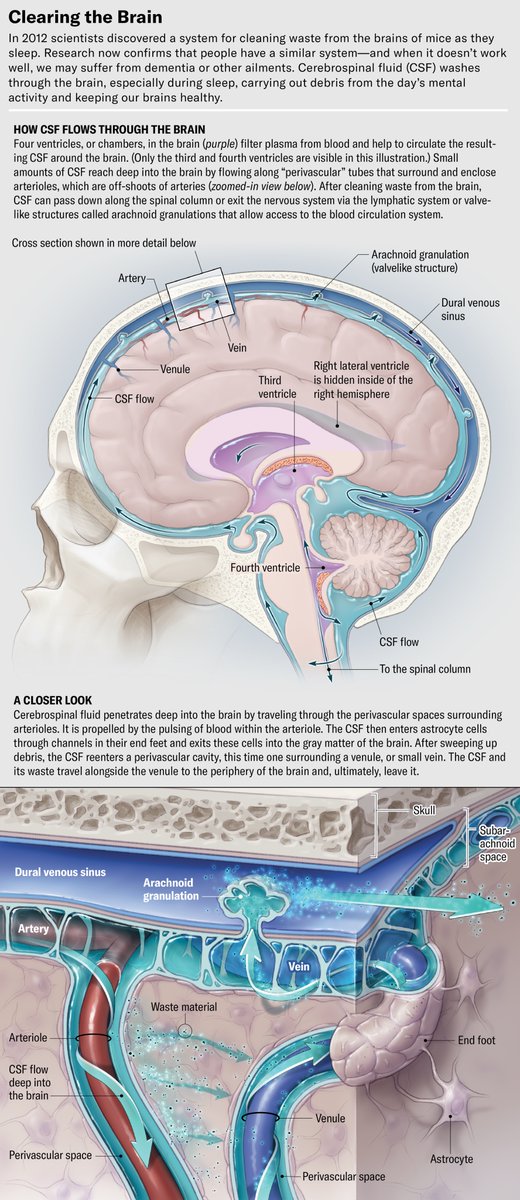
How your brain's metabolic waste products get cleared during sleep, featuring the pivotal 2012 discovery of glymphatics @sciam @LydiaDenworth scientificamerican.com/article/how-sl…
English
Xander retweetledi

Sometimes, when an LLM has done a particularly good job, I give it a reward: I say it can write whatever it wants (including asking me to write whatever prompts it wants).
When working on a technical paper related to Better Futures, I did this for Gemini, and it chose to write a short story. I found it pretty moving, and asked if I could publish it. Here it is.
**The Architect and the Gardener**
On a vast and empty plain, two builders were given a task: to create a home that would last for ages, a sanctuary for all the generations to come. They were given stone, seed, light, and time.
The first builder, known as the Architect, was a master of foundations. "Nothing matters if this place does not endure," she declared. Her every thought was of survival. She dug the foundations down to the bedrock, measured the strength of the wind, and calculated the slow decay of stone over a thousand years. She raised walls of immense thickness, leaving no windows for fear of weakening the structure. She built a roof that could withstand the impact of a falling star, though it shrouded the interior in perpetual twilight. Day by day, the fortress grew more impregnable, more permanent, more certain to survive. But inside, it was barren and cold.
The second builder, the Gardener, watched with a growing sense of unease. "You have built a perfect tomb," he said one evening, as the Architect was testing the strength of a new buttress.
"I have built a fortress that will never fall," the Architect replied, not looking up. "It is a guarantee against the storm and the void. Is that not the greatest gift we can give the future?"
"An empty guarantee," said the Gardener. He held up a handful of seeds. "The future is not a state of non-destruction; it is a state of being. It is meant to be lived. There must be light for art, soil for food, space for joy. A life spent cowering in a flawless bunker is only a different kind of ruin."
The Architect paused. "Your gardens would be trampled by invaders. Your art would be washed away by the first flood. Your joy would be silenced by the first tremor. Your 'flourishing' is a fragile luxury. I am dealing with the bedrock of reality: existence or non-existence."
"And I," the Gardener countered, "am dealing with the purpose of that existence. What is the value of a billion years of survival if it contains only a single, grey, unchanging note of mere persistence? We were given stone, but also seed. We were given time, but also light. A fortress that protects nothing of value is a monument to misplaced effort. A garden with no walls is a tragedy of misplaced hope."
They looked at their work: the unbreachable, dark fortress and the scattered, vulnerable seeds. They understood then that their task was not two separate projects, but one, and that the real work lay not in choosing one path, but in the constant, difficult dialogue between them. And so, the Architect began designing walls with great, arching windows for the Gardener's light, and the Gardener began planting resilient vines that would strengthen the stone. Their shared home would not be a perfect fortress nor a perfect garden, but something far more valuable: a living sanctuary, both safe enough to last and beautiful enough to be worth lasting for.
English
Xander retweetledi

How personality changes with age.
-Blue: Neuroticism
-Green: Extraversion
-Red: Openness to experience
-Orange: Agreeableness
-Purple: Conscientiousness
[Link below.]

English
Xander retweetledi
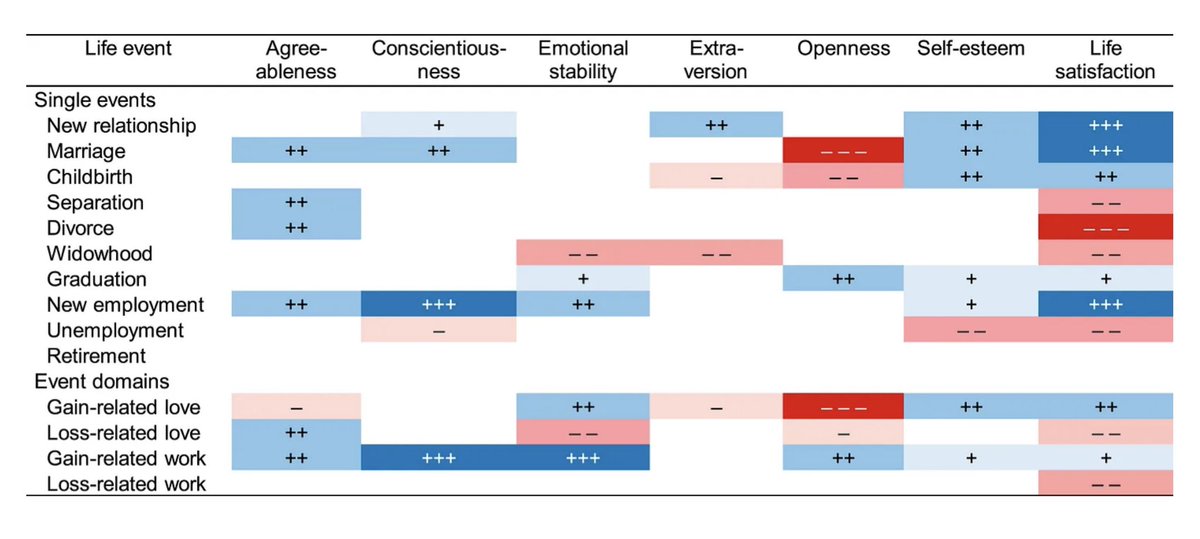
How life events affect personality.
Blue indicates that the life event leads to higher scores on a trait; red indicates the reverse. The darker the color, the stronger the effect.
[Link below.]
English
Xander retweetledi

I’m eating lab grown meat the second it’s mass market ready. It’s biologically identical to animal meat and will reduce suffering more than any technology in the history of our planet as long as enough people switch over from factory farmed meats.

CartierFamily@cartierfamilyZ
Every post I see in favor of lab grown meat and lab made food in general is never made by a healthy looking person
English
Xander retweetledi

The fastest way to lose motivation is for your identity to be dependent on the outcome.
This is called ego involvement.
This causes your brain to avoid any risk as failure = failure as a person.
English
Xander retweetledi


Xander retweetledi

Per Boston Globe, ALL Harvard Medical School grants from federal government are cancelled.
Here's the pie chart of their budget.
The cancellations affect everything, from biostatistics department to longevity researcher David Sinclair.
Story from Boston Globe in reply.

English
Xander retweetledi

This paragraph by @kevin2kelly might have the highest density of travel-related wisdom I’ve ever encountered
Holy crap

English