Taylor Schmidt

6.5K posts

Taylor Schmidt banner
Taylor Schmidt

Taylor Schmidt

@t__schmidt

Founder of Corbu • SF • Architecture Podcast Host • I like to travel :)

San Francisco, CA Katılım Ağustos 2013
2.2K Takip Edilen802 Takipçiler
Taylor Schmidt
Taylor Schmidt@t__schmidt·
@benjamintink It's Google's design tool to use Nano Banana and their video models. From their Labs team. Free to use, very good
English
0
0
1
47
Ben Tinklenberg
Ben Tinklenberg@benjamintink·
The secret sauce for amazing site plan renders? Take a half-baked Sketch Up model screenshot and feed it into Gemini Nano Banana. LIFE CHANGING! Oh, and tell Gemini to keep the same orthographic projections in the prompt.
English
3
0
19
9.9K
Drafted
Drafted@DraftedAI·
Discover what's possible on Drafted with the new Explore page. 🌎 Browse standout designs by other Drafters to inspire your own floor plan creations.
English
2
6
53
4.6K
Taylor Schmidt retweetledi
Joe Kent
Joe Kent@joekent16jan19·
After much reflection, I have decided to resign from my position as Director of the National Counterterrorism Center, effective today. I cannot in good conscience support the ongoing war in Iran. Iran posed no imminent threat to our nation, and it is clear that we started this war due to pressure from Israel and its powerful American lobby. It has been an honor serving under @POTUS and @DNIGabbard and leading the professionals at NCTC. May God bless America.
Joe Kent tweet media
English
72.4K
219.6K
845.5K
98.8M
Taylor Schmidt retweetledi
Alberto
Alberto@taiuti·
Big update: I’m starting a new company. 6 months ago, @_bschmidtchen and I made a bet. What if entire worlds could be generated on the fly, pixel by pixel? World models are the next platform shift, and we saw it coming. Since then, we’ve: - secured major contracts across media and physical AI industries - assembled a team of 10+ from Apple, Meta, Google, Adobe & Microsoft - raised from top-tier investors More details soon. We’re scaling fast, and hiring now. Come build with us: reactor.inc
English
61
31
360
59.4K
Taylor Schmidt
Taylor Schmidt@t__schmidt·
@Mattbrown Do you think a startup could begin as only the tech, before they become the fin? Or, do you have to plan to raise enough to jump straight to being the fin with the tech?
English
0
0
0
406
Andrew Jeffery
Andrew Jeffery@credealjunkie·
I am creating a Bay Area rental housing database with Claude, and had the same thought. Claude created the sql DB with my parameters, and together we are populating the data. Then I just upload the latest version and ask questions. Why isn’t this my CRE pro forma in 6 months?
andrew chen@andrewchen

prediction re the end of spreadsheets AI code gen means that anything that is currently modeled as a spreadsheet is better modeled in code. You get all the advantages of software - libraries, open source, AI, all the complexity and expressiveness. think about what spreadsheets actually are: they're business logic that's trapped in a grid. Pricing models, financial forecasts, inventory trackers, marketing attribution - these are all fundamentally *programs* that we've been writing in the worst possible IDE. No version control, no testing, no modularity. Just a fragile web of cell references that breaks when someone inserts a row. The only reason spreadsheets won is that the barrier to writing real software was too high. A finance analyst could learn =VLOOKUP in an afternoon but couldn't learn Python in a month. AI code gen flips that equation completely. Now the same analyst describes what they want in plain English, and gets a real application - with a database, a UI, error handling, the works. The marginal effort to go from "spreadsheet" to "software" just collapsed to near zero. this is a massive unlock. There are ~1 billion spreadsheet users worldwide. Most of them are building janky software without realizing it. When even 10% of those use cases migrate to actual code, you get an explosion of new micro-applications that look nothing like traditional software. Internal tools that used to live in a shared Google Sheet now become real products. The "shadow IT" spreadsheet that runs half the company's operations finally gets proper infrastructure. The interesting second-order effect: the spreadsheet was the great equalizer that let non-technical people build things. AI code gen is the *next* great equalizer, but the ceiling is 100x higher. We're about to see what happens when a billion knowledge workers can build real software.


English
7
0
15
7.3K
Nick Donahue
Nick Donahue@PrimalNick·
We have a new shaping feature coming out that is the most fun thing I've played with since Minecraft Creative Mode. Here's a wild plan I generated with it:
Nick Donahue tweet media
English
4
1
23
2.2K
Taylor Schmidt
Taylor Schmidt@t__schmidt·
@mwmoedinger @JKSaba44 What platforms/tools did you try? Google's image model is very good, and I would be surprised at this point if you don't find it useful.
English
0
0
0
14
Marilyn Moedinger
Marilyn Moedinger@mwmoedinger·
@JKSaba44 I'm not an AI expert, so I have no idea. But the issues in architectural rendering are very specific and complex, and I'm not sure if anyone is addressing those specific concerns.
English
1
0
1
85
Marilyn Moedinger
Marilyn Moedinger@mwmoedinger·
We've been doing a deep dive into AI rendering for our projects. Conclusion: it's not good enough to put in front of clients. Not even close. "It only took me 27 seconds but just ignore this, this, this, and that weird thing" won't fly with clients paying for premium services.
English
12
4
107
7.9K
Taylor Schmidt
Taylor Schmidt@t__schmidt·
@toddsaunders @stripe Seems like an intermediate step. Wrong incentive to charge for tokens at the app layer. Charge for the outcome, not the tokens used.
English
0
0
0
36
Todd Saunders
Todd Saunders@toddsaunders·
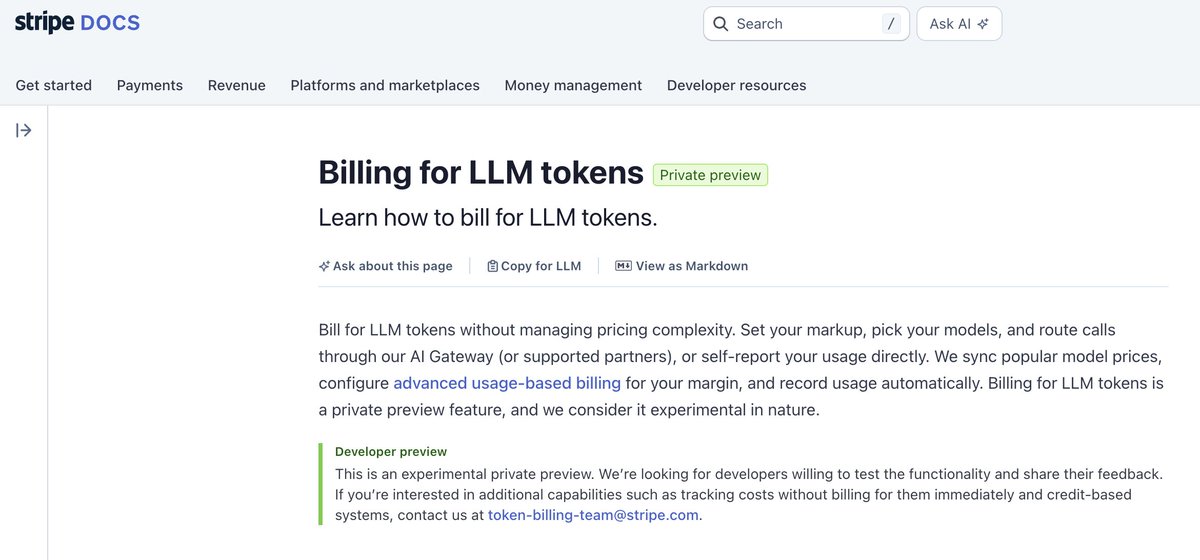
I think @stripe just mass produced a business model for every AI startup on earth and increased their TAM exponentially. Customer buys a shirt for $40, Stripe takes 2.9% + 30 cents. It's a simple formula, but token billing is completely different. AI costs are variable. They shift by model, by provider, by week. A startup using Claude for 40% of inference and GPT-4o for 60% has a blended cost structure that changes every time Anthropic or OpenAI adjusts pricing... which is constantly. Stripe is now ingesting those real-time model prices, applying the startup's target markup, metering per-customer usage, and generating the invoice automatically. That's constructing unit economics at a scale and complexity far beyond anything in traditional payments. And the data asset being created by them is a massive moat. OpenAI knows what OpenAI charges, and Anthropic knows what Anthropic charges. But Stripe will know what every model charges, what every startup pays, what every startup marks up, and what every end customer actually consumes. But the gateway is where this gets really interesting. Stripe's AI gateway routes inference, returns the response, and attributes tokens to the customer in one API call. Today it's "pick the best model." Tomorrow it's "Stripe recommends the model that optimizes your target margin across 12 providers in real time." The moment that recommendation engine turns on, model providers start competing on Stripe's terms. Pricing power inverts from provider to platform. This is AWS turned sideways (or i guess diagonally). Amazon didn't build apps... they built the infrastructure every app depended on, then used the data to optimize the infrastructure itself. Stripe is running the same playbook on AI economics instead of AI compute. I truly believe that token billing will make Stripe the most strategically important company in tech that doesn't train a model.
Todd Saunders tweet media
English
95
104
1.7K
296.6K
Taylor Schmidt
Taylor Schmidt@t__schmidt·
@feldman You used to work at Sidewalk Labs?! Any urban data projects going on at Anthropic?
English
0
0
0
133
Adam Feldman
Adam Feldman@feldman·
I recently joined Anthropic to lead Consumer Product and we're growing. Our goal is to build AI that millions of people use every day to think better, create more, and accomplish what matters to them. A bit biased here, but this is the most interesting opportunity in the world.
English
58
18
720
114.2K
Tanay Kothari
Tanay Kothari@tankots·
We offered 5 people a Porsche 911 GT3 RS if they could get @WisprFlow to make a mistake It's the fastest and most accurate AI voice dictation app that's 3x more accurate than ChatGPT, Claude, or Siri. Today, we’re finally launching on Android. Download now: play.google.com/store/apps/det… As a part of the launch, we’re giving away 6 months of Wispr Flow Pro for free. Like, retweet and comment ‘Wispr Flow’ to get it. Enjoy. — Written with Wispr Flow
English
4.6K
3.2K
10.9K
4.2M
Taylor Schmidt retweetledi
PeteNova
PeteNova@SuperrNova38·
One of the greatest sports clips I’ve ever seen.
English
313
3.6K
61.4K
3.3M
Jason,
Jason,@jasonc_nc·
Meanwhile this 24 year old Brookings paper is even MORE true today. Community banks declined. Local small developers declined. Every building and block begins to look the same. Our cities have no sense of place. It’s the United States of Generica. Virtually every data point in this paper has gotten significantly worse since.
Jason, tweet mediaJason, tweet mediaJason, tweet media
Jason,@jasonc_nc

Along with (further) decimating locally-led, small-scale development the increased financialization, commoditization of real estate has created monoculture development - which long term will prove to be a much bigger, systemic risk.

English
4
5
30
5.3K
Jason,
Jason,@jasonc_nc·
The next niche code reform around housing, urban affordability, etc needs to be the creation of a Middle Building Code. Some starting thoughts: -12 unit buildings should not be treated the same as 120 unit ones. -loading small buildings with the same requirements as large has destroyed the ability to build family-friendly urban infill. -the costs and timelines of doing so has driven local small development nearly extinct, encouraging institutional, generic, BIG development. code has killed localism. -this is a crucial first step towards addressing other obstacles for owner-occupied urban housing related to finance, condo liability laws, etc.
Trevor Acorn 🔰🌹🇺🇸🌎@trevoracorn

Clearly we need some kind of transition allowance in our building code etc for multi-family that isn't 100+ units per building.

English
11
26
207
28.9K
Nathan S. Robinson
Nathan S. Robinson@NathanSRobinson·
I understand the appeal of privacy. But privacy is not the same as isolation, and somewhere along the way we started confusing the two. I have thought about this a lot, especially in the context of how housing tends to work in the US. For many people, the path looks something like this: 1. As young adults, we live in apartments, often in college or right after. 2. Then we move into a shared space with friends. Often still an apt or townhome. 3. If we are lucky, we buy a small single family home or duplex with a partner in our 20s or 30s. 4. As income rises, we move farther from the city into a larger suburban house. 5. And if we become wealthy, we end up in a gated community, in an even bigger house. At each step, the house gets larger, the distance from other people increases, and daily life becomes more isolated. Fewer spontaneous interactions. Fewer reasons to see or rely on the people around you. We optimize for space, quiet, and separation, and then act surprised when loneliness increases alongside square footage.
New York Post@nypost

The bigger your house is, the more miserable you are: study trib.al/avlWqmT

English
1
0
2
130