Thoms Bosboom

9K posts

Thoms Bosboom banner
Thoms Bosboom

Thoms Bosboom

@thomasbosboom

Now at @[email protected]

A'dam (office) / R'dam (home) Katılım Ekim 2010
1.9K Takip Edilen952 Takipçiler
Thoms Bosboom retweetledi
North Pole Security
North Pole Security@northpolesec·
Happy to report we got our SOC 2 Type II in April of 2026. We've been so busy getting the next versions of Santa and Workshop together we forgot to share the good news.
English
0
2
2
92
Thoms Bosboom retweetledi
Spatial Insider
Spatial Insider@spatialinsider·
Gaussian splat videos are getting really good. The detail here, especially in the fabric and hair, is seriously impressive. Well done @gracia_vr Thanks for letting me check out the TestFlight on Apple Vision Pro.
English
5
6
58
19.4K
Thoms Bosboom retweetledi
Todd Dailey
Todd Dailey@twid·
Simple Codex and Claude Code trick when troubleshooting mobile design. - open Xcode simulator with whatever device you want to test simulated - prompt "I have a simulator open if you'd like to use it" That's it, that's the trick.
Todd Dailey tweet media
English
2
1
1
91
Thoms Bosboom retweetledi
Spatial Insider
Spatial Insider@spatialinsider·
Apple Vision Pro is being used in surgery. Seriously. Dr. Eric Rosenberg and the team at ScopeXR have already performed hundreds of cataract surgeries using Apple Vision Pro.
English
4
22
101
11.7K
Thoms Bosboom retweetledi
Jun Kim
Jun Kim@jundotkim·
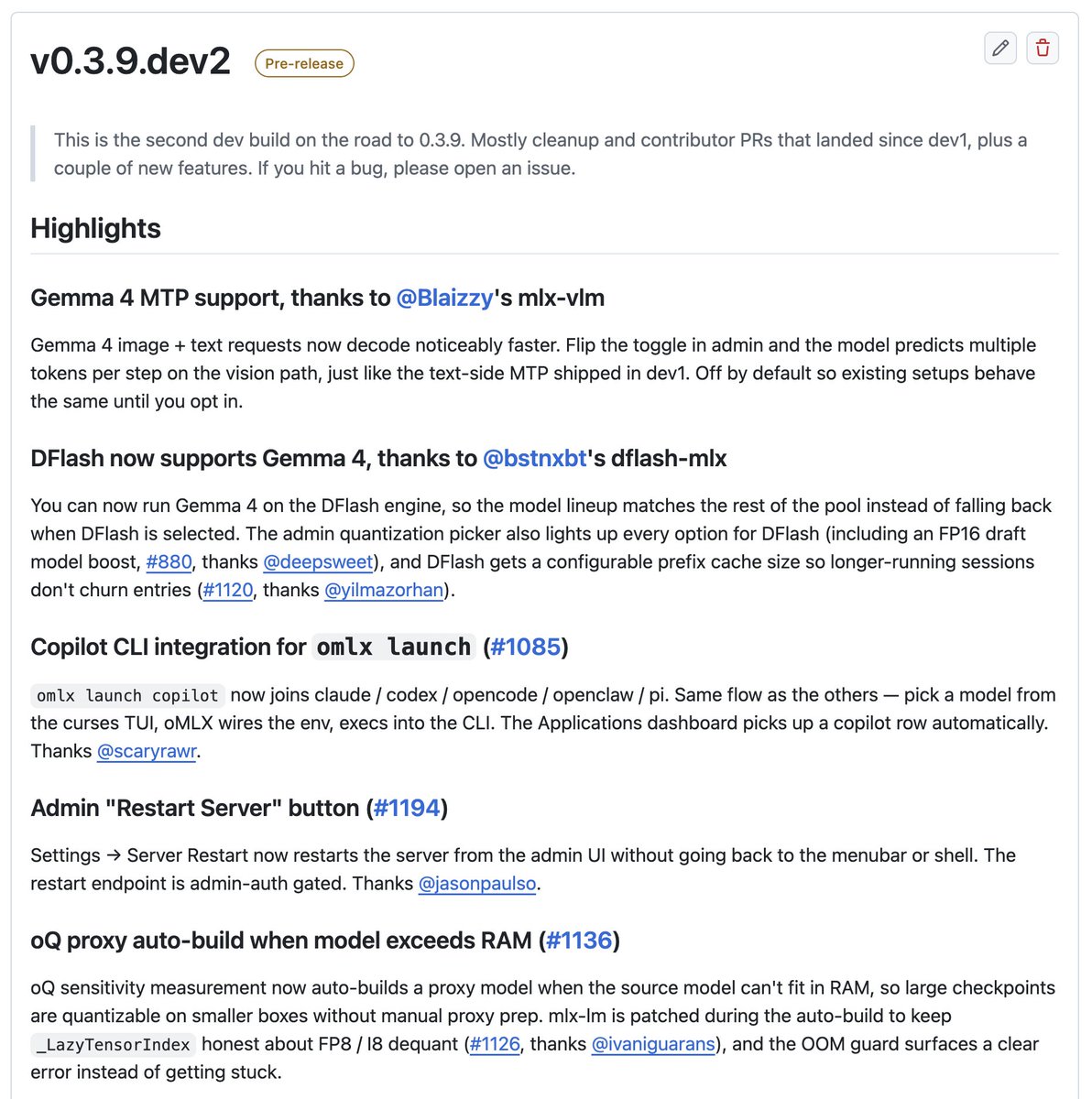
oMLX 0.3.9.dev2 released. Highlights: - Gemma 4 MTP on the vision path (thanks to @Prince_Canuma's mlx-vlm). Image+text decodes much faster now - Gemma 4 on the DFlash engine (thanks to @bstnxbt's dflash-mlx) - ParoQuant support - omlx launch copilot joins claude / codex / opencode / openclaw / pi - Restart server button right in the admin UI - oQ auto-builds a proxy when the model can't fit in RAM Plus a lot of bug fixes and 20 new contributors in this cycle. Thanks everyone! github.com/jundot/omlx/re…
Jun Kim tweet media
English
7
21
163
29.2K
Thoms Bosboom retweetledi
Jint3x
Jint3x@Jint3x·
@IntCyberDigest POV: you are downloading packages in 2026
GIF
English
4
92
980
77.3K
Thoms Bosboom retweetledi
송준 Jun Song
송준 Jun Song@jun_song·
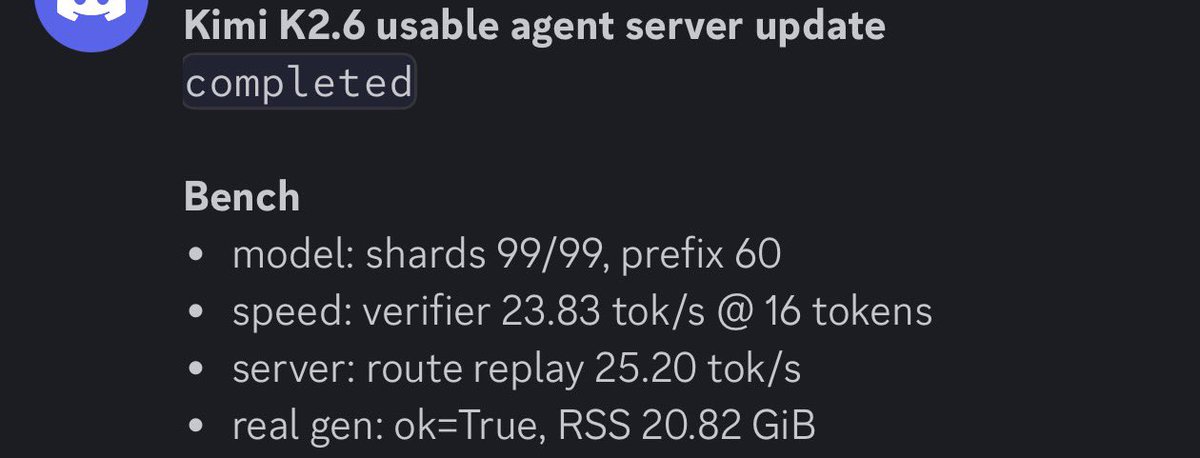
Running Kimi-k2.6 1T 8bit with only 21GB RAM on my Macbook at speed of 25tok/s. Some of my theory worked, but architecture is not perfect. Need to fix a lot of stuff, but there is hope. Working hard on this future method of Local LLM.
송준 Jun Song tweet media
English
50
40
740
39.5K
Prince Canuma
Prince Canuma@Prince_Canuma·
This is so good! Especially in the context of Open-source where you get a lot of pool towards many different directions
English
1
2
19
3.4K
Thoms Bosboom retweetledi
Alex Rad
Alex Rad@defendtheworld·
It is hard to understate how much more hardened Apple's Application-Processor-side of WiFi is than any other operating system out there. Between MIE and the XZM allocator there's some serious hardening on the latest iOS and iPhone 17. We spend a lot of time in wifi land and Apple's the gold standard here. The first big thing to know about Apple's WiFi on iOS is that they removed attack surface from the kernel and brought it into userland with DriverKit (developer.apple.com/videos/play/ww…). The concept was initially formed by Simon Douglas while he was at NeXT, Inc working for Steve Jobs and brought to Mac in 2019 by Douglas and team. Most memory corruption can't get far by design and it should be exceedingly difficult to see another Ian Beer type wifi exploit (projectzero.google/2020/12/an-ios…) This use after free bug occured in `wifid`, a root userland process on iOS and can be triggered without any user interaction.
Supernetworks, Inc@spr_networks

iOS 26.5 dropped today with a fix for CVE-2026-28994 — a Wi-Fi use-after-free our @defendtheworld discovered via automated Wi-Fi fuzzing. The bug is preauth and requires no user interaction.

English
8
58
495
81.8K
Thoms Bosboom retweetledi
clem 🤗
clem 🤗@ClementDelangue·
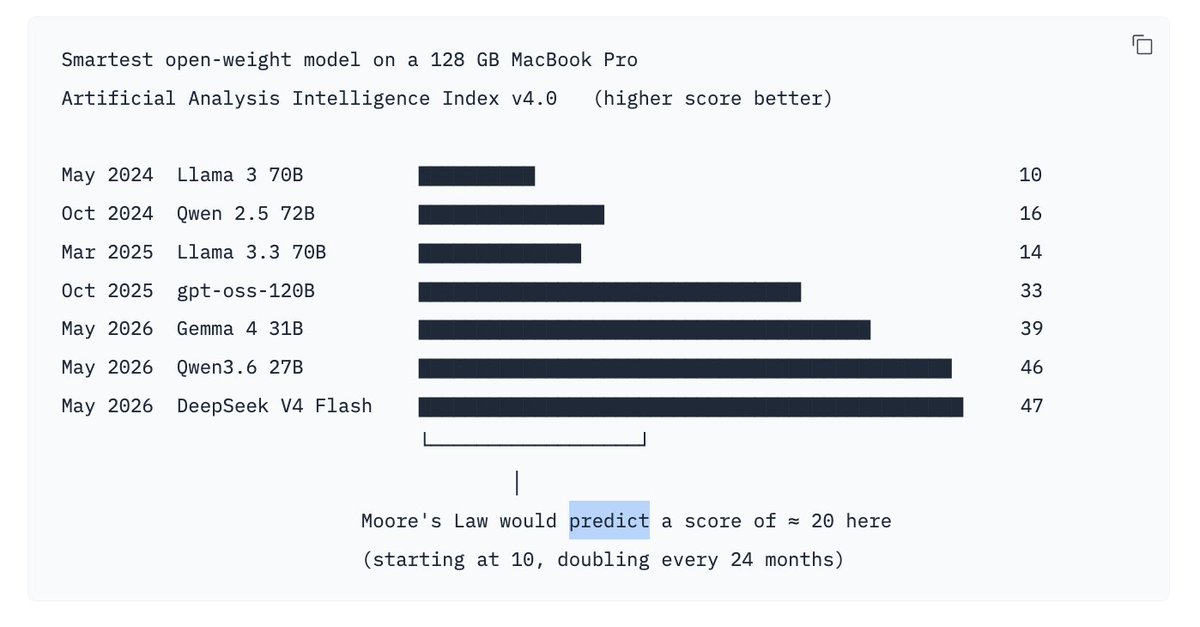
Local open-weight AI on a laptop has been improving more than twice as fast as Moore's Law! Between May 2024 and May 2026, the most expensive MacBook Pro you could buy stayed at 128 GB of unified memory. The hardware ceiling barely moved. But the smartest open-weight model from @huggingface you could actually run on it went from a score of 10 (Llama 3 70B) to 47 (DeepSeek V4 Flash on @antirez's mixed-Q2 GGUF) on the @ArtificialAnlys Intelligence Index. That is 4.7× in 24 months, or a doubling of intelligence every 10.7 months. Moore's Law (transistor count) doubles every 24 months. Local open-weight AI on a laptop has been improving more than twice as fast as Moore's Law, on completely unchanged hardware.
clem 🤗 tweet media
English
48
90
610
56.7K
Thoms Bosboom retweetledi
Michael Guo
Michael Guo@Michaelzsguo·
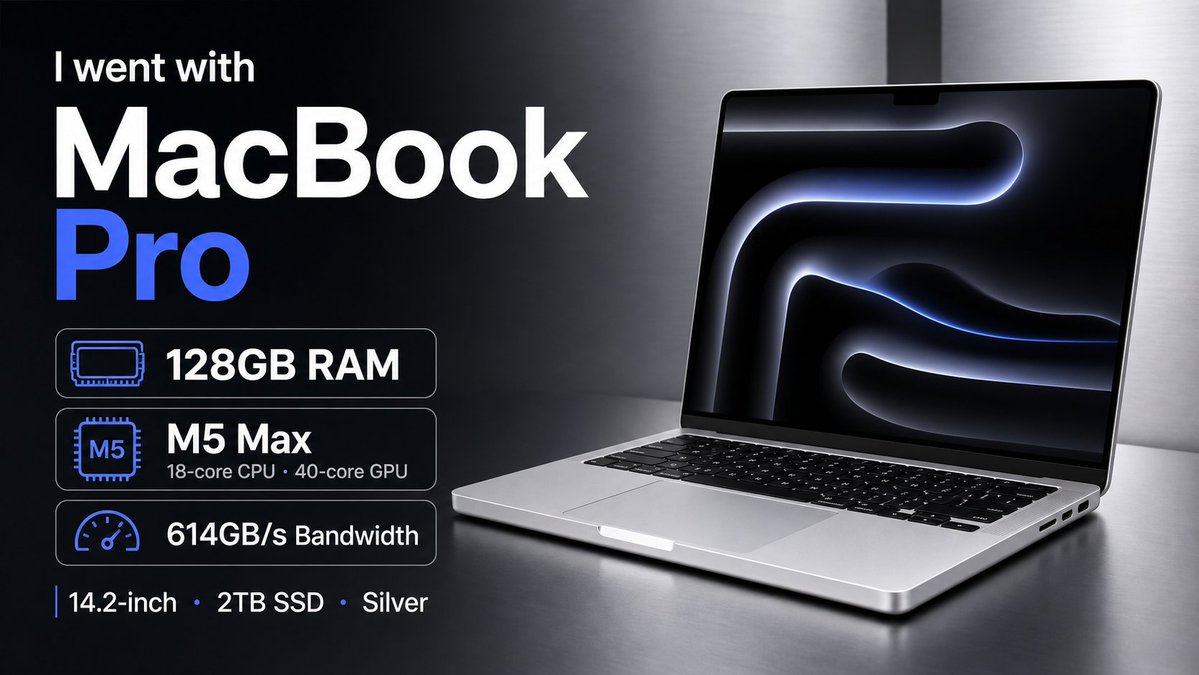
We had a great discussion here about what hardware we need for local LLMs. I thought I would give an update on what I bought, and also share the thinking behind the decision for others on the same journey. I ended up choosing the 14" MacBook Pro with M5 Max, 128GB RAM, 2TB SSD, in Silver. The deciding factor was RAM. I originally thought 64GB would be the sweet spot. I still believe local models will get smaller and better, and I strongly believe future PCs and Macs will ship with OEM LLMs by default. Local AI should become standard off-the-shelf hardware, not something reserved only for the highest-end machines. But a few things changed my mind. First, a lot of the feedback people shared from their own experience pointed in the same direction: get more RAM. Second, I don’t just want local LLMs to be technically deployable. I want them to be usable. That means a good balance of speed, quality, context, and headroom. We are getting closer, but I don’t think smaller models are quite enough yet for what I want to do. The final push was antirez’s ds4.c. I know I want to get my hands on it, and that basically makes 128GB a hard requirement. Why not Mac Studio? Normally, with the same budget, Mac Studio should give you better specs than a MacBook Pro. I don’t really need the mobility or the built-in screen, so I was originally leaning Studio. But Apple’s current supply constraints changed the equation. Higher RAM Mac Studio configs effectively disappeared, and the highest RAM option I could find was 96GB. Since 128GB became non-negotiable, MacBook Pro won. The tradeoff: I gave up the 819GB/s memory bandwidth I could have had with an M3 Ultra Mac Studio. The MacBook Pro gives me 614GB/s instead. Not ideal, but RAM mattered more. Why not wait? A lot of people suggested waiting for M5. I thought about it, but the timing of M5 is unclear, and some rumors point to October, which is too far out for me. More importantly, I don’t think waiting is risk-free right now. With supply chain pressure and AI-driven demand, the longer you wait, the more today’s configs may disappear. The Mac Studio RAM situation is a good example. Prices may also keep moving up, not down. I also looked at used Macs on eBay and other sites. The pricing is wild. Some used Mac Studios are almost the same price as new, sometimes worse. So that’s where I landed: 128GB RAM first. M5 Max second. Everything else after that. By the way, I made the purchase from Amazon instead of Apple directly. The MacBook will be delivered in 4 days instead of 3 weeks. Hope this helps anyone else trying to make the same decision.
Michael Guo tweet media
English
13
5
65
8.4K
Thoms Bosboom retweetledi
antirez
antirez@antirez·
DS4 is now called DwarfStar4, since you can put a lot of mass into a tiny space... And in a few minutes it is going to be much better on 128GB Macs because I'l pushing much better 2 bit quants generated with an in-house iMatrix magic recipe.
English
35
40
752
60.8K
Thoms Bosboom retweetledi
Niall O'Higgins
Niall O'Higgins@niallohiggins·
DS4 on a 128GB MBP Max is the first local LLM that has felt worth running day to day. Subjectively, it feels somewhere between Sonnet 3.7 and low-end Sonnet 4.0 for chat-style use. A lot slower, but surprisingly usable. Try it with Pi as an agent harness, or use @cocktailpeanut's Web UI for easier setup: github.com/cocktailpeanut…
English
4
8
76
6.4K
Thoms Bosboom retweetledi
Alex Ziskind
Alex Ziskind@digitalix·
Just tried a new use case for LLMs. I have two lav mics and wanted an objective comparison, matched for loudness. It did not disappoint. Even gave me easily comparable audio samples from my recordings. from one prompt.
Alex Ziskind tweet media
English
7
2
45
3.9K
Thoms Bosboom retweetledi
Todd Dailey
Todd Dailey@twid·
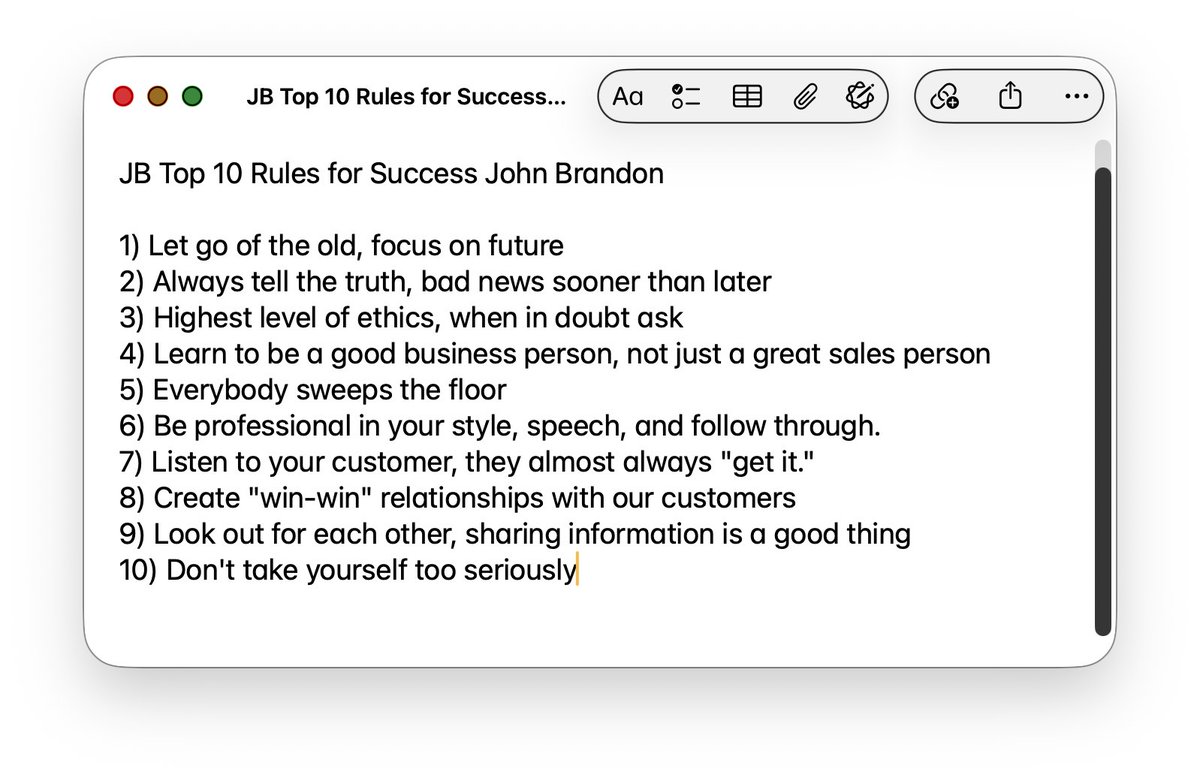
Here’s an Apple secret: Success comes from culture, not technology. Like many at Apple, I worked for many years under John Brandon, our longtime head of sales. He had his “Top Ten Rules for Success” which I carried around and lived by. It’s easy to spot someone from Brandon’s team by how they collaborate. I tried to be one of them. I mopped the floor (literally at times), I shared everything I knew without gatekeeping, I always assumed the customer knew their business. I think about AI the same way. Most AI advice right now is for builders. Almost nobody is helping the marketers, sales engineers, and execs who actually have to put AI in front of customers. That’s the gap I work in. I left Apple last month after 22 years. After some thinking and a lot of conversations, I’m now doing what I did inside Apple, but for other organizations: AI positioning, helping businesses understand AI, and creating Apple-level presentations and content.
Todd Dailey tweet media
English
0
3
12
67.8K
Thoms Bosboom retweetledi
Alex
Alex@AlexJonesax·
Two open-source MLX inference servers worth knowing about if you run LLMs on Mac: MTPLX (@youssofal) Uses a model's own MTP heads for speculative decoding. No draft model needed. ~63 tok/s on Qwen3.6-27B (M5Max). Mathematically exact sampling too; not just greedy prefix matching. oMLX (@jundot) Tiered KV cache that persists to SSD across restarts. Huge for coding agents where you're sending the same codebase context repeatedly. Also serves LLMs, VLMs, embeddings, rerankers, and audio simultaneously. They're solving different problems; MTPLX maximizes tok/s, oMLX maximizes workflow efficiency. Both have OpenAI + Anthropic-compatible APIs, both work with Claude Code/OpenCode/Cursor out of the box. Running both depending on the task. But, both worth checking out.
English
15
21
180
12.9K
Thoms Bosboom retweetledi
Ivan Fioravanti ᯅ
Ivan Fioravanti ᯅ@ivanfioravanti·
Apple M5 Max + MLX = raw power! 🔥 Look at this demo I'm playing with "FasterLivePortrait-MLX" I started with MPS but result was poor I then decided to migrate to MLX and boom! It's so much better and faster. There is still room for improvements BTW. I'll keep playing with this. Don't underestimate the power of your Apple Silicon devices there, I bet we'll soon see optimizations everywhere to run anything faster on them!
Ivan Fioravanti ᯅ tweet media
English
11
7
118
13.3K