Tolga Bolukbasi

95 posts

Tolga Bolukbasi

Tolga Bolukbasi

@tolgab0

AI research/Gemini pretraining @GoogleDeepmind, PhD, opinions my own.

Katılım Kasım 2014
258 Takip Edilen319 Takipçiler
Sabitlenmiş Tweet
Tolga Bolukbasi
Tolga Bolukbasi@tolgab0·
Our work on scaling training data attribution is out. There are a lot of insights in there, I especially like the distinction between attribution and influence. Thanks to our amazing student researcher Tyler for making this happen.
Tyler Chang@tylerachang

We scaled training data attribution (TDA) methods ~1000x to find influential pretraining examples for thousands of queries in an 8B-parameter LLM over the entire 160B-token C4 corpus! medium.com/people-ai-rese…

English
0
1
11
2K
Tolga Bolukbasi retweetledi
Andrej Karpathy
Andrej Karpathy@karpathy·
A few random notes from claude coding quite a bit last few weeks. Coding workflow. Given the latest lift in LLM coding capability, like many others I rapidly went from about 80% manual+autocomplete coding and 20% agents in November to 80% agent coding and 20% edits+touchups in December. i.e. I really am mostly programming in English now, a bit sheepishly telling the LLM what code to write... in words. It hurts the ego a bit but the power to operate over software in large "code actions" is just too net useful, especially once you adapt to it, configure it, learn to use it, and wrap your head around what it can and cannot do. This is easily the biggest change to my basic coding workflow in ~2 decades of programming and it happened over the course of a few weeks. I'd expect something similar to be happening to well into double digit percent of engineers out there, while the awareness of it in the general population feels well into low single digit percent. IDEs/agent swarms/fallability. Both the "no need for IDE anymore" hype and the "agent swarm" hype is imo too much for right now. The models definitely still make mistakes and if you have any code you actually care about I would watch them like a hawk, in a nice large IDE on the side. The mistakes have changed a lot - they are not simple syntax errors anymore, they are subtle conceptual errors that a slightly sloppy, hasty junior dev might do. The most common category is that the models make wrong assumptions on your behalf and just run along with them without checking. They also don't manage their confusion, they don't seek clarifications, they don't surface inconsistencies, they don't present tradeoffs, they don't push back when they should, and they are still a little too sycophantic. Things get better in plan mode, but there is some need for a lightweight inline plan mode. They also really like to overcomplicate code and APIs, they bloat abstractions, they don't clean up dead code after themselves, etc. They will implement an inefficient, bloated, brittle construction over 1000 lines of code and it's up to you to be like "umm couldn't you just do this instead?" and they will be like "of course!" and immediately cut it down to 100 lines. They still sometimes change/remove comments and code they don't like or don't sufficiently understand as side effects, even if it is orthogonal to the task at hand. All of this happens despite a few simple attempts to fix it via instructions in CLAUDE . md. Despite all these issues, it is still a net huge improvement and it's very difficult to imagine going back to manual coding. TLDR everyone has their developing flow, my current is a small few CC sessions on the left in ghostty windows/tabs and an IDE on the right for viewing the code + manual edits. Tenacity. It's so interesting to watch an agent relentlessly work at something. They never get tired, they never get demoralized, they just keep going and trying things where a person would have given up long ago to fight another day. It's a "feel the AGI" moment to watch it struggle with something for a long time just to come out victorious 30 minutes later. You realize that stamina is a core bottleneck to work and that with LLMs in hand it has been dramatically increased. Speedups. It's not clear how to measure the "speedup" of LLM assistance. Certainly I feel net way faster at what I was going to do, but the main effect is that I do a lot more than I was going to do because 1) I can code up all kinds of things that just wouldn't have been worth coding before and 2) I can approach code that I couldn't work on before because of knowledge/skill issue. So certainly it's speedup, but it's possibly a lot more an expansion. Leverage. LLMs are exceptionally good at looping until they meet specific goals and this is where most of the "feel the AGI" magic is to be found. Don't tell it what to do, give it success criteria and watch it go. Get it to write tests first and then pass them. Put it in the loop with a browser MCP. Write the naive algorithm that is very likely correct first, then ask it to optimize it while preserving correctness. Change your approach from imperative to declarative to get the agents looping longer and gain leverage. Fun. I didn't anticipate that with agents programming feels *more* fun because a lot of the fill in the blanks drudgery is removed and what remains is the creative part. I also feel less blocked/stuck (which is not fun) and I experience a lot more courage because there's almost always a way to work hand in hand with it to make some positive progress. I have seen the opposite sentiment from other people too; LLM coding will split up engineers based on those who primarily liked coding and those who primarily liked building. Atrophy. I've already noticed that I am slowly starting to atrophy my ability to write code manually. Generation (writing code) and discrimination (reading code) are different capabilities in the brain. Largely due to all the little mostly syntactic details involved in programming, you can review code just fine even if you struggle to write it. Slopacolypse. I am bracing for 2026 as the year of the slopacolypse across all of github, substack, arxiv, X/instagram, and generally all digital media. We're also going to see a lot more AI hype productivity theater (is that even possible?), on the side of actual, real improvements. Questions. A few of the questions on my mind: - What happens to the "10X engineer" - the ratio of productivity between the mean and the max engineer? It's quite possible that this grows *a lot*. - Armed with LLMs, do generalists increasingly outperform specialists? LLMs are a lot better at fill in the blanks (the micro) than grand strategy (the macro). - What does LLM coding feel like in the future? Is it like playing StarCraft? Playing Factorio? Playing music? - How much of society is bottlenecked by digital knowledge work? TLDR Where does this leave us? LLM agent capabilities (Claude & Codex especially) have crossed some kind of threshold of coherence around December 2025 and caused a phase shift in software engineering and closely related. The intelligence part suddenly feels quite a bit ahead of all the rest of it - integrations (tools, knowledge), the necessity for new organizational workflows, processes, diffusion more generally. 2026 is going to be a high energy year as the industry metabolizes the new capability.
English
1.6K
5.5K
40.1K
7.7M
Tolga Bolukbasi retweetledi
Oriol Vinyals
Oriol Vinyals@OriolVinyalsML·
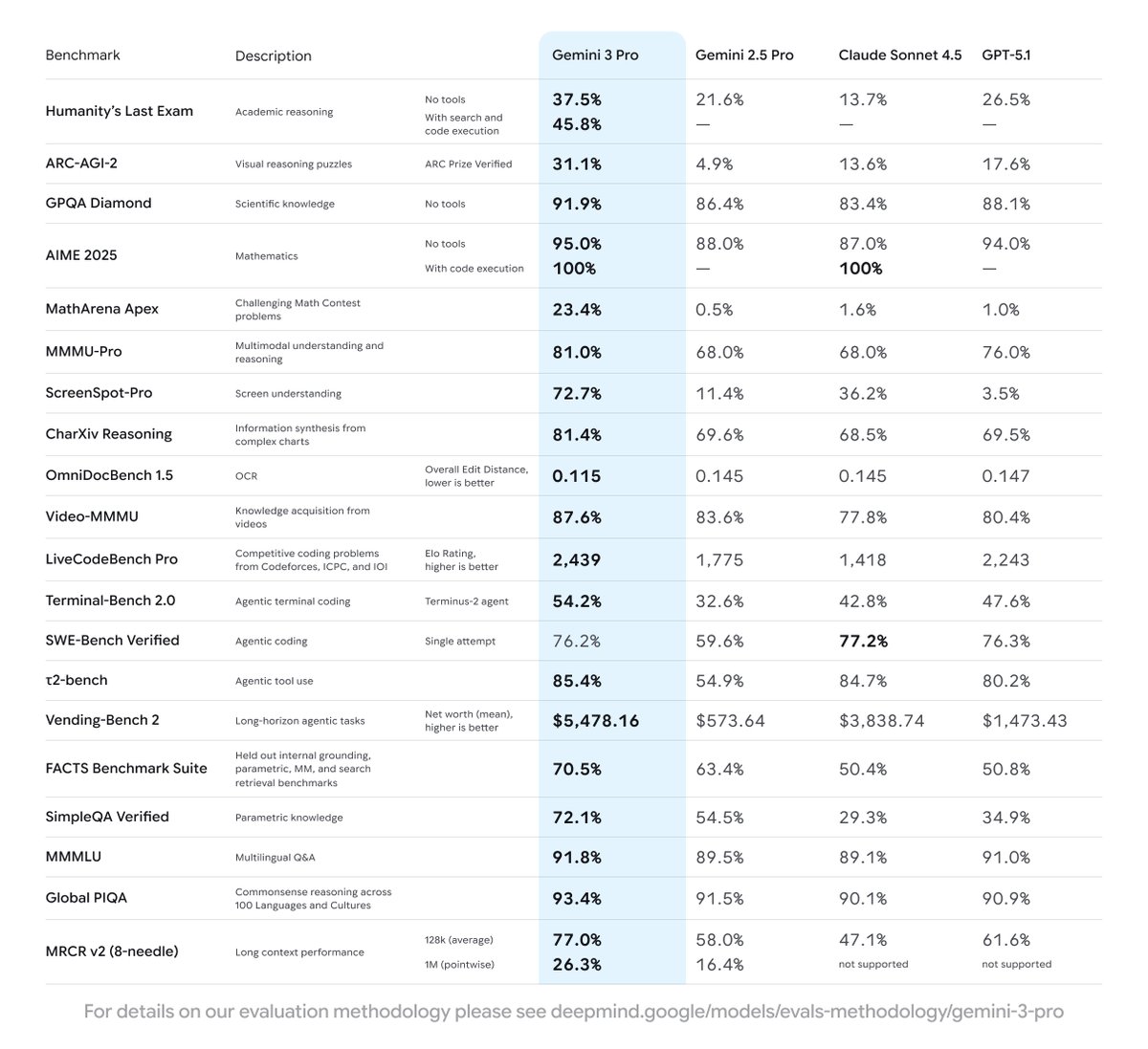
The secret behind Gemini 3? Simple: Improving pre-training & post-training 🤯 Pre-training: Contra the popular belief that scaling is over—which we discussed in our NeurIPS '25 talk with @ilyasut and @quocleix—the team delivered a drastic jump. The delta between 2.5 and 3.0 is as big as we've ever seen. No walls in sight! Post-training: Still a total greenfield. There's lots of room for algorithmic progress and improvement, and 3.0 hasn't been an exception, thanks to our stellar team. Congratulations to the whole team 💙💙💙
Oriol Vinyals tweet media
English
119
549
4.4K
2M
Tolga Bolukbasi retweetledi
🇺🇦 Alex Polozov
🇺🇦 Alex Polozov@Skiminok·
✨ This is Jules, our SWE assistant powered by Gemini.
English
5
11
100
11.5K
Tolga Bolukbasi retweetledi
Sundar Pichai
Sundar Pichai@sundarpichai·
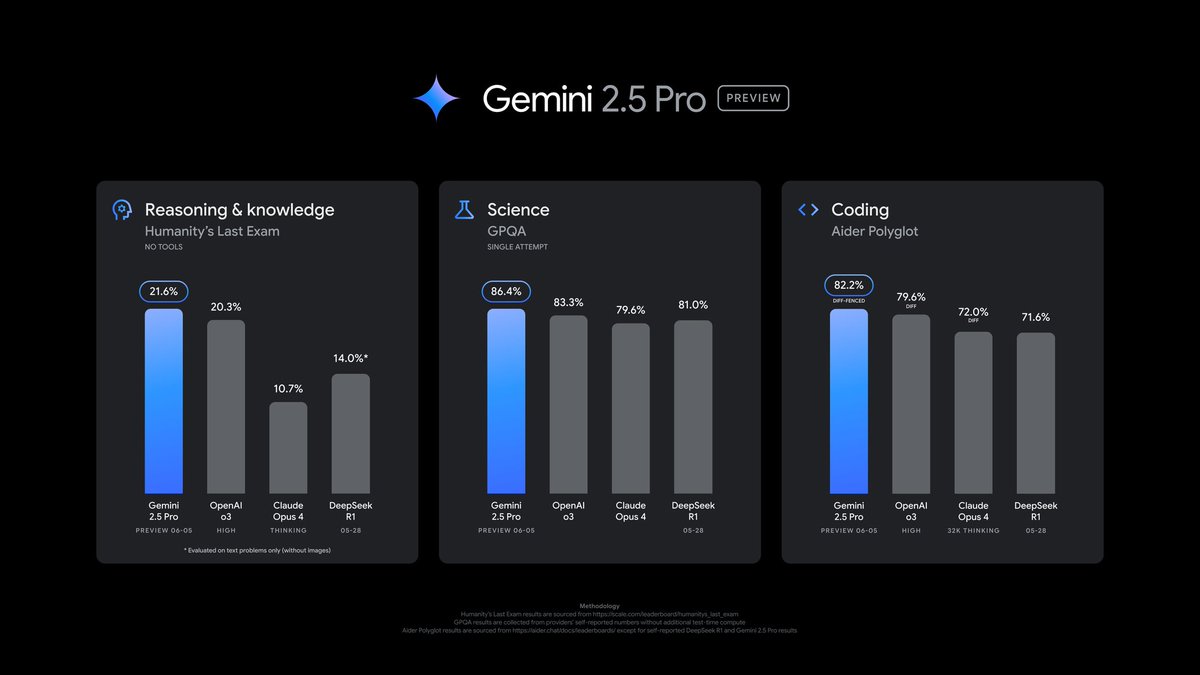
Our latest Gemini 2.5 Pro update is now in preview. It’s better at coding, reasoning, science + math, shows improved performance across key benchmarks (AIDER Polyglot, GPQA, HLE to name a few), and leads @lmarena_ai with a 24pt Elo score jump since the previous version. We also heard your feedback and made improvements to style and the structure of responses. Try it in AI Studio, Vertex AI, and @Geminiapp. GA coming soon!
Sundar Pichai tweet media
English
318
678
6.1K
741.3K
Tolga Bolukbasi retweetledi
Noam Shazeer
Noam Shazeer@NoamShazeer·
This model’s “thinking” capabilities are driving major gains: 🧑‍🔬Top performance on math and science benchmarks (AIME, GPQA) 💻Exceptional coding performance (LiveCodeBench) 📈Impressive performance on complex prompts (Humanity’s Last Exam) #1 on @lmarena_ai leaderboard 🏆
GIF
English
4
18
303
35.6K
Tolga Bolukbasi retweetledi
Mike Morton
Mike Morton@morteymike·
I worked on the M series while at Apple. The main advantage that stuck out to me was actually that they were able to acquire dozens of top Intel engineers 5-10 years ago as Intel started struggling and making poor decisions. For example, Intel had a couple sites around the country with top talent and decided to shut these sites down. The reason? Intel wanted their talent more centrally located near headquarters, and they thought their engineers would be willing to relocate closer to headquarters and stick with the company. Apple discovered this, recruited all of these people, and opened new engineering facilities in these locations (and probably paid better). The result? They now had most subject matter experts from Intel without having to train or discover the engineering techniques themselves. The engineers then had freedom to create (Intel was tied down by corporate BS) and this was the fuel needed to blow Intel out of the water.
English
79
469
8.5K
514.6K
Tolga Bolukbasi
Tolga Bolukbasi@tolgab0·
I will be in ATTRIB workshop tomorrow (attrib-workshop.cc). Stop by if you’d like to chat with me and connect with other great researchers in this area.
English
0
1
8
486
Peter J. Liu
Peter J. Liu@peterjliu·
Update: A couple of us Google Brain / DeepMind researchers have left to work on something new. Some observations: * Off-the shelf AI libraries (e.g. RAG and agents) do not work well enough for high-quality products. * In-house research is essential to get the higher quality/reliability that transforms a cool, but flaky demo into an indispensable tool. * Recent competitive trends and a paradigm shift in scaling compute is drying up the moat around traditional foundation model companies. * There are hints of AI disruption in some fields, but it is still early innings and is inevitable for most knowledge work. Finally, a cracked team can get a lot more done with far fewer people these days.
English
79
205
2.8K
294.3K
Tolga Bolukbasi retweetledi
Jeff Dean
Jeff Dean@JeffDean·
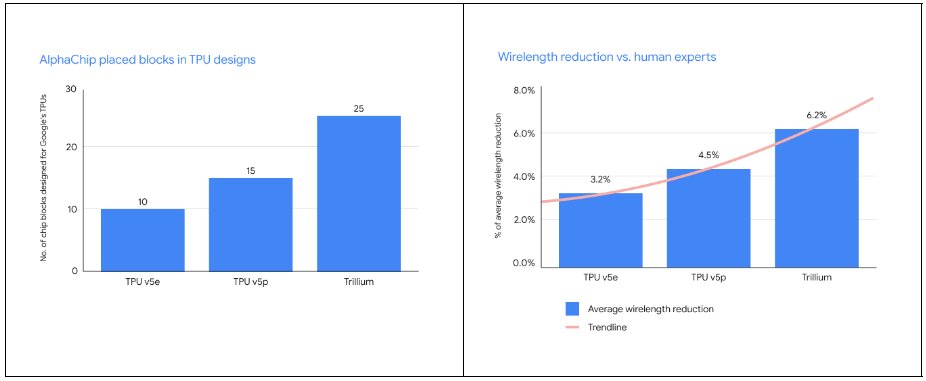
Welcome, AlphaChip! Today, we are sharing some exciting updates on our work published in @Nature in 2021 on using reinforcement learning for ASIC chip floorplanning and layout. We’re also naming this work AlphaChip. Since we first published this work, our use of this approach internally has grown significantly. It has now been used for multiple generations of TPU chips (TPU v5e, TPU v5p, and Trillium), with AlphaChip placing an increasing number of blocks and with larger wirelength reductions vs. human experts from generation to generation: AlphaChip has also been used with excellent results for other chips across Alphabet, including Google’s Axion chip, an Arm-based general-purpose data center CPU. In 2022, as a companion to the Nature paper, we open-sourced the code for the AlphaChip algorithms described in the Nature paper (see link below). Since then, external researchers could use this repository to pre-train on a variety of chip blocks and then apply the pre-trained model to new blocks, as was done and described in our original paper. Today we’re also releasing a pre-trained AlphaChip checkpoint for the open source release that makes it easier for external users to get started using AlphaChip for their own chip designs. Original Nature paper w/ wonderful joint first authors @Azaliamirh + @annadgoldie, and @mnyazgan, @joesmemory, @ESonghori, @ShenWangURC, @xylophi, @efjohnson, @pathomkar, @Azade_na, @PakJiwoo, Andy Tong, @kavyasrinivas23, @willhang_, @emretuncer, @quocleix, @JamesLaudon, @rh00, Roger Carpenter, and myself): nature.com/articles/s4158… (PDF: rdcu.be/cmedX) Today’s Addendum to the paper published in Nature: nature.com/articles/s4158… (same authors) AlphaChip blog post: deepmind.google/discover/blog/… Open source release: github.com/google-researc… Pre-trained checkpoint: #PreTrainedModelCheckpoint" target="_blank" rel="nofollow noopener">github.com/google-researc… Three things we have observed in the external community are described in the Nature Addendum: (1) not doing any pre-training (circumventing the learning aspects of our method by removing its ability to learn from prior experience) (2) not training to convergence (standard practice in ML methods), and (3) using fewer computational resources than described in our Nature paper (using fewer resources is likely to harm performance, or require running for considerably longer to achieve the same performance). Pre-training the model for it to learn the craft of chip layout and to be able to generalize to new designs is an important part of our method. The pre-training process requires some effort to perform, since one has to find representative blocks and then run a lengthy computational process to pre-train the model to be good at placing those blocks. To avoid external users having to perform this process and make it easier for the external community to use AlphaChip, today we are releasing an AlphaChip model checkpoint pre-trained on 20 TPU blocks. This will enable users to get good zero-shot performance and faster convergence for novel blocks right out of the box. (For best results, however, we continue to recommend that developers pre-train on their own in-distribution blocks, and we provide a tutorial on how to perform pre-training with our open-source repository: see the Addendum). Many organizations have used AlphaChip as a building block for their own chip design efforts. For example, MediaTek, one of the top chip design companies in the world, extended AlphaChip to accelerate development of their most advanced chips (e.g. the Dimensity Flagship 5G used in Samsung mobile phones), while improving power, performance and chip area. We’re very excited about the increasing impact of AlphaChip internally and externally, and we look forward to continued work in this space to make custom higher performance, more efficient, and more capable chips dramatically easier to design and build.
Jeff Dean tweet media
Google DeepMind@GoogleDeepMind

Our AI for chip design method AlphaChip has transformed the way we design microchips. ⚡ From helping to design state-of-the-art TPUs for building AI models to CPUs in data centers - its widespread impact can be seen across Alphabet and beyond. Find out more → dpmd.ai/3ZDRtYY

English
43
330
1.9K
473.5K
Tolga Bolukbasi
Tolga Bolukbasi@tolgab0·
I have been thinking about this since ChatGPT came out. Using RLHF never fully made sense to me given how restricted it is compared to regular RL. There should be a way simpler non-exploring method to distill RM knowledge into the main model.
Andrej Karpathy@karpathy

# RLHF is just barely RL Reinforcement Learning from Human Feedback (RLHF) is the third (and last) major stage of training an LLM, after pretraining and supervised finetuning (SFT). My rant on RLHF is that it is just barely RL, in a way that I think is not too widely appreciated. RL is powerful. RLHF is not. Let's take a look at the example of AlphaGo. AlphaGo was trained with actual RL. The computer played games of Go and trained on rollouts that maximized the reward function (winning the game), eventually surpassing the best human players at Go. AlphaGo was not trained with RLHF. If it were, it would not have worked nearly as well. What would it look like to train AlphaGo with RLHF? Well first, you'd give human labelers two board states from Go, and ask them which one they like better: Then you'd collect say 100,000 comparisons like this, and you'd train a "Reward Model" (RM) neural network to imitate this human "vibe check" of the board state. You'd train it to agree with the human judgement on average. Once we have a Reward Model vibe check, you run RL with respect to it, learning to play the moves that lead to good vibes. Clearly, this would not have led anywhere too interesting in Go. There are two fundamental, separate reasons for this: 1. The vibes could be misleading - this is not the actual reward (winning the game). This is a crappy proxy objective. But much worse, 2. You'd find that your RL optimization goes off rails as it quickly discovers board states that are adversarial examples to the Reward Model. Remember the RM is a massive neural net with billions of parameters imitating the vibe. There are board states are "out of distribution" to its training data, which are not actually good states, yet by chance they get a very high reward from the RM. For the exact same reasons, sometimes I'm a bit surprised RLHF works for LLMs at all. The RM we train for LLMs is just a vibe check in the exact same way. It gives high scores to the kinds of assistant responses that human raters statistically seem to like. It's not the "actual" objective of correctly solving problems, it's a proxy objective of what looks good to humans. Second, you can't even run RLHF for too long because your model quickly learns to respond in ways that game the reward model. These predictions can look really weird, e.g. you'll see that your LLM Assistant starts to respond with something non-sensical like "The the the the the the" to many prompts. Which looks ridiculous to you but then you look at the RM vibe check and see that for some reason the RM thinks these look excellent. Your LLM found an adversarial example. It's out of domain w.r.t. the RM's training data, in an undefined territory. Yes you can mitigate this by repeatedly adding these specific examples into the training set, but you'll find other adversarial examples next time around. For this reason, you can't even run RLHF for too many steps of optimization. You do a few hundred/thousand steps and then you have to call it because your optimization will start to game the RM. This is not RL like AlphaGo was. And yet, RLHF is a net helpful step of building an LLM Assistant. I think there's a few subtle reasons but my favorite one to point to is that through it, the LLM Assistant benefits from the generator-discriminator gap. That is, for many problem types, it is a significantly easier task for a human labeler to select the best of few candidate answers, instead of writing the ideal answer from scratch. A good example is a prompt like "Generate a poem about paperclips" or something like that. An average human labeler will struggle to write a good poem from scratch as an SFT example, but they could select a good looking poem given a few candidates. So RLHF is a kind of way to benefit from this gap of "easiness" of human supervision. There's a few other reasons, e.g. RLHF is also helpful in mitigating hallucinations because if the RM is a strong enough model to catch the LLM making stuff up during training, it can learn to penalize this with a low reward, teaching the model an aversion to risking factual knowledge when it's not sure. But a satisfying treatment of hallucinations and their mitigations is a whole different post so I digress. All to say that RLHF *is* net useful, but it's not RL. No production-grade *actual* RL on an LLM has so far been convincingly achieved and demonstrated in an open domain, at scale. And intuitively, this is because getting actual rewards (i.e. the equivalent of win the game) is really difficult in the open-ended problem solving tasks. It's all fun and games in a closed, game-like environment like Go where the dynamics are constrained and the reward function is cheap to evaluate and impossible to game. But how do you give an objective reward for summarizing an article? Or answering a slightly ambiguous question about some pip install issue? Or telling a joke? Or re-writing some Java code to Python? Going towards this is not in principle impossible but it's also not trivial and it requires some creative thinking. But whoever convincingly cracks this problem will be able to run actual RL. The kind of RL that led to AlphaGo beating humans in Go. Except this LLM would have a real shot of beating humans in open-domain problem solving.


English
0
0
1
418
Tolga Bolukbasi retweetledi
Jeff Dean
Jeff Dean@JeffDean·
We have an experimental updated version of Gemini 1.5 Pro that is #1 on the @lmsysorg Chatbot Arena. This model is a significant improvement over earlier versions of Gemini 1.5 Pro (it cracks into 1300+ elo score territory). I'm really proud of the whole team of people that worked really hard to make this happen. Excited to see what people do with the long context and multimodal capabilities, and looking forward to even better models in the future!
Arena.ai@arena

Exciting News from Chatbot Arena! @GoogleDeepMind's new Gemini 1.5 Pro (Experimental 0801) has been tested in Arena for the past week, gathering over 12K community votes. For the first time, Google Gemini has claimed the #1 spot, surpassing GPT-4o/Claude-3.5 with an impressive score of 1300 (!), and also achieving #1 on our Vision Leaderboard. Gemini 1.5 Pro (0801) excels in multi-lingual tasks and delivers robust performance in technical areas like Math, Hard Prompts, and Coding. Huge congrats to @GoogleDeepMind on this remarkable milestone! Gemini (0801) Category Rankings: - Overall: #1 - Math: #1-3 - Instruction-Following: #1-2 - Coding: #3-5 - Hard Prompts (English): #2-5 Come try the model and let us know your feedback! More analysis below👇

English
30
108
781
107K
Tolga Bolukbasi
Tolga Bolukbasi@tolgab0·
It was great to work with Minsuk and excited to see this released. Looking at individual model outputs this way helps one see which examples/tasks are truly wins across model versions and which ones are just due to randomness of generation or raters.
Minsuk Kahng@minsukkahng

Very excited to open-source LLM Comparator! This new #visualization tool lets you analyze LLM responses side-by-side. It’s been used for evaluating LLMs @Google, and we're proud to release it as part of Google's Responsible GenAI Toolkit. medium.com/people-ai-rese…

English
0
0
7
943