

turtlebeard
229 posts


turtlebeard retweetledi
turtlebeard retweetledi

Shot in school uniform: BBC reveals police order led to Gen Z protest killings bbc.in/4sboZAW
English
turtlebeard retweetledi

संचारकर्मी प्रभात रिमालको विचार एस्तो रहेछ बालेन, केपी वली र गगन थापा बीच बहस गर्नुपर्छ भन्ने ट्रेन्डमा । बहस केको लागि गर्ने ?
NE
turtlebeard retweetledi

turtlebeard retweetledi

Men are all for freedom of speech until women start speaking facts about a rapist pedophile
English
turtlebeard retweetledi


turtlebeard retweetledi

turtlebeard retweetledi

turtlebeard retweetledi

Incase you forgot, this is how Oli government killed kids and injured thousands on September 8th, 2025!
JayDesh 🇳🇵नेपाल@JayDesh_Nepal
English
turtlebeard retweetledi

अबस्था यस्तो थियो ! अब दमकल किन गएँन भन्दै सत्तोसराप गर्दैछन एकाथरीहरु ! सुरक्षाकर्मीहरु नै भागिसकेको अबस्था अनि त्यहा दमकल जादै गर्दा दमकल नै जलाईदिएको भए हालात के हुन्थ्यो? ज्यामादुतहरुले जताबाट पनि राजनीतिक रोटि सेकिहाल्ने कुरा मात्र गर्छन है !

NE
turtlebeard retweetledi
DEAR GEN Zs,
Your “Directly Elected Executive” Dream Isn’t What You Think It Is
Most Nepalese want in the directly elected executive one strong leader chosen by the people. But as political scientist Francis Fukuyama reminds us, this idea can be more dangerous than it looks.
Here’s why,
1. In a presidential system, power is divided between the President and the Parliament (or Congress). Both claim to represent the people but when things go wrong, no one can be clearly blamed. Everyone says, “It’s not my fault.” By contrast, In a parliamentary system, the Prime Minister and Parliament act as one governing body This creates a clear chain of responsibility citizens know exactly whom to hold accountable. A study comparing 119 countries (1950–2015) found that parliamentary democracies are 2–3 times more stable than presidential ones and grow 0.6–1.2% faster economically (Phys,org, 2019).
2. In the U.S., there are many veto players and Fukuyama calls it “vetocracy" the President, House, Senate, Supreme Court, and sometimes state governments. Every law passes through several “gates,” which slows or kills reform.
That’s why issues like climate action or healthcare reform often stall in the U.S.
Countries with fewer veto players (mainly parliamentary systems) pass reforms 50–70% faster than presidential systems (Tsebelis, 2002).
For Example: The U.S. took decades to reform immigration and health insurance. In contrast, the UK passed major healthcare reform in one year (1946–47) through its parliament.
3. In presidential systems, power is divided, and every reform must pass through multiple institutions each with its own interests.
Example: The United States took 80 years (from 1883 to 1963) to build a modern, merit-based bureaucracy. Meanwhile, Germany and the UK did it in less than 30 years. A World Bank study found that parliamentary systems have 30% higher bureaucratic quality scores than presidential ones.
4. When power is divided, money finds a way in.
In the U.S., laws go through Congress, committees, the executive, and many agencies and each one can be lobbied. That’s why U.S. corporations spend over $4 billion per year on lobbying (OpenSecrets, 2023).
In parliamentary systems Lobbying one MP rarely changes national policy. OECD analysis shows lobbying influence is twice as strong in presidential systems as in parliamentary ones.
For Example: U.S. health care policy is heavily shaped by lobbyists.
5. Countries like Sweden, Japan, and Germany show that parliamentary systems can be strong and democratic at the same time.
From 1946–1999, 1 in 23 presidential democracies collapsed into dictatorship, compared to only 1 in 58 parliamentary ones (Stepan & Linz, 2009).
For Example: Turkey’s shift to a stronger presidential system in 2017 reduced checks on power and weakened democratic accountability.
So before calling for “one strong leader,” remember Fukuyama’s warning:
“Vetocracy does not strengthen democracy; it strangles it.”
Reference: Fukuyama (2014); Stepan & Linz (2009); Physorg (2019), Tsebelis (2002): World Bank Governance Indicators (2019). OpenSecrets (2023); OECD (2021), Stepan & Linz (2009); Time (2017).
English
turtlebeard retweetledi

turtlebeard retweetledi


turtlebeard retweetledi
turtlebeard retweetledi
We express our strong and grave concern over @Online_khabar publication featuring Dr. Balkrishna Shah, which promotes delaying or stopping menstruation for celebrations like Dashain. This dangerous advice not only poses a serious health risk but also actively perpetuates the regressive and discriminatory notion that menstruation equates to 'impurity'.
Menstruation is a natural and life-sustaining biological process. The Government of Nepal has already declared all forms of menstrual discrimination a punishable offense, and the Muluki Criminal Code, 2074, outlines penalties for it. Promoting the use of medication to suppress this function for cultural reasons is a clear act of discrimination and undermines the spirit of the 'Dignified Menstruation' resolution. We warn OnlineKhabar to recognize its societal role and cease promoting practices that are both medically harmful and legally regressive.

English
turtlebeard retweetledi
एमाले ओलीका गुण्डाहरु कसरी रातारात खर्बौंका मालिक बने? नेपाली जनताले हिसाब किताब मिलान गर्नुपर्ने समय आएको छ ! ब्युरो रिपोर्ट : टिकटक !!
NE
turtlebeard retweetledi

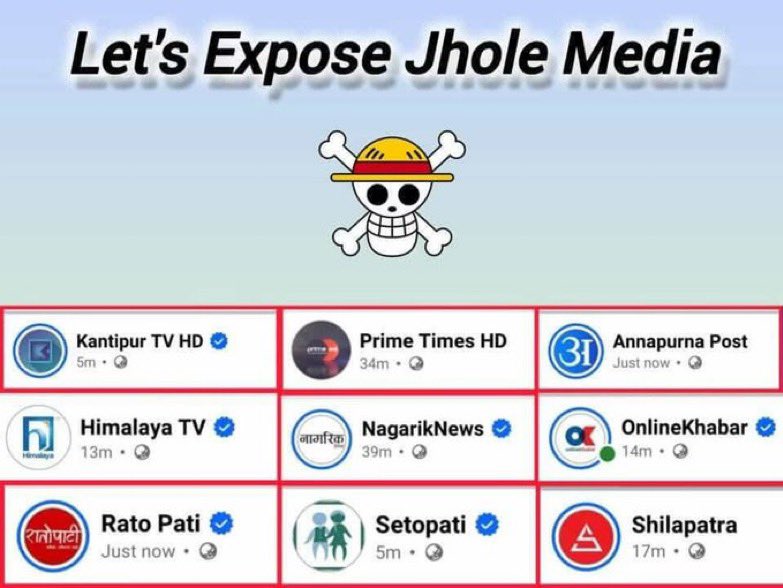
पत्रकारिता क्षेत्रका झोलेहरुको भण्डाफोर गरौँ गरौ पनी,सुनौ पनी,हेरौ पनी I
NE
turtlebeard retweetledi

#ExposeJhole
Different party jholes active as "Journalists"
x.com/Daadaghare/sta…
डाँडाघरे~रबि को परिवार@Daadaghare
पत्रकारिता क्षेत्रका झोलेहरुको भण्डाफोर गरौँ गरौ पनी,सुनौ पनी,हेरौ पनी I
Français