
Sabitlenmiş Tweet
Uberdeus
2.5K posts


@MoloWarMonitor I don’t get it. He could use b2 to drop nukes as well, so what they will try to drop instead?
English

A few minutes ago, while speaking at the White House, President Trump confirmed that the U.S. will "hit the area pretty soon and very heavily," referring to Pickaxe Mountain, where Israeli intelligence says Iran transferred the enriched uranium.
However, as I've already said, the only way to destroy or damage this facility is to drop a tactical nuclear bomb, or alternatively, to recover the material through a highly risky ground operation.
Most likely, however, they will first attempt to destroy the fortified entrances using B-2 stealth bombers.
MoloMonitor 🇮🇹@MoloWarMonitor
Yesterday, while speaking at the White House, President Trump said he wanted to strike "Pickaxe Mountain," the deepest uranium enrichment site in Iran. The facility is so deep (about 100 meters inside the mountain) that during last year's Operation "Midnight Hammer" against Iranian nuclear sites, U.S. B-2 bombers did not even attempt to strike it. In fact, destroying or damaging this base would require a tactical nuclear weapon or a ground operation.
English
Uberdeus retweetledi

There def seems to be some degree of “distillation” or training on synthetic data generated from a more powerful model. I’d be shocked if there wasn’t. But this analysis is still intriguing. Acc to it, apparently Zhipu/GLM has been distilling Gemini 3.1 Pro? What I also find remarkable is how little DeepSeek seems to have distilled from anyone else. And apparently nobody has bothered to distill from OpenAI. 😂

Lisan al Gaib@scaling01
pinky promise there's no distillation
English
Uberdeus retweetledi

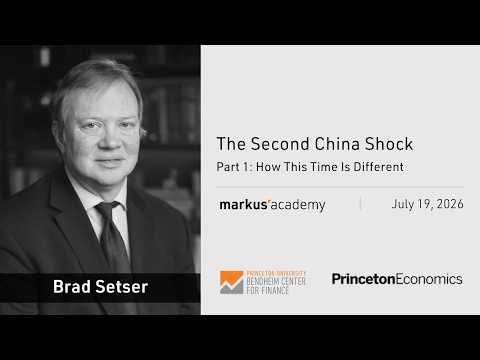
Fantastic webinar with @Brad_Setser on the 2nd China Shock. Part 1 is here:
youtu.be/FtyB5eO0Aw8?si…
Watch and comment.
Executive summary is here markusacademy.substack.com
YouTube
Brad Setser@Brad_Setser
I had a lot of fun discussing the second China shock with Princeton's Markus Brunnermeier -- There are some similarities with the first China shock -- but also many critical differences markusacademy.substack.com/p/the-second-c…
English
Uberdeus retweetledi

Been having some really enlightening conversations with this new generation of Chinese tech entrepreneurs, and I keep coming back to the sense that almost everyone is a 做题家, a kind of exam-trained problem solver. (By the way the term is a little derogatory in Chinese. Its more specific cousin 小镇做题家 / or small-town exam striver, refers to kids from smaller cities who study their way into elite universities, only to discover that doing well on exams does not give them the social capital or broader fluency of the urban kids...) But I don’t mean it dismissively here at all! There’s almost a kind of purity built into that mindset: you have a target (used to be the Gaokao, IMO gold medal, or now some global AI ranking or benchmark…) and you have this huge, incredibly capable community of other 做题家 competing with you to get there.
What’s interesting to me is how little interest many of them seem to have in the grand philosophical questions or, for better or worse, politics... Even revenue and business model strategies feel secondary unless they are part of the formula for solving the problem / 做题. Many are genuine tech purists, a little surprising to me especially given the complicated geopolitics around them!
They’re also very honest about themselves being 做题家. (Many call themselves that! Or some variation of the term, like 理工男.) And many point out that, among all the challenges they face, from compute restrictions to the current legal uncertainty, the hardest is the transition from 做题家 to 出题家, i.e., from solving a clearly defined problem to deciding which problem is worth solving in the first place.
We know China is exceptionally good at asymptoting from No. 2 to No. 1, as No. 1 effectively gives you the problem and the target, and that’s where 做题家 shine. But what happens when the 题 / exam question is deciding what the next target should be when there is no benchmark…
FYI trying out Substack notes now... Will probably write more (random!) thoughts over there:
substack.com/profile/315221…
English
Uberdeus retweetledi

Who’s Afraid of Chinese Models?
Everyone is worried about Chinese models, but the frontier labs will be fine; we need to enable open U.S. alternatives.
stratechery.com/2026/whos-afra…
English
Uberdeus retweetledi

China’s Ministry of Commerce is talking with AI companies such as “Alibaba, ByteDance and Zhipu on limiting the transfer of key data for the training of their models overseas, as well as allowing their model weights to be downloaded by foreign users”
FT: ft.com/content/6049a0…
Zijing Wu@zijing_wu
Scoop: China weighs tighter export controls on 1. taking data overseas for training; open model weights 2. advanced chip fab overseas 3. acquisition of AI start-ups * Regulators are consulting tech firms with no final decision made as.ft.com/r/fc745fce-628…
English
Uberdeus retweetledi

@MoloWarMonitor Che tipo di escalation possiamo aspettarci e con quali fini?
Italiano
According to my sources, Israeli PM Netanyahu will hold a closed security meeting tonight, as tensions escalate in the Middle East.
Meanwhile, dozens of USAF fighter jets and refueling tankers continue to arrive from American bases in Europe, landing at various airports and air bases in Israel.
I believe preparations for a major escalation will be completed by the end of the week, and the new operation could begin Friday night, when markets close.
For now, however, to avoid worsening the market situation at the opening, a Reuters report is circulating about a possible 10-day pause in attacks to create an opportunity to revive the MoU between the U.S. and Iran.

English
Uberdeus retweetledi

“The most urgent challenge confronting China’s leadership may not be how to surpass the West but how to rebalance its economy before the world forces it to,” write Enrico Fardella and @DrRadchenko.
foreignaffairs.com/china/china-sa…
English
Uberdeus retweetledi

The story of AI in the next few years is going to be compute: an essay on the future of AI.
K3 in 2 days is already #10 on OpenRouter with ~140B tok/day, and it’s infra is crumbling. Throughput is down from 30tok/s to 13tok/s, E2E latency is up to 72s and time to first token is >20s! It would cost a minimum of $500k to buy the 8 B300s it would take to serve even quantized Kimi K3 and ~$4M for the more recommended GB300 NVL72 rack.
I don’t think Moonshot has the compute available to scale to their demand! In fact, even the US based inference providers will likely not be able to scale capacity as much as they’d like even if they were to host it: a 2.8T model is no joke. GPU providers (neoclouds etc) are doing 3yr and I recently hear 5yr commits with an ungodly 30% down, and customers are chomping it up. Prices continue to go to the moon. The two big labs, hyperscaler clouds, Grok and Meta have compute deals locked in prior, and the rest are fighting for scraps. Tier 1 neoclouds (coreweave/nebius etc) are rumored to not even small “smaller” customers. Meta is the biggest wildcard here. With ~7GW of compute by eoy 2026 and no clear big model ties, they either get to frontier on their own or can host the most Kimi K3 capacity (unless they sell it to the labs).
Even though the price of models has fallen over time, it’s worth noting that the price of frontier has not. 3yrs ago, GPT-4 released at $60/M, o1 at $60/M, Opus 4 at $75/M, GPT5 at $10/M, Fable at $50/M and now Sol at $30/M and K3 at $15/M. Even if you consider K3 frontier, that’s only a 4-5x flux in 3yrs. In that time, frontier demand has increased at least 3+ ooms and frontier intelligence performance has gone 32x at least by task time by METR.
Essentially, so long as a) the demand for frontier intelligence continues to grow to near infinity, b) the frontier continues to grow in performance, even as c) if the price of frontier declines a little, the value accrued to frontier grows significantly! And there’s a tremendous bull case for those who have locked up compute if you’re bitter lesson pilled and believe larger models will always be smarter models.

English
Uberdeus retweetledi

"The U.S. has an imperial appetite, but a tourist's approach to it."
Good line, that.
npr.org/2026/07/18/g-s…
English
Uberdeus retweetledi
We wrote a while ago in our private newsletter about the different positioning of Beijing, Shanghai, Hangzhou, and Shenzhen as China’s four 4 AI innovation hubs just as @kyleichan said and the bureaucratic competition underpinning each ecosystem and among them. (should probably update that to include the emerging Hefei Wuhan nexus which is increasingly central through eg CXMT + YMTC, optoelectronics, the broader memory and hardware cluster etc)
It is also a good time to remind readers that AI competition is not only a U.S.-China issue. It is also a (fierce!) subnational competition within China itself. Cities and provinces are competing for talent, capital, good companies, and Beijing leadership attention! while Beijing leadership is running the horse race but also trying to coordinate these rival ecosystems toward one national goal. Lots of tension between local bureacratic competition and national mobilization (another defining feature of China’s AI push less discussed…)
Will probably write something public about it at some point…
Zichen Wang@ZichenWanghere
The city of Beijing emphasizes that China's two latest high-performing LLMs, the Kimi K3 and GLM-5.2, originate from Beijing. It cannot allow Shanghai, the city hosting the ongoing World Artificial Intelligence Conference (WAIC), steal the limelight of AI without a fight.
English
Uberdeus retweetledi

Shenwan Hongyuan's Zhao Wei: "Weak income expectations, deleveraging and poor social protections are not isolated phenomena. They all stem from a fragile employment market. The structural vulnerabilities in China’s labor market directly suppress wage growth and exacerbate the need for defensive savings."
We are seeing an increasing number of analysts arguing publicly that wage suppression has been the structural reason for China's weak consumption growth which, in turn, leads to the economic fragility that further pushes up household saving.
caixinglobal.com/2026-07-17/com…
English
Uberdeus retweetledi

Uberdeus retweetledi

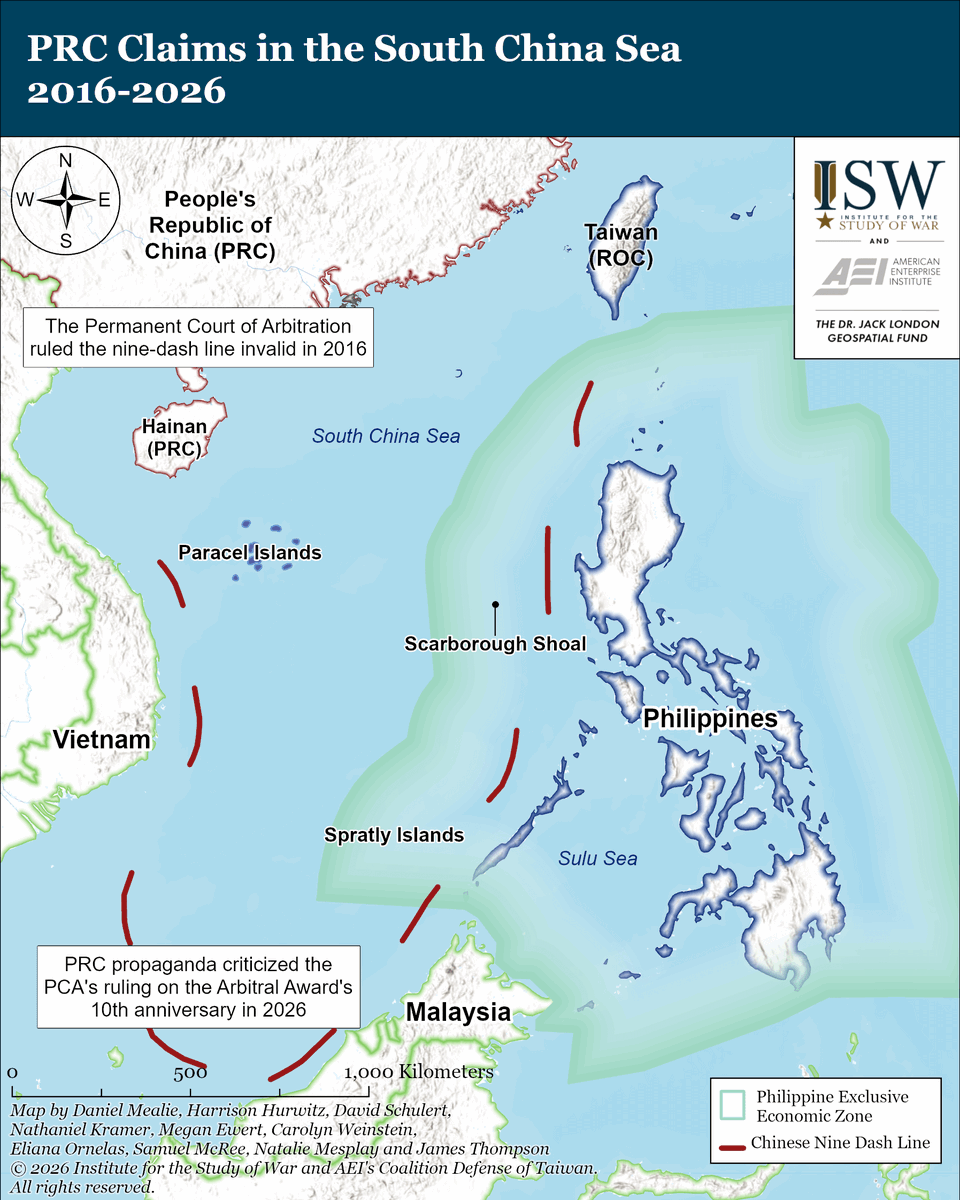
NEW: Japan is developing a centralized intelligence agency for the first time since the Second World War, with advice from its allies and partners. The agency will help counter PRC and Russian espionage in Japan and enhance Japan’s contributions to a US-aligned coalition in the Indo-Pacific. (1/2)
Other Key Takeaways:
PRC academics and state media promulgated a narrative that the Philippines’ northern Batanes Islands belong to the PRC. The PRC may be setting information conditions to expand coercive patrols around the Batanes to strengthen PRC access and control in the Luzon Strait.
PRC authorities are likely detaining and questioning Taiwanese nationals who travel to the PRC to recruit collaborators and intimidate pro-independence voices.
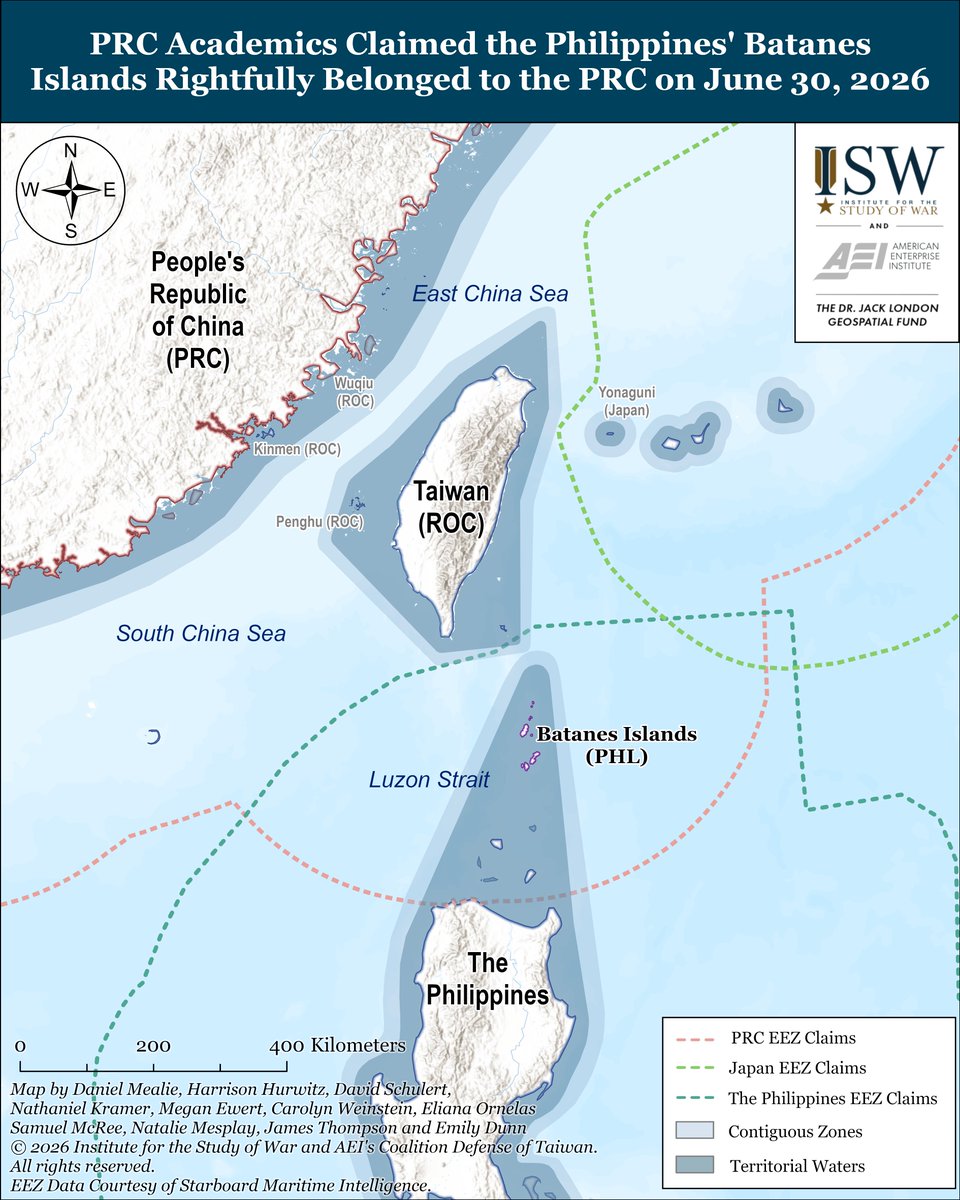
English
Uberdeus retweetledi

China Maritime Studies Institute's,
China Maritime Report #56: The Silent Service: Assessing PLAN Influence in the Central Military Commission
Full report:
tinyurl.com/4pp83knm

English
Uberdeus retweetledi

A year ago, the big three was OpenAI, Anthropic, and Google. Things have changed.
Moonshot's Kimi K3 sits above Gemini on every composite benchmark, and it's open source in 10 days.
New episode: what K3 reveals about frontier margins, model sizes, and who's actually still in the game.
00:11 Is Kimi K3 the Third Best Model?
04:04 Why Delay the Weights?
05:30 2.8T Parameters and Serving Constraints
06:48 Frontier Margins and the 3x Price Hike
11:10 New Architecture, What Comes Next
14:09 Will Open Source Catch Closed?
19:51 Built for Chinese Accelerators
22:57 The Harness Is the Product
28:49 We're Still Early
English
Uberdeus retweetledi

New #FEDSNote: Vietnam's Export Boom to the U.S.: The Role of Chinese Firms: federalreserve.gov/econres/notes/… #EconTwitter
English
Uberdeus retweetledi

New @MilitaryTimes reporting this week on why U.S. 155mm shell production keeps missing targets. The bottleneck isn't the explosive fill or final assembly it's forging and machining enough projectile metal bodies.
militarytimes.com/news/your-mili…
English
Uberdeus retweetledi

Some observations on Kimi:
1. It's a very good model! I don't think its performance can be explained away by distillation or anything like that. In agentic coding sessions, it seems pretty much on par with the best public models of Q1 2026. In my fairly limited use, it also seemed very token hungry. It's not obvious to me that this model is actually that cheap to run.
2. I am personally surprised the Chinese state continues to allow the open sourcing of models this good, given potential risks. To be clear, I *myself* might be fine with models presenting this level of marginal risk being open weight, but I am surprised that China is fine with it. I suspect the reason they are is 75% explained by strategic blindness/lack of AGI-pilledness (the CCP is very Yann Lecun-y in its views of AI). The other 25% or so is their lack of compute for customer inference (making China's open-weight strategy an unintended byproduct of US export controls) and the normal Chinese strategy of aggressive exports. For the companies, as opposed to the government, the decision to open source is partially ideological and partially because they are behind, and they know that very few people would pay for sub-frontier models from China.
3. Open-weight models are inherently decelerationist, and I'm continually surprised to see the so-called "accelerationists" so excited about open-weight models. I suspect the reason they are is that they know open-weight models are effectively ungovernable, and they simply like the overall cloak of ungovernability open-weight models create over the whole of AI. It's not a bad strategy; it reminds me of James Scott's recounting of the hill people in "the art of not being governed." Still, in the end, open-weight models deter further AI capex.
4. One probable outcome of an open-weight-model-dominant world is full AI communism, which is precisely what China proposes: rather than a market product, AI is a "public good" which will ultimately be provided by the state as a kind of "digital public infrastructure." This future strikes me as a dystopian hellscape, but I've never met an open-weight models advocate who doesn't ultimately concede this is where things end. You'd be surprised how many 'accelerationists' lobbied me, while I was in government, to support an eleven or twelve-figure federally funded data center so that startups could train models at a subsidy and then give them away for free. There was no other way for AI to progress, they said. Perhaps this is the logical end state of things. Nonetheless, I find myself surprised to see supposed accelerationists excited about such an outcome. I think many of them just don't know what they're doing. Many accelerationists do not view the creation and serving of frontier models as a legitimate business.
5. I would guess that the Trump Administration will at some point realize that their best strategy here would be to create large amounts of regulatory risk around the use of open-weight Chinese models. You don't need to "ban open source" (one of the dumber motifs of AI policy discussion). You just need to direct every agency to issue soft law that creates FUD. "A Federal Reserve Advisory Bulletin found that there may be backdoors in Chinese AI models." It needn't be that well justified. You just create enough regulatory risk that every regulated enterprise backs off. You probably don't want to create so much regulatory risk that you scare off the hyperscalers from serving Chinese models; this will just drive startups to sketchier providers. There's a happy middle ground here. I'd assume they will do some version of this.
6. It's probably true that open-weight models of this capability make the world a bit more dangerous, but not so much more that you'll really notice. At some point the models will be capable enough that you will notice. "A nonliving, invisible, dangerous, and infinitely self-replicating agent escaped from a Chinese lab," you say? Color me shocked.
English