Vashistha Iyer

20.9K posts

Vashistha Iyer banner
Vashistha Iyer

Vashistha Iyer

@uptickr

Design + Tech. Executive Director @CapitalmindMF. Strategy & investment technology across the @capitalmind_in group.

India Katılım Şubat 2015
675 Takip Edilen12.7K Takipçiler
Vashistha Iyer retweetledi
Capitalmind Mutual Fund
Capitalmind Mutual Fund@CapitalmindMF·
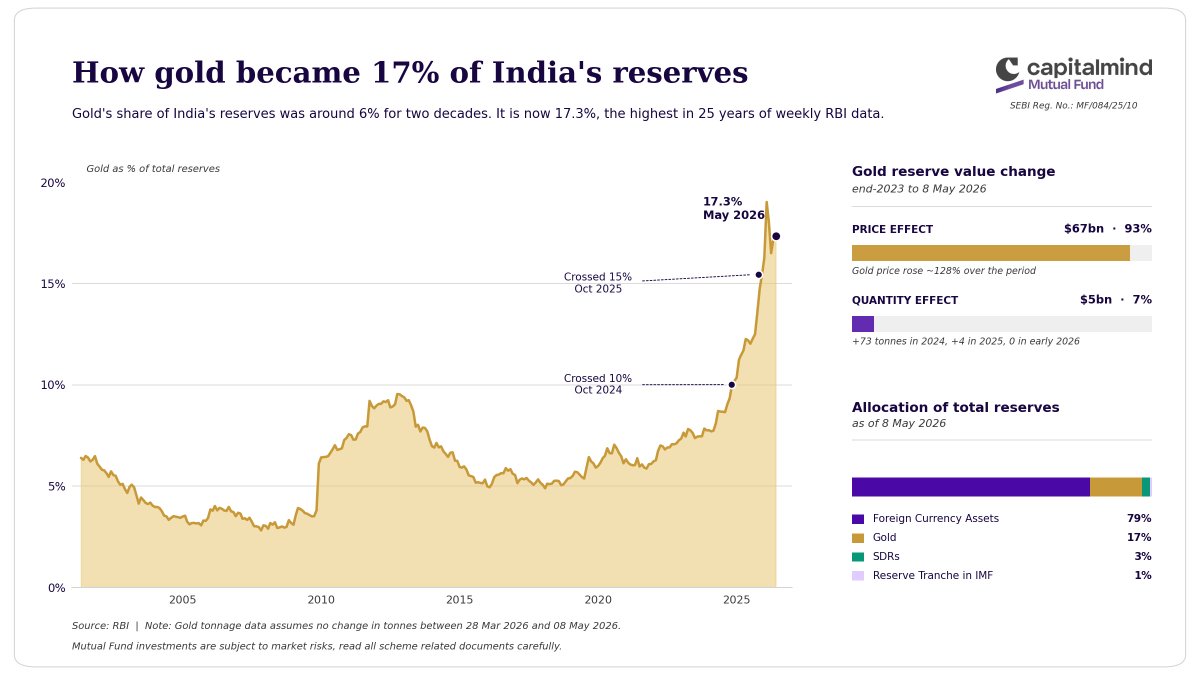
Has RBI been buying gold aggressively? India's gold reserves just hit a 25-year high at 17.3% of total forex reserves. Of the $72bn rise in gold's reserve value since end-2023, 93% came from price appreciation and only 7% from buying more gold. RBI bought only 73 tones in 2024, 4 in 2025, and nothing in 2026.
Capitalmind Mutual Fund tweet media
English
5
11
96
59.2K
Vashistha Iyer retweetledi
Deepak Shenoy
Deepak Shenoy@deepakshenoy·
Watch @CalmInvestor on @CNBCTV18News talk about the markets, our funds and more: - Earnings of the large/mid/smallcaps - Cynefin 4 situation framework - How the @CapitamindMF Flexi Cap fund managed cash - The Multi-asset fund that goes beyond Gold and Silver - And more! youtube.com/watch?v=WQ2TBH… Mutual Funds are subject to market risks, read all scheme related documents carefully.
YouTube video
YouTube
Deepak Shenoy tweet media
English
5
3
27
8K
Vashistha Iyer
Vashistha Iyer@uptickr·
ESOPs are compensation. Hence, it will be taxed as income. That's not the problem. The timing i.e. tax liability arising upon exercise, creates a cashflow problem. A better way would be to shift that liability to the point of sale of the converted shares.
Alan@cbe_sam

India taxes ESOPs twice... I've observed this in 2 of my previous companies. Will be paying more tax when the listing happens and will sell it. I'm all in for paying tax, but this arrogant tax policy should end.

English
0
2
12
2.1K
Vashistha Iyer retweetledi
Save Invest Repeat 📈
Save Invest Repeat 📈@InvestRepeat·
Capitalmind Mutual Fund is now the first AMC to add "Portfolio Changes" summary in their factsheet. Earlier, I used to manually compare two months portfolio & share the changes. Now AMC itself is doing it. Great work @deepakshenoy @CalmInvestor @uptickr & team. 👏
Save Invest Repeat 📈 tweet media
English
6
7
164
10.6K
Vashistha Iyer retweetledi
Prasiddh Shroff, CFA
Prasiddh Shroff, CFA@PrasiddhShroff·
More FMs should be doing this; the transparency and clarity regarding the Portfolio changes are a good addition, and more AMCs should follow Kudos to the team! @deepakshenoy @CalmInvestor
Deepak Shenoy@deepakshenoy

In the @CapitalmindMF Flexi Cap Fund last month, I'll post the factsheet notes on the summary of what we own and how it is: We have increased allocations over the month of April, from the 66% in March to around 85% in April:

English
2
8
26
11K
Vashistha Iyer retweetledi
Tony Fadell
Tony Fadell@tfadell·
Spotted in the NYC subway. “Zero screen time.” An iPod Shuffle ad in 2026. When we built the iPod, the goal was the technology disappeared and you could have your music wherever you were. 1,000 songs in your pocket. Now we’re living through a moment where people are actively looking for ways to disconnect from the infinite feed, algos, and constant notifications. That doesn’t mean technology is bad. It means the best technology understands when to step back. Not every problem needs another screen, another menu, or another layer of complexity. Constraints create freedom (read: @DavidEpstein new book Inside the Box). And often removing features creates a better product than adding them. The future of technology shouldn’t just be more engagement. It should help us be more human.
Tony Fadell tweet media
English
311
1.4K
13.2K
1.7M
Vashistha Iyer retweetledi
Aashish P Sommaiyaa
Aashish P Sommaiyaa@AashishPS·
Learnt something last couple of days… appears vast majority of people think a PMS is only and only what you use to manage equity portfolios. World over one of the more prevalent use of PMS is to administer and execute advice for clients. A PMS which can allocate to direct plans of MFs and to REITs, InVITs, Bonds, Index Funds, ETFs et al can be a powerful structure for advisory practitioners. It can manage asset allocation and manager selection decisions with advice embedded in the PMS and a non clumsy formal mechanism of charging advisory fees. The fee might end up higher than direct plans of mutual funds but with advice embedded and it would be lower than regular plans of equity and hybrid funds on a full asset allocation basis.
English
14
17
92
40.2K
Vashistha Iyer
Vashistha Iyer@uptickr·
@thatfinanceguy @capitalmind_in DIY is not for everyone. PMS is not for DIY investors. PMS is also not for everyone. x.com/AkankshaMaulik…
Akanksha M Pandey@AkankshaMaulik

While DIY investors debate PMS wrapper for MF, the PMSes everyday find more and more people struggling to manage their MF portfolios. Here's the usual journey of a PMS investor for MF wrappers : 1. Start off like most of us did. Invests in MFs sold by bank RMs or family agents. 2. Someone who is DIY-ing questions regular vs direct. 3. Investor takes some initial help and sets up some investments in Direct MFs. 4. They try to educate themselves, make mistakes and build a portfolio of 20-25 MFs minimum across regular and direct MFs (I have seen 75-80 schemes in one client portfolio). 5. They miss the one-on-one relationship that came with bank RMs or agents. Specially in uncertain markets. In FOMO. In Fear. 6. They find educational material and courses online supporting both passive and active mutual funds. 7. As they learn more, they realise it only gets more nuanced. Not simple. 8. The overwhelm is real. So is self-doubt. 9. They buy, but they never sell. 10. They realise, just like a lot of other things we can do ourselves but we don't, they would rather have someone manage it for them end-to-end. But in direct funds. 11. They understand there are no free lunches and their problem is critical enough to justify a reasonable fee for solving it. 12. In PMS, they invest in Direct mutual funds baskets and everything is delegated - purchase, redemption, SIPs, allocation et al. 13. They gain an advisor relationship who also helps them build a small DIY portfolio on the side, if they prefer, so they can participate in the thrill without making costly mistakes. 14. And lo behold! Contrary to the general commentary, some PMS comes at a fixed fee of 0.5% p.a and no profit share. Very quickly, here's how most UHNI decision making goes (the wealthy ones with double digit Cr portfolios) : 1. At some point in the past, already decided - I will pay for someone to handle everything that's not my primary business. 2. I want something that doesn't create frequent tax instances. 3. Take the fee and let me use the MF Basket. 4. I am paying for time and mind space. To me, this is building leverage for better use of my time on endeavours that can actually give me outsized returns. It really is that simple. DIY is not for everyone. PMS is not for DIY investors. PMS is also not for everyone.

English
1
0
0
71
Capitalmind
Capitalmind@capitalmind_in·
Done right, PMS' can be one of the most effective ways to service HNIs with tax-efficient Mutual Fund baskets. At @capitalmind_in, our first such portfolios were offered for fees as low as 25bps. Today, we offer 5 such investment approaches. And for each, our gross fees (including the underlying MF's BER) is < the basket's weighted average Regular BER. And, we don't charge any performance fees on any of our MF baskets
Capitalmind tweet media
Vashistha Iyer@uptickr

Performance fees on top of a mutual fund portfolio - that too without a hurdle - is unusual, to say the least. It's asking for a profit share for recognising someone else's skill. When the underlying isn't allowed to charge a performance fee, layers on top shouldn't be allowed either.

English
7
9
66
82.9K
Vashistha Iyer retweetledi
Akanksha M Pandey
Akanksha M Pandey@AkankshaMaulik·
While DIY investors debate PMS wrapper for MF, the PMSes everyday find more and more people struggling to manage their MF portfolios. Here's the usual journey of a PMS investor for MF wrappers : 1. Start off like most of us did. Invests in MFs sold by bank RMs or family agents. 2. Someone who is DIY-ing questions regular vs direct. 3. Investor takes some initial help and sets up some investments in Direct MFs. 4. They try to educate themselves, make mistakes and build a portfolio of 20-25 MFs minimum across regular and direct MFs (I have seen 75-80 schemes in one client portfolio). 5. They miss the one-on-one relationship that came with bank RMs or agents. Specially in uncertain markets. In FOMO. In Fear. 6. They find educational material and courses online supporting both passive and active mutual funds. 7. As they learn more, they realise it only gets more nuanced. Not simple. 8. The overwhelm is real. So is self-doubt. 9. They buy, but they never sell. 10. They realise, just like a lot of other things we can do ourselves but we don't, they would rather have someone manage it for them end-to-end. But in direct funds. 11. They understand there are no free lunches and their problem is critical enough to justify a reasonable fee for solving it. 12. In PMS, they invest in Direct mutual funds baskets and everything is delegated - purchase, redemption, SIPs, allocation et al. 13. They gain an advisor relationship who also helps them build a small DIY portfolio on the side, if they prefer, so they can participate in the thrill without making costly mistakes. 14. And lo behold! Contrary to the general commentary, some PMS comes at a fixed fee of 0.5% p.a and no profit share. Very quickly, here's how most UHNI decision making goes (the wealthy ones with double digit Cr portfolios) : 1. At some point in the past, already decided - I will pay for someone to handle everything that's not my primary business. 2. I want something that doesn't create frequent tax instances. 3. Take the fee and let me use the MF Basket. 4. I am paying for time and mind space. To me, this is building leverage for better use of my time on endeavours that can actually give me outsized returns. It really is that simple. DIY is not for everyone. PMS is not for DIY investors. PMS is also not for everyone.
English
1
3
18
4.3K
Vashistha Iyer
Vashistha Iyer@uptickr·
Fair question. A lot of AMCs that also run PMS' do this. @capitalmind_in has one Investment Approach that's a feeder into our Flexi Cap fund - on which the PMS doesn't charge any management fees at all. It was offered because the erstwhile PMS fund manager moved to the AMC to run the Flexi Cap scheme.
English
0
0
0
51
Explorer
Explorer@Explorerwong·
@Rajan1969H @uptickr Agree. the fee should be based on Alpha generated (in which case the rate will need to be higher). However, there are practical challenges: what if fund generates 20% profit, then market falls reducing gains to 10% at the time of calculation and goes up again, etc.
English
1
0
0
17
Anugrah Shrivastava
Anugrah Shrivastava@anugrah_shrivas·
As we continue to build the investment ecosystem for India, solving for liquidity without friction is the natural next step. To solve the investor dilemma of liquidating a long-term portfolio for short-term requirements, we introduced Loans Against Mutual Funds (LAMF) on @smallcaseHQ Now, we have updated the offering to India’s best-in-class secured credit stack for mutual funds and stocks: Higher credit: Direct banking integrations allow you to borrow up to 60% of your equity holdings. Most other apps still offer only 50%. Best-in-class rates: Starting at 9.99%, not just for high-ticket loans, but for amounts as low as ₹50,000. Best-in-class experience: Fully digital and starting as low as ₹10,000. Whether you are an investor looking for liquidity or a platform looking to integrate this via our plug-and-play solution, we’ve built this to be the most seamless experience in the market. Check it out here - smallcase.com/credit or reach out to us for B2B integrations. 🚀
Vasanth Kamath@vasanthkamath

Loans against mutual funds have become one of the fastest growing credit categories for individuals. It’s an ideal way for investors to get access to instant liquidity with in-built flexibility for anytime repayment & interest-only monthly payments, while continuing to let their investments compound Till recently, investors could only borrow up to 50% of their equity investments value. With its updated framework, RBI has raised this ceiling for banks, making loans against securities a more compelling proposition We’ve now also implemented this on @smallcaseHQ, making our mutual funds loan offering the most investor-friendly stack · Borrow up to 60% of your equity mutual fund holdings, higher limits on debt continue · Interest rates as low as 9.99%, even for loan amounts as low as ₹50000 · Instant and fully digital process with loans starting at ₹10000 Live now on the smallcase mobile & web apps, we also offer a plug-and-play solution for platforms who want to offer this to their clients. DM for access

English
1
4
5
1.4K
Prashanth
Prashanth@Prashanth_Krish·
@uptickr Congrats Vashishta. I assume this is your first article in a newspaper.
English
1
0
0
223
Vashistha Iyer
Vashistha Iyer@uptickr·
SEBI 2026 MF regulations require TER to be disclosed as four components: Base Expense Ratio, brokerage, transaction costs, and statutory levies. Each reported daily, annualized. The intent is good. Investors should see what they're paying for. But there's nuance that may get lost. Here's how to make sense of it: Brokerage scales with trading volume, not AUM. So do the variable statutory levies - STT, GST on brokerage - and exchange/clearing charges. All are incurred only on days when the fund transacts. Annualizing a single day's transaction costs assumes that level of activity repeats every day for a year. On a heavy trading day, this produces an enormous number. On a quiet day, these components drop to near zero. I pulled this FY's first week's AMFI data for open-ended equity schemes. Two examples: Mirae Asset Arbitrage Fund (Regular): 14% TER on April 1, down to 0.93% by April 3. BER is 0.79% throughout. The difference is entirely transaction costs and statutory levies from one day of likely derivatives activity. Kotak Nifty Midcap 150 Index Fund (Regular): 0.88% on April 1, 3.5% on April 2 (likely rebalancing), 0.63% on April 3. The BER is stable and reflects the actual cost structure of the fund. The variable components are noise at the daily level - they only converge to something meaningful when averaged over a full year. There's a second issue. The new TER isn't comparable to the old TER. It now includes brokerage, STT, exchange charges, and GST - none of which were in the old disclosed number. The old TER was closer to what's now called BER, but even that isn't a clean match: the expense line items and caps have been restructured. There is no like-for-like mapping. Screeners and comparison tools that sort on TER will need to account for this. An interesting side-effect: TER minus BER is now a daily proxy for trading activity by each fund. That data was never available before at this granularity. Whether SEBI intended it or not, anyone tracking fund behavior just got a new metric.
Vashistha Iyer tweet media
English
3
9
37
34K
Vashistha Iyer
Vashistha Iyer@uptickr·
Annualising one day's txn cost is conceptually problematic - especially as a disclosure to retail investors. Just as annualising a single day's return would be. The right approach here would be to use aggregate costs for trailing 1yr or simple annualise for trailing 6 months (just as is required for returns reporting). One fund hit 70%+ "TER". The number is now pretty much meaningless.
Neil Borate@ActusDei

⚠️ Your SIF fund showed 11% TER on April 6. Before Apr 1, this was hidden. Now SEBI forces funds to show brokerage + trading costs in daily TER. One heavy trading day spiked costs from 0.62% → 11.17% (same fund, 3 days apart). This is a single-day figure — not your annual cost. So don't read it that way. But it tells you something important: High-churn funds are expensive. You just couldn't see it before. Story by @VedantVichare99 thefynprint.com/YX1buZfgy

English
0
1
15
3.4K