va4az

141 posts

va4az

va4az

@va4az

Silent observer of my destiny...

Katılım Mayıs 2009
976 Takip Edilen72 Takipçiler
va4az retweetledi
Giuliano
Giuliano@Giuliano_Mana·
"When you find a genius, give them all power." I've been obsessed with this idea for 12 months now. I learned it from Munger but then saw all successful people apply it. From Steve Jobs to Robert Oppenheimer. Thread:
Giuliano tweet media
English
98
729
8K
1.5M
Chuck Will
Chuck Will@Chuckwill·
@stevenbjohnson Neat but not sure this is going to actually help you learn the material though.
English
3
0
3
4.2K
Steven Johnson
Steven Johnson@stevenbjohnson·
How to do school with NotebookLM: 1. Record audio from class on your phone 2. Keep laptop closed. Just jot down short phrases to describe most important points 3. Upload audio and PDF scan of notes to NotebookLM 4. Ask Notebook to expand your notes with details from recording Bonus: at the end of the week, create an Audio Overview from all your class summaries to review the most important concepts in podcast format. (As of this morning, NotebookLM now supports audio files--and YouTube videos--as sources. And we've added easy sharing tools for Audio Overviews.) notebooklm.google.com
Steven Johnson tweet media
English
87
400
2.6K
351.8K
va4az
va4az@va4az·
@alexalbert__ Voice interface in the chat [platform agnostic]
English
0
0
0
4
Alex Albert
Alex Albert@alexalbert__·
We've got some exciting things coming up in the pipeline but we want to ship even more features that people want. What do you wish we added/fixed on claude dot ai or the API?
English
386
21
496
73K
va4az retweetledi
Thomas Wolf
Thomas Wolf@Thom_Wolf·
There was a super impressive AI competition that happened last week that many people missed in the noise of AI world. I happen to know several participants so let me tell you a bit of this story as a Sunday morning coffee time. You probably know the Millennium Prize Problems where the Clay Institute pledged a US$1 million prize for the first correct solution to each of 7 deep math problems. To this date only one of these, the Poincaré conjecture, has been solved by Grigori Perelman who famously declined the award (go check Grigori out if you haven't the guy has a totally based life). So this new competition, the Artificial Intelligence Math Olympiad (AIMO) also came with a US$1M prize but was only open to AI model (so the human get the price for the work of the AI...). It tackle also very challenging but still simpler problems, namely problems at the International Math Olympiad gold level. Not yet the frontier of math knowledge but definitely above what most people, me included, can solve today. The organizing committee of the AIMO is kind-of-a who-is-who of highly respected mathematicians in the world, for instance Terence Tao widely famous math prodigy widely regarded as one of the greatest living mathematicians. Enter our team, Jia Li, Yann Fleuret, and Hélène Evain. After a successful exit in a previous startup (that I happen to have know well when I was an IP lawyer in a previous life but that's for another story) they decided to co-found Numina as a non-profit to do open AI4Math. Numina wanted to act as a counterpoint to AI math efforts like DeepMind's but in a much more open way with the goal to advance the use of AI in mathematics and make progress on hard, open problems. Along the way, they managed to recruit the help of some very impressive names in the AI+math world like Guillaume Lample, co-founder of Mistral or Stanislas Polu, formerly pushing math models at OpenAI. As Jia was participating in the code-model BigCode collaboration with some Hugging Face folks, came the idea to collaborate and explore how well code models could be used for formal mathematics. For context, olympiad math problems are extremely hard and the core of the issue is in the battle plan you draft to tackle each problem. A first focus of Numina was thus on creating high quality instruction Chain-of-Thought (CoT) data for competition-level mathematics. This CoT data has already been used to train models like DeepSeek Math, but is very rarely released so this dataset became an unvaluated ressource to tackle the challenges. BigCode's lead Leandro put Jia in touch with the team that trained the Zephyr models at Hugging Face, namely, Lewis, Ed, Costa and Kashif with additional help from Roman and Ben and the goal became to have a go at training some strong models on the math and code data to tackle the first progress prize of AIMO. And the trainings started: Jia being an olympiad coach, was intimately familiar with the difficulty level of these competitions and able to curate an very strong internal validation set to enable model selection (Kaggle submissions are blind). While iterating on dataset construction, Lewis and Ed from Hugging Face focused on training the models and building the inference pipeline for the Kaggle submissions. As often in competition it was an intense journey with Eureka and Aha moments pushing everyone further. Lewis told me about a couple of them which totally blow my mind. A tech report is coming so this is just some "along the way" nuggets that will be soon gathered in a much more comprehensive recipe and report. Learning to code: The submission of the team relied on self-consistency decoding (aka majority voting) to generate N candidates per problem and pick the most common solution. But initial models trained on the Numina data only scored around 13/50... they needed a better approach. They then saw the MuMath-Code paper (arxiv.org/abs/2405.07551) which showed you can combine CoT data with code data to get strong models. Jia was able to generate great code execution data from GPT-4 to enable the training of the initial models and get to impressive boost in performance. Taming the variance: Another Ahah moment came at some point when a Kaggle member shared a notebook showing how DeepSeek models worked super well with code execution (the model breaks down the problem into steps and each step is run in Python to reason about the next one). However, when the team tried this notebook they found this method had huge variance (the scores on Kaggle varied from 16/50 to 23/50). When meeting in Paris for a hackathon to improve this issue (like the HF team often does) Ed had the idea to frame the majority voting as a "tree of thoughts" where you'd progressively grow and prune a tree of candidate solutions (arxiv.org/abs/2305.10601). This had an impressive impact on the variance and enabled them to be much more confident in their submissions (which showed in how the model ended up performing extremely well on the test set versus the validation set) Overcoming compute constraints: the Kaggle submissions had to run on 2xT4s in under 9h which is really hard because FA2 doesn't work and you can't use bfloat16 either. The team explored quantization methods like AWQ and GPTQ, finding that 8-bit quantization of a 7B model with GPTQ was best Looking at the data: a large part of the focus was also on checking the GPT-4 datasets for quality (and fixing them) as they quickly discovered that GPT-4 was prone to hallucinations and failing to correctly interpret the code output. Fixing data issues in the final week led to a significant boost in performance. Final push: The result were really amazing and the model climbed to the 1 place. And even more, while tying up for first place on the public, validation leaderboard (28 solved challenges versus 27 for the second place), it really shined when tested on the private, test leaderboard where it took a wide margin solving 29 challenges versus 22 for the second team. As Terence Tao himself set it up, this is "higher than expected" Maybe what's even more impressive about this competition, beside the level of math these models are already capable of is how ressource contraint the participants were actually, having to run inference in a short amont of time on T4 which only let us imagine how powerful these models will become in the coming months. Time seem to be ripe for GenAI to have some impact in science and it's probably one of the most exciting thing AI will bring us in the coming 1-2 year. Accelerating human development and tackling all the real world problems science is able to tackle.
Thomas Wolf tweet mediaThomas Wolf tweet mediaThomas Wolf tweet mediaThomas Wolf tweet media
English
62
503
2.9K
650.9K
va4az
va4az@va4az·
@ShaanVP This is by far the most underestimated characteristic among investors. Understanding your own thought process with objectivity has the highest ROI. Decision Journaling is nitro boost for self awareness - top characteristic of top 0.1% traders and investors both of our lifetime!
English
0
0
0
23
Shaan Puri
Shaan Puri@ShaanVP·
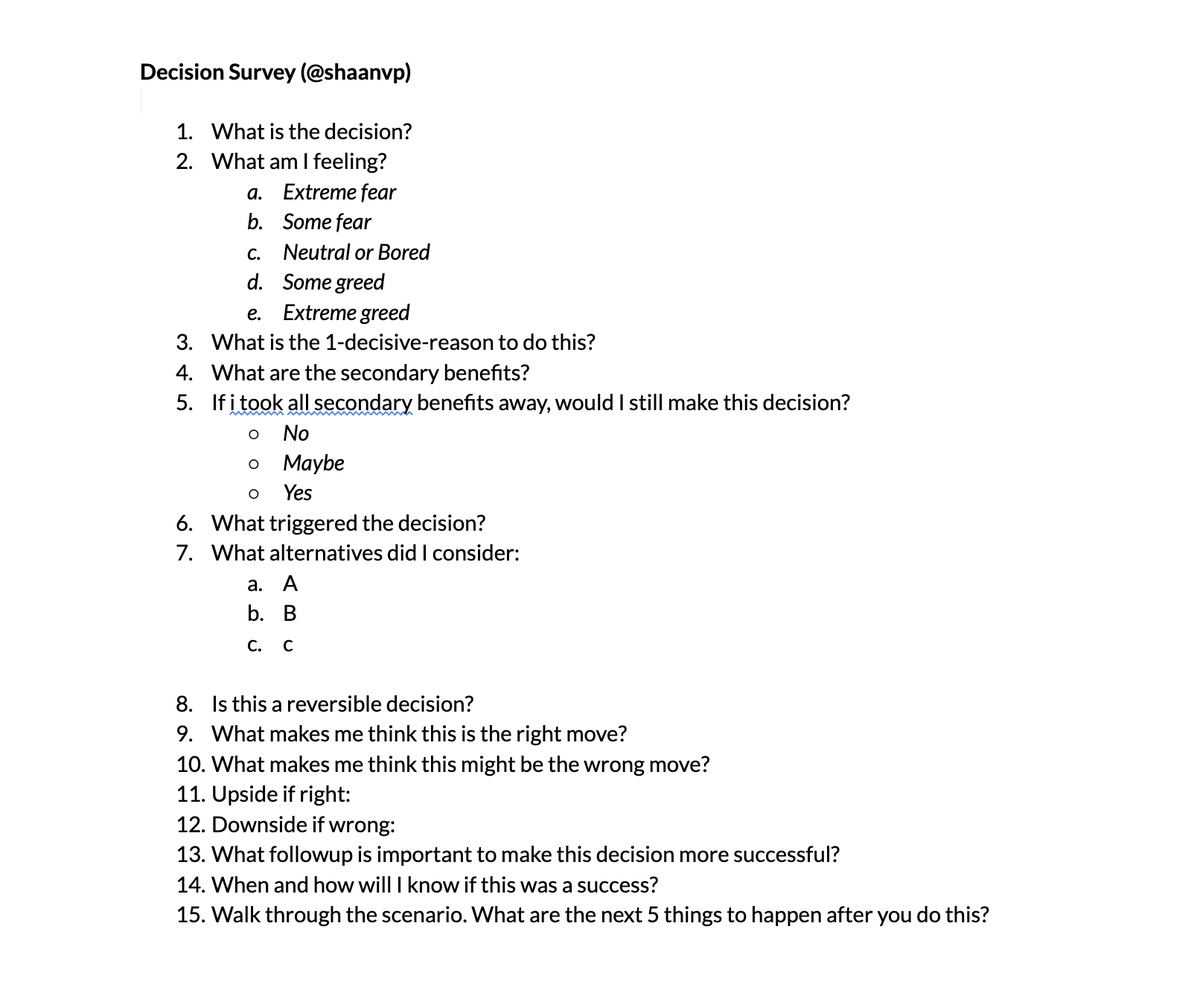
How do you become the type of person who makes great decisions? I fill this out everytime I make a major decision (eg. big investment, start/sell a company, etc.) Then I re-visit it ~1 year later and look at my line of thinking. Without writing it down, I lie to myself later
Shaan Puri tweet media
English
56
116
1.4K
299.6K
va4az retweetledi
Herbie Bradley
Herbie Bradley@herbiebradley·
sharing some new work :) i'm excited to push further in this direction as well as support alternative approaches to the same problem: predicting downstream capabilities if you have ideas or takes about how to tackle this, please let me know!
Rylan Schaeffer@RylanSchaeffer

❤️‍🔥❤️‍🔥Excited to share our new paper ❤️‍🔥❤️‍🔥 **Why Has Predicting Downstream Capabilities of Frontier AI Models with Scale Remained Elusive?** w/ @haileysch__ @BrandoHablando @gabemukobi @varunrmadan @herbiebradley @ai_phd @BlancheMinerva @sanmikoyejo arxiv.org/abs/2406.04391 1/N

English
1
6
35
5.1K
va4az retweetledi
Emmanuel Ameisen
Emmanuel Ameisen@mlpowered·
Today, we announced that we’ve gotten dictionary learning working on Sonnet, extracting millions of features from one of the best models in the world. This is the first time this has been successfully done on a frontier model. I wanted to share some highlights 🧵
Emmanuel Ameisen tweet media
English
34
245
1.5K
193.2K
va4az retweetledi
The Product Folks 🚀
The Product Folks 🚀@TheProductfolks·
Ready to level up your PM journey? 🚀 Launching INSURJO '24: Product Management Cohort 🚀 Our BIGGEST flagship initiative to make your Product Career dreams come true 🔥 Get FREE access: 1⃣ Like + RT this post 2⃣ Comment JOIN 3⃣ Register below 👇 bit.ly/Insurjo24
English
2.1K
1.5K
2.3K
64.5K
va4az retweetledi
Apoorva Govind
Apoorva Govind@Appyg99·
The reason I left France after a year of living there is because it’s not a serious country when it comes to capitalism. You can cry all you want about how America sucks at this or that. But let’s be real. There is no real social mobility in Europe. If there was, we’d all be flooding there. C'est tout. Micro coupé. All this “Europe is superior” is a cope.
English
651
498
8.5K
4M
va4az retweetledi
Value Theory
Value Theory@ValueInvestorAc·
Warren Buffett Leaves The Audience Speechless One of his most inspiring speeches:
English
19
360
1.4K
314.4K
va4az retweetledi
Nithin Kamath
Nithin Kamath@Nithin0dha·
Most Indians think that you don't need strength training as you age. The truth is strength training becomes even more critical as we get older, especially after our 40s. The stronger we are, the more active we can be when we are older. 2/5 knowablemagazine.org/article/health…
English
12
50
662
251.2K
va4az retweetledi
Michaël Benesty
Michaël Benesty@pommedeterre33·
Ran tests of Flash attention V2 from OpenAI Triton team: - unlike CUDA version, it runs on 3090 RTX (not just A100) - brings significant speed up on *fwd* pass (below: before / after), around 20% on long cxt, no effect on bwd pass (which has been recently improved on Triton)
Michaël Benesty tweet mediaMichaël Benesty tweet media
Michaël Benesty@pommedeterre33

It was fast, Flash Attention v2 just landed on OpenAI Triton repo, less than 24h after the CUDA release. github.com/openai/triton/… github.com/openai/triton/…

English
3
18
133
31.5K
va4az
va4az@va4az·
@TheGregYang Allegedly - only verified folks can DM you. I bet there are a lot of people who are not verified but would be able to add a lot of value to your initiative.
English
0
0
0
34
Greg Yang
Greg Yang@TheGregYang·
Finally launched x.ai! The mathematics of deep learning is profound, beautiful, and unreasonably effective. Developing the "theory of everything" for large neural networks will be central to taking AI to the next level. Conversely, this AI will enable everyone to understand our mathematical universe in ways unimaginable before. Math for AI and AI for math! Any mathematician/theorist excited about this needs to DM me!
English
540
907
7.6K
2.6M
Paul Graham
Paul Graham@paulg·
First guest we've ever had who recognized what our walrus baculum was.
English
16
7
346
125.2K
va4az retweetledi
Paul Graham
Paul Graham@paulg·
I just got interviewed by Tyler Cowen. It was exhausting. He kept asking me questions that were interesting but so hard they'd take an essay to answer.
English
83
67
2.9K
1.2M
Greg Brockman
Greg Brockman@gdb·
Being willing to ask dumb questions is a superpower. Often by far the fastest way to get oriented in a new domain, and though perhaps counterintuitive, experts tend to love it when people genuinely want to learn about their passion area.
English
277
645
5.9K
2.3M