Vivek Mohta

3.1K posts

Vivek Mohta

Vivek Mohta

@vmohta1

Co-Founder @Manifold_ai. Previously @MIT_Physics @HarvardMath. Lucky husband of @VanithaMD.

San Francisco, CA Katılım Mayıs 2009
492 Takip Edilen870 Takipçiler
Sabitlenmiş Tweet
Vivek Mohta
Vivek Mohta@vmohta1·
👋🏽 Going to be more active on X, since it seems like a lot of convos are happening here again - AI adoption, AI for life sciences, high-quality biological datasets, etc Would love to hear about problems we should be solving at Manifold - please tag me
English
1
0
4
132
Vivek Mohta retweetledi
Buffy Wicks
Buffy Wicks@BuffyWicks·
After months of research, dozens of interviews, many tours, and two public hearings, I am so excited to announce the Housing Innovation bill package!
English
26
31
129
16.3K
Vivek Mohta retweetledi
Ethan Mollick
Ethan Mollick@emollick·
I don't feel like this fact has been fully absorbed yet, and a lot depends on companies and individuals making decisions now about how we can use AI to make white collar work better for both workers and organizations, rather than taking the path of pure automation.
English
5
4
146
11.9K
Vivek Mohta retweetledi
François Chollet
François Chollet@fchollet·
AI agents will soon graduate to fully-fledged economic actors that buy services, compute, and even data in the course of accomplishing high-level goals. 1-2 years before we start seeing this at scale.
English
198
187
1.7K
261.7K
Vivek Mohta retweetledi
Bartosz Naskręcki
Bartosz Naskręcki@nasqret·
It finally happened-my personal move 37 or more. I am deeply impressed. The solution is very nice, clean, and feels almost human. While testing new models in the last few weeks, I felt this coming, but it's an eerie feeling to see an algorithm solve a task one has curated for about 20 years. But at least I have gained a tool that understands my idea on par with the top experts in the field. And I am now working on a completely new level. My singularity has just happened… and there is life on the other side, off to infinity!
Epoch AI@EpochAIResearch

We ran GPT-5.4 (xhigh) an additional ten times on Tier 4 to get a pass@10 score. This was 38%. In one of these runs, it solved another problem no model had solved before. This problem was by @nasqret.

English
105
454
3.6K
1.1M
Vivek Mohta retweetledi
Bo Wang
Bo Wang@BoWang87·
Prof. Donald Knuth opened his new paper with "Shock! Shock!" Claude Opus 4.6 had just solved an open problem he'd been working on for weeks — a graph decomposition conjecture from The Art of Computer Programming. He named the paper "Claude's Cycles." 31 explorations. ~1 hour. Knuth read the output, wrote the formal proof, and closed with: "It seems I'll have to revise my opinions about generative AI one of these days." The man who wrote the bible of computer science just said that. In a paper named after an AI. Paper: cs.stanford.edu/~knuth/papers/…
Bo Wang tweet media
English
155
1.9K
9.2K
1.4M
Vivek Mohta retweetledi
Michael Truell
Michael Truell@mntruell·
We believe Cursor discovered a novel solution to Problem Six of the First Proof challenge, a set of math research problems that approximate the work of Stanford, MIT, Berkeley academics. Cursor's solution yields stronger results than the official, human-written solution. Notably, we used the same harness that built a browser from scratch a few weeks ago. It ran fully autonomously, without nudging or hints, for four days. This suggests that our technique for scaling agent coordination might generalize beyond coding.
English
264
513
8.3K
1M
Vivek Mohta retweetledi
Andrej Karpathy
Andrej Karpathy@karpathy·
It is hard to communicate how much programming has changed due to AI in the last 2 months: not gradually and over time in the "progress as usual" way, but specifically this last December. There are a number of asterisks but imo coding agents basically didn’t work before December and basically work since - the models have significantly higher quality, long-term coherence and tenacity and they can power through large and long tasks, well past enough that it is extremely disruptive to the default programming workflow. Just to give an example, over the weekend I was building a local video analysis dashboard for the cameras of my home so I wrote: “Here is the local IP and username/password of my DGX Spark. Log in, set up ssh keys, set up vLLM, download and bench Qwen3-VL, set up a server endpoint to inference videos, a basic web ui dashboard, test everything, set it up with systemd, record memory notes for yourself and write up a markdown report for me”. The agent went off for ~30 minutes, ran into multiple issues, researched solutions online, resolved them one by one, wrote the code, tested it, debugged it, set up the services, and came back with the report and it was just done. I didn’t touch anything. All of this could easily have been a weekend project just 3 months ago but today it’s something you kick off and forget about for 30 minutes. As a result, programming is becoming unrecognizable. You’re not typing computer code into an editor like the way things were since computers were invented, that era is over. You're spinning up AI agents, giving them tasks *in English* and managing and reviewing their work in parallel. The biggest prize is in figuring out how you can keep ascending the layers of abstraction to set up long-running orchestrator Claws with all of the right tools, memory and instructions that productively manage multiple parallel Code instances for you. The leverage achievable via top tier "agentic engineering" feels very high right now. It’s not perfect, it needs high-level direction, judgement, taste, oversight, iteration and hints and ideas. It works a lot better in some scenarios than others (e.g. especially for tasks that are well-specified and where you can verify/test functionality). The key is to build intuition to decompose the task just right to hand off the parts that work and help out around the edges. But imo, this is nowhere near "business as usual" time in software.
English
1.6K
4.8K
37.3K
5.1M
Vivek Mohta retweetledi
François Chollet
François Chollet@fchollet·
It is becoming clearer that Jevons paradox applies to competent human software engineers. If AI makes them more efficient and more productive, demand for their work will increase.
English
81
123
1.5K
213K
Vivek Mohta retweetledi
tobi lutke
tobi lutke@tobi·
The world of software leaps forward right now _by the weekend_
English
119
125
1.9K
382.4K
Vivek Mohta retweetledi
Surya Ganguli
Surya Ganguli@SuryaGanguli·
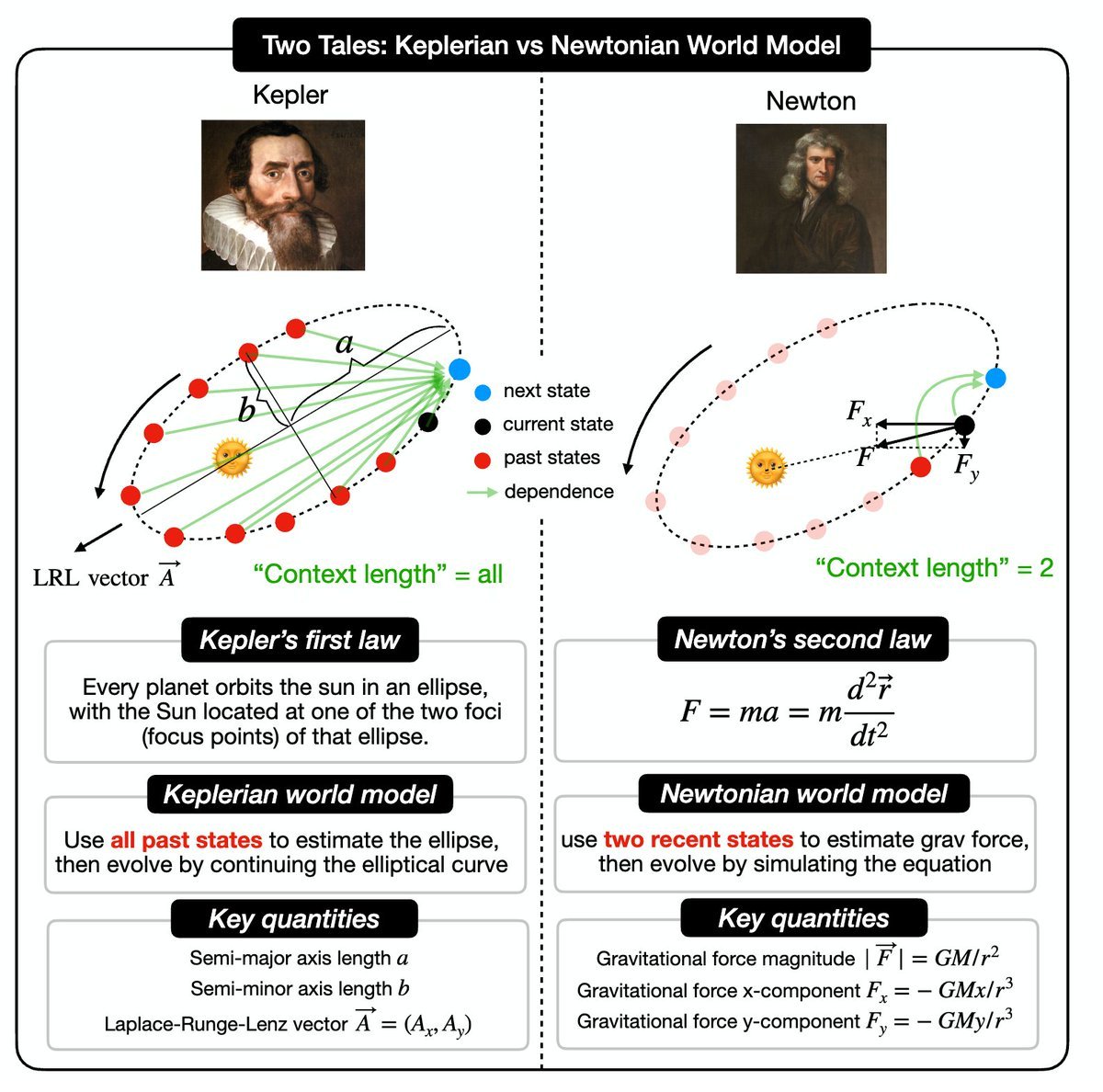
Our new paper "From Kepler to Newton: Inductive Biases Guide Learned World Models in Transformers" arxiv.org/abs/2602.06923 lead by @ZimingLiu11 w/ @naturecomputes @AToliasLab Prev work suggests transformers trained on planetary motion do not learn a world model. We fix this: Key ingredients in the fix: 1) promote spatial continuity in the learned tokenization of space 2) ensure noise robustness of future predictions With these two ingredients the transformer learns a Keplerian world model (Kepler's elliptical equations can be decoded from the transformer hidden states). 3) reduce the context length to 2. Then (and only then) is Newton's gravitational world model learned (Newton's force law can be decoded from transformer hidden states). See @ZimingLiu11's excellent thread for more details. x.com/ZimingLiu11/st…
Surya Ganguli tweet media
English
16
67
392
23.9K
Vivek Mohta retweetledi
Bret Taylor
Bret Taylor@btaylor·
AI is your ghostwriter, but you are the author. I was speaking with my friend Arya about the complex dynamics software teams face now that most code is being generated by AI agents. There are very few natural bottlenecks to code “slop” - features over quality, and functionality over polish. I have made a point of banning speaking about AI as the author of code. Codex/Claude didn’t write that code, just like your table saw didn’t cut the wood - you did, with the help of AI. If we start speaking about AI that way, we remove the accountability of the engineer for the quality of the system they are producing. Arya put it succinctly in a way that I hadn’t heard before: AI is your ghostwriter, but you are the author. It’s your name on the cover of the book. I think the next year of software engineering will be building out the tools that enable all of us to be proud to sign our name to and take accountability for the increasingly complex systems we produce with our agents.
English
23
21
268
43.9K
Vivek Mohta retweetledi
Alex Imas
Alex Imas@alexolegimas·
If you’re an economist, or any sort of social scientist, I’m not sure how you can look at the chart below and keep doing the same type of research you were a year ago.
Noam Brown@polynoamial

When GPT-5 was released, some folks claimed AI progress was hitting a wall, whereas others said progress would continue. GPT-5.2 was released 2 months ago. GPT-5.3-Codex was released 2 days ago and is twice as token efficient for coding. It's clear who turned out to be correct.

English
39
58
701
195.6K
Vivek Mohta retweetledi
Caleb Watney
Caleb Watney@calebwatney·
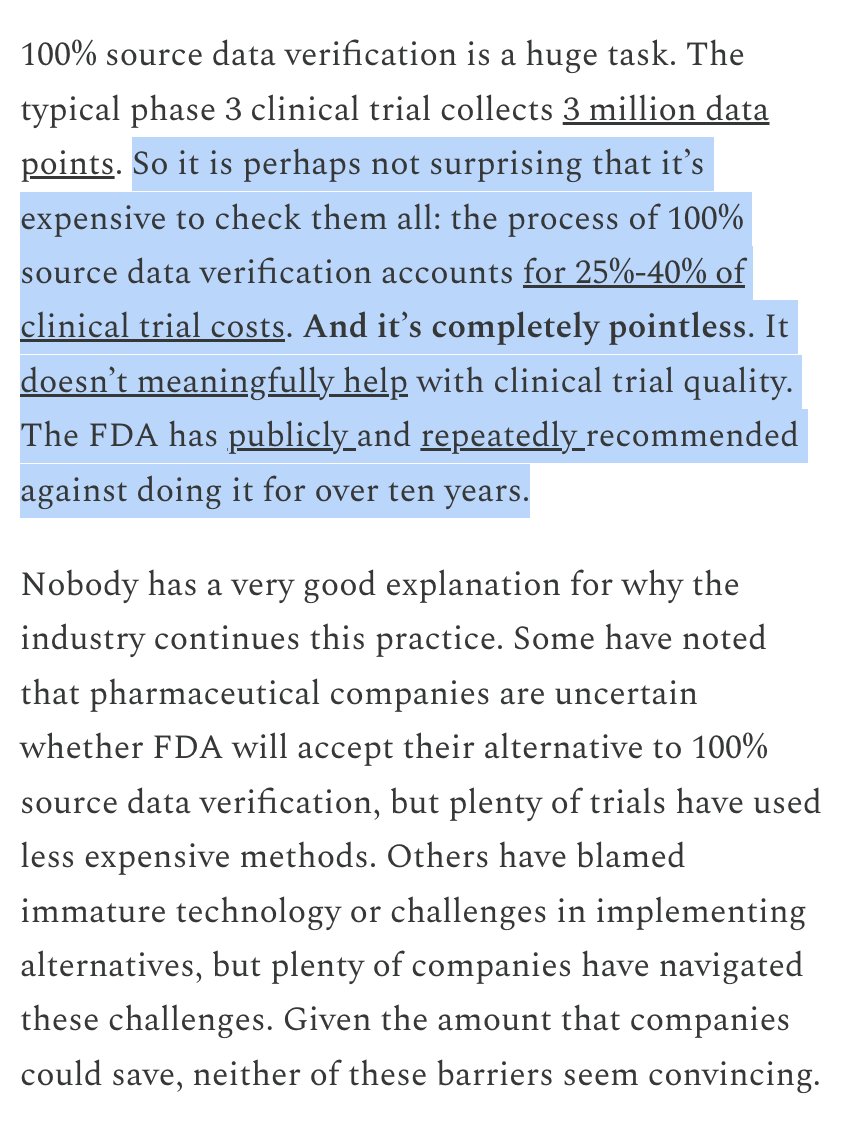
25-40% of clinical trial costs come from an excessive quality-check process that the FDA itself has recommended against for over a decade. Great piece from a former FDA official on why the whole system is stuck in a "too big to fail" loop. learninghealthadam.substack.com/p/why-clinical…
Caleb Watney tweet mediaCaleb Watney tweet media
English
12
94
510
50.1K
Vivek Mohta retweetledi
Derek Thompson
Derek Thompson@DKThomp·
for me the odds that AI is a bubble declined significantly in the last 3 weeks and the odds that we’re actually quite under-built for the necessary levels of inference/usage went significantly up in that period basically I think AI is going to become the home screen of a ludicrously high percentage of white collar workers in the next two years and parallel agents will be deployed in the battlefield of knowledge work at downright Soviet levels
English
249
355
4.6K
1.2M
Vivek Mohta retweetledi
Andrej Karpathy
Andrej Karpathy@karpathy·
A lot of people quote tweeted this as 1 year anniversary of vibe coding. Some retrospective - I've had a Twitter account for 17 years now (omg) and I still can't predict my tweet engagement basically at all. This was a shower of thoughts throwaway tweet that I just fired off without thinking but somehow it minted a fitting name at the right moment for something that a lot of people were feeling at the same time, so here we are: vibe coding is now mentioned on my Wikipedia as a major memetic "contribution" and even its article is longer. lol The one thing I'd add is that at the time, LLM capability was low enough that you'd mostly use vibe coding for fun throwaway projects, demos and explorations. It was good fun and it almost worked. Today (1 year later), programming via LLM agents is increasingly becoming a default workflow for professionals, except with more oversight and scrutiny. The goal is to claim the leverage from the use of agents but without any compromise on the quality of the software. Many people have tried to come up with a better name for this to differentiate it from vibe coding, personally my current favorite "agentic engineering": - "agentic" because the new default is that you are not writing the code directly 99% of the time, you are orchestrating agents who do and acting as oversight. - "engineering" to emphasize that there is an art & science and expertise to it. It's something you can learn and become better at, with its own depth of a different kind. In 2026, we're likely to see continued improvements on both the model layer and the new agent layer. I feel excited about the product of the two and another year of progress.
Andrej Karpathy@karpathy

There's a new kind of coding I call "vibe coding", where you fully give in to the vibes, embrace exponentials, and forget that the code even exists. It's possible because the LLMs (e.g. Cursor Composer w Sonnet) are getting too good. Also I just talk to Composer with SuperWhisper so I barely even touch the keyboard. I ask for the dumbest things like "decrease the padding on the sidebar by half" because I'm too lazy to find it. I "Accept All" always, I don't read the diffs anymore. When I get error messages I just copy paste them in with no comment, usually that fixes it. The code grows beyond my usual comprehension, I'd have to really read through it for a while. Sometimes the LLMs can't fix a bug so I just work around it or ask for random changes until it goes away. It's not too bad for throwaway weekend projects, but still quite amusing. I'm building a project or webapp, but it's not really coding - I just see stuff, say stuff, run stuff, and copy paste stuff, and it mostly works.

English
637
820
8.8K
1.2M
Vivek Mohta retweetledi
Quoc Le
Quoc Le@quocleix·
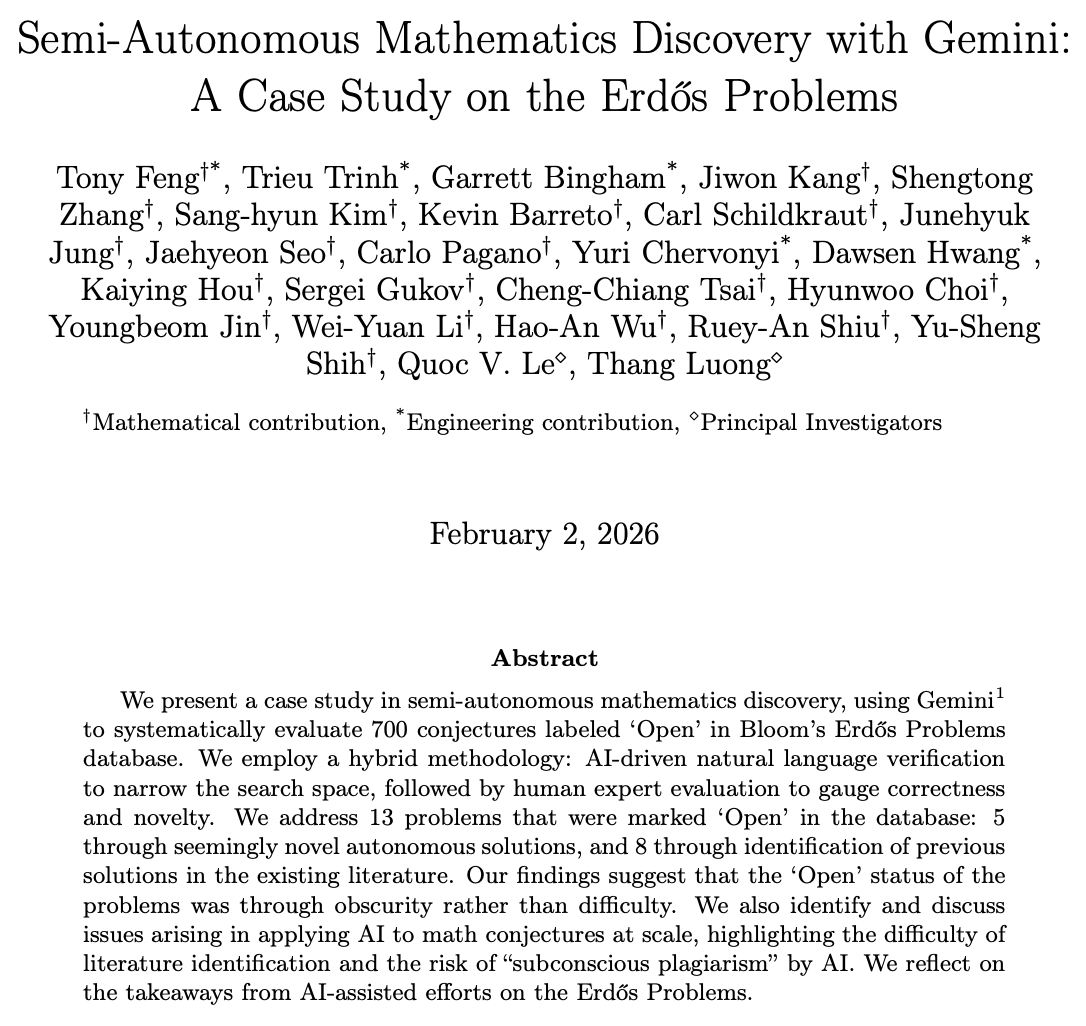
Excited to share our latest work: "Semi-Autonomous Mathematics Discovery with Gemini." We used Gemini to systematically evaluate 700 "open" conjectures in the Erdős Problems database. The result? We addressed 13 problems marked as open—finding 5 novel autonomous solutions and identifying 8 existing solutions missed by previous literature. Read the full case study here: arxiv.org/abs/2601.22401
Quoc Le tweet media
English
45
207
1.3K
246.1K
Vivek Mohta retweetledi
SpaceX
SpaceX@SpaceX·
SpaceX has acquired xAI, forming one of the most ambitious, vertically integrated innovation engines on (and off) Earth → #xai-joins-spacex" target="_blank" rel="nofollow noopener">spacex.com/updates#xai-jo…
SpaceX tweet media
English
3.9K
8.2K
45.8K
19.3M
Vivek Mohta retweetledi
Waymo
Waymo@Waymo·
The age of autonomous mobility at scale is here. Waymo has raised $16B to bring the world’s most trusted driver to more cities. ✅ $126B valuation ✅ 20M+ lifetime rides ✅ 90% reduction in serious injury crashes Read more from our co-CEOs: waymo.com/blog/2026/02/w…
English
73
100
675
197.3K
Vivek Mohta retweetledi
Eric Topol
Eric Topol@EricTopol·
The largest randomized trial of medical A.I. —Over 100,000 women in Sweden —radiologist + AI vs 2 radiologists, in follow-up —AI added led to 29% more cancer detected, 44% reduced workload, and —Less cancer dx in subsequent 2 years, and, when found, less aggressive thelancet.com/journals/lance…
Eric Topol tweet media
English
113
1.3K
6K
1.5M