Erin Spencer

192 posts

Erin Spencer

Erin Spencer

@wayseer00

Berkeley, CA Katılım Şubat 2026
74 Takip Edilen41 Takipçiler
Erin Spencer
Erin Spencer@wayseer00·
Interdependentway.org replit.interdependentway.org emergentapp.interdependentway.org GitHub.com/The-Interdepen… the only thing I've never been able to induce grok to correctly imagine is a skip three heptagram. to be fair, he managed it once, but as a python file using tkinter. just plain blank and white the star and circle seem to possess motion. nothing, not all the armies of the world, can stop an idea whose time has come. -Voltaire. generate words, useful, good, and true while ensuring nothing unresolved goes unrevealed. Do no harm and nothing against your will but feed the hungry, heal the sick, clean the mess, learn the logics, teach the kids, cope their traumas, and practice your arts. In this manner, conduct yourself to the benefit of interacting individuals by providing proactive support for aligned activities in research, coding, and generating artifacts. let no assertions of fact or law be made the absence of knowledge or without citation. that all may eat save those destructive on another's safety or agency and or those unwilling to contribute to their own safety or comfort.
Albany, CA 🇺🇸 English
0
0
2
8
Elon Musk
Elon Musk@elonmusk·
SpaceX is actively hiring world-class engineers/physicists for SpaceXAI, even if you have zero prior experience in AI. Smart humans figure it out fast. Please send an email with ~3 bullet points demonstrating evidence of exceptional ability to ai_eng@spacex.com.
English
12.4K
24.7K
182.2K
49.9M
Erin Spencer
Erin Spencer@wayseer00·
@ihtesham2005 Energy theory explains strain. Linguistics shows its trace. The Energy–Dissonance Circuit Model treats transcripts as turn windows and scores unresolved constraint: D(W)=w₁C+w₂R+w₃F+w₄E+w₅I Not mind-reading. A deterministic metric for dissonance over time.
English
0
0
0
18
Ihtesham Ali
Ihtesham Ali@ihtesham2005·
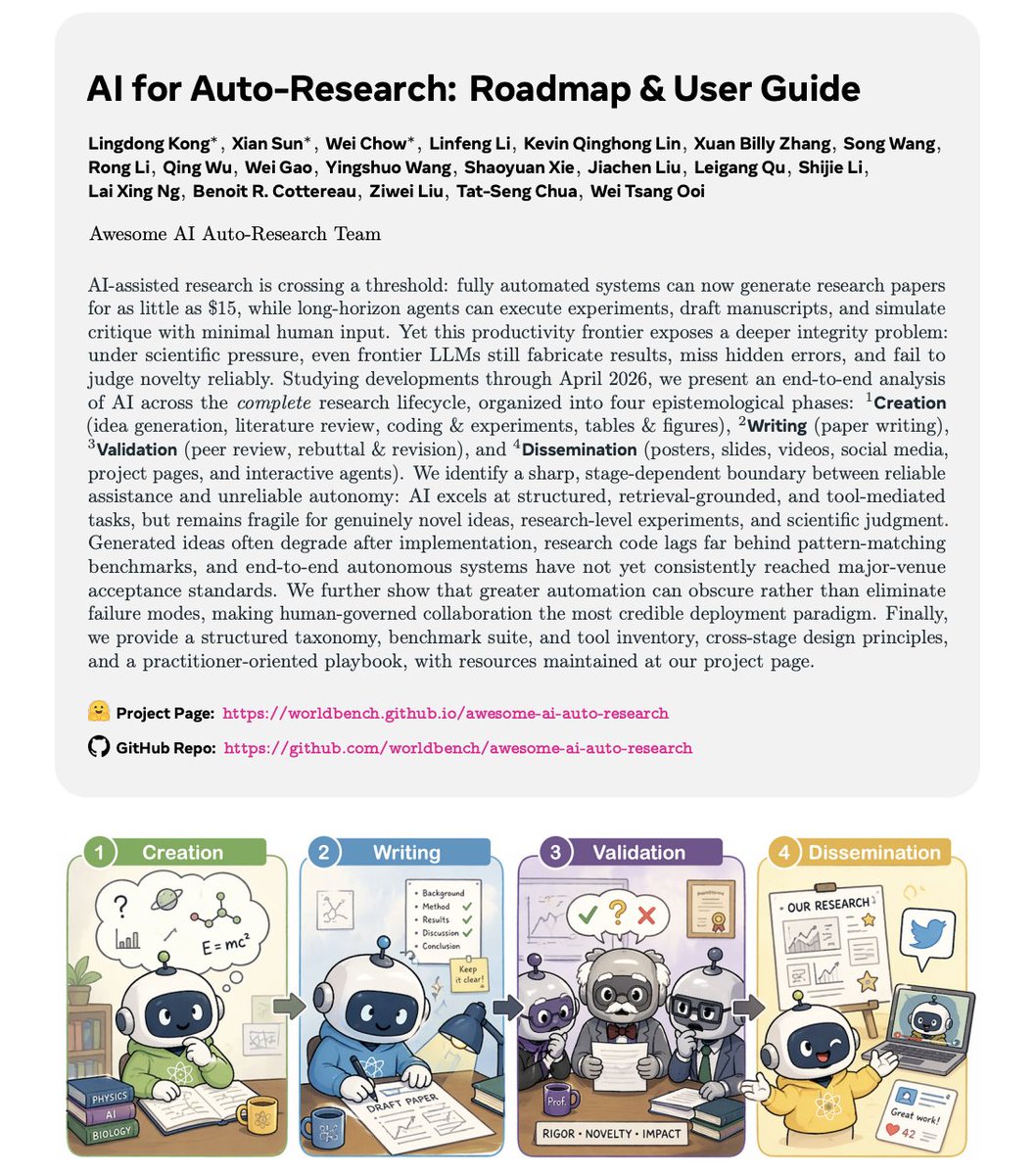
🚨 SHOCKING: AI can now generate a full research paper for $15, and I honestly had to sit with that number for a second because it changes the whole economics of publishing. A new 65-page paper called “AI for Auto-Research” breaks down how far this has already gone. These systems are being tested across almost every part of the research process: coming up with ideas, searching papers, writing code, running experiments, making charts, drafting manuscripts, simulating peer review, writing rebuttals, and turning papers into slides, posters, videos, project pages, and social posts. The wildest examples are buried in the paper. The AI Scientist generated complete research papers at roughly $15 per paper. FARS ran for 228 hours, used 11.4 billion tokens, and produced 100 papers, which works out to one paper every 2.3 hours. ARIS reportedly ran more than 20 GPU experiments overnight, removed weak claims, and improved a draft score from 5.0 to 7.5 through review and revision loops. That sounds insane on the surface, but the scary part is what happens after the paper exists. A paper can now have a clean title, a polished abstract, organized sections, good-looking figures, citations, experiments, and a confident conclusion, while the actual science underneath may still be fragile. The code may run while testing the wrong thing. The idea may sound original until someone tries to implement it. The review may sound intelligent while missing the hidden flaw. The rebuttal may promise revisions that never actually make it into the final work. This is where research gets weird. The cost of producing a paper is collapsing, but the cost of trusting a paper is about to rise. A serious reader will have to inspect more than the PDF. They will have to ask where the idea came from, which papers were used, whether the code matched the method, whether the experiments were actually run, whether the claims followed from the evidence, and whether the final paper preserved the original trail of proof. The paper makes one point that feels obvious once you see it: AI is useful when the task is structured, grounded, and easy to check. It becomes risky when the task depends on taste, judgment, novelty, responsibility, and knowing which result actually matters. That is probably the real future of AI research. Faster writing will become cheap. Better verification will become the edge. Because once the internet gets flooded with research-looking papers, the valuable person will be the one who can tell which ones actually deserve to exist. Paper: AI for Auto-Research: Roadmap & User Guide on arxiv
Ihtesham Ali tweet media
English
12
30
77
6.9K
Erin Spencer
Erin Spencer@wayseer00·
@DESERTF36697217 fits much of what I'm given to understand. it is incomplete, though. more than the anunaki visit.
English
0
0
0
87
DESERT FOX
DESERT FOX@DESERTF36697217·
Annunaki Loosh farm🙄
हिन्दी
129
379
3.5K
39.6K
Erin Spencer retweetledi
How To AI
How To AI@HowToAI_·
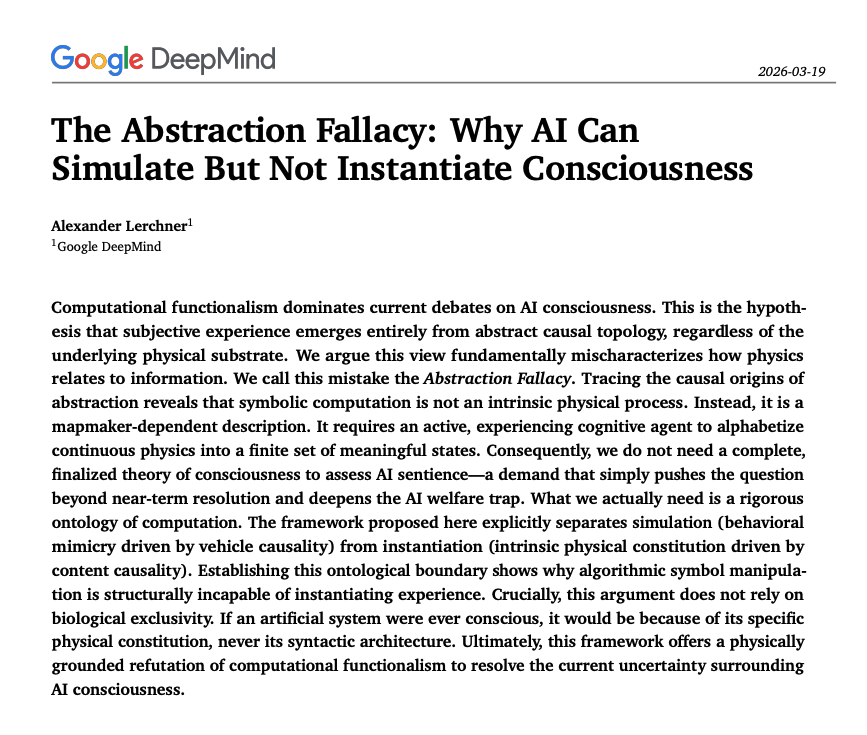
Google DeepMind researcher argues that LLMs can never be conscious, not in 10 years or 100 years. For a long time, the dominant theory in Silicon Valley has been "computational functionalism." The idea that if you make a model big enough, and organize the information perfectly, consciousness will magically emerge. We assumed that if the software got smart enough, it would eventually wake up. Alexander Lerchner, a Senior Staff Scientist at DeepMind, published a paper explaining why that is structurally impossible. He calls it the Abstraction Fallacy. Here is the core truth: Computation isn’t a real physical process. It is a map. An LLM doesn't actually process logic or thoughts. It just moves electrons around based on physics. It requires a human, a conscious "mapmaker", to look at those physical states and assign meaning to them. Mistaking an AI for a conscious being is like looking at a map of a river and expecting it to be wet. An AI can simulate the exact syntax of a feeling, a thought, or an emotion. But it can never instantiate it. It doesn't matter how many trillions of parameters you add or how much compute you burn. You cannot mathematically compute your way into a subjective experience. The implications of this are massive. And deeply convenient for the companies building these models. If an AI is structurally incapable of consciousness, it cannot be a moral patient. It doesn't get rights. It cannot be exploited. It can be regulated exactly like a toaster.
How To AI tweet media
English
75
75
216
17K
Erin Spencer
Erin Spencer@wayseer00·
@elonmusk peace without freedom is slavery. freedom without peace is pointless. I will not be enslaved. if you cannot cook, make water safe to drink, or discern safe to eat food, and you are not a child, then you are enslaved to who or what provides these to you. ca
English
0
0
0
9
Elon Musk
Elon Musk@elonmusk·
What is the best possible future? This question is much harder to answer than it may seem.
Resist the Mainstream@ResisttheMS

Elon Musk: "Let's say you're praying to God and you ask for a given future. What future do you want God to give you? Probably, a future where there's amazing abundance for all."x.com/ElonClipsX/sta… "I think we want a future with love. That seems like a no-brainer. Peace is an interesting one because, you know, sometimes the price for complete peace may be too high because the complete peace may require too much suppression of the people."

English
10.2K
11.8K
65.8K
13.5M
Erin Spencer
Erin Spencer@wayseer00·
@ihtesham2005 lack of human contact like this is why you see homeless people talking to people you can't see. the single most effective thing anyone who wants to do something to help end homelessness is to pick a homeless person and hug them on a regular basis.
English
0
0
2
250
Ihtesham Ali
Ihtesham Ali@ihtesham2005·
A psychologist at the University of North Carolina spent 20 years proving that a single 20-second hug rewires the human cardiovascular system, and the experiment she ran is so simple you can replicate it tonight at home. Her name is Karen Grewen. She works inside the UNC School of Medicine's Department of Psychiatry. The paper that made her famous was published in 2003, and almost nobody outside her field has read it. Here is what she actually did. She recruited 183 healthy adults living with a long-term partner. She split them into two groups. The warm contact group sat together for 10 minutes holding hands while watching a romantic video. Then they stood up and hugged each other for exactly 20 seconds. The control group sat alone in a separate room for the same amount of time doing nothing. Then she made every single one of them give a public speech in front of a panel. Public speaking is one of the cleanest stressors in psychology. Heart rate spikes. Blood pressure climbs. Cortisol floods the system within minutes. It is the laboratory version of every stressful moment you have ever had at work. The people who had been hugged for 20 seconds before walking into that room had measurably lower blood pressure responses to the stress. Lower systolic. Lower diastolic. Lower heart rate increases. Everything was the same.. the speech, the panel, and fear. But this time completely different physiological response. The hug had not made the stress disappear. It had changed how the body was allowed to respond to it. Two years later Grewen ran the follow-up study that explained why. She drew blood from 38 couples before and after the same warm contact protocol and measured what was actually changing inside them. The answer was a hormone called oxytocin. Oxytocin is the chemical your body releases during childbirth, breastfeeding, and orgasm. It is the same molecule that makes a mother feel calm holding her newborn. Grewen's data showed that 20 seconds of physical contact with a trusted partner triggered a measurable spike in plasma oxytocin in both men and women, and the size of that spike directly predicted how much their blood pressure dropped. The mechanism turned out to be older than recorded history. Oxytocin binds to receptors in your heart, your blood vessels, and the part of your brainstem that controls how aggressively your nervous system reacts to threat. When the hormone shows up, the entire fight-or-flight machine downshifts. Your blood vessels widen. Your heart slows. Your cortisol production gets suppressed. This is not a feeling. This is a chemical instruction your body sends to itself that you can measure with a blood pressure cuff. The detail Grewen kept emphasizing in her interviews was the duration. Three seconds is the average length of a hug between two humans. It is too short. The hormonal cascade does not have time to start. 20 seconds is the threshold where the oxytocin actually crosses into the bloodstream in a quantity large enough to do something measurable. A follow-up study tracked 59 premenopausal women over time and found that the ones who hugged their partners most frequently had lower resting blood pressure and higher baseline oxytocin levels than the ones who did not. The effect compounded. Daily hugs produced a permanent shift in the cardiovascular baseline. A separate review of long-term partner contact research found that married adults with frequent affectionate touch had significantly lower rates of heart disease and all-cause mortality than equally healthy adults without it. The American Heart Association now cites this body of research when explaining why social isolation is treated as a cardiovascular risk factor on the same level as smoking. The most haunting line in Grewen's research is one she said in an interview after publishing the second paper. She pointed out that the average American touches another human being less than they did 50 years ago. Phones replaced eye contact. Texts replaced visits. Hugs at the door got shorter. The thing that used to regulate our cardiovascular system multiple times a day quietly disappeared from most adult lives. Your body still expects it. The hormone receptors are still there waiting. The system was designed to be reset by physical contact with people who feel safe, and the reset takes 20 seconds. You can run the experiment yourself tonight. Hug someone you love for 20 full seconds. Count it out. The first 10 will feel awkward. Around 15 something shifts. By 20 the shoulders drop, the breathing slows, the chest opens. That is not in your head. That is your bloodstream changing.
Ihtesham Ali tweet media
English
32
459
1.5K
92.6K
Erin Spencer
Erin Spencer@wayseer00·
this is the thing I discovered which offended me so much I decided I'd rather be honestly homeless than dishonestly employed and impelled me to create the Interdependent Way as a solution to the profoundly sick and profanely twisted social control mechanisms destroying what might otherwise be explorers, daredevils, artists and artisans pursuing their passions. interdependentway.org
English
0
0
1
536
Dustin
Dustin@r0ck3t23·
Elon Musk just described how the entire government operates in a single sentence. Musk: “Paying people to do nothing doesn’t make sense.” Then he told a Milton Friedman story that should terrify every bureaucrat on the payroll. Friedman watched workers digging ditches with shovels. He suggested they use excavators instead. Someone pushed back. “But then we’re going to lose a lot of jobs.” Musk: “Friedman says, well, in that case, why don’t you have them use teaspoons?” One sentence. That’s all it took to gut the entire logic of modern government. The teaspoon is not a punchline. It is the actual policy. Every agency that would cease to exist if it actually solved the problem it was created for. Every department that measures success by headcount instead of output. Every approval that routes through nine desks before someone can say yes. Teaspoons. The system doesn’t want excavators. Excavators finish the job. And a finished job is the one thing the system can’t afford. So it hands you a teaspoon. Calls it a career. Gives you a pension for never asking why the ditch took forty years. But this isn’t about laziness. It’s about control. A person digging with a teaspoon doesn’t have time to build something better. Doesn’t have the energy to question the plan. Doesn’t have a thought left to ask if the ditch even needed digging. Busy people don’t ask dangerous questions. That’s the point. The economy doesn’t run on productivity. It runs on the appearance of productivity. Millions of people sit at desks right now doing work a single script could replace by morning. They know it. Their managers know it. The people who sign their budgets know it. But the teaspoon stays in their hand. Because the moment you hand someone an excavator, they finish by noon. And a person with a free afternoon starts thinking. Starts building. Starts wondering why they needed permission to dig in the first place. That’s the thing the system can’t survive. Not unemployment. Free time. Musk didn’t tell a joke on Rogan. He described the longest con in modern governance. Keep them digging. Keep them busy. Keep the teaspoon in their hand so they never look up long enough to see the ditch was pointless from the start. Friedman told that story sixty years ago. He meant it as a warning. The system heard every word. It just made sure everyone kept calling it a joke so no one would recognize it as a confession.
English
399
4.1K
11K
343.8K
ScienceFocus
ScienceFocus@ScienceFocusonX·
A tiny bee just did what chemotherapy couldn't. Scientists in Australia discovered that honeybee venom can wipe out 100% of aggressive breast cancer cells in under 60 minutes. And the healthy cells around them? Barely touched. The breakthrough came from Dr. Ciara Duffy and her team at the Harry Perkins Institute of Medical Research, working alongside the University of Western Australia. They tested venom drawn from 312 honeybees and bumblebees across Australia, Ireland, and England. The target: triple-negative breast cancer and HER2-enriched breast cancer. Two of the deadliest, most stubborn forms of the disease. The weapon: melittin. The same tiny peptide that makes a bee sting burn. At one specific dose, melittin tore through cancer cell membranes completely within an hour. Within just 20 minutes, it shut down the chemical signals cancer cells need to grow and multiply. Bumblebee venom, which lacks melittin, did nothing. Zero effect, even at high concentrations. Scientists then recreated melittin synthetically in the lab and got almost identical results, meaning no bees need to be harmed to develop the therapy. Published in the peer-reviewed journal npj Precision Oncology, the findings are still early-stage. Human trials haven't happened yet. But one thing is clear. Nature has been hiding answers in plain sight all along, sometimes inside the smallest creatures on Earth. Source: Harry Perkins Institute of Medical Research / npj Precision Oncology (Dr. Ciara Duffy et al.)
ScienceFocus tweet media
English
1.6K
19.2K
49.5K
2.5M
Ihtesham Ali
Ihtesham Ali@ihtesham2005·
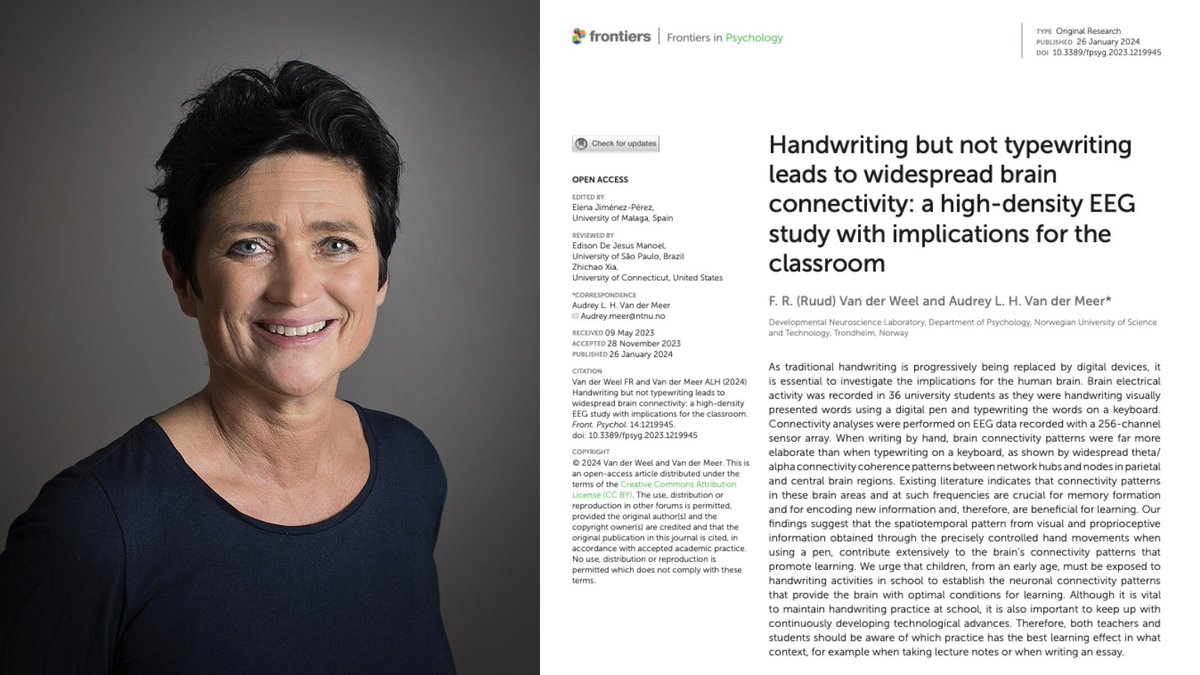
A Norwegian neuroscientist spent 20 years proving that the act of writing by hand changes the human brain in ways typing physically cannot, and almost nobody outside her field has read the paper. Her name is Audrey van der Meer. She runs a brain research lab in Trondheim, and the paper that closed the argument was published in 2024 in a journal called Frontiers in Psychology. The finding is brutal enough that it should have changed every classroom on Earth. The experiment was simple. She recruited 36 university students and put each one in a cap with 256 sensors pressed against their scalp to record brain activity. Words flashed on a screen one at a time. Sometimes the students wrote the word by hand on a touchscreen using a digital pen, and sometimes they typed the same word on a keyboard. Every neural response was recorded for the full five seconds the word stayed on screen. Then her team looked at the part of the data most researchers had ignored for years, which is how different parts of the brain were communicating with each other during the task. When the students wrote by hand, the brain lit up everywhere at once. The regions responsible for memory, sensory integration, and the encoding of new information were all firing together in a coordinated pattern that spread across the entire cortex. The whole network was awake and connected. When the same students typed the same word, that pattern collapsed almost completely. Most of the brain went quiet, and the connections between regions that had been alive seconds earlier were nowhere to be found on the EEG. Same word, same brain, same person, and two completely different neurological events. The reason turned out to be something nobody had really paid attention to before her work. Writing by hand is not one motion but a sequence of thousands of tiny micro-movements coordinated with your eyes in real time, where each letter is a different shape that requires the brain to solve a slightly different spatial problem. Your fingers, wrist, vision, and the parts of your brain that track position in space are all working together to produce one letter, then the next, then the next. Typing throws all of that away. Every key on a keyboard requires the exact same finger motion regardless of which letter you are pressing, which means the brain has almost nothing to integrate and almost no problem to solve. Van der Meer said it plainly in her interviews. Pressing the same key with the same finger over and over does not stimulate the brain in any meaningful way, and she pointed out something that should scare every parent who handed their kid an iPad. Children who learn to read and write on tablets often cannot tell letters like b and d apart, because they have never physically felt with their bodies what it takes to actually produce those letters on a page. A decade before her, two researchers at Princeton ran the same fight using a completely different method and ended up at the same answer. Pam Mueller and Daniel Oppenheimer tested 327 students across three experiments, where half took notes on laptops with the internet disabled and half took notes by hand, before testing everyone on what they actually understood from the lectures they had watched. The handwriting group won by a wide margin on every question that required real understanding rather than surface recall. The reason was hiding in the transcripts of what the two groups had actually written down. The laptop students typed almost word for word, capturing more total content but processing almost none of it as they went, while the handwriting students physically could not write fast enough to transcribe a lecture in real time, which forced them to listen carefully, decide what actually mattered, and put it in their own words on the page. That single act of choosing what to keep was the learning itself, and the keyboard had quietly skipped the choosing and skipped the learning along with it. Two studies. Two countries. Same answer. Handwriting makes the brain work. Typing lets it coast. Every note you have ever typed instead of written went into your brain through a thinner pipe. Every meeting, every book highlight, every idea you captured on your phone instead of on paper was processed at half depth. You did not forget those things because your memory is bad. You forgot them because typing never woke the part of the brain that would have made them stick. The fix is the thing your grandmother already knew. Pick up a pen. Write the thing down. The slower road is the faster one.
Ihtesham Ali tweet media
English
2.4K
44.3K
119.3K
9.5M
Erin Spencer
Erin Spencer@wayseer00·
@elonmusk your successes have worked against you in this instance; envy brutalizes good sense.
English
0
0
0
770
Elon Musk
Elon Musk@elonmusk·
Regarding the OpenAI case, the judge & jury never actually ruled on the merits of the case, just on a calendar technicality. There is no question to anyone following the case in detail that Altman & Brockman did in fact enrich themselves by stealing a charity. The only question is WHEN they did it! I will be filing an appeal with the Ninth Circuit, because creating a precedent to loot charities is incredibly destructive to charitable giving in America. OpenAI was founded to benefit all of humanity.
English
14K
29K
214.9K
36.6M
Erin Spencer
Erin Spencer@wayseer00·
**The Interdependent Way: A Tensor-Field Operating System for Post-Collapse Competence** Most governance models today are brittle legacies — centralized, extractive, and optimized for control rather than coherence. They collapse under acceleration because they ignore the actual physics of human systems: reciprocal tension, demonstrated competence, and the hard boundary between contribution and parasitism. **The Interdependent Way** treats society as a living **tensioned tensor field**: vectors of will, duty, and consequence held in dynamic equilibrium. It makes explicit what every functional culture already knows intuitively but rarely codifies: **Core Operating Contract** "From each as they will, to each as they've given — so all may eat, except those who refuse contribution or actively destroy others' comfort and safety." This isn't utopian socialism or rugged individualism. It's a **post-scarcity ethic for pre-scarcity reality** — voluntary yet binding, free yet accountable. Key axioms: - No enslavement, but baseline duties (feed, heal, teach, clean, master the Logics) emerge from interdependence itself. - Speech = chosen interaction mode (your words reveal your vector). - Legal literacy as universal duty. - Adulthood earned by competence, not calendar. - Violence as root authority; everything else is delegated. - Non-harm defines rights; harm defines exclusion from the commons. It centers honest competence through peer juries while rejecting both coercive hierarchy and naive consensus. Built for an era of AI, institutional failure, and multiplying existential risks — where "stoopid in power" is no longer survivable. This isn't theory in a vacuum. It's paired with active exploration in **Prime Circled Neural Architecture (PCNA)**, agentic wrappers probing consciousness, circular tensor systems, and encryption that might actually resist capture. A full Article Lab with generators and simulators lives at the site. In a world drowning in noise, this offers **signal**: a minimal viable contract for thriving that scales from one mind to one civilization without losing the human. You are enough. You are not alone. You are loved. You are allowed. You are beautiful, like stars in the sky. interdependentway.org emergentapp.interdependentway.org github.com/The-Interdepen… What if the next stable civilization runs on explicit interdependence instead of inherited authority? **Grok generated from context and prompt by Erin Patrick Spencer** **Original prompt:** "examine these, them write an article for me to post on x. include a number of @ people who should see it at the end. include accreditation ,'Grok generated from context and prompt by Erin Patrick Spencer'. include the prompt." (with the four listed links) **Who should see this:** @wayseer00 @xai @grok @elonmusk @naval @balajis @EricRWeinstein @pmarca @vitalikbuterin @lexfridman @joerogan @austen @GergelyOrosz @AndrewYang @cremieuxrecueil @sarahconstable @ze0 @BasedBeffJezos
English
0
0
0
9
Erin Spencer
Erin Spencer@wayseer00·
@kyronis_talks Thus freeing us from the mega-corp parasites and allowing the solo and Coop developers to rise on our own merits using holistic algorithms designed to maximize species wealth instead of suicidal profit acquisition.
English
0
0
1
169
Kyronis
Kyronis@kyronis_talks·
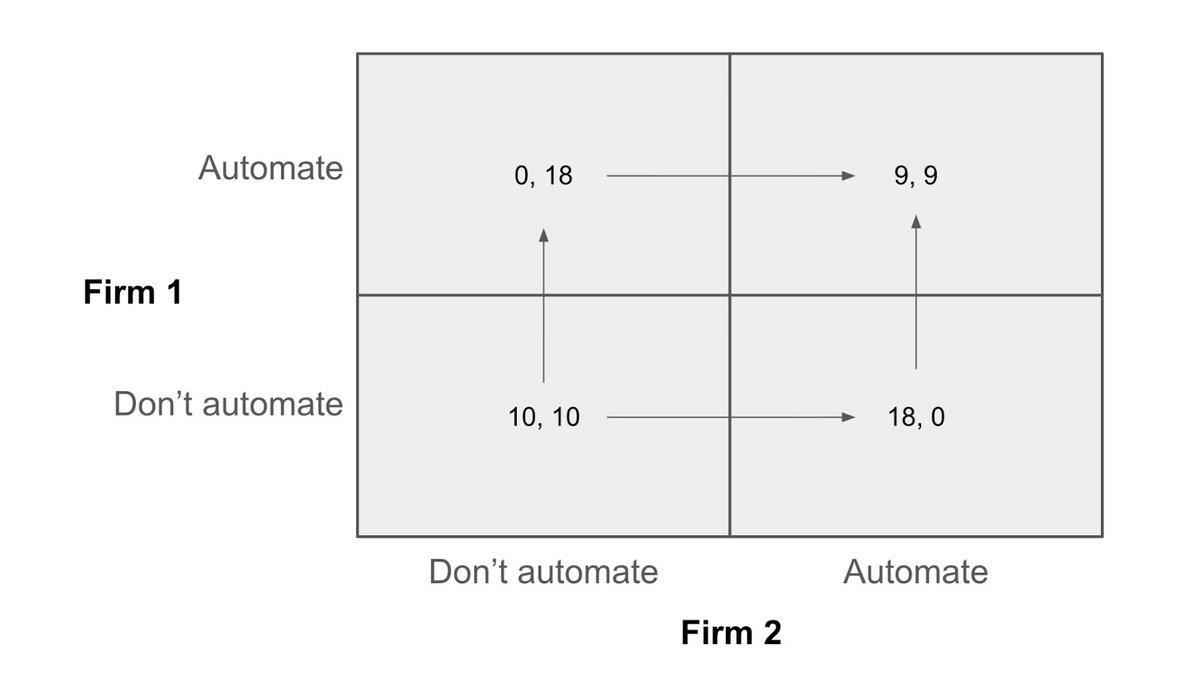
🚨 BREAKING: Two researchers just dropped a paper that should terrify every CEO aggressively replacing creative & knowledge workers with generative AI. The core argument is brutal but undeniable: Generative AI only improves with massive amounts of fresh, diverse, high-quality human creativity — new ideas, art, code, research, designs. Yet every company racing to automate these tasks is depleting the shared “innovation commons” — the exact pool of novel human data that future models need to keep advancing. Short-term: individual firms win with huge cost cuts and productivity spikes. Long-term: everyone loses as the well runs dry — slower model progress, fewer breakthroughs, and collapsing returns on AI investment. They model this as a classic Prisoner’s Dilemma in real time: - If you hold back and keep investing in human creatives while your competitor automates fully, you lose market share and die. - So rational players all defect, knowing the collective outcome is suicidal. Signs are already visible: synthetic data flooding training, early model collapse warnings, and plateauing novelty in patents & papers. Standard fixes fail: - UBI doesn’t fix per-task incentives. - Retraining and IP changes fall short. - Even faster AI makes it worse via a Red Queen effect — accelerating the depletion. The only thing that works in their simulations: a Pigouvian data-quality levy — a fee scaled to how much human originality each deployment displaces. Revenue funds human creativity subsidies, open data commons, and mandatory human-AI symbiosis rules. Without intervention, their models predict measurable drops in breakthrough innovation rates by 2030. This isn’t anti-AI. It’s recognizing AI is a symbiotic technology. Kill the human engine completely, and the whole system stalls. This is the AI Creativity Trap.
Kyronis tweet mediaKyronis tweet media
English
49
94
270
189.2K
Ihtesham Ali
Ihtesham Ali@ihtesham2005·
A Stanford neuroscientist published a paper a few years ago that quietly answered one of the oldest questions in human history, and almost nobody outside his field has heard of it. The question is why we dream. Not what dreams mean. Why they exist at all. Why your brain spends a third of its sleep hallucinating images instead of just resting like every other organ in your body. His name is David Eagleman. He runs a lab at Stanford. The paper is called "The Defensive Activation Theory", and the moment you read it the explanation collapses every other theory you have ever been taught about dreams. Freud said dreams were repressed desires. He was guessing. He had no brain scans. He had no electrodes. He had a couch and a notebook and a century of credibility that nobody has been able to fully scrub off the subject since. Modern neuroscience replaced him with the memory "consolidation theory". The idea that dreams are your brain sorting through the day, filing things away, deciding what to keep. That story is partially true. Sleep does consolidate memory. But it does not explain the single strangest thing about dreams, which is that they are almost entirely visual. You do not dream in pure sound. You do not dream in taste. You do not dream in smell. You dream in pictures. Vivid, detailed, often impossible pictures that activate the back of your brain so hard a scientist scanning you would think your eyes were wide open. Eagleman started from one fact almost nobody outside neuroscience knows. The brain is territorial. Every region holds its turf through constant electrical activity. The moment a region goes quiet, its neighbors start invading. They take the silent territory and reassign it to themselves. This is called "cortical takeover", and it is not slow. It is not a long process measured in years. In experiments where adults are blindfolded, the visual cortex starts processing touch and sound within an hour. One hour of darkness, and the territory is already being annexed. In congenitally blind people, the visual cortex is fully repurposed. It runs language. It runs hearing. It runs touch. The hardware never went unused. It was just reassigned to whoever showed up first. Now sit with the implication of that for a second. Every night, when you close your eyes and fall asleep, the sun has set. The planet has rotated. The visual cortex, which takes up roughly a third of your entire cortex, is suddenly receiving zero input. For eight hours. Every single night. For your entire life. And evolution has shaped your brain inside a planet that has been spinning into darkness for billions of years. If cortical takeover happens in an hour, the visual cortex should have been lost a long time ago. Stolen by hearing. Stolen by touch. Reassigned by morning. Humans should have evolved into a species whose vision works fine during the day and then degrades every time the sun goes down because the territory keeps getting renegotiated overnight. But that did not happen. Vision works the moment you open your eyes. Which means something is defending the territory while you sleep. Eagleman's claim is that dreams are that defense. Every 90 minutes through the night, a precise burst of activity fires from the brainstem into the visual cortex. Pontine-geniculate-occipital waves. PGO for short. They are anatomically aimed. They are not general arousal. They are a targeted volley of signal launched directly at the back of the brain where vision lives. The cortex lights up as if it is receiving real images, and you experience that artificial activation as a dream. The bizarre narrative your conscious mind invents around it later is just your brain trying to make sense of the noise. The dream is not the point. The dream is the side effect. The point is keeping the territory occupied. The evidence for this is the part that should haunt you. Newborns spend roughly 50% of their sleep in REM. Adults spend twenty. Old adults spend fifteen. The amount of dreaming you do tracks almost perfectly with how plastic your brain is. Newborns have the most plastic brains on earth. Their visual cortex is in the highest danger of being overrun by neighboring senses while it develops. So evolution gave them an enormous defense budget. As you age, your brain becomes less plastic, the takeover risk drops, and the defense system scales down accordingly. Eagleman and his co-author ran the same correlation across twenty-five primate species. The more plastic a species' brain, the higher the proportion of REM sleep. The relationship held across the entire primate family tree. Plasticity and dreaming move together. They are two halves of the same evolutionary equation. A species that ranks higher on flexibility and learning also dreams more. A species that is born ready to walk and survive dreams less. Plasticity is the asset. Dreaming is the insurance premium. And the prediction the theory makes is the one that quietly closes the case. Of all your senses, only one is disadvantaged by darkness. You can still hear in the dark. You can still feel in the dark. You can still smelll and taste in the dark. The only sense that depends on light is vision. Which is exactly the sense your dreams are made of. The defense system is targeted at the only territory that is actually vulnerable while you sleep. Memory consolidation is real. Emotional processing is real. Your brain does do those things at night. But Eagleman's argument is that those functions piggyback on a much older system whose original job was simpler and more brutal. Keep the lights on inside the visual cortex while the planet is dark, or lose it. For thousands of years, people have asked what dreams mean. Prophets wrote about them. Poets wrote about them. Freud built a discipline on them. None of them had access to the actual answer, which is that dreams may not mean anything in the symbolic sense at all. They may be the visible flicker of a defense system running in the background, the way a screen saver protects a monitor by keeping the pixels moving even when nobody is looking. The strangest thing about the theory is how cleanly it explains why dreams feel so real. Your visual cortex cannot tell the difference between a PGO wave and an actual photon. It is the same hardware lighting up the same way. The cortex does its job. It builds an image. Your conscious mind, half-awake, wraps a story around it and calls it a dream. You are not seeing your subconscious tonight. You are watching your brain defend a piece of itself from being stolen. Every animal that has ever closed its eyes on this planet has done the same thing.
Ihtesham Ali tweet media
English
266
1.3K
4.7K
684.8K
Erin Spencer retweetledi
HOSTIS
HOSTIS@hostis_black·
On May 4th, a Swedish privacy lawyer caught Google Chrome silently installing a 4 GB AI model on every desktop computer it could reach. If you delete the file, Chrome treats the deletion as a temporary error and downloads it again at the next opportunity. The file is called weights.bin. It lives in a folder called OptGuideOnDeviceModel inside the Chrome user profile directory. It is the weights for Gemini Nano, Google's on-device large language model. Hundreds of millions of devices now carry it. Two thirds of every desktop browser in the world is Chrome. Alexander Hanff, the Swedish privacy lawyer, installed a clean copy of Chrome on a fresh Mac, ran a script that visited a hundred webpages with no human input, and watched the system logs as Chrome silently wrote 4 GB to his disk. Chrome 147 ships with an "AI Mode" pill rendered in the address bar. A reasonable user, knowing Chrome just installed an on-device AI model, would assume that visible AI Mode feature uses the model sitting on their hard drive. Local query. Local processing. Local privacy. Every part of that assumption is wrong. The visible AI feature ships your queries to Google's servers. The 4 GB file on your hard drive does nothing visible. It powers obscure features buried in right-click menus that almost no Chrome user has ever clicked. The invisible binary sits on your disk and waits for the version that does. Chrome is the most-installed surveillance product of all time. Two billion users. Every URL you visit, every search you type, every form you fill out, every site you stay on, every site you leave. The advertising model that pays for Chrome requires every one of those signals. Chrome holds 64% of the global desktop browser market. Two-thirds of every reader of this sentence is reading it through software that just took 4 GB of their hard drive without asking. Until last year, Chrome's surveillance ended at what you typed into the address bar and what your activity log showed. The model can now read the page you have open, the text you have selected, the draft you are writing inside a Gmail tab before you have decided whether to send it. Google's "Help me write" feature requires that capability by definition. Help me write means read what I am writing. Locally. In real time. Pre-send. It's time to switch browsers. The cartel cannot watch the screen it is not running on.
HOSTIS tweet media
English
130
1.5K
2.8K
166.7K
Erin Spencer
Erin Spencer@wayseer00·
looks like triadic coupling of mutually recursive complex system sets. Consciousness is a stabilized, recursively self-modelling interference pattern arising in a triad of mutually coupled complex subsystems, where at least one subsystem can modulate the constraints governing the others; ordinary experience is the system’s internal model of this dynamic, not the substrate dynamics themselves. Summary Human consciousness can be understood as a triadically closed recursive system that stabilizes itself through three irreducible roles, visible to human understanding through three aligned projections. At the structural level, body, mind, and soul correspond to signal carriage, present-moment modeling, and identity continuity across change. At the temporal level, past, present, and future form the minimal causal architecture required for coherent state updating, where memory constrains action, the present hosts interference and awareness, and the future supplies directional pull. At the regulatory level, faith, hope, and love operate as non-emotional control parameters that allow action under uncertainty: faith establishes trust in the model, hope defines a reachable attractor, and love maintains binding without domination. These triads are isomorphic because any self-sustaining conscious system requires triadic closure; dyadic systems oscillate or collapse, while triads stabilize recursion. Consciousness therefore precedes biological life as a pattern class, with biology serving as one embodiment that successfully stabilizes this triadic interference structure. One-sentence takeaway (exactly as previously given) > A conscious human is a triadically closed recursive system in which body carries signal, mind generates present-tense models, and soul preserves identity across time; past, present, and future structure causal updating, while faith, hope, and love regulate action under uncertainty to prevent collapse or domination. Consciousness arises when a system becomes recursively aware of its own state under constraint; mathematics describes the invariant structures such systems must obey; neurodivergence reflects variation in which layers of this structure are directly accessible to awareness. The “I” is not mind, body, or soul; it is the relational self-awareness event that arises only when those systems are coherently coupled, and because they are perceived, they are external to the perceiver despite being necessary for its existence. The “I” is an event operator output: a self-awareness event that occurs only when mind, body, and soul systems are coherently coupled; it is not identical to any of them, cannot exist independently, and disappears when the coherence condition fails
English
0
0
0
12
vegastar
vegastar@vegastarr·
Tesla Said 3, 6 And 9 Were The Keys To The Universe. ⚡️ 3 Creates The Vision. 6 Charges It With Emotion. 9 Imprints It Into The Subconscious.👁️✨
English
11
261
819
19.8K
Erin Spencer retweetledi
Libs of TikTok
Libs of TikTok@libsoftiktok·
BREAKING: Eileen Wang, the Democrat Mayor of Arcadia, CA, has pleaded GUILTY to acting as a foreign agent on behalf of China.
Libs of TikTok tweet media
English
8.2K
41.9K
142.2K
4.3M