Constantine Yurevich

189 posts

Constantine Yurevich banner
Constantine Yurevich

Constantine Yurevich

@weird_ceo

✻ Combabulating... Apply for https://t.co/HqgRXL4CKy research preview Founder @ SegmentStream - AI-native marketing measurement infrastructure.

Katılım Şubat 2010
386 Takip Edilen188 Takipçiler
Constantine Yurevich
Constantine Yurevich@weird_ceo·
SegmentSteam AI-native marketing infrastructure is integrated with all other marketing tools you use. Check our integrations list. - Web analytics / product analytcs / app analytcs - Ad platforms - CRM platforms - Call tracking - Data warehouses - AI platforms - Shopify / Stripe .. and many more
Pavel Petrinich@pavel_petrinich

We've added a SegmentStream Integrations page ✅ We used it as a chance to explain how we actually think about integrations, and why we build them in the first place. Four principles we kept coming back to 👇

English
1
0
2
21
Marc Benioff
Marc Benioff@Benioff·
Welcome Salesforce Headless 360: No Browser Required! Our API is the UI. Entire Salesforce & Agentforce & Slack platforms are now exposed as APIs, MCP, & CLI. All AI agents can access data, workflows, and tasks directly in Slack, Voice, or anywhere else with Salesforce Headless 360. Faster builds, agentic everything. 🚀 #Salesforce #Agentforce #AI venturebeat.com/ai/salesforce-…
English
321
615
5.6K
4.2M
Slack
Slack@SlackHQ·
AI agents are everywhere. But if they live in isolated browser tabs, disconnected from where your team actually works, they're just expensive toys. Slack is changing that. Here's what we're shipping for developers 👇
English
33
43
836
217.5K
Nicolas Sharp
Nicolas Sharp@nicolasosharp·
We built Attio to be the context layer at the center of your GTM stack, and now that context becomes available everywhere you work. Today we're launching native connections for @Attio in @Claude, @ChatGPT, and @Notion. Research prospects, update records, surface deal insights, and connect with other AI tools, all from wherever you're already working. Learn more: attio.xyz/connect-attio
English
13
6
104
14.1K
OpenAI
OpenAI@OpenAI·
Codex for (almost) everything. It can now use apps on your Mac, connect to more of your tools, create images, learn from previous actions, remember how you like to work, and take on ongoing and repeatable tasks.
English
795
1.4K
13.9K
2.8M
Constantine Yurevich retweetledi
Claude
Claude@claudeai·
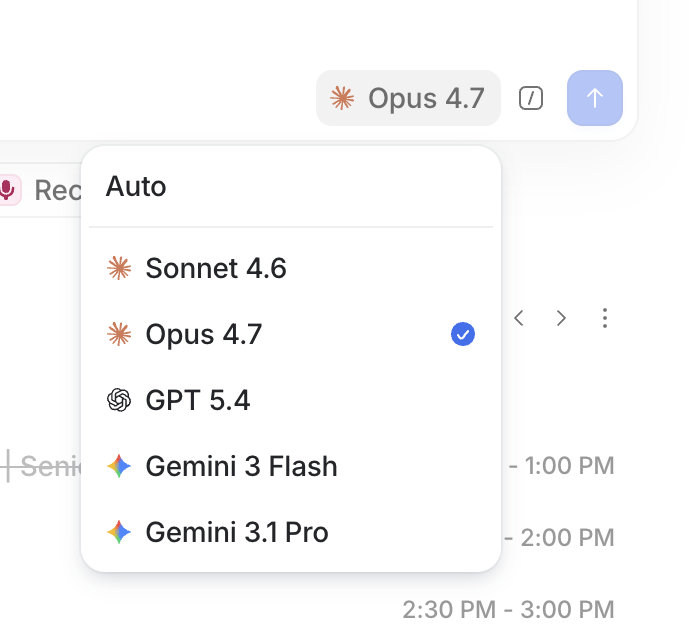
Introducing Claude Opus 4.7, our most capable Opus model yet. It handles long-running tasks with more rigor, follows instructions more precisely, and verifies its own outputs before reporting back. You can hand off your hardest work with less supervision.
Claude tweet media
English
4.6K
10.3K
80.5K
12.5M
Constantine Yurevich
Constantine Yurevich@weird_ceo·
First-click attribution is probably the smartest attribution model you can use right now. Yes, the one most "sophisticated" marketers dismissed years ago as too simplistic. Here's the logic most people miss: incrementality measures whether a conversion would happen without marketing. The most incremental touchpoint is the one that introduced the user. That touchpoint is the first click. Every other rule-based model has a hidden bias toward re-engagement channels. Last-click rewards retargeting that was going to convert anyway. Algorithmic MTA is a black box trained on the platform's own data. Post-view attribution lets Facebook, Google, and TikTok claim the same conversion simultaneously. Fun fact: Facebook shortened their post-view attribution window from 28 days to 1 day. Not because 1 day is more accurate. Because a 7-day window would attribute nearly everything to social. I wrote probably the most detailed piece I've ever done on this topic. It covers why the entire measurement architecture is designed to over-credit bottom-funnel channels, and what you can actually do about it. Link in the first comment. Curious what attribution setup you're currently running.
Constantine Yurevich tweet media
English
1
0
0
18
Constantine Yurevich
Constantine Yurevich@weird_ceo·
Great move @HeyGen! People don’t want to use browsers and UIs — they want bring more capabilities to their AI Agents. Few understand this yet but those who understand already started moving from UX (User Experience) to AX (Agentic Experience).
HeyGen@HeyGen

Your AI agent can now generate and ship videos. HeyGen CLI is now live. Run one command and your agent handles it all: script → avatar creation → video → delivery All from the terminal. Just your agent and the CLI. RT + Comment “CLI” and we’ll DM API credits (must follow)

English
0
0
0
73
Constantine Yurevich
Constantine Yurevich@weird_ceo·
What is like about @OpenAI Codex is that it is reconnecting MCPs for each session. Yes, it takes time, but you always get fresh MCP handshake with all updated tools and descriptions. Compared to @claudeai which caches MCP descriptions and never updates it. @bcherny can we expect proper MCP cache updates anytime soon? 😉
English
0
0
0
53
Constantine Yurevich
Constantine Yurevich@weird_ceo·
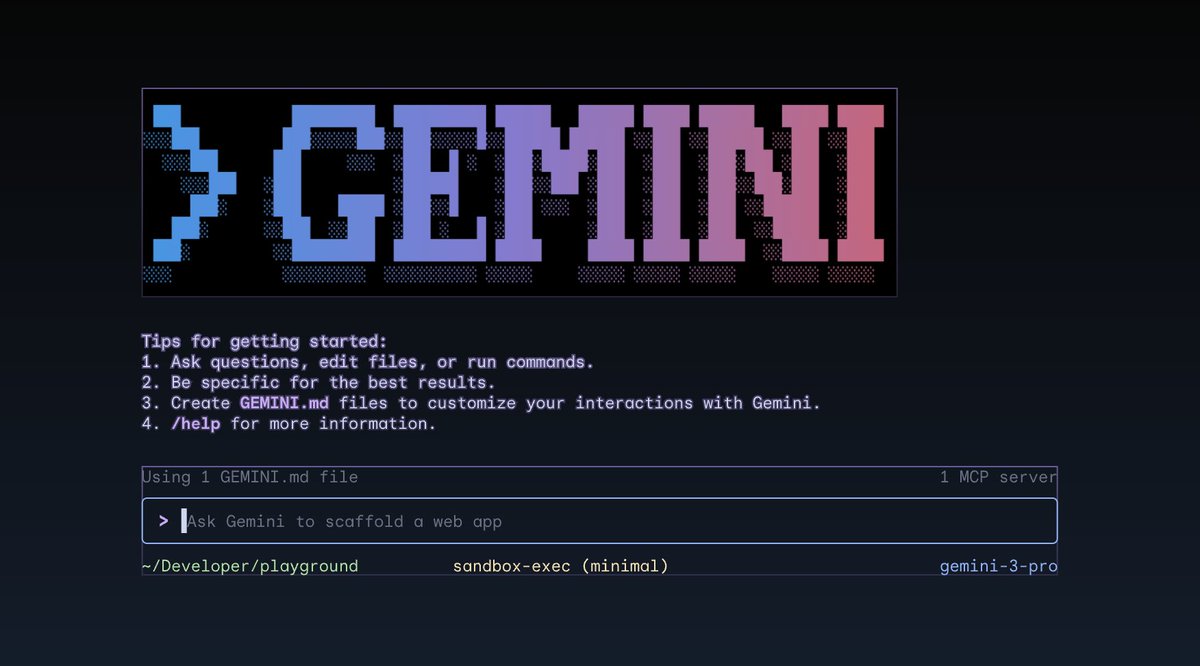
Currently works in: Claude Code, Claude Desktop, Cursor, Windsurf, ChatGPT, Codex, Gemini CLI. Gemini CLI: free, open source, installs in 2 minutes. Add our MCP server and you're running attribution queries from your terminal. segmentstream.ai
English
0
0
0
117
Constantine Yurevich
Constantine Yurevich@weird_ceo·
We've never built an integration with Gemini. Or Claude. Or Cursor. Or ChatGPT. Or Windsurf. SegmentStream works in all of them. One MCP server. Every AI tool that speaks the Model Context Protocol gets the same measurement engine. Attribution, campaign analysis, optimization recommendations. Same capabilities everywhere. We didn't plan for Gemini CLI support. But because we built on an open standard instead of locking into one AI vendor, it just worked. Here's why this matters beyond the technical elegance: Gemini CLI is free. Any Google account. 1,000 requests a day. No subscription needed. You don't need Claude Pro or ChatGPT Plus to have an AI-powered marketing analyst. If you have a Google account (you do), you can connect SegmentStream right now and start querying your attribution data from the terminal. This is what MCP-native means. Not "we have an API." Not "here's a chatbot in your dashboard." Your AI becomes your marketing analyst. Whichever AI you already use. The list keeps growing without us writing a single line of code.
Constantine Yurevich tweet media
English
3
0
2
110
Constantine Yurevich
Constantine Yurevich@weird_ceo·
@garrytan It should be thin enough but the same time smart enough so that you don't need "fat skills" :) It's all about the design.
English
0
0
0
342
Garry Tan
Garry Tan@garrytan·
This is the simplest distillation of what I have learned about agentic engineering this year Push smart fuzzy operations humans do into markdown skills. Fat skills. Push must-be-perfect deterministic operations into code. Fat code. The harness? Keep it thin.
Garry Tan tweet media
English
105
211
2.8K
213.4K
Constantine Yurevich
Constantine Yurevich@weird_ceo·
I stopped writing code 8 years ago. Moved into product, sales, strategy, fundraising. The usual founder path. Three months ago I came back into engineering. And I saw something I don't think I would have seen if I'd never left. Most teams building AI products are building for the wrong user. They add an AI chat to their dashboard. Put a copilot next to their UI. Treat the agent as an assistant to the human experience. But the actual end user of your product is no longer a human. It's an agent. @johnmaeda at Microsoft just published his Design in Tech Report 2026 with a simple title: "From UX to AX." Agentic Experience. His argument: agents will browse, click, and decide on our behalf. Traditional UI design is ending. Agents are becoming the primary users of digital services. This isn't theory for me. This is what we're building at segmentstream.ai right now. When we rebuilt our marketing measurement platform around MCP, the first instinct was to expose our tools and let the agent call them. That's what everyone does. 40 API endpoints, good descriptions, done. It doesn't work. An agent with 40 tools and no guidance is like handing someone a toolbox and telling them to build a house. They pick up a hammer, hit something, ask what to do next. What an agent needs is not tools. It's a harness. If you've used Claude Code, you've experienced this difference. Raw Claude and Claude Code run on the same model. Same brain. The difference is the harness: the system that manages context, sequences actions, recovers from errors, and guides the model through complex work without stopping to ask you every 30 seconds. We're building the same thing for marketing measurement. Our MCP isn't a collection of endpoints. It's a remote harness that guides continuous agent experience. The metric we optimize for isn't DAU or time on page. It's how many steps the agent can take to solve the user's problem without needing the user at all. @AnthropicAI recently published research showing that 68% of production agents complete 10 or fewer steps before needing human intervention. That's the current bar. Every step you add beyond that is a step closer to the agent being genuinely useful. Today our harness handles analytics questions, data source onboarding, warehouse connections, attribution reports. Continuously, without the user needing to understand any of it. But that's not where this ends. Here's what I think is actually happening. Three things are converging right now. LLMs are getting better at sustained reasoning and tool use with every generation. MCP is becoming the universal protocol for how agents talk to services. And the harness layer is quietly emerging as where real product differentiation lives. The UI is not disappearing. But it's changing roles. It's becoming a governance layer. A place where humans monitor, set boundaries, and intervene when needed. Not where the work happens. The metric shift from "engagement" to "autonomy" will be as significant as the shift from "page views" to "conversions" in the early 2010s. We'll measure products by how much an agent can accomplish without asking for help. For marketing, the path is concrete. Today: autonomous analytics and reporting. Tomorrow: autonomous budget recommendations. After that: autonomous media buying and optimization. Not because models will suddenly get smarter. Because harnesses will get better. Each layer of domain knowledge encoded into the orchestration brings the agent one step closer to operating independently. The companies that define the next era won't be the ones with the best dashboards. They'll be the ones that build the best harness for their domain. And the irony is that my 8 years away from building software might be the best preparation for building this. No muscle memory for settings pages and navigation bars. No instinct to design a UI when the user is an agent. Just a clean question: what does the agent need to do its job? In this transition, beginner's mindset isn't a disadvantage. It might be the only way to see what's actually changing. If you're building for agents, not just with them, I'd love to hear what you're learning.
Constantine Yurevich tweet media
English
0
0
0
36
Constantine Yurevich
Constantine Yurevich@weird_ceo·
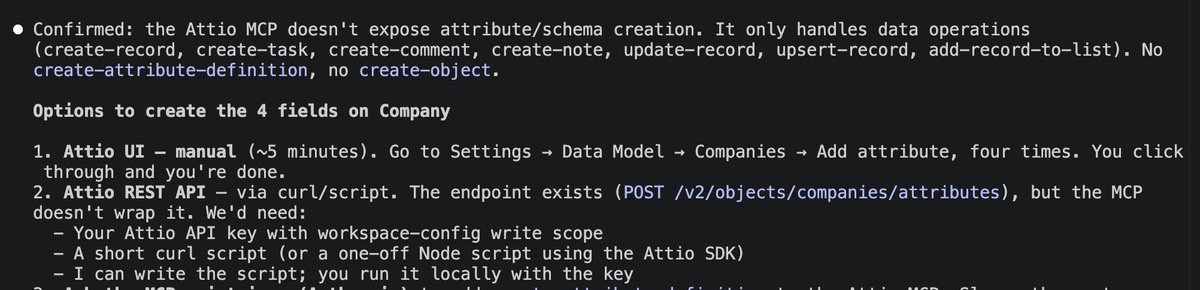
@nicolasosharp do you have plans to add update/remove tools to MCP anytime soon? Agents are already capable enough to take care of sales ops in our company :) but still can't fully access @attio
English
0
0
0
40