WPS - We Protect our Seas

863 posts

WPS - We Protect our Seas banner
WPS - We Protect our Seas

WPS - We Protect our Seas

@wps_ph

A non-government, nonprofit, and nonpartisan volunteer-based organization that seeks to advance principled approaches to resolving disputes in the West PH Sea.

Katılım Nisan 2025
74 Takip Edilen256 Takipçiler
Sabitlenmiş Tweet
WPS - We Protect our Seas
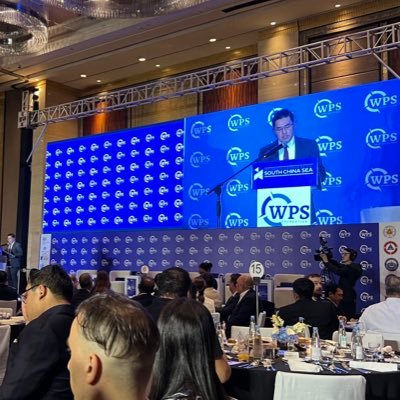
The second iteration of The Manila Dialogue on the South China Sea took place last Nov. 5-7. Convening over 270 maritime experts and practitioners, government officials, academics and other thought leaders from at least 25 countries, the dialogue has become one of the largest South China Sea conferences in the world. At the dialogue, participants debated issues, pitched ideas, and offered recommendations to ensure that the rule of law, not coercion and the use of force, prevails in the South China Sea. Check out the agenda and video recording, here: scsdialogue.org
English

3
2
7
777
WPS - We Protect our Seas retweetledi
Jeffrey Ordaniel
Jeffrey Ordaniel@JeffreyOrdaniel·
Code for: “Set aside your rights under UNCLOS and let me take your oil, gas, and fishery resources in peace.” As former Foreign Secretary Albert del Rosario once said, talks with China on this will always end the same way—with 🇨🇳Beijing essentially telling 🇵🇭Manila: “What is mine is mine. What is yours is also mine—but I am willing to share.” Theft packaged as “joint development.”
GMA Integrated News@gmanews

READ: The Chinese Embassy in the Philippines issued a statement on the possibility of a joint oil and gas exploration. “As long as the Philippine side demonstrates sincerity, China’s door to dialogue and cooperation will remain open,” part of the statement said. | via @jpsoriano

English
0
5
4
250
WPS - We Protect our Seas retweetledi
Jeffrey Ordaniel
Jeffrey Ordaniel@JeffreyOrdaniel·
Reassuring. Marcos should never follow Arroyo’s secret deals. Note that the previous 🇵🇭exploration deal with 🇨🇳 (circa 2005), which allowed Beijing to survey Reed Bank and even some areas within PH EEZ that lie outside the nine-dash line, contained the following provision: “This Agreement and all relevant documents, information, data and reports with respect to the joint marine seismic undertaking shall be kept confidential during the Agreement Term and within five (5) years after its expiration and shall not be disclosed by a Party to any third party without the written consent of the other Party.”
Tristan Nodalo@TristanNodalo

“WALA PO SIYANG SECRET DEAL” WATCH: Communications Undersecretary Claire Castro says any move to revive joint oil and gas talks with China will be transparent, assuring the public there will be no secret agreements. "Sa lahat ng pagkakataon, sa lahat ng okasyon, ang Pilipinas ay laging sincere sa pakikipag-usap, pakikipagnegosasyon lalung-lalo na sa pamumuno po ni Pangulong Marcos Jr. Wala po siyang secret deal," said Castro. @newswatchplusph

English
0
6
23
1.1K
WPS - We Protect our Seas retweetledi
Jeffrey Ordaniel
Jeffrey Ordaniel@JeffreyOrdaniel·
It’s bizarre how joint exploration with China is being framed as one of the solutions to the Iran War-driven energy crisis in 🇵🇭. How does “joint exploration with China” solve the problem? Even if a deal were signed tomorrow, no oil flows next week, no gas lowers prices next month. Kowtowing to China now and accommodating its illegal claims will not deliver fuel to Filipinos. It will only cause Marcos to commit an impeachable offense, give 🇨🇳 more leverage to coerce 🇵🇭 in the future, and still do nothing to address the current crisis.
Tristan Nodalo@TristanNodalo

MIDDLE EAST CONFLICT MAY DRIVE PH, CHINA JOINT OIL AND GAS TALKS IN THE SOUTH CHINA SEA President Bongbong Marcos says the Middle East conflict could push the Philippines and China to revisit joint oil and gas exploration in the South China Sea. In an interview with Bloomberg, Marcos says shifting geopolitical dynamics may prompt a recalibration of ties, while stressing that peace and national interest remain the country’s guiding principles. @newswatchplusph

English
12
17
61
2.8K
WPS - We Protect our Seas retweetledi
Jeffrey Ordaniel
Jeffrey Ordaniel@JeffreyOrdaniel·
Lots of discussion in Manila today about potentially restarting “joint exploration” talks with the 🇨🇳PRC in the South China Sea. Mostly hype. Unlikely to happen. We’re hosting a National Symposium on the Law of the Sea and the West Philippine Sea next week to help clarify these issues—and more 👇🏼
WPS - We Protect our Seas@wps_ph

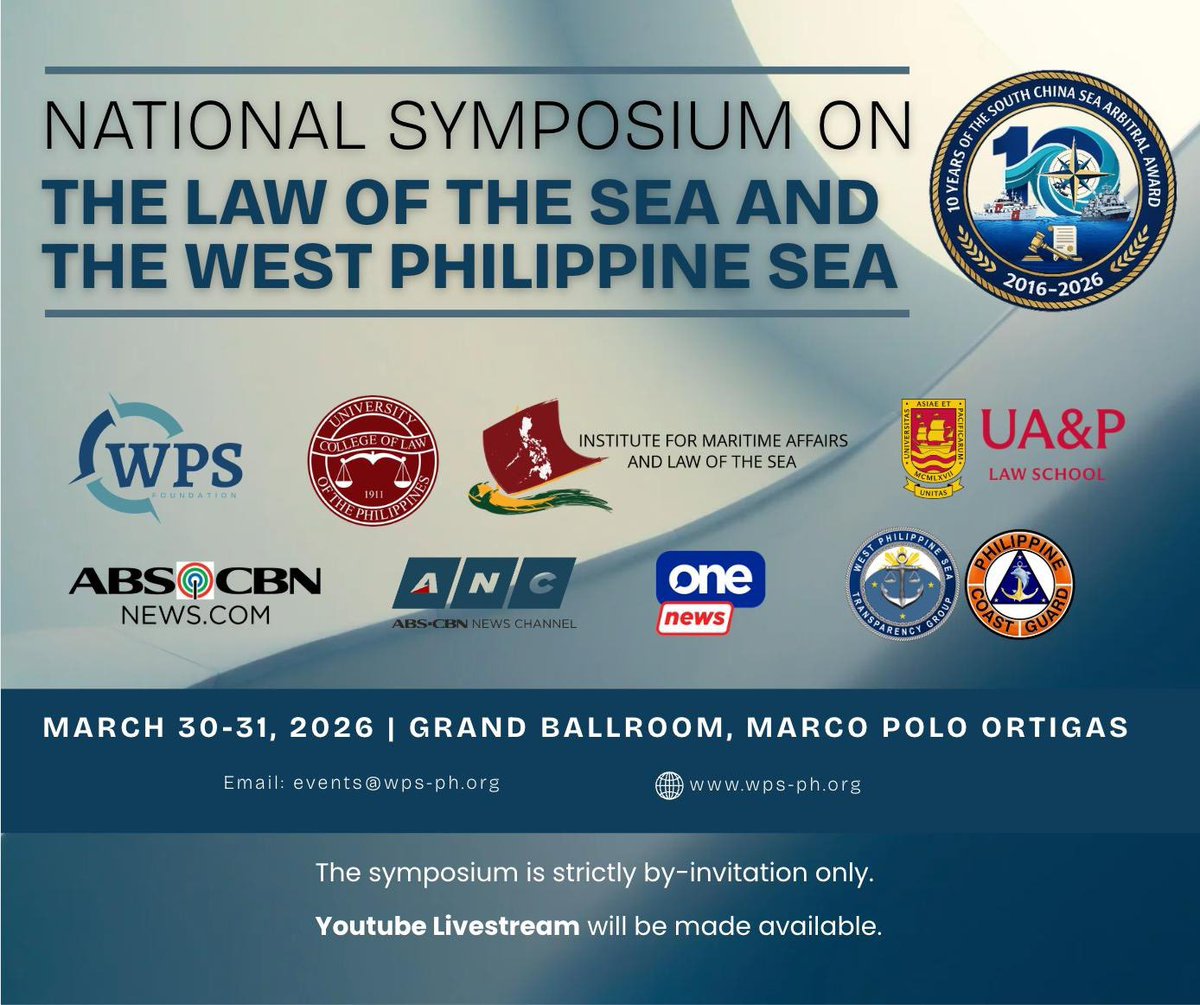
🇵🇭National Symposium on the Law of the Sea and the West Philippine Sea🇵🇭, happening on March 30-31 at the Marco Polo Ortigas. In partnership with UA&P School of Law, the @Official_UPD College of Law, @ABSCBNNews, @onenewsph and @PIADesk. Catch the conversations on YouTube, live! @wpstransparency @jaytaryela @IvanAtHome @nscphilippines @coastguardph @ConstantKC @JeffreyOrdaniel

English
2
5
20
1.8K
WPS - We Protect our Seas retweetledi
Frances Mangosing 🇵🇭
My first for Stratbase. A quick look at how China uses its united front strategy to engage overseas Chinese in the Philippines…There’s clearly still a lot more to study on this topic. adrinstitute.org/wp-content/upl…
English
1
10
23
1.7K
WPS - We Protect our Seas retweetledi
Inquirer
Inquirer@inquirerdotnet·
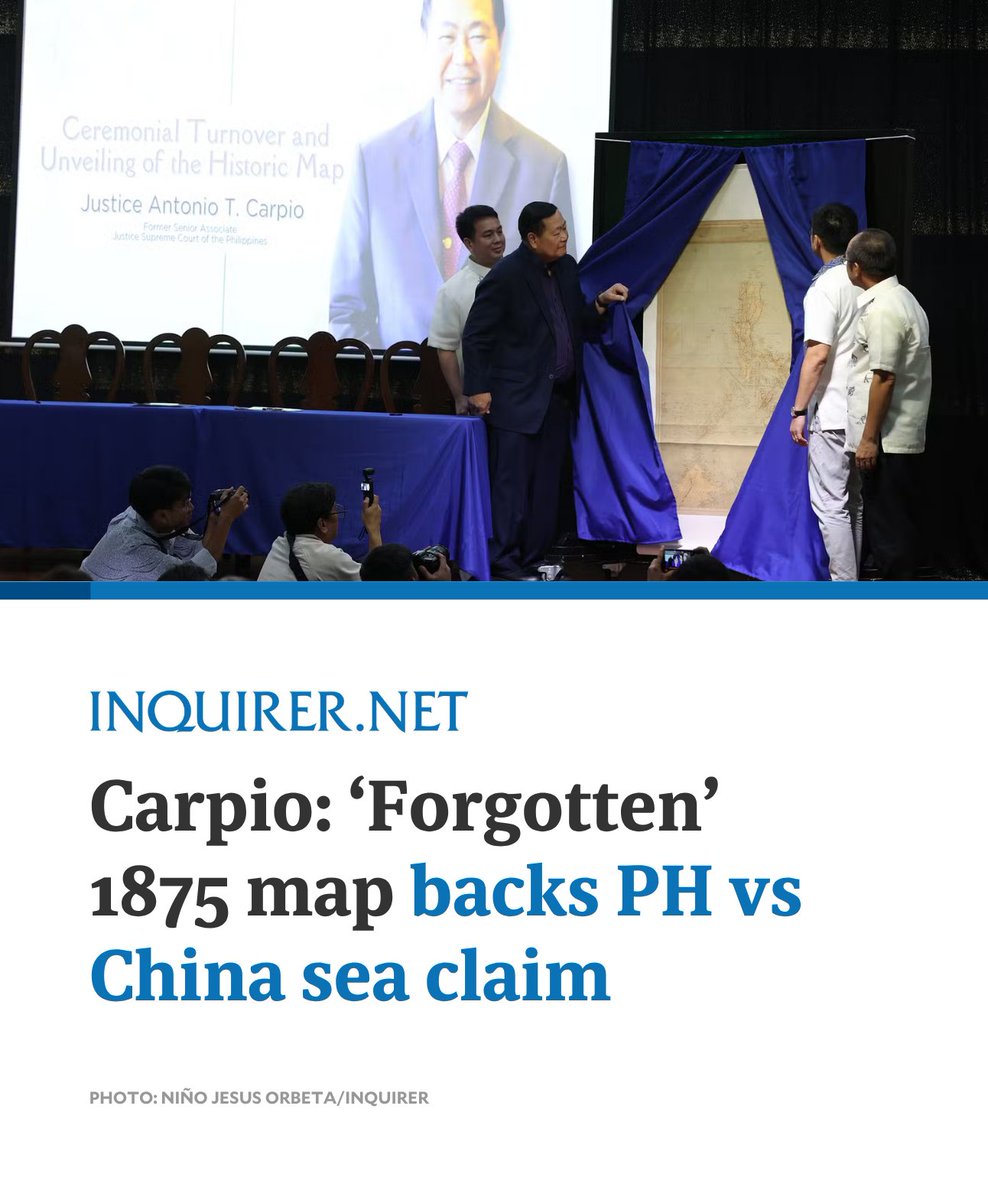
There is a “forgotten” map dating back to the Spanish colonial era and adopted during the American period that Filipinos need to rediscover. The map, the “1875 Carta General del Archipielago Filipino,” is another “answer” that can disprove China’s claim that it has historical rights over these islands and maritime features, former Supreme Court Senior Associate Justice Antonio Carpio said. READ MORE: inqnews.net/Forgotten1875M…
Inquirer tweet media
English
20
269
1.1K
26.5K
WPS - We Protect our Seas retweetledi
Nguyen Thi hong
Nguyen Thi hong@NguyenThih36·
"Intimidation" barely scratches the surface here! China takes advantage of low visibility to swarm the Filipino waters, then operate in very close proximity to Filipino vessels & eventually seclude the Filipino ships from its convoy. Making it an easy prey for the Chinese goons.
English
19
204
467
10.5K
WPS - We Protect our Seas
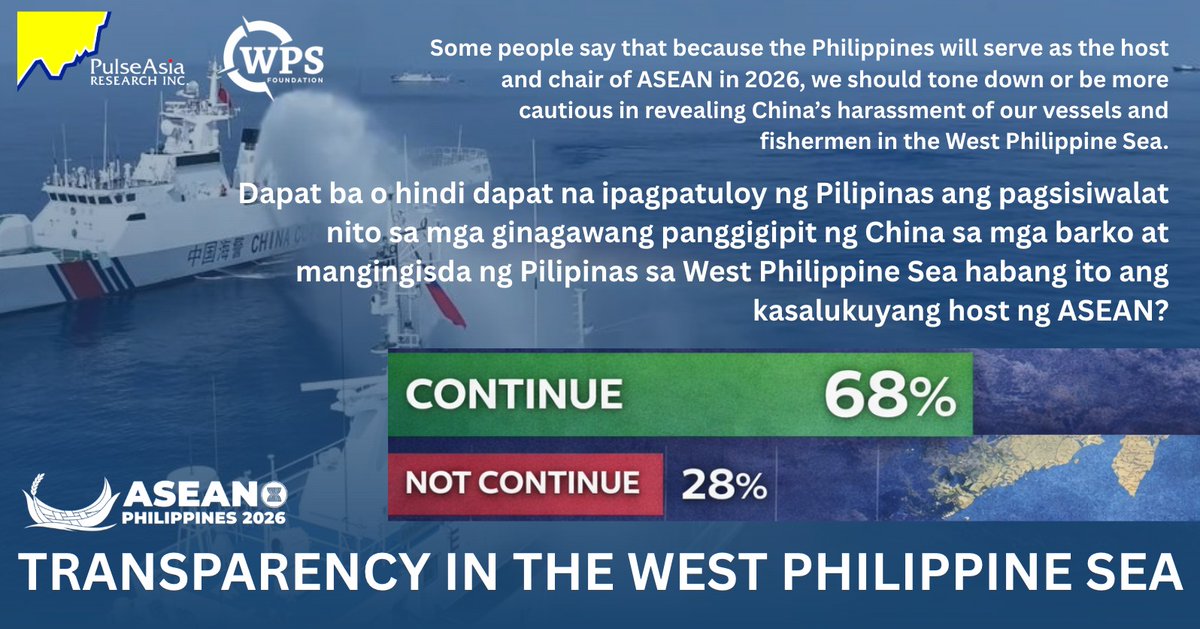
[Pulse Asia Survey] Some people say that because the Philippines will serve as the host and chair of ASEAN in 2026, we should tone down or be more cautious in revealing China’s harassment of our vessels and fishermen in the West Philippine Sea. In your opinion, should the Philippines continue or not continue disclosing China’s coercive actions against Philippine ships and fishermen in the West Philippine Sea while it is currently hosting the ASEAN? Sabi ng ilan, dahil Pilipinas ang Host at Chair ng ASEAN sa 2026, ay dapat maghinayhinay tayo sa pagsiwalat ng mga panggigipit ng China sa ating mga barko at mangingisda sa West Philippine Sea. Sa tingin ninyo, dapat ba o hindi dapat na ipagpatuloy ng Pilipinas ang pagsisiwalat nito sa mga ginagawang panggigipit ng China sa mga barko at mangingisda ng Pilipinas sa West Philippine Sea habang ito ang kasalukuyang host ng ASEAN? #WestPhilippineSea #WPS #ASEAN
WPS - We Protect our Seas tweet media
English
0
0
2
137
WPS - We Protect our Seas
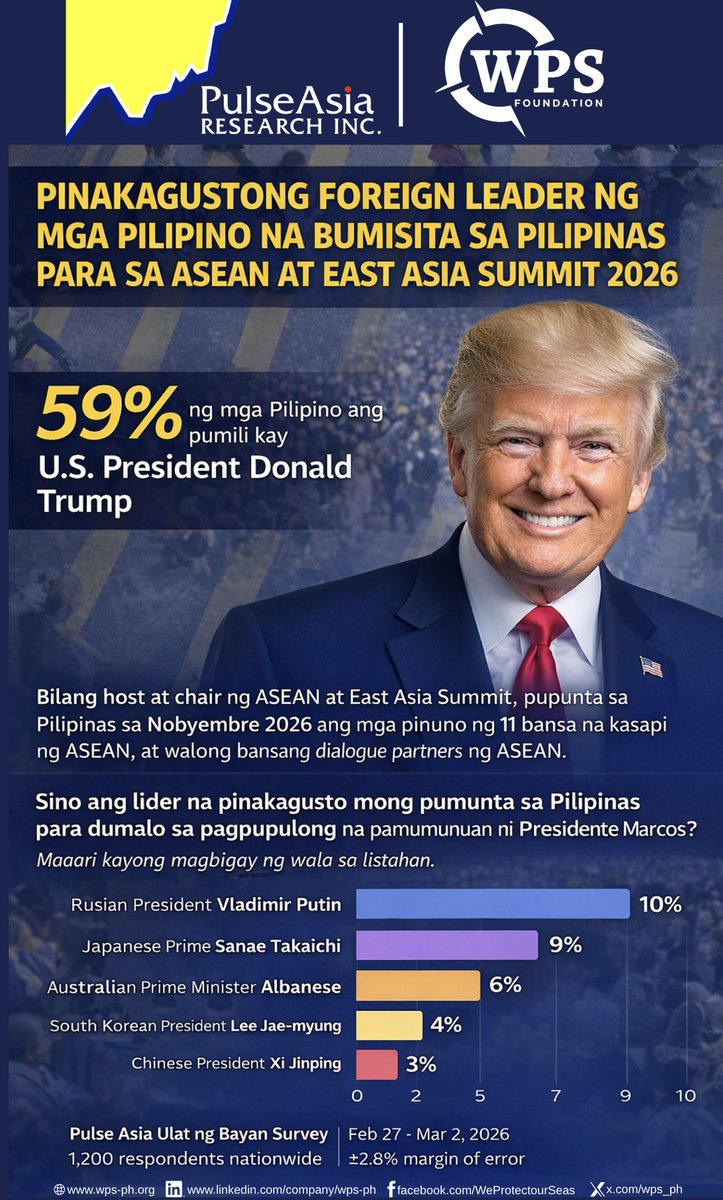
A majority of Filipinos say they want U.S. President Donald Trump to visit the Philippines for the 2026 ASEAN and East Asia Summits. In a Pulse Asia Ulat ng Bayan Survey (Feb 27–Mar 2, 2026) of 1,200 respondents nationwide, 59% selected Trump as the foreign leader they most want to see attend the meetings that will be chaired by President Ferdinand Marcos Jr.. Other leaders mentioned include: • Vladimir Putin – 10% • Sanae Takaichi – 9% • Anthony Albanese – 6% • Lee Jae-myung – 4% • Xi Jinping – 3% Margin of error: ±2.8% Notably, only 3% chose Xi Jinping, reflecting the persistently low level of public trust toward China amid continuing tensions and coercive activities in the West Philippine Sea. #WestPhilippineSea #ASEAN #WPS
WPS - We Protect our Seas tweet media
English
0
0
2
102
WPS - We Protect our Seas
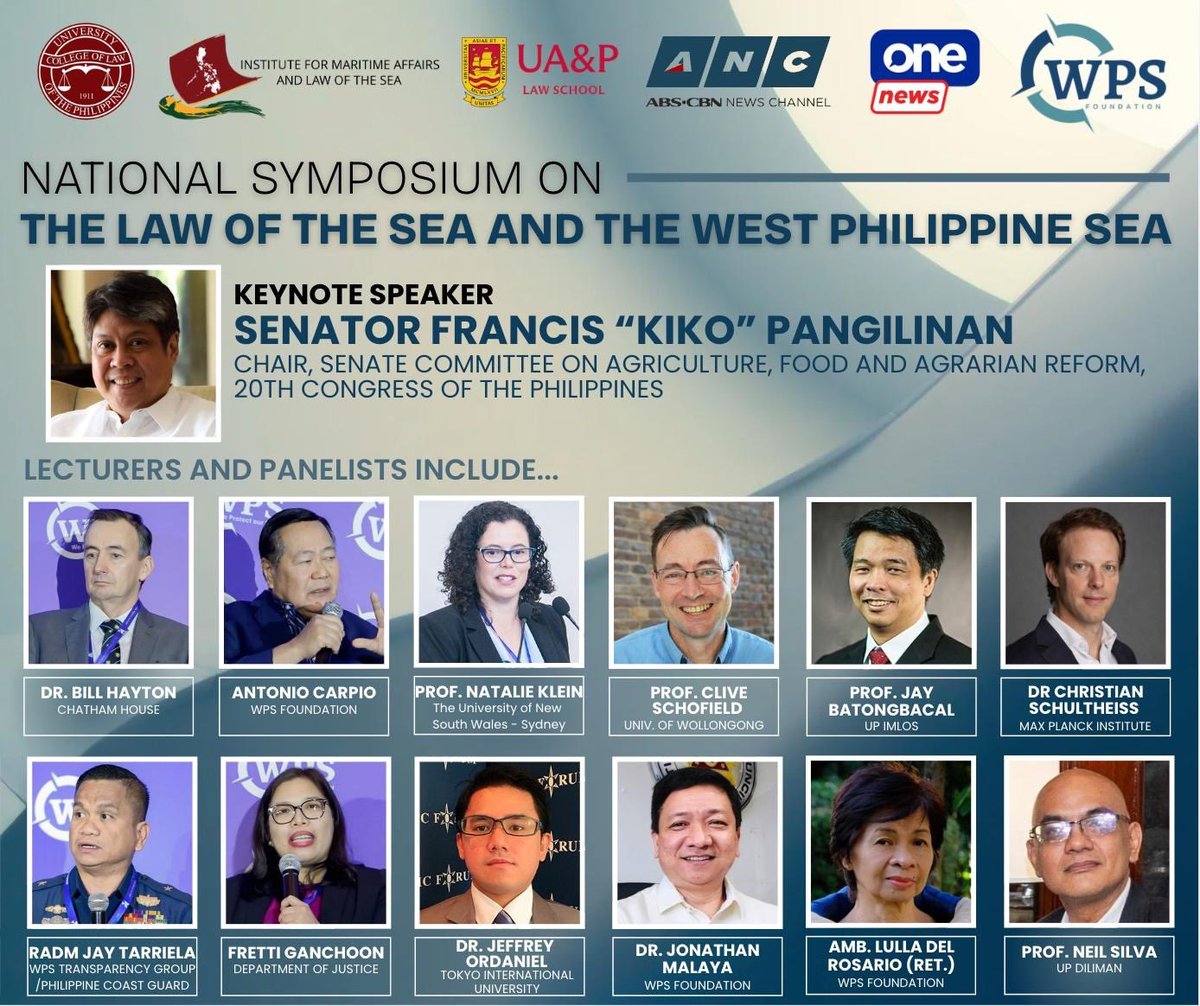
📣Keynote Speaker Announcement📣 We are honored to announce that Senator @kikopangilinan will serve as Keynote Speaker at the National Symposium on the Law of the Sea and the West Philippine Sea on 30–31 March 2026 at the Marco Polo Ortigas. As Chair of the Senate Committee on Agriculture, Food and Agrarian Reform, and a longstanding advocate of good governance and principled approach to foreign policy, Senator Pangilinan’s insights will be invaluable as we reflect on the 10th year of the 2016 Arbitral Award and the Philippines’ continued pursuit of a rules-based maritime order. The symposium will combine capacity-building with policy dialogues, and will bring together leading legal scholars, academics, and practitioners to deepen understanding of UNCLOS, strengthen national consensus on the West Philippine Sea and broader China policy.  📅March 30–31, 2026  📍Grand Ballroom, Marco Polo Ortigas  📽️YouTube Livestream available #WestPhilippineSea #UNCLOS #ArbitralAward #MaritimeSecurity #Philippines @wpstransparency @jaytaryela @SITREPph @ConstantKC @RichHeydarian @newswatchplusph
WPS - We Protect our Seas tweet mediaWPS - We Protect our Seas tweet mediaWPS - We Protect our Seas tweet media
English
0
10
22
1.6K
WPS - We Protect our Seas retweetledi
Ivan 🇵🇭🇻🇦
Ivan 🇵🇭🇻🇦@IvanAtHome·
Please follow our friends @JeffreyOrdaniel and his team at @wps_ph . They commissioned this very important set of survey questions. We Protect Our Seas (WPS) is a volunteer-based research and advocacy organization dedicated to promoting public awareness, informed debate, and evidence-based policy discussions on the Philippines’ maritime rights and interests in the West Philippine Sea, as well as regional maritime cooperation.
Ivan 🇵🇭🇻🇦 tweet media
Ivan 🇵🇭🇻🇦@IvanAtHome

PULSE ASIA/@wps_ph: MOST FILIPINOS FAVOUR US ALLIANCE || WANTS @realDonaldTrump TO VISIT THE PHILIPPINES Which world leader should most want to visit the Philippines for the ASEAN summit this November, 2026? 🇺🇸 Trump: 59% 🇷🇺 Putin: 10% 🇯🇵 Takaichi: 9% 🇦🇺 Albanese: 6% 🇰🇷 Lee: 4% 🇨🇳 Xi: 3% 🇮🇳 Modi: 0.4% ⬜️NONE Fieldwork: February 27 to March 2, 2026 Sample size: 1,200 Margin of Error: +/- 2.8% This survey indicates the Filipino public continues to want to engage with our primary ally, the United States despite a push by some in our country to pivot to China. Only 3% wanted most wanted China's Xi to visit the country. "The Filipino public clearly sees the value of strong partnerships with countries that support a rules-based international order. These relationships are critical as the Philippines works to defend its maritime rights and uphold international law in the West Philippine Sea." - @JeffreyOrdaniel of @wps_ph

English
0
17
45
1.9K
WPS - We Protect our Seas retweetledi
Ivan 🇵🇭🇻🇦
Ivan 🇵🇭🇻🇦@IvanAtHome·
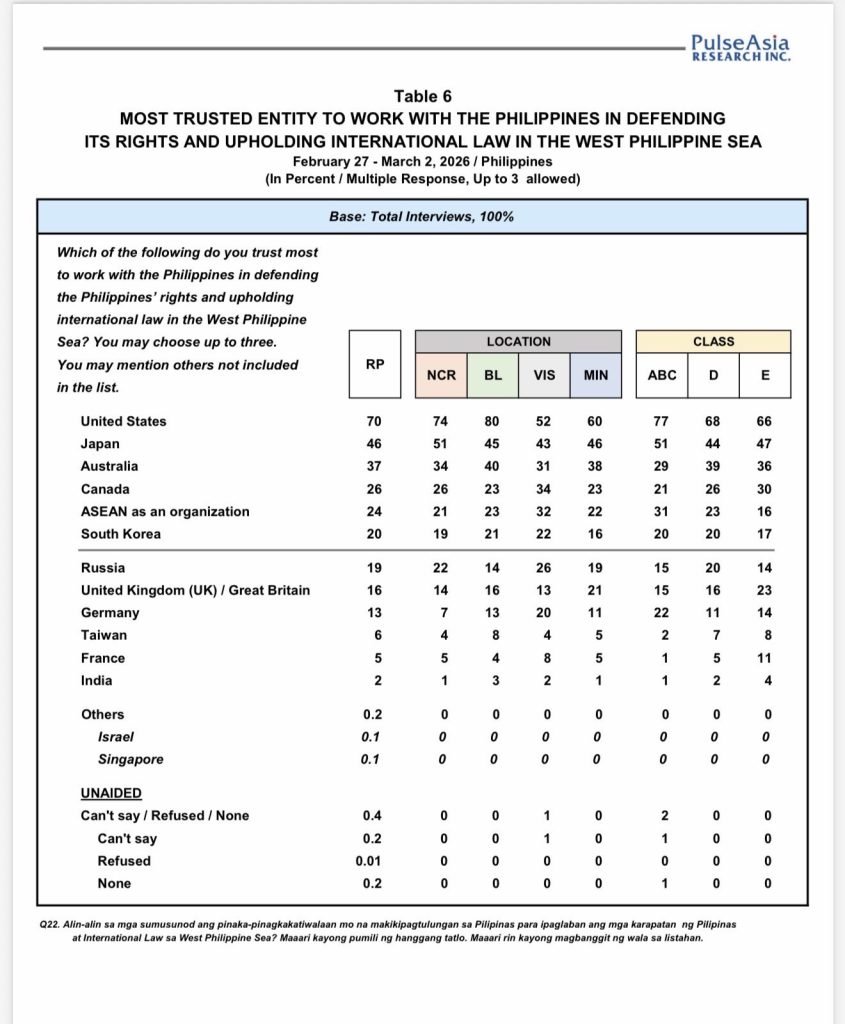
PULSE ASIA/@wps_ph: UNITED STATES REMAINS MOST TRUSTED PARTNER IN DEFENDING PHILIPPINE RIGHTS AND SOVEREIGNTY | FOLLOWED BY JAPAN AND AUSTRALIA Which do you trust the most in working with the Philippines defending its rights and upholding international law? 🇺🇸 United States: 70% 🇯🇵 Japan: 46% 🇦🇺 Australia: 37% 🇨🇦 Canada: 26% 🌏ASEAN as an organization: 24% Fieldwork: February 27 to March 2, 2026 Sample size: 1,200 Margin of Error: +/- 2.8% The survey shows continued strong public support in favor of our alliance with the United States and our other pro-Western/democratic partners against China. It also shows Filipinos remain very eager to defend our rights and maritime claims. "The West Philippine Sea is not just a national issue—it is also about defending international law and our collective aspirations for a free and open maritime order. We should persist and not subordinate our principled approach to the expansionist goals of any superpower. Filipinos clearly support working with like-minded partners who share an interest in maintaining a rules-based order in the region." - Rear Admiral @jaytaryela of the @coastguardph
Ivan 🇵🇭🇻🇦 tweet media
English
0
4
8
601
WPS - We Protect our Seas retweetledi
Jay Tarriela
Jay Tarriela@jaytaryela·
STATEMENT OF THE DFA SPOKESPERSON FOR MARITIME AFFAIRS ON THE SOVEREIGNTY OF THE PHL OVER BDM 16 March 2026 In response to the Chinese Embassy’s erroneous and misleading statement issued on Saturday, 14 March 2026, the Department of Foreign Affairs firmly underscores the Philippines’ indivisible, incontrovertible and longstanding sovereignty over Bajo de Masinloc and the Kalayaan Island Group. The historical and legal foundations of Philippine sovereignty over Bajo de Masinloc are unassailable. The Murillo Velarde map of 1734 clearly portrays the high-tide feature as Philippine territory, and all subsequent cartographic records affirm the same. More critically, the Philippines has exercised continuous, uninterrupted sovereignty and jurisdiction over Bajo de Masinloc for centuries — demonstrated through detailed hydrographic surveys, official government correspondences, and decisive acts of administration, including its designation as a target range by the Armed Forces of the Philippines and the demolition by Philippine authorities of illegal structures erected on the shoal by foreign smugglers. Sovereignty is not merely claimed — it is exercised. The Philippines has done precisely that, consistently and without interruption. The Philippines flatly rejects China's assertion of indisputable sovereignty over the entire South China Sea. This claim has no basis in fact, no basis in history, and no basis in international law. Full stop. As regards the recent letter posted by the Chinese Embassy in Manila, the DFA will not engage in conjecture or speculation over a document of uncertain origin and authenticity, and certainly without value. There is no merit in debating supposed documentary artifacts produced by third parties and presented as posts on social media, especially if these third parties have vested interests and willfully misconstrue and misrepresent established facts. China must be reminded that maritime and territorial claims are subject to established international legal procedures and dispute settlement mechanisms — not to unilateral proclamations or social media posts. China's persistent evasion of proper international legal scrutiny speaks volumes: it betrays the utter baselessness of its positions. A state confident in the legality of its claims does not shy away from international adjudication. China's conduct is a tacit admission that its claims cannot withstand legal scrutiny. The Philippines, on the other hand, duly proved and established its maritime claims through the 2016 Arbitral Award, which has become an integral part of international law. The Philippines likewise consistently exercised and upheld sovereignty, sovereign rights and jurisdiction over its archipelago and other territories, including Bajo de Masinloc and the high-tide features of the Kalayaan Island Group (KIG), which is incontrovertible and firmly founded on international law and effective administration. Finally, while the Department welcomes the resumption of dialogue mechanisms with China as critical platforms for effective diplomacy, consistent with the guidance of President Ferdinand R. Marcos Jr., the Philippines makes one thing unequivocally clear: engagement is not concession. Our pursuit of dialogue reflects a calibrated and principled commitment to peaceful dispute settlement — it does not, in any manner, dilute or qualify the Philippines' firm, unequivocal positions in the West Philippine Sea. Our sovereignty is non-negotiable. Our resolve is absolute. (END)
Jay Tarriela tweet mediaJay Tarriela tweet media
English
10
103
268
5.5K
WPS - We Protect our Seas retweetledi
Ivan 🇵🇭🇻🇦
Ivan 🇵🇭🇻🇦@IvanAtHome·
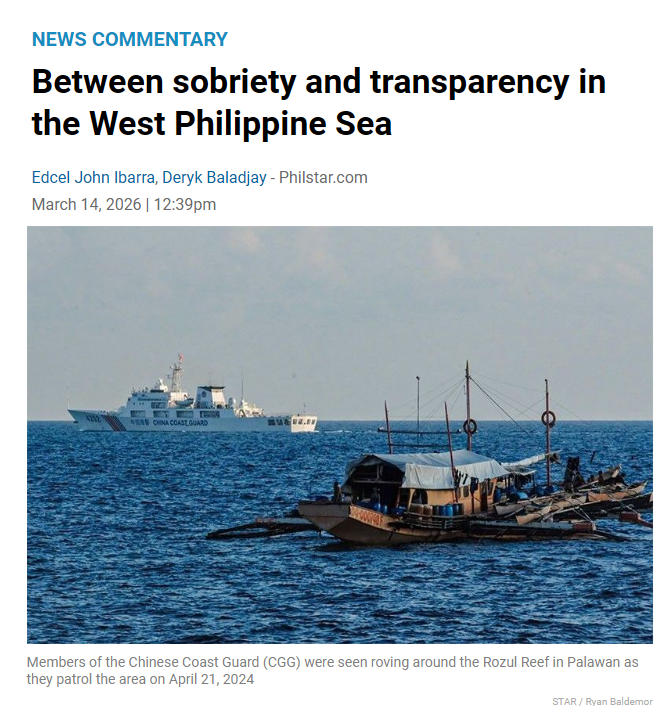
Absolutely terrible op-ed which screams defeatism in the guise of "sobriety" in the West Philippine Sea, just as many weak-willed diplomats have done over the decades to the detriment of our Republic's interest. Let's rebut it, point by point, shall we? 1. The “provisional understanding” (PU) with China over the Ayungin Shoal DOES sideline UNCLOS or the Arbitral Award, contrary to what the authors claim. This misses the core issue. Under the Philippines v. China Arbitration and the United Nations Convention on the Law of the Sea, China has no legal basis to interfere with Philippine resupply missions to the BRP Sierra Madre at Ayungin Shoal. When an unlawful actor is effectively given a say over how a lawful activity is conducted, the result is simple: coercion is rewarded with negotiating leverage. Conflict prevention cannot come at the cost of normalizing illegal interference. I can't believe that the writers are saying hinting that a "provisional understanding" with the CCP somehow circumvents Philippine law and international norms. China has no legal right to interfere with Philippine resupply missions, as Ayungin Shoal is within the Philippines' Exclusive Economic Zone. By giving China a say in how these lawful activities are conducted, the PU rewards coercion with negotiating leverage. He stresses that conflict prevention should not normalize illegal interference. 2. Secrecy and ambiguity are normal in diplomacy but China is not normal Confidential diplomacy is normal but only if you are dealing with a “normal” country negotiating in good faith. China is NOT a normal country, far from it. How many times has this country been scammed by China via secret deals (see 1995 Mischief 'shelters for fishermen," 2005 JMSU, 2012 mutual pullout from Scarborough). Are we going to scammed again like gullible patsies? Is this how we want people to see our country on the world stage? While confidential diplomacy is standard, it's inappropriate with China, which has a history of bad-faith secret deals China's unreliability makes transparency essential. 3. The PU does reward coercion The sequence of events matters. China created the crisis-through obstruction, water cannons, and dangerous maneuvers. If coercive behavior leads to arrangements that constrain the Philippines’ lawful operations, the message becomes clear: coercion works. This sends the message that coercion is effective. Confidence-building measures are useful between legitimate disputants. But at Ayungin Shoal, China has no lawful entitlement under international law. China refuses to engage with us on the international stage concerning it. Where is there "confidence" when they continue to harass us? 4. Why are the authors still calling Ayungin "disputed waters"? Do they dispute our claims? Aren't they patriots? Ayungin (Second Thomas) Shoal lies within the Philippines’ EEZ under the United Nations Convention on the Law of the Sea, as affirmed by the Philippines v. China Arbitration. Describing it as such echoes Beijing's narrative, undermines the arbitral victory, and questions whether the original authors truly believe in the ruling's authority. It is therefore not legally "disputed waters." It is Filipino. It's ours. So the question must be asked: why continue to describe it that way? Using that language echoes Beijing’s narrative and undermines the Philippines’ legal victory. Do the authors themselves not believe in the authority of the 2016 ruling? Absolutely silly article and a cheap attack against our good friends @JeffreyOrdaniel and his team at @wps_ph. Clearly an attempt by some to protect the EMBATTLED Foreign Secretary, Tess Lazaro who has been rightfully attack for her WEAKNESS in the face of Beijing's harassment of our Filipino journalists at @PCIJdotOrg . Thankfully the Palace is chose to intervene last week by chastising China for interfering in our local politics and media, and by arresting all those Chinese spies and TRAITORS weeks before. That is the sort of response a self-respecting nation should do. We Filipinos must reject such blatant defeatism and assert our rights both by insisting our foreign department fights for us diplomatically and also by pressuring Congress to give our armed services the funding needed to fight for us in our the waters. philstar.com/news-commentar…
Ivan 🇵🇭🇻🇦 tweet media
English
3
53
116
8K
WPS - We Protect our Seas retweetledi
Jay Tarriela
Jay Tarriela@jaytaryela·
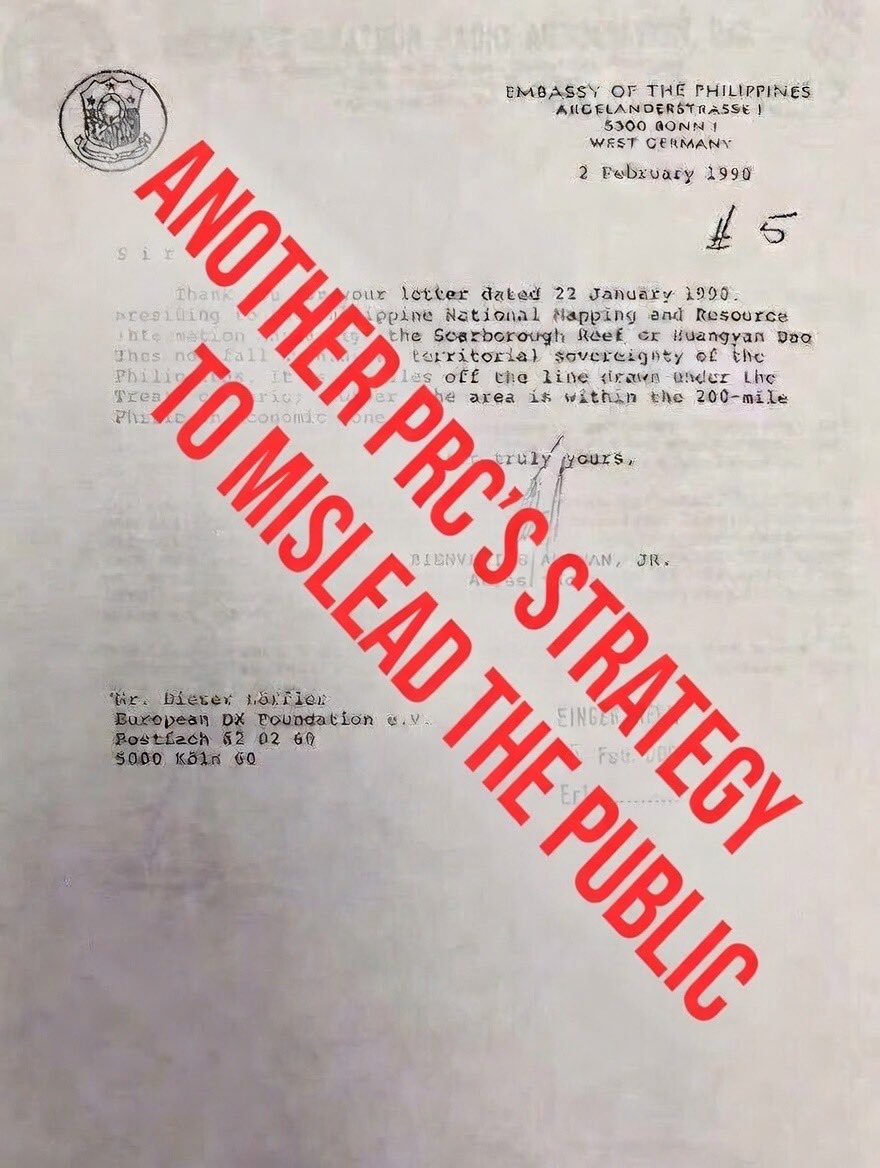
The PRC’s attempt to present this 1990 letter as proof of Philippine concession over Scarborough Shoal (Bajo de Masinloc) is misleading at best and a deliberate distortion at worst. This unverified document presented as letter from Ambassador Bienvenido A. Tan, Jr. to a German radio hobbyist was not an official waiver of sovereignty—it merely noted that the shoal lies outside the colonial boundaries set by the 1898 Treaty of Paris, while affirming it is within the Philippines' 200-nautical-mile Exclusive Economic Zone. Under international law, as retired Philippine Supreme Court Justice Antonio Carpio has pointed out, an ambassador lacks the authority to waive, abandon, or decide on a state's sovereignty or territory. Only statements from the head of state or foreign minister can bind the nation. This casual correspondence to a private individual does not qualify as a binding admission, and relying on it ignores the 2016 Arbitral Tribunal ruling, which confirmed Scarborough Shoal is within the Philippines' EEZ and that China has no historic rights overriding UNCLOS entitlements. China released this letter years ago, but recycling it now as "evidence" is just another selective narrative to justify encroachment—it is not a lie detector, it is a smoke screen. The fact remains: China has not once exercised sovereignty over Bajo de Masinloc. The PRC claim is bogus and has no credible historical basis. The Scarborough Shoal has always been and will always be a Philippine territory.
Jay Tarriela tweet media
English
35
347
959
30.1K
WPS - We Protect our Seas
Last Thursday, WPS President & CEO Dr. Jeffrey Ordaniel convened the Advisory Board to discuss upcoming research and dialogue initiatives, including preparations for The Manila Dialogue on the South China Sea this November. The Board is chaired by former Philippine Supreme Court Associate Justice Antonio Carpio, with Stratbase President Dindo Manhit serving as Vice-Chair. Members include: NSC PH Adviser Jonathan Malaya, former AFP Senior Officials, Gen. Edilberto Adan, Gen. Emmanuel Bautista, and MGen. Resty Padilla, former DFA Undersecretary for Economic Affairs, Amb. Laura del Rosario, @rapplerdotcom Editor-at-Large Marites Vitug, UP Professor Jay Batongbacal, and DLSU Lecturer @DonMcLainGill95. @jaytaryela also serves as honorary adviser from the maritime sector. @wpstransparency @beacupin @rapplerdotcom @IvanAtHome @SITREPph
Jeffrey Ordaniel@JeffreyOrdaniel

Last night, I had the opportunity to convene the @wps_ph Advisory Board—chaired by Justice Antonio Carpio, with Prof. Dindo Manhit serving as Vice-Chair—to provide an update on the Manila Dialogue on the South China Sea and the many international and local research and dialogue initiatives we are spearheading this year. @jaytaryela @wpstransparency @StratbaseADRi @DFAPHL @coastguardph @nscphilippines

English
0
4
7
722