

X
75 posts

Poking around Chord's assets this morning as the rumour mill spins, and 4 mile U-turn lateral is pretty crazy. Well done.

English


we're going to roll Riggs out to everyone in oil and gas soon.
I need 50 friends that want to test it out and beat it up.
If you're a petroleum engineer, ofs, landman, geologist, own an E&P etc. hit me up and drop a comment here.
English

People who frac U-turn laterals: Is the U part being frac'd, or just the straight parts?
GIF
English
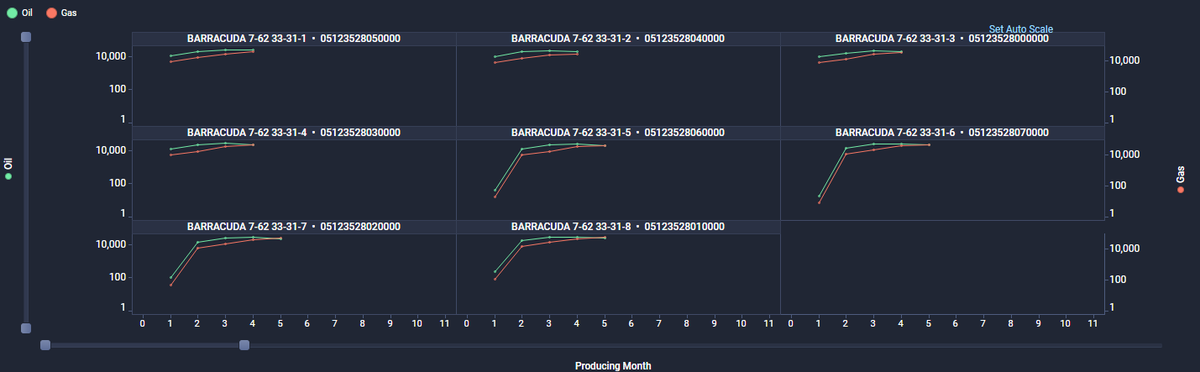
@zacurate @DufffTrader My newest AFE in same neighborhood came in at $5.5 million. The Barracuda wells look great. Already paid out. Cum over 100,000 BO each in 7 months. Not sure what the 70,000 number coming from.
English
This is the kind of feedback I am here for.
Looking closer only adds confusion.
This one looks like it ramped up for nearly a year.
~ 70,000 bbl EUR can't be economical for a 12,829 ft lateral...
NGLs will help, but I must be missing something...
How much do these things cost all in?
English
Does it look like Bison is choking these Barracudas?
Terrible tasting fish either way, do not recommend.
English
@TrashMcOiltrash It’s because you’re in metric. Use cubic miles and you’ll fine.
English


So wait. If the river was flowing at 430m3/s during the 2013 flood.
And its 300 now.
And we are supposed to get over 100mm of rain over the next few days….
Plus the ground in the mountains is frozen and some still has snow…
No flooding expected.
The Ganges is gunna rip

English
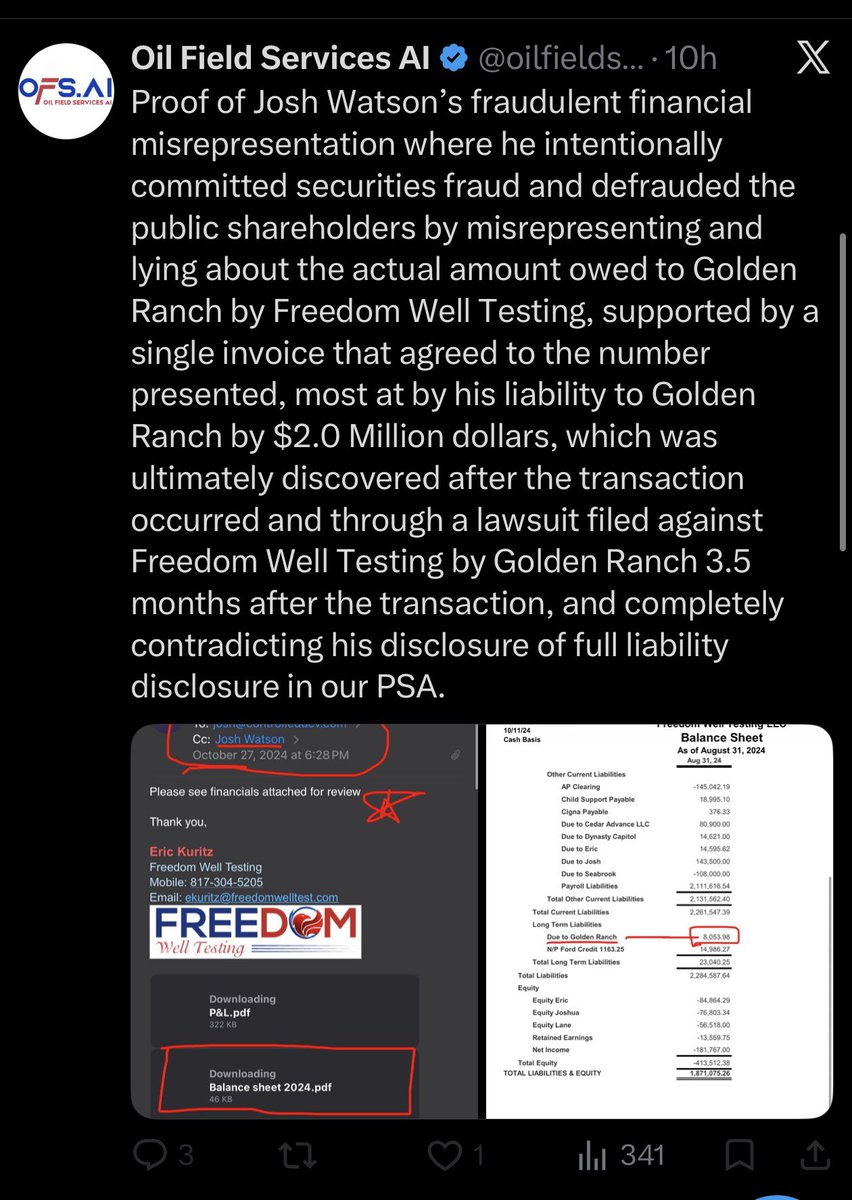
@opinioncasino @oilmutt Child Support Payable!
And over $2 million in payable salary liabilities, amazing.
English

Josh Cohen is now attacking all the former executives of $AZRH. The dude is the most pathetic person to ever exist.

English




Excellent post (below) on $TMDX, I'll do another detailed post in the next few days however in the meantime I'm doing calls with sell-side analysts and management.
Here's what I'll say for now...
Today is obviously frustrating for long-term shareholders but I honestly don't believe anything in our long-term thesis has changed thus we have not sold any shares.
I've owned $TMDX personally since January 2021 when the stock was around $20... I've been though multiple -50% drawdowns... it's always painful while it's happening but no reason to panic if the long-term story/opportunity still holds true. $TMDX is one of the most volatile stocks I've ever owned... it moves by an average of 20% (up or down) every month.
$TMDX is sticking with their long-term targets of 10k annual cases by 2028... 20k annual cases by 2030 and 30k annual cases by 2032.
Right now the biggest issue is the amount of investments that $TMDX is making into R&D for OCS 2.0 plus enrollment in trials, R&D into CHOPS for cold perfusion plus approvals, R&D for OCS Kidney for trials in 2027, international expansion starting with Italy, starting to build their European NOP network which includes a strategic investment into a German aviation company and several others things including a new HQ in Boston, MA.
Every single one of these investments (which are good for the long term) comes with an upfront cost but no near term revenues so it's a hit to margins, profits and eps. It does feel like $TMDX has too many things going on at once but we have to remember this is a founder-led company and he's trying to build a $20B+ company with the best moat possible, he's not worried about quarter-to-quarter results (even though we sometimes wish he was).
$TMDX margins are clearly taking in hit in the short term but it's so they can expand their product portfolio and their geographic footprint in order to grow their TAM which should lead to higher revenues and more profits over the long term.
After the sell-off today... $TMDX is trading below 3.2x NTM revs (using sell side estimates) which is by far the cheapest this stock has ever been.
In my next post I'll share additional thoughts on where I think revenues, margins and eps go over the next 3-5 years.
Based on my estimates for next 12-18 months, $TMDX is now trading below 20x 2027 eps and I still think EPS grows at a 30-35% CAGR for the next 4-5 years.... base case is still $10 of EPS in 2030.
It's very possible that operating margins stay compressed for the next few quarters as they go through this investment cycle however on the other side of this I think we see operating margins much higher. One year ago $TMDX had 30% operating margins and they just reported 7.6% operating margins... slightly over 10% if you use the adjusted numbers... but this goes to show how much capital they're investing right now for future and it's crushing margins... but I think we see operating margins back in the 25-30% range within the next 18 months and I think we see operating margins in the 35-40% range by 2030 especially if ground transports are 40-50% of total OCS cases when you include Europe and the full rollout of OCS 2.0
I'm definitely not happy with $TMDX management for their lack of transparency and communication over the past few months however this is a small, founder-led company... things are not going to be perfect all the time which is why you need to step back and decide whether your investment thesis is still in tact... for me, it is.
NFA.
DYOR.
*I own $TMDX personally and so does @FirstWaveFund
Ismael@ismael27_X
Los últimos resultados de $TMDX son el reflejo real del algoritmo de creación de riqueza generacional que más confunde a los inversores novatos, pero que más oportunidades crea entre los que ya somos perros viejos. Te explico 👇🗒️ Desde hace años $TMDX inició la transición hacia un modelo de negocio intensivo en capital y logística de altos coste fijos y peores márgenes que su negocio de productos médicos tradicional con un objetivo. Desbloquear un TAM gigantesco que no podría ser atendido de otra manera por la infraestructura logística y tecnológica existente dadas las limitaciones intrínsecas del proceso de trasplante de órganos (se mueren si vas lento y ya no sirven). Al igual que tradicionalmente han hecho empresas como $AMZN o $COST, $TMDX deteriora artificialmente la contabilidad de la empresa en el presente en harás de un mayor crecimiento duradero y mejor posición competitiva en el futuro. Una vez creces y escalas, nadie puede competir ni en precios ni en calidad contigo, mientras tu valor terminal, junto con tus retornos sobre el capital invertido futuros a perpetuidad son holgadamente superiores a los de la media del conjunto del mercado. Algo inmensamente valioso en matemática financiera si uno hace un DCF y sabe echar números. La contraparte 👇 Antes de usar una red logística nacional hay que crearla y antes de explotar una tecnología disruptiva hay que mejorarla. Esto implica inversión, tanto a nivel de OPEX (i+d) como CAPEX (aviones y aplicaciones) y por ende, bajos márgenes y ROIC ópticos a corto plazo. El mercado cree que esto es malo y el negocio es menos rentable. Pero lo que realmente ocurre es que el mercado no normaliza los números (ex-inversión en crecimiento) ni sabe anticipar lo retornos que están por venir acorde a lo que está preparando el negocio, que con casi total seguridad y tal y como ya ha ocurrido en el pasado, llegará. Es natural, dada la descomunal propuesta de valor tanto económica como social de la empresa. Salva vidas. Trasladado a los números de este Q1 2026 de $TMDX 👇 $TMDX ha iniciado el despegue de la expansión europea a fin replicar la misma red logística que ya tiene en Estados Unidos. Una oportunidad casi igual de grande o más, aún sin explotar y que catapultará la adopción de su producto (OCS) en el viejo continente. A diferencia de lo que ocurrió durante sus inicios en USA 🇺🇸, donde $TMDX siempre dependió inicialmente fuerte de la infraestructura de terceros con un modelo ineficiente que te exprime en márgenes (aviones caros gestionados por otros), $TMDX ha decido integrar verticalmente desde el primer momento toda su red logística de aviación en Europa 🇪🇺 a través de un contrato multi-década en forma de derechos de uso a través del acuerdo con una compañía de aviación idónea para el tipo de trabajo que $TMDX lleva a cabo. En el balance se ve como deuda, pero no lo es. Es el valor descontado al presente de todos los pagos que $TMDX va a realizar a décadas vistas por la utilización de ese CAPEX que las normas contables te obligan a reflejar de esta manera en forma de "derechos de uso" en el activo y "leasing financiero" en el pasivo. "Las gallinas que entrar por las que salen", como diría un famoso humorista español. Bajo los criterios GAAP en USA 🇺🇸, el leasing financiero se refleja vía P&L año a año como una amortización o depreciación del "derecho de uso" más una parte de interés relativa al echo de haber alquilado y no comprado íntegramente el activo tú mismo. Pero en esencia es como si ya fuera tuyo. En otras palabras, es OPEX y/o COGS al uso por llevar a cabo tu actividad, pero con otro nombre y desglose más rimbombante. 😂 Por otro lado, es sabido ampliamente por todos que las verticales del pulmón, corazón y riñón aún no han despegado, pero el coste en i+d sí, porque va antes. Una vez las ventas de estos últimos crezcan lo harán más rápido que el gasto en i+d y, especialmente, que el número de aviones de su flota actual, que verán su utilización incrementada y por ende sus niveles de retorno sobre el capital invertido (mejores márgenes y ratio ingresos/CAPEX). Por último, es también sabido por todos que el coste del combustible para aviones por la subida de precios del petróleo ha afectado ligeramente a presente, pero también que esa es una situación insostenible que tiene los días contados. Algo que probablemente anticipa hasta el menos lúcido. La afección real es simplemente nula largo plazo. Como no puede ser de otra forma y a la luz de la ejecución de la compañía hasta ahora, definitivamente "the best for $TMDX is yet to come". 🩷
English

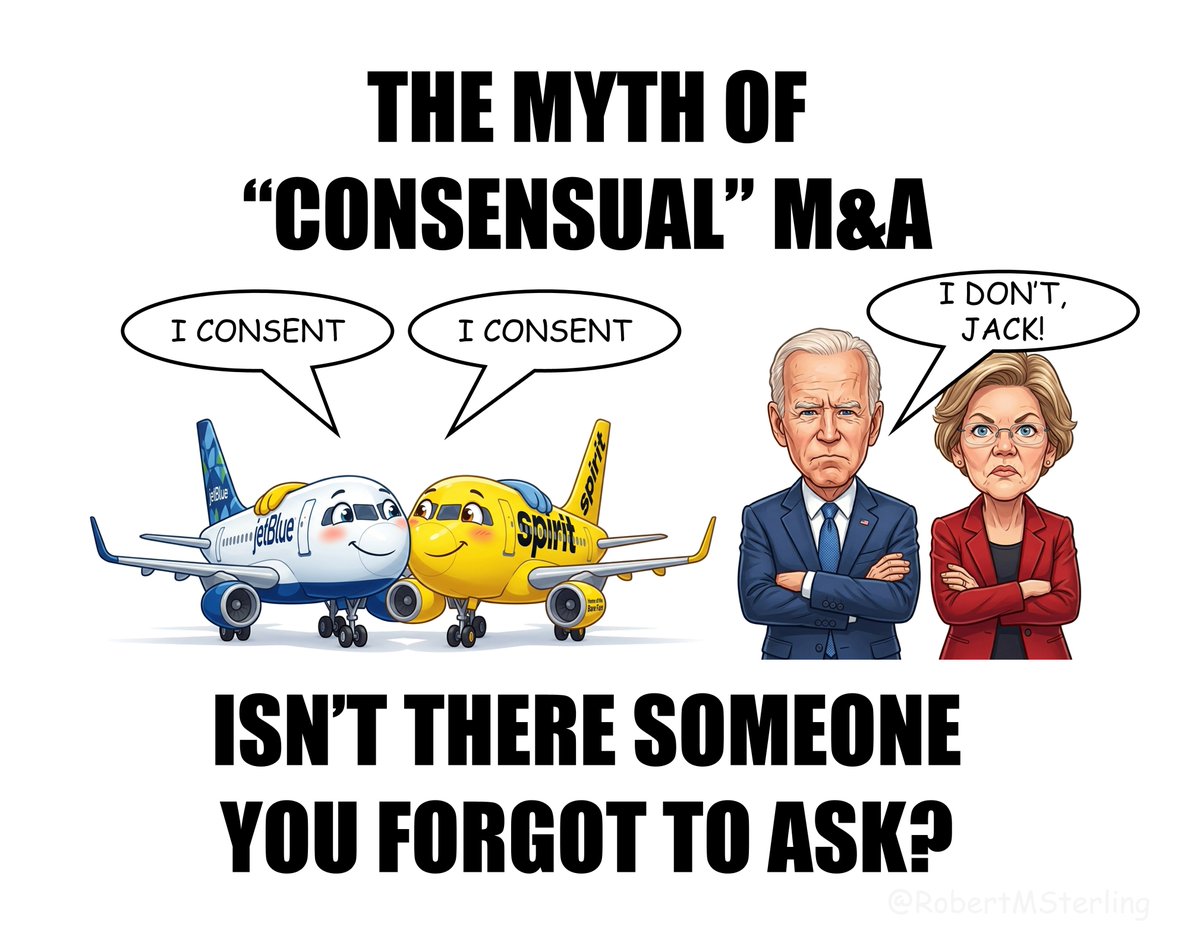
Joe Biden killed Spirit Airlines. And anti-business, anti-market politicians like Elizabeth Warren celebrated as he did so.
Spirit has been in financial distress for years. Its ultra low-cost operating model simply no longer works. Back in 2022, though, JetBlue offered Spirit a lifeline.
JetBlue bid to acquire the struggling airline for $3.8B, and Spirit’s shareholders accepted the deal. The Spirit brand would have been retired, and the interior of the jets would have been somewhat reconfigured (more premium seats, more legroom, no more inserting a quarter to use the lavatory, etc.). The core of what made Spirit “Spirit”—good, bad, and ugly alike—would have changed. But the majority of flight routes would have been preserved, and most Spirit employees would have kept their jobs.
Given the sizable challenges to Spirit’s business model—as well as the company’s weak balance sheet—it was the best outcome any of its stakeholders could have hoped for.
But that wasn’t good enough for the Biden administration, nor for politicians like Senator Warren (who has never seen a dollar of shareholder value she didn’t wish to tax, regulate, or otherwise strangle out of existence).
In 2023, the Biden DOJ sued to block the deal. In January 2024, a judge ruled in the DOJ’s favor, and the deal was dead by March. By November 2024, Spirit was in Chapter 11 bankruptcy; after emerging with a restructured balance sheet in early 2025, it would file for Chapter 11 again—a rare “double dip” bankruptcy process—less than a year later, in August 2025.
And now, possibly as early as this weekend, Spirit will enter liquidation. Its planes will be parceled out to the highest bidders, where they will likely fly completely different routes across the US. Its pilots will land safely on their feet (though they, too, may have to relocate their families to new home bases), as will some flight attendants. Most mechanics and other ground crew are probably out of luck—and jobs.
The Biden administration’s lawsuit against JetBlue all but guaranteed this. And the worst part is, anyone could have predicted it (in fact, countless people across the aviation and finance worlds did just that).
When the DOJ or FTC sues to block an M&A deal, it typically does so by arguing the post-transaction market will be too concentrated (you’ll hear something called the Herfindahl-Hirschman index referenced to argue this; and don’t worry, the rest of us can’t pronounce it either). But this was not the argument the Biden DOJ made.
The DOJ instead argued that Spirit, as an independent company, charged so little that it created a disproportionate downward pricing effect that affected the rest of the airline industry. In other words, Spirit was so cheap that it couldn’t be allowed to be acquired by a competitor, lest the entire airline industry be able to raise prices.
It’s analogous to saying the dirty Arby’s in my town can’t shut down, or else the steak house across the city might be able to charge more.
But here’s the thing: Those disproportionately downward prices meant Spirit wasn’t viable as a business. Unlike legacy carriers such as United—which now generate a large share of profit from premium seats—Spirit does not offer premium seats with which it can subsidize its lower-cost fares. ALL of Spirit’s fares are ultra low-cost tickets, with ultra low margins for the company.
And now, the company is about to die.
So way to go, Joe Biden, Elizabeth Warren, Lina Khan and all the rest of you who—despite barely having held private-sector jobs, let alone built companies or been responsible for payroll—know what a business should do better than its shareholders, board of directors, executives, employees, investment bankers, and lawyers.
Job well done. I hope you’re proud.
English
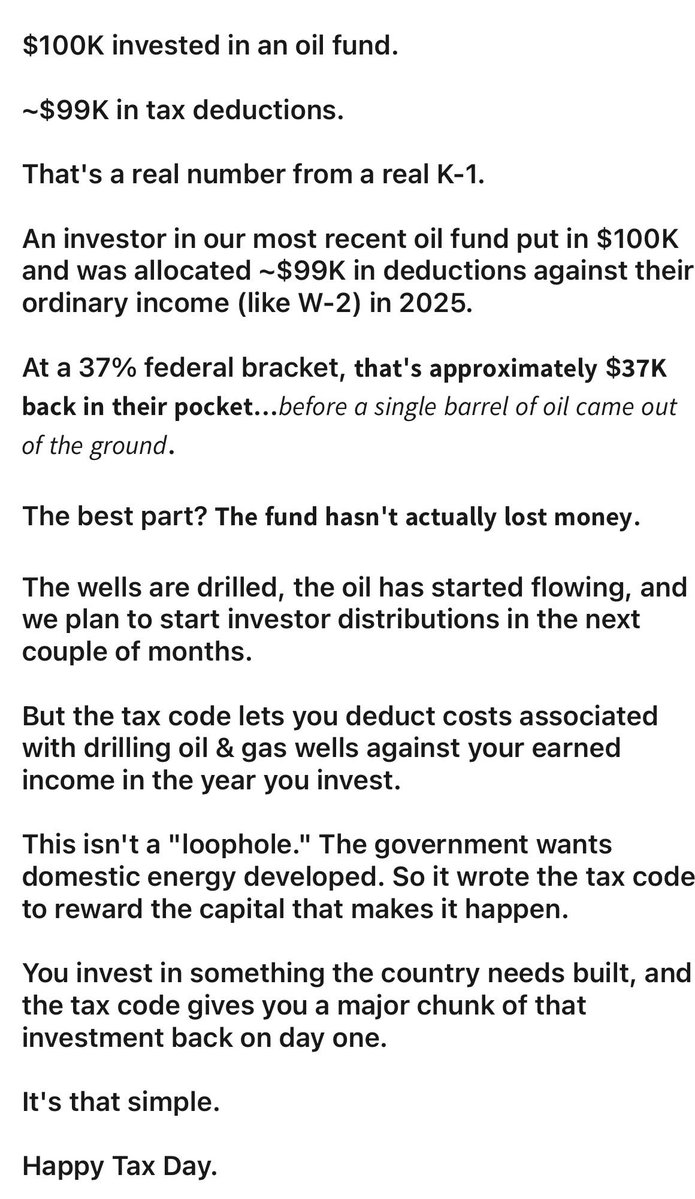
@OilCoIntern I do not understand how your IDCs could be 99% of your investment? No tangibles? Dry hole is mostly IDC I Guess.
English

Intangible drilling costs are not free tax write-offs.
Regardless, many oil & gas-fund pitches portray them this way. This example from LinkedIn today shows $100k investment turning into ~$99k in IDC deductions that wipe out a material portion of the client’s W-2 income in year 1.
Technically true. It’s a real K-1.
But it’s not the full picture if you’re deciding whether to actually invest.
The IDC deduction is real tax savings in year 1. No argument there. The part that gets glossed over is when that investment starts throwing off revenue, usually a lot, in year 2. Your K-1 then shows ordinary income from the wells on top of your full W-2 income.
You’re not creating “free” money. You’re accelerating a deduction and pushing taxable income into the future.
Here’s the correct way to analyze any non-operated oil & gas working interest deal:
Step 1: Project your baseline cash flow WITHOUT the investment.
Take your expected W-2 (or other ordinary income) for the next several years and calculate the true after-tax dollars you keep each year.
Step 2: Run the investment scenario.
Layer in your expected K-1 line items: year-1 IDC loss being the big one, future revenue, operating expenses, tangible depreciation, and depletion that shelters income for years to come.
Calculate the incremental after-tax cash you actually receive from the wells.
Step 3: Credit the oil & gas investment with the difference. Only the difference.
That “extra” after-tax cash flow is the true economic benefit of the investment.
Now compare that incremental after-tax cash flow stream to your alternative investment options. (Risk adjusted, of course.)
If the oil & gas deal’s projected IRR (after all taxes, fees, and decline curves) beats your alternatives on an apples-to-apples after-tax basis, then it’s a good deal.
If not, the big year-1 deduction didn’t magically make the investment beat the alternatives.
Tax benefits are powerful, but they’re only one input.
The deal has to stand on its own merit.
English
@OilCoIntern @EFMinerals What about the non consent penalties some states impose?
English
@EFMinerals I would also add that with statutory royalties in some states (12.5% to 16%+), the ROI sees an uplift from pulling cashflow forward. The value of earlier cashflows more than compensate for the slower payout.
English


Unrealized loss means nothing. Realized loss means sold. He didn't sell. He converted depreciating dollars into a fixed supply asset at a lower price. That's not a failed gamble. That's a tax loss harvest dressed up as a headline.
$14.5 billion on paper is noise. The signal is that he still holds. The same people calling it a loss today will call it genius when the dollar drops another 20% and Bitcoin recovers.
Markets punish paper hands. They reward conviction. Saylor has the second. You have the first.
English

BREAKING: Michael Saylor’s Strategy registered a $14.5 billion unrealized loss in the first quarter for their failed Bitcoin gamble.
English
@macrocephalopod I’m doing it with 6 year old. But they need to invest a portion of their allowance which I will 10x as long as it’s long term.
English

What’s a good age to give my kid a sub-account of her trust fund to manage, pick stocks for etc? I want to introduce her to the idea of deep research, conviction bets, and good risk management. Is seven too young?
English
@clawrence Why would prices be higher? You would have smaller demand at that point?
English

One of several reasons people should support renewables, batteries, EVs & electrification in the US that has nothing to do w/climate. The less fossil fuel we use at home, the more we can export at higher prices.
English
@OkieLandman580 Get on Allopurinol. Have not had an attack after starting it.
English

Public service announcement, if you’re going to get gout, anywhere but your sternum and ribs is preferred. The last three years of attacks have been miserable. That is all.
English

I’ve watched one game of each and I’m now a draft expert
Zero clue how anybody could possibly pick Boozer over Acuff
English