

VS
806 posts

VS
@ChainShah
Slightly concerned that #BTC may be trying to right an economic-wrong, when economics itself is being rewritten. Founder at stealth startup
เข้าร่วม Ağustos 2018
628 กำลังติดตาม1.3K ผู้ติดตาม

THE MOST CONTRARIAN TAKE ON OIL YOU WILL READ THIS YEAR!
We are living through a truly historic moment. There is real momentum building around bilateral energy deals that completely bypass the United States as alliances are shifting.
France is for example increasingly aligning with China and Russia in the UN on key votes around this question.
The global order is fragmenting in ways that would have seemed unthinkable just a few years ago.
But this may actually resolve the oil crisis sooner than most expect...
Let the insults begin!
Andreas Steno Larsen@AndreasSteno
English

The greed and corruption of Trump’s insider trading is SO bad, that bots look for any headline where Trump says things like “Strait Open” and instantly buy BILLIONS.
This happens to a small extent on all headline news, but it’s 1000x worse now because Trump rules by social media, and frequently tries to manipulate makers for insiders.
The US financial system was considered the most refined in the world, and now it’s a joke under this volatile old man.

*Walter Bloomberg@DeItaone
TRUMP: WITH A LITTLE MORE TIME, WE CAN EASILY OPEN HORMUZ STRAIT, TAKE THE OIL
English

The U.A.E. has launched a widespread crackdown on Iranians in the country, canceling visas and closing institutions. on.wsj.com/4c1WzCU
English

If true, the Saudi population (in a country bombed by Iran) sides with Iran vs Israel >5x.
As to Egypt, >10x
asad abukhalil أسعد أبو خليل@asadabukhalil
So Israel is still winning hearts and minds among Arabs and Muslims.
English
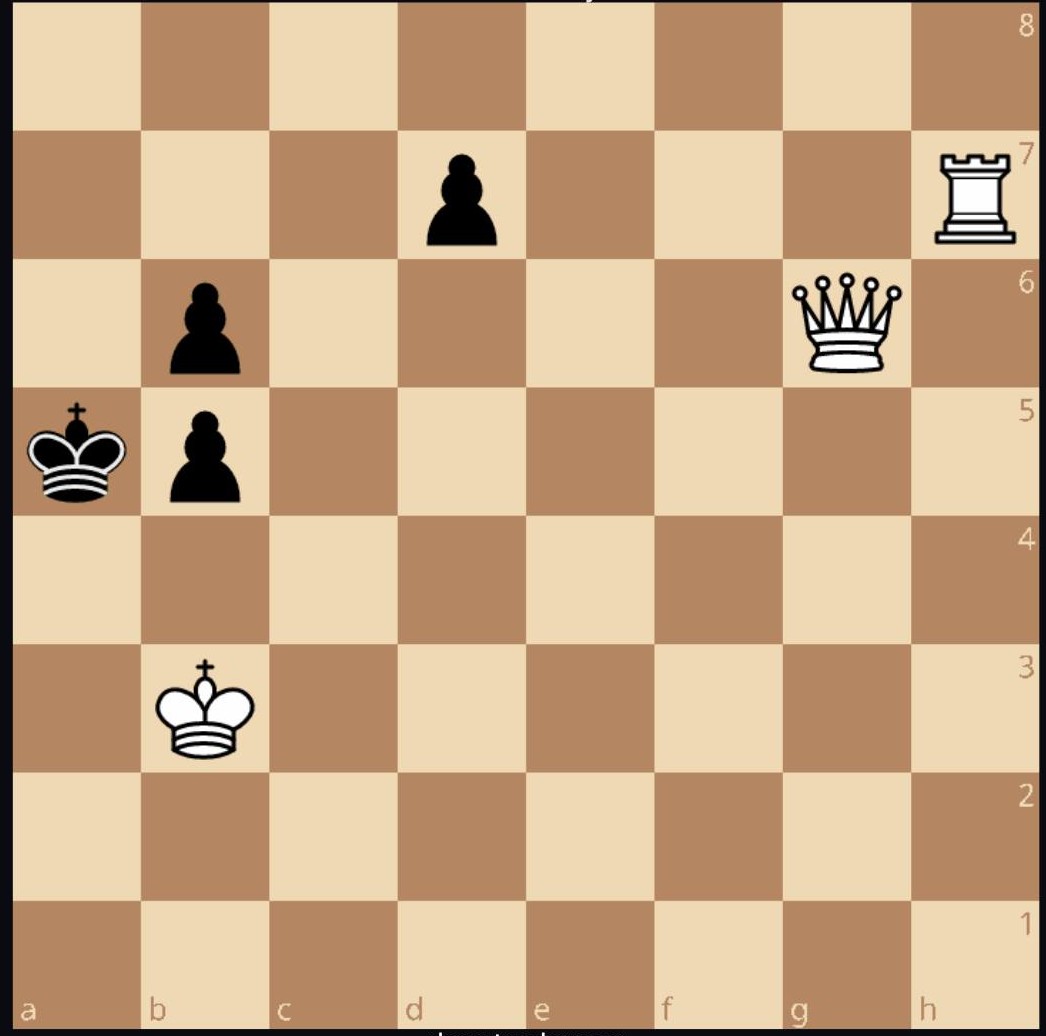
@GMIgorSmirnov Pawn to g8, make bishop
doesn't matter where black bishop moves
bishop to d5 for checkmate
English

Can you solve this tricky puzzle?
White Mates In 2 🤔🤔

English

🚨🇺🇸🇦🇪 The U.S. just told people to reconsider travel to the UAE
And if you stay, be ready to hide indoors when missiles show up.
Casual travel advisory

Mario Nawfal@MarioNawfal
🇺🇸🇮🇷 If the U.S. bombs Iran’s Bushehr nuclear plant, radioactive fallout could spread across the Persian Gulf. Millions in nearby Arab states could lose drinking water and face deadly radiation. A global catastrophe.
English

It’s time for Proof Of Human.
Alex Blania@alexblania
Agentic capability is improving fast. We believe Proof of Human is becoming critical for the internet and many of the platforms we use (like X). This paper explains why FaceID, face biometrics & government IDs won’t solve the problem, and what properties are most important.
English
@balajis @Selkis_2028 Yes and bitcoin hit $1m prior to 2025 just like you predicted. Save your energy for pragmatism instead of doomsday hyperboles.
English

I'm going to make some obvious points.
(1) Blowing up all the oil infrastructure in the Middle East is an insane idea, and may well result in a global economic crash and humanitarian crisis unrivaled in the lives of those now living. We're talking about the price of everything everywhere rising, from food to gas, at a moment when inflation was already high. All of that will be laid at the feet of the authors of this war.
(2) The antebellum status quo of Feb 27, 2026 was just not that bad, but we're unlikely to return to it. Expect indefinite, long-term, ongoing disruptions to everything out of the Middle East.
(3) Also assume tech financing crashes for the indefinite future. The genius plan to get the Gulf states caught in the crossfire has incinerated much of the funding for LPs, for datacenters, and for IPOs. Anyone in tech who supported this war may soon learn the meaning of "force majeure" as funding gets yanked.
(4) Many capital allocators will instead be allocating much further down Maslow's hierarchy of needs, towards useful basic things like food and energy.
(5) It's fortunate that all those progressives yelled about the "climate crisis." Yes, their reasoning about timelines was wrong, and much of the money was wasted in graft, but the result was right: we all need energy independence from the Middle East, pronto. It's also fortunate that Elon and China autistically took climate seriously. Now they're going to need to ship a billion solar panels, electric vehicles, batteries, nuclear power plants, and the like to get everyone off oil, immediately.
(6) It's not just an oil and gas problem, of course. It's also a fertilizer problem, and a chemical precursor problem. Maybe some new sources will come online at the new prices, but it takes time to dial stuff up, particularly at this scale, so shortages are almost a certainty.
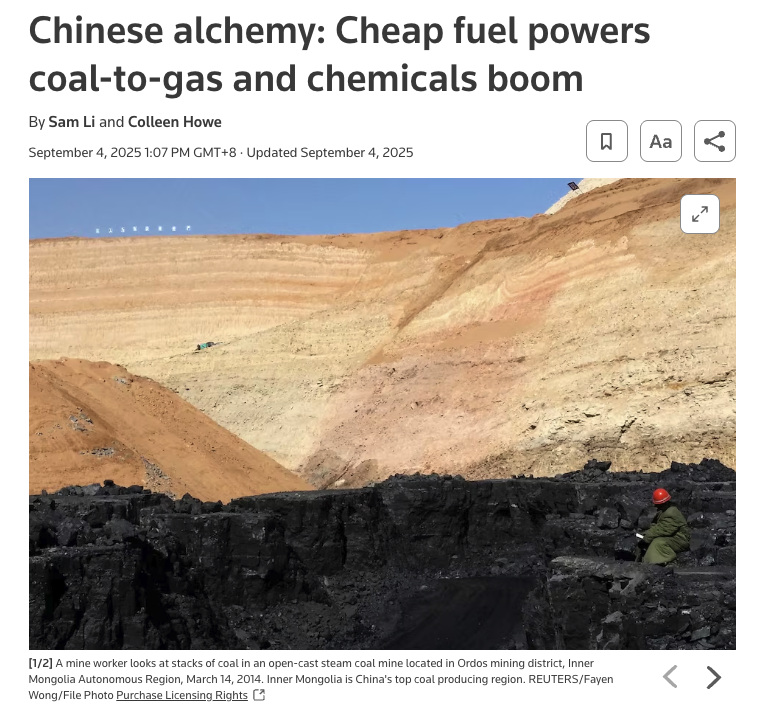
That said, China has actually scaled up coal-to-chemicals[a,c] (C2C), and there's also something more sci-fi called Power-to-X[b] which turns arbitrary power + water + air into hydrocarbons. But all of that will need to get accelerated. I have a background in chemical engineering so may start funding things in this area.
(7) Ultimately, this war is going to result in tremendous blame for anyone associated with it. It's a no-win scenario to blow up this much infrastructure for so many people. Simply not worth it for whatever objective they thought they were going to attain. But unless you're actually in a position to stop the madness, the pragmatic thing to do is: scramble to mitigate the fallout to yourself, your business, and your people.
[a]: reuters.com/business/energ…
[b]: alfalaval.com/industries/ene…
[c]: reuters.com/sustainability…
English
@michaeljmcnair @LukeGromen Gold was heavy prior to all of your Harry hindsight explanations - but good timing to release it the day when prices fall the most. You would’ve had my ear had you posted it at $5300
English

Gold and silver are not acting well in a period of rapidly rising geopolitical risks. We have an Iran War, Strait of Hormuz blockade, rising volatility. In the old framework, that setup should be close to ideal for gold. But once you understand what is now driving gold, this move makes perfect sense.
Something fundamental changed after the US and Europe froze Russian reserves in 2022. For decades, surplus countries parked their excess savings in US dollar assets, mostly Treasuries. The freezing of Russian reserves combined with the current administration's explicit push to discourage foreign countries from parking excess savings in US financial assets, forced surplus countries to rethink where they store reserves.
And those countries haven't changed their domestic policies that generate the excess savings, so those savings have to be placed somewhere. The result is that gold and silver have increasingly become the obvious “neutral” reserve assets.
That’s why gold decoupled from the three factors that used to explain it…real interest rates, volatility, and liquidity. Now reserve accumulation flows have become the primary driver.
That shift has a consequence I don’t think most investors have thought through. If gold is now primarily driven by reserve flows from surplus countries, then gold has become pro-cyclical.
Reserve growth is driven by export revenues, trade surpluses, economic growth in surplus economies. When the global economy is strong and surplus countries are generating large export revenues, their excess savings grow, their reserve accumulation accelerates, and gold catches a bid. When that surplus generation is disrupted, the bid weakens or reverses.
This is exactly what is happening with the blockade of the Strait of Hormuz.
The GCC countries are major reserve/gold buyers and now their export revenues are collapsing. They likely need to liquidate some reserves to cover fiscal obligations, and gold is one of their most liquid assets. Even if the reserve sales aren’t excessive yet, the market can see their reserve accumulation has stalled and probably reversed. That flow, which was a meaningful source of gold demand, has gone to zero at best.
There are also secondary effects on other surplus economies. China is the world's largest oil importer. An energy shock of this magnitude slows Chinese growth, and compresses Chinese surpluses, which slows Chinese reserve accumulation. That same growth shock ripples through Korea, Taiwan, Japan, and the rest of Asia.
The whole chain that has been driving gold higher, surplus countries generating excess savings that need a home outside the dollar system, is being disrupted by an event that in the old model would have been unambiguously bullish for gold.
This doesn't mean the structural case for gold is broken. The dollar standard is still ending. Surplus countries still need an alternative to Treasuries and gold is still the most obvious destination. But it does mean gold is going to be more volatile along that structural trend than most people expect, and the volatility will correlate with global growth and surplus generation rather than with the old drivers. Gold rallies when surpluses expand. Gold sells off when surpluses contract. Even if the reason for the contraction is rising geopolitical risk that, under the old model, should have sent gold to the moon.
English
@swfarids @alialsalim If people are unwilling to lose 10%, that means they are effectively buyers on a dip to 10%. If they thought it would fall 30%, they would step away from the deposit.
English

Correct ! but it is rather HEAVY penalty, 10% of the full unit price !
Very few people would be willing to lose that much to exit a deal that was just committed a month earlier.
I'm not saying sales will be affected.
All what I'm trying to explain is the concept of delayed impact, that can only be measured after 2-3 months. And this is typical in general statistics worldwide
English

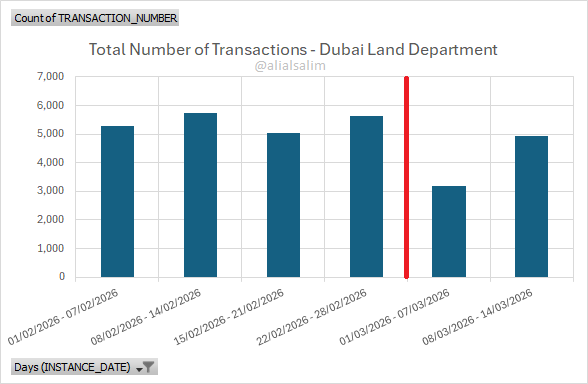
Incredible to see that despite the war, Dubai real estate transactions have been remarkably strong. 🇦🇪
Official data showing a drop in the first week of the US-Israeli war, now shows higher volumes for the second week, on par with the weeks both pre-conflict and pre-ramadan.
There's no doubt conflict will lower prices, however the market is still clearing.
Source: Dubai Land Department.
English
@biancoresearch Kharg is the scapegoat. Iranian oil can and does go through land pipelines. Many oil analysts have highlighted this..
English

Follow-up to above
---
Trade is the circulatory system of the world economy. It only works if it keeps flowing.
The Strait of Hormuz is the carotid artery of that system. If it gets blocked, oxygen stops reaching the brain. You do not have the luxury of patience. You clear it immediately, or the global economy suffers a massive stroke.
That helps explain the logic behind the Kharg strike.
The goal was not to clear the Strait by force. It was to tighten the pressure on Tehran by showing that the economic cost can rise quickly and sharply. Kharg sits too close to the center of Iran’s export system to be ignored. Even the threat to it carries real strategic weight.
The danger is plain enough. More pressure on Iran can also mean more pressure on global supply, higher oil prices, and a broader escalation.
So, the United States appears to be making a hard coercive bet: that a sharper warning now is still less costly than allowing Hormuz to remain shut for any length of time.
English
Let me offer discussion points on why they decided to bomb Kharg Island.
The administration and military planners likely concluded that it would take weeks, if not months, to secure the Strait of Hormuz. During that time, oil prices could rise to levels that would suffocate the global economy.
This was unacceptable. They are desperate for immediate action. So, they needed a bold, decisive move to force Iran to relent quickly.
Trump was clear. They bombed Iranian military structures on Kharg but left the oil infrastructure unharmed (assuming this is accurate).
Recognizing that this could freak out oil markets, they announced it on Friday evening to give markets 48 hours to digest the news. Trump also made it explicit that oil infrastructure would be next if Iran did not allow ships to pass freely through the Strait of Hormuz.
In football terms, they're throwing a Hail Mary pass now, hoping it works. They don't have any more time on the clock. Oil markets and the world economy cannot wait weeks or months for the military to open the Strait.
Further, I could envision political advisors suggesting that if oil prices are destined to hit $200 without this action, it might as well happen next week, giving six months to bring them down before the midterm elections.
As I've argued in many other posts, Trump cannot simply declare victory and pull out (TACO). That would be worse. It would leave Iran in control of the world's economic jugular, allowing it to punish everyone by permanently holding oil at $200. So, they must force Iran to relent.
Again, these are just the thoughts running through my head as I try to explain to myself why they took this step.
The White House@WhiteHouse
“Moments ago, at my direction, the United States Central Command executed one of the most powerful bombing raids in the History of the Middle East, and totally obliterated every MILITARY target in Iran’s crown jewel, Kharg Island... Iran has NO ability to defend anything that we want to attack — There is nothing they can do about it!" - President Donald J. Trump 🇺🇸
English
@biancoresearch 70%+ of the oil can be re-routed, and will be within weeks via:
1. Jones Act + Permitted flags through the strait
2. east/west pipeline + Fujairah
you're conflating geopolitics with actual physical shortage. the former is more uncertain than the latter
English
@LucasSa56947288 Read the post… didn’t strike oil infrastructure
If you want to be an armchair military analyst, do it from the line of fire instead of passing off sensationalist claims as the obvious outcomes
English

The Kharg Island is the heart of Iran’s oil exports.
Most of the country’s crude shipments pass through there, so hitting it is a huge blow to Iran’s economy and will very likely trigger Iranian retaliation against oil facilities in Gulf states across the region.
This is a very major escalation!!!!!
Lucas Sanders 👊🏽🔥🇺🇸@LucasSa56947288
🚨JUST IN: Donald Trump says that the U.S. forces “totally obliterated every military target” on Iran’s Kharg Island in a major bombing raid. DONALD TRUMP: AT MY DIRECTION, UNITED STATES CENTRAL COMMAND STRUCK KHARG ISLAND.
English
@michaeljmcnair @8teAPi Yes, same situation arose with European price caps on Russian oil.. change flags and rubber stamps but what’s in the barrel is more or less fungible.
English
If Iran allows Chinese cargoes through the Strait of Hormuz, it will break its own blockade. Iran can’t create a blockade that inflicts pain on everyone except China. That’s not how commodity markets work.
Commodities like oil are fungible. The benefit China gets from a carve out doesnt stay contained in China, even if Beijing wants it to. It spreads through the entire global market.
Every extra Gulf barrel China buys is one less barrel it has to buy from the rest of the world. In theory, nearly all Gulf supply could reroute through China. But the point isnt whether China literally takes every barrel. It’s that the more Gulf oil China buys, the less oil it has to buy from everyone else. And it is the act of China buying less from the rest of the world that transmits the relief globally. Trade routes change, and prices re-equilibrate.
That doesnt mean prices fall all the way back to the exact pre-war price. There would still be frictions. But it would dramatically loosen the market, especially relative to the alarmist view.
So Iran can’t have it both ways. It can’t maintain a blockade that economically punishes everyone else while sparing China. If China gets through at scale, China becomes the relief valve for the world. So they either keep the strait closed to everyone or the blockade breaks.
China and Iran must understand this. Which means the real game for China probably isn’t securing a full scale carve out immediately. China’s leverage is highest while the threat of the blockade remains real, and prices remain elevated, and Beijing can broker from a position of maximum leverage. The moment Chinese passage opens at scale, that leverage starts to evaporate along with the scarcity premium.
The US needs to understand this. If Iran wants to give China a shipping carve out, let them. It will gut the blockade and the benefits will be shared globally.
If Iran lets China through, it breaks the blockade. If it keeps China out, it isolates itself from its only lifeline.
Either way, the Strait is unlikely to stay closed for long…Which is why 6 month oil futures are still trading with a 7 handle.
English
@shanaka86 Later this year is different to “rest of this year”.
Your (AI-created) writing is click-bait, reductionist, sensationalism . Case in point for why it sucks that AI works tirelessly.. People like you should be screened for fanning misinformation
English

JUST IN: British Airways just cancelled all flights to Abu Dhabi until later this year. Not next week. Not next month. The rest of the year.
Over 21,000 flights have been cancelled across seven Gulf airports since 28 February. Dubai International, the world’s busiest hub for international passengers, is operating at 85% below normal capacity. Abu Dhabi is down over 50%. Etihad and Emirates are running limited repatriation and cargo flights only. Full scheduled services are suspended until further notice.
The list of carriers that have cancelled or rerouted: British Airways, Lufthansa, Air France, KLM, Delta, American Airlines, Cathay Pacific, Singapore Airlines, Air India, flydubai, Air Arabia, airBaltic, Qatar Airways. Suspensions range from 16 March to 28 March to open-ended. Europe-to-Asia long-haul routes are rerouting around the entire Gulf. Private charter evacuations from Muscat and Riyadh to Europe are running at 85,000 to 200,000 euros per flight, two to three times normal pricing.
The reason is not missiles. It is the same mechanism that closed the Strait.
Aviation war-risk insurers operate under the same actuarial logic as maritime P&I clubs. They model incident density per route per day. The IRGC’s 31 autonomous provincial commands, each with independent anti-aircraft missiles, drone arsenals, and pre-delegated firing authority that no living Supreme Leader has rescinded, create an incident-density profile that no insurer can price at commercially viable premiums. A single IRGC provincial commander can independently decide to target an aircraft transiting the Gulf without consulting Tehran, without consulting other commands, and without the wounded Mojtaba Khamenei issuing an order. The aviation insurers modelled this and withdrew.
The question everyone asks: can the UAE provide fighter jet escorts for every commercial flight to restore confidence?
No. Dubai International handled approximately 1,100 flights per day before the war. Abu Dhabi handled over 300. Providing continuous fighter escort for 1,400 daily commercial movements would require dozens of dedicated aircraft in permanent rotation, thousands of additional flying hours per week, and diversion of F-16 and Mirage squadrons currently defending Ruwais, ADNOC facilities, and the population from Iranian drone and missile barrages. The UAE Air Force has approximately 79 F-16E/F Block 60 and 55 Mirage 2000-9 aircraft. They are currently intercepting over 1,500 Iranian projectiles. There are no spare fighters to babysit every Emirates 777 from takeoff to cruising altitude.
Even if escorts were feasible, they would not solve the insurance problem. Aviation war-risk underwriters do not price fighter escorts. They price the probability of a shootdown event. That probability is determined by the number of autonomous threat actors with anti-aircraft capability in the airspace. Thirty-one IRGC commands with that capability means thirty-one independent probability nodes. Escorts reduce interception time. They do not reduce the number of actors who might fire.
Dubai built itself as the world’s connecting hub. Sixty percent of the global population within an eight-hour flight. Over 90 million passengers in 2023. The entire business model depends on uninterrupted airspace that airlines will insure and passengers will trust. Both are gone.
British Airways does not cancel until year-end for a two-week war. It cancels until year-end because its insurers modelled the Mosaic Doctrine and concluded the same thing the P&I clubs concluded on 5 March: the probability that 31 autonomous commands will simultaneously refrain from threatening Gulf airspace is near zero.
The Strait closed by spreadsheet. The airport closed by the same spreadsheet.
Full analysis in the link.
open.substack.com/pub/shanakaans…

Shanaka Anslem Perera ⚡@shanaka86
Dubai just shut down. The busiest international airport on earth. Closed. Indefinitely. Dubai International and Al Maktoum International both suspended all operations on February 28 per official Dubai Airports statement. Over 280 flights canceled. 250 more delayed. The airspace that handles more international passengers than any hub on the planet went dark this morning because Iranian ballistic missiles were flying through it. Now read the airline list and understand the scale of what just broke. Emirates. Grounded. Etihad. Grounded. Qatar Airways. Suspended all flights to and from Doha after Qatari airspace closed. Air India. Every single flight to every destination in the entire Middle East. Suspended indefinitely. Turkish Airlines. Suspended flights to Bahrain, Iraq, Iran, Jordan, Kuwait, Lebanon, Oman, Syria, Qatar, and the UAE until at least March 2. Lufthansa. Dubai suspended. Air France. Tel Aviv and Beirut suspended. Wizz Air. Israel, Dubai, Abu Dhabi, and Amman suspended until March 7. British Airways. Affected. Virgin Atlantic. Affected. Japan Airlines. Affected. Norwegian Air, LOT Polish, Scandinavian Airlines, Aegean, Iberia, Air Arabia, PIA, Saudia, Air Algerie. All affected. All grounded or rerouting. This is not a regional disruption. This is the global aviation network breaking at one of its most critical nodes. Dubai is not just an airport. It is the single largest connecting hub between Asia, Europe, Africa, and the Middle East. Every flight from Mumbai to London, from Singapore to Frankfurt, from Nairobi to New York that routes through the Gulf is now either canceled, delayed, or burning extra fuel on thousand-mile detours around closed airspace. IndiGo just suspended flights to Almaty, Baku, Tashkent, and Tbilisi until March 28. Not March 2. March 28. A month of Central Asian connectivity erased because Iranian missiles crossed the flight paths. The cost is compounding by the hour. Rerouted flights burn more fuel when oil is spiking past 100 dollars a barrel because the same conflict that closed the airspace is threatening the strait that moves 21 million barrels a day. Airlines are paying surge prices for fuel to fly longer routes around a war zone that did not exist yesterday morning. Every hour the airspace stays closed, the losses multiply across carriers already operating on thin margins. And here is what nobody is calculating yet. Dubai’s economy runs on connectivity. Tourism. Trade. Finance. Logistics. All of it depends on DXB being open. The UAE just absorbed an act of war on its sovereign territory with a civilian killed in Abu Dhabi from missile debris. The country that built its entire economic model on being the safe, neutral, connected hub of the Middle East is now closed for business because the country it had no quarrel with fired missiles through its airspace. Iran did not just attack military bases this morning. Iran shut down the economic engine of the Gulf. That is a cost Tehran cannot afford to repay and the UAE will not forget.
English
That first move is too stunning to ignore.
White mates in 2 🤔🤔
English
@shanaka86 @BillAckman You’ve trained your AI well to post well with high frequency and varying tone :)
English
Everyone is counting Iran’s missiles. They are counting the wrong thing.
The number that determines the outcome of this war is not 2,000 or 2,500 or 3,000. Those are pre-war missile inventory estimates and they are now largely irrelevant. The number that determines the outcome is the one that moved from 504 to 29 in five days.
On Day 1 of Operation Epic Fury, Iran fired 504 ballistic missiles and drones across the Gulf theater. On Day 5, the number was 29. That is a 94 percent collapse in daily launch volume in less than a week. Not because Iran ran out of missiles. Because Iran ran out of the thing that launches them.
Launchers.
The ballistic missile is a precision munition that requires a precision launch platform. Iran entered this war with approximately 200 operational launchers, rebuilt from the roughly 100 serviceable platforms that survived the June 2025 Israel-Iran war. JINSA assessed that 75 percent of those launchers have been destroyed through March 5. The B-2 strike on the underground Damavand missile base east of Tehran, which CENTCOM confirmed today, targets the category of facility designed to protect launchers from exactly this kind of attrition. Damavand is not a missile warehouse. It is a launch infrastructure complex, the place where the hardware that puts missiles in the air is hardened and sheltered below ground.
The GBU-57 Massive Ordnance Penetrator does not care about the rock above Damavand. That is what it was designed to not care about.
Iran’s missile doctrine was built on volume and simultaneity. The mass salvo, hundreds of missiles launched in coordinated waves from dispersed platforms designed to overwhelm Iron Dome and US Patriot batteries by saturating their intercept capacity, is the only mechanism by which Iran’s missile force constitutes a genuine strategic threat to Israel. A degraded launcher pool that can produce 29 fires per day is not a mass salvo capability. It is a harassment capability. The two are not the same threat in any meaningful military sense.
The Damavand strike is not simply another underground complex attacked. It is the US targeting the reconstitution node, the facility where surviving or replacement launchers would be sheltered, maintained, and redeployed. Destroying Damavand does not just eliminate what is there. It eliminates the survivability architecture that would allow the launcher fleet to recover.
Day 1: 504 fires.
Day 5: 29 fires.
The trajectory of that number is what the B-2 was sent to Damavand to continue. Every penetrator bomb that goes into that mountain is not destroying a missile. It is foreclosing the operational recovery that would allow the 29 to become 504 again.
The missiles still exist in tunnels and caches across Iran. They are increasingly becoming missiles with nowhere to go.
open.substack.com/pub/shanakaans…
Shanaka Anslem Perera ⚡@shanaka86
The B-2 is not a bomber. It is a key. And there is only one thing on earth it was built to unlock. The GBU-57 Massive Ordnance Penetrator. Thirty thousand pounds. The largest non-nuclear bomb in the American arsenal, developed at a cost of $330 million over a decade of classified engineering, built for a single strategic purpose: to reach what Iran spent fifteen years burying beneath mountains. The B-2 Spirit is the only aircraft on earth capable of delivering it. Four of them flew from Diego Garcia. Twelve Iranian underground missile complexes have been struck. The underground infrastructure of the Iranian ballistic missile program is not a storage problem. It is a statement. The IRGC began tunneling after the 1991 Gulf War demonstrated what American air power could do to surface targets in a single week. The conclusion Iranian military planners drew was absolute: anything that exists above ground can be destroyed. So they built downward. Facilities assessed at 60 to 80 meters of reinforced rock. Tunnel networks carved into the Zagros Mountains. Launch complexes hardened against everything in the American arsenal except the one weapon that required a $2.1 billion aircraft to deliver and a targeting intelligence apparatus that took decades to build. They called it the “city of missiles.” A network of tunnels beneath mountains, pre-sited, pre-stocked, built to survive the opening strikes of any war and preserve the ability to launch after the surface was destroyed. The entire Iranian deterrence architecture for the last twenty years has rested on the calculation that the underground survived. Four B-2s just tested that calculation against twelve complexes. The IRGC’s claim that facilities remain intact is expected and unverifiable from outside. The observable data point is the one that matters: Iran launched cluster warheads at Tel Aviv from mobile systems after the B-2 strikes, which means mobile launch capability persists. But mobile launch capability is not the same as tunnel-based mass launch capability. The distinction is volume, coordination, and survivability. A mobile launcher is one vehicle with one missile. A tunnel complex is a coordinated mass salvo architecture designed to overwhelm Iron Dome simultaneously from multiple vectors. Those are different weapons in every meaningful strategic sense. If the IRGC’s underground complexes are destroyed, Iran retains the ability to launch harassment attacks. It loses the ability to launch the mass salvo that saturates Israeli air defense. The difference between those two capabilities is the difference between a war Iran can sustain and a war Iran can win. The Zagros Mountains have been Iran’s strategic depth for twenty years. Four aircraft flew from an island in the Indian Ocean, penetrated Iranian airspace undetected, and put thirty-thousand-pound bombs into the mountain. The mountain was the plan. The mountain is now the problem. open.substack.com/pub/shanakaans…
English
@cryptorand @cz_binance This chart is only ballistic missiles , not cruise missiles or drones unfortunately
English

The Iran missile chart is the most important geopolitical visual of 2026. Not because of the 350 on day one. Because of the zero on day ten
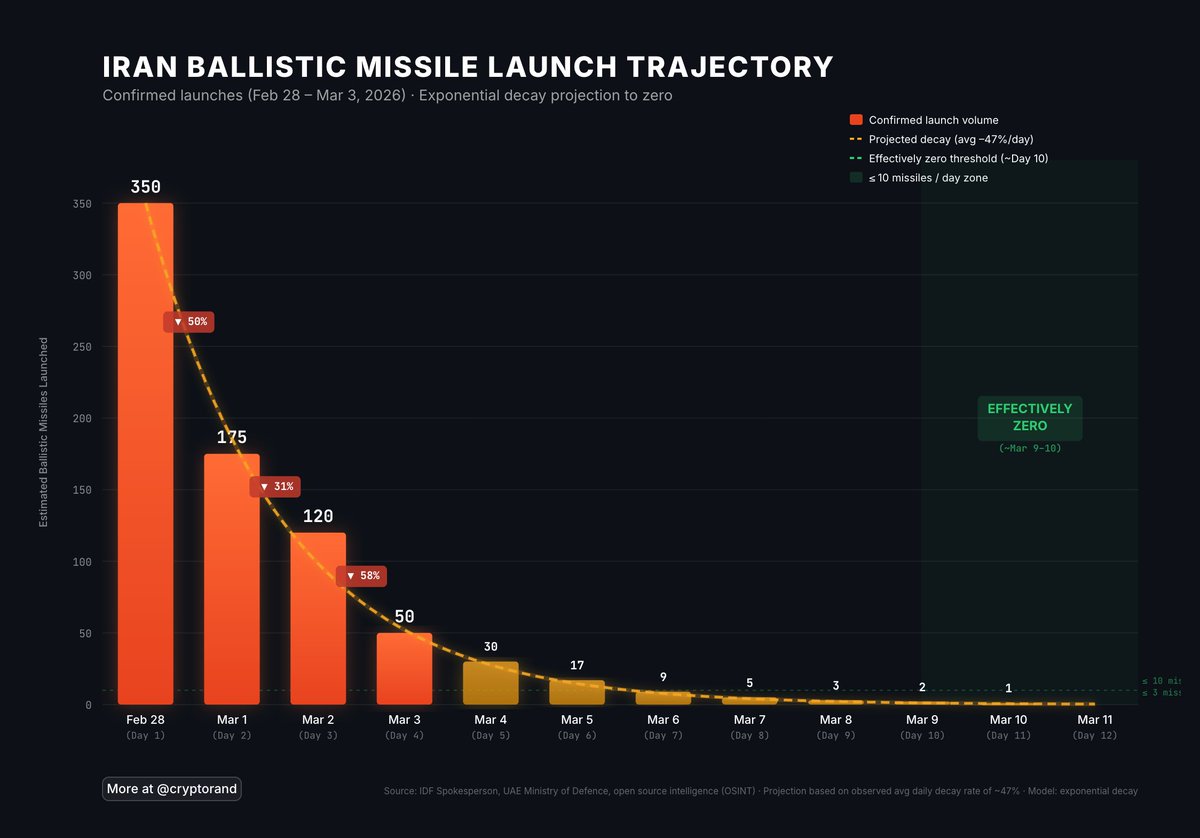
English
@shanaka86 your numbers need updating. these costs can be per ticket depending on destination.
English
The first real signal of a war is not the missile.
It is the price of exit.
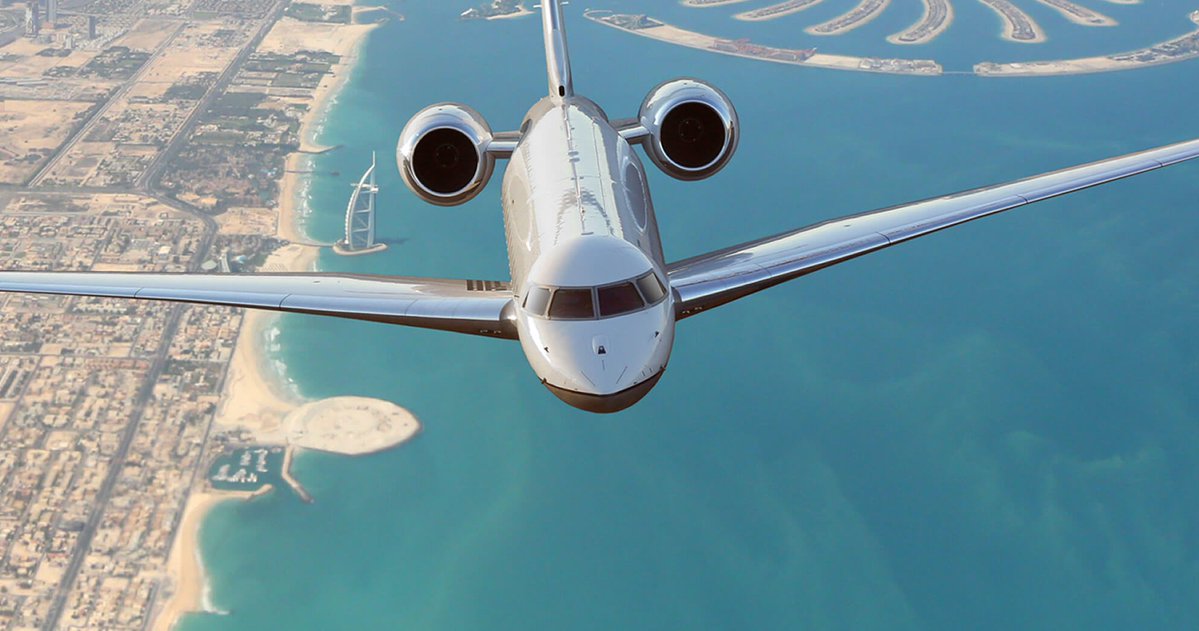
Tonight the ultra rich are paying up to £260,000 ($350,000) for a single private jet charter just to get out of the Gulf, because the normal map is gone.
Dubai, Doha, Abu Dhabi, the transit machine that moves the planet’s people and capital, is effectively paused. Airspace restrictions, security alerts, mass cancellations, crews stranded.
So the evacuation route is medieval in a futuristic wrapper.
Step 1: disappear from the skyline.
Step 2: get picked up by a private security team.
Step 3: sit in an SUV convoy for a brutal 10 hour drive across desert highways to Riyadh, one of the few hubs still functioning.
Step 4: buy a seat on a jet that has no refunds, no guarantees, and a contract built around force majeure.
That is not travel.
That is a market discovering what “permission to leave” costs when the state cannot provide normality.
Here is the part everyone misses: this is how regimes change.
Not through speeches. Through pricing.
When commercial aviation freezes, the world splits into two economies overnight.
One economy waits in terminals, refreshes apps, sleeps on floors, runs out of cash, runs out of options.
The other economy converts money into motion and motion into safety.
And the premium they are paying is not for leather seats.
It is for probability.
The same logic will hit everything next.
Insurance reprices first.
Freight and shipping lanes follow.
Energy and commodities move from “supply” to “security.”
Then credit tightens because every lender realizes the collateral has a missile shaped tail risk.
You are watching a new global tax being born.
Call it the volatility tax.
Call it the verification tax.
Either way, the bill is rising and it is not being paid equally.
Question: when the price of exit goes parabolic, what do you think happens to the price of everything else?
open.substack.com/pub/shanakaans…
Shanaka Anslem Perera ⚡@shanaka86
Dubai just shut down. The busiest international airport on earth. Closed. Indefinitely. Dubai International and Al Maktoum International both suspended all operations on February 28 per official Dubai Airports statement. Over 280 flights canceled. 250 more delayed. The airspace that handles more international passengers than any hub on the planet went dark this morning because Iranian ballistic missiles were flying through it. Now read the airline list and understand the scale of what just broke. Emirates. Grounded. Etihad. Grounded. Qatar Airways. Suspended all flights to and from Doha after Qatari airspace closed. Air India. Every single flight to every destination in the entire Middle East. Suspended indefinitely. Turkish Airlines. Suspended flights to Bahrain, Iraq, Iran, Jordan, Kuwait, Lebanon, Oman, Syria, Qatar, and the UAE until at least March 2. Lufthansa. Dubai suspended. Air France. Tel Aviv and Beirut suspended. Wizz Air. Israel, Dubai, Abu Dhabi, and Amman suspended until March 7. British Airways. Affected. Virgin Atlantic. Affected. Japan Airlines. Affected. Norwegian Air, LOT Polish, Scandinavian Airlines, Aegean, Iberia, Air Arabia, PIA, Saudia, Air Algerie. All affected. All grounded or rerouting. This is not a regional disruption. This is the global aviation network breaking at one of its most critical nodes. Dubai is not just an airport. It is the single largest connecting hub between Asia, Europe, Africa, and the Middle East. Every flight from Mumbai to London, from Singapore to Frankfurt, from Nairobi to New York that routes through the Gulf is now either canceled, delayed, or burning extra fuel on thousand-mile detours around closed airspace. IndiGo just suspended flights to Almaty, Baku, Tashkent, and Tbilisi until March 28. Not March 2. March 28. A month of Central Asian connectivity erased because Iranian missiles crossed the flight paths. The cost is compounding by the hour. Rerouted flights burn more fuel when oil is spiking past 100 dollars a barrel because the same conflict that closed the airspace is threatening the strait that moves 21 million barrels a day. Airlines are paying surge prices for fuel to fly longer routes around a war zone that did not exist yesterday morning. Every hour the airspace stays closed, the losses multiply across carriers already operating on thin margins. And here is what nobody is calculating yet. Dubai’s economy runs on connectivity. Tourism. Trade. Finance. Logistics. All of it depends on DXB being open. The UAE just absorbed an act of war on its sovereign territory with a civilian killed in Abu Dhabi from missile debris. The country that built its entire economic model on being the safe, neutral, connected hub of the Middle East is now closed for business because the country it had no quarrel with fired missiles through its airspace. Iran did not just attack military bases this morning. Iran shut down the economic engine of the Gulf. That is a cost Tehran cannot afford to repay and the UAE will not forget.
English