James Emanuel

722 posts

James Emanuel banner
James Emanuel

James Emanuel

@Delta9Echo

Tweets must not be relied upon for your investment decisions. Do your own research, seek independent advice. We may have a position in securities mentioned.

London, England เข้าร่วม Kasım 2018
200 กำลังติดตาม483 ผู้ติดตาม
James Emanuel
James Emanuel@Delta9Echo·
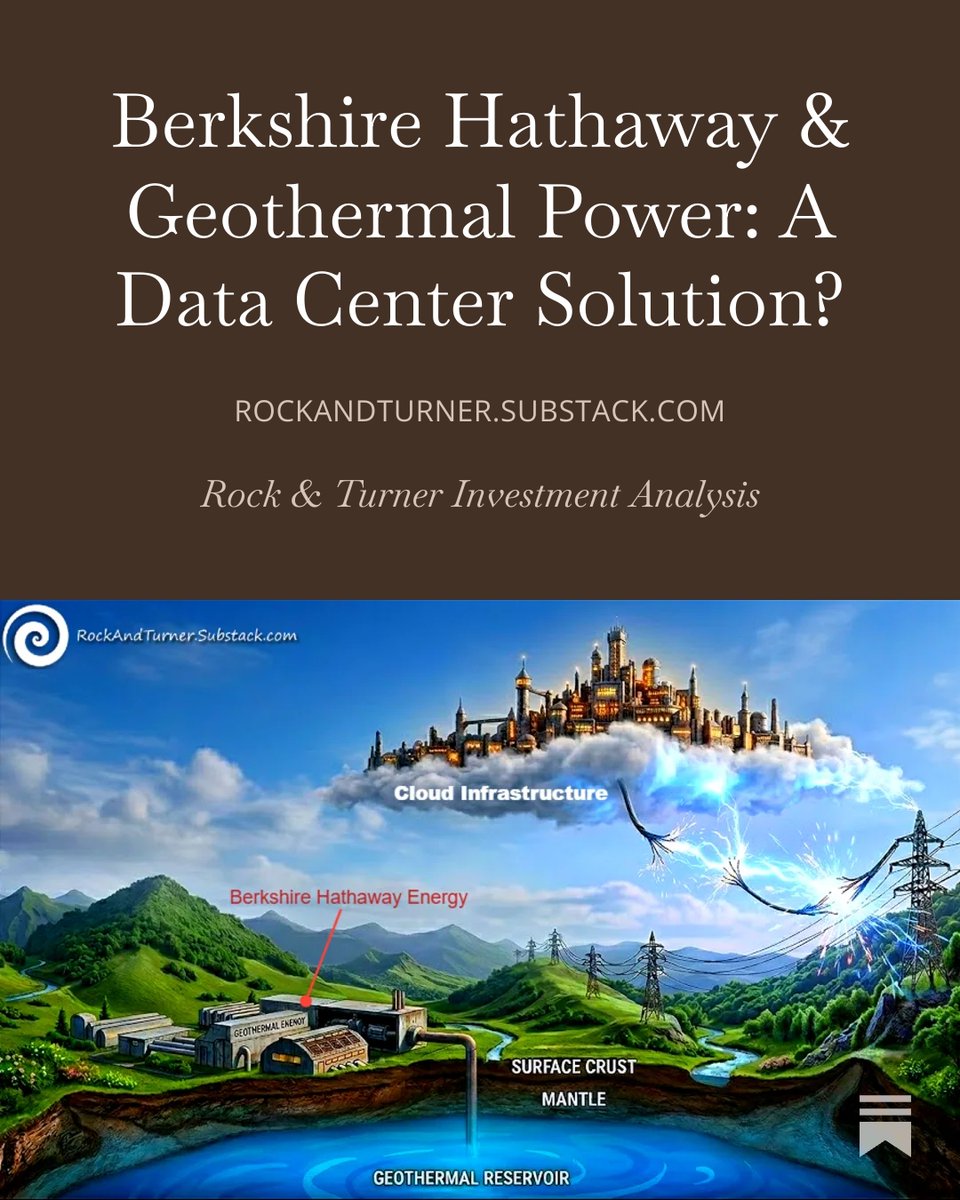
ServiceNow, down 60% from its peak. A great buying opportunity with AI as a tailwind? Or further to fall as a victim of the AI revolution. I decided to investigate for myself... Full analysis: open.substack.com/pub/rockandtur… $NOW $SPY $QQQ $MSFT $CRM $ADBE
James Emanuel tweet media
English
0
0
1
153
James Emanuel
James Emanuel@Delta9Echo·
@afc @bgurley It's nothing to do with dilution. It's about the amount of capital burned masking/offsetting dilution. That's where the damage is being done. I suggest re-running your numbers through that lens.
English
0
0
1
180
Alex Clayton
Alex Clayton@afc·
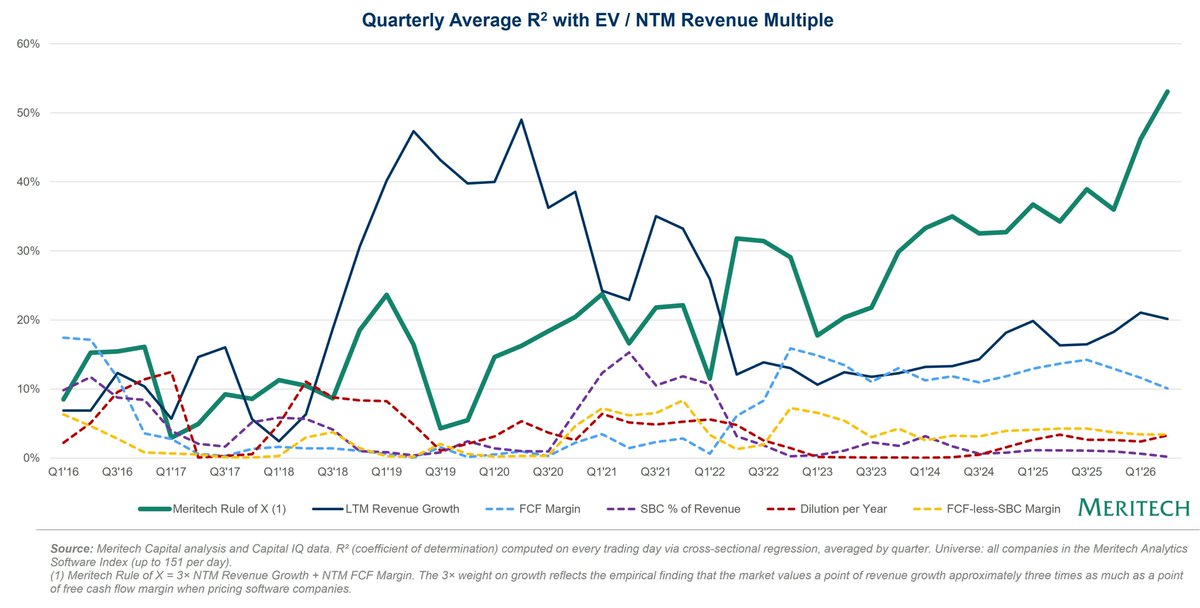
@bgurley we have been doing some analysis on this...I don't agree that SBC is the root cause based on the data. == SBC (stock-based compensation) is not the root cause of the selloff in software — it's slowing revenue growth as AI threatens the core value proposition of sticky, recurring revenue and ever-growing absolute free cash flow. SBC is a derivative of this (to be clear, it should be treated as a cash expense). We looked at 1.5M data points from 10 years of trading data across 141 companies, and there is no discernible correlation between either dilution per year or SBC as a % of revenue and valuation multiples. The Street cares about revenue growth. Each time there is a correction and/or growth slows, as it did in 2022, the SBC comments emerge. That is not to say that dilution is not important, because it is, but high and durable revenue growth matters much more. For example, over the past 10 years, 88% of the time, there is a stronger correlation between revenue growth and valuation multiples than between any SBC, dilution, or free cash flow metric. Moreover, 100% of the time (by quarter) over the past 10 years, reported free cash flow had a higher correlation to valuation than free cash flow less SBC. The market has never, in any single quarter over the past decade, placed more value on SBC-adjusted free cash flow than on reported free cash flow…. A few other notes: we looked at every company that has been continuously in the public software index over the past 10 years (33 companies with full 10-year track records). Dilution explains 12% of return variance; SBC as a % of revenue has essentially zero correlation with returns (r-squared of ~0). Revenue CAGR is the single strongest predictor, explaining 41% of 10-year return variance (r-squared=0.41). The top quartile by share price return over the past ten years (SHOP, AXON, TTD, PANW, NOW, APPF, HUBS, TWLO) diluted a median 47% and returned a median 635%. The bottom quartile of share price returns (RPD, BLKB, OTEX, PRGS, FIVN, BL, SGE, SPSC), which included 4 net share buyers, returned a median of (7)% and had a median cumulative dilution of 4% (basically nothing!). The pattern is clear: the best-performing software companies used equity aggressively to attract top talent and fund growth, while the most capital-conservative companies delivered the weakest returns. Even during the 2022–2023 rate-hike correction — the most hostile environment for growth stocks in a decade — growth metrics only lost to FCF and SBC metrics in 3 consecutive quarters before reasserting dominance. Many public software companies are in a "burn the ships" moment, figuring out how to grow revenue faster, which requires getting into the token flow. It's almost akin to being an offline business in 1997 and needing to go online. Public technology markets care about high, durable revenue growth, and I don't believe that, looking back in 10 years, the companies that didn't make it will be the ones that just limited SBC. It will be the ones that failed to innovate / hire the best people, and failed to achieve high, durable revenue growth. This is clear when looking at this chart over time...the market cares about Rule of X (which is mostly growth).
Alex Clayton tweet media
Bill Gurley@bgurley

x.com/i/article/2042…

English
5
6
70
10.6K
James Emanuel รีทวีตแล้ว
David Barbato
David Barbato@Valuehunte·
In this @MicroCapClub Business Breakdown, Erik Voss and I sat down with Enterprise Group’s $E.TO/ $ETOLF President and Director Desmond O'Kell. The company was originally profiled on MicroCapClub by member @Delta9Echo This discussion took place live on March 23rd, 2026, on the MicroCapClub Community. Join MicroCapClub and unlock the ability to listen and participate live in these discussions - #join" target="_blank" rel="nofollow noopener">microcapclub.com/#join In this detailed interview, Desmond O'Kell, President and Director of Enterprise Group, shares insights into the company's operations, growth strategies, and the future of natural gas and site power solutions in Canada. Discover how Enterprise is leveraging innovative turbine technology, market opportunities, and strategic initiatives to drive sustainable growth in the resource and construction industries. Chapters Introduction to Enterprise Group and Daz O'Kell Overview of Enterprise Group's Operations and Financials Strategic Positioning in the Natural Gas Market Innovative Power Solutions and Sustainability Client Base and Market Expansion Opportunities Financial Snapshot and Future Outlook Discussion on Natural Gas Production Outlook Business Development Strategies and Challenges Customer Relations and Revenue Impact Flex Turbine Acquisition and Financial Insights CapEx Management and Future Projections Navigating Financial Visibility and CapEx Strategy Sales Initiatives and Market Focus Pricing Strategy and Market Penetration Diversifying Customer Base and Utilization Rates Buyback Strategies and Legacy Contracts Opportunities for Growth and Competitive Landscape
MicroCapClub@MicroCapClub

Here is our latest business breakdowns with @Valuehunte and Erik Voss sitting down with Enterprise Group’s $E.TO $ETOLF CEO Desmond O'Kell microcapclub.com/enterprise-gro…
English
0
2
5
2K
James Emanuel
James Emanuel@Delta9Echo·
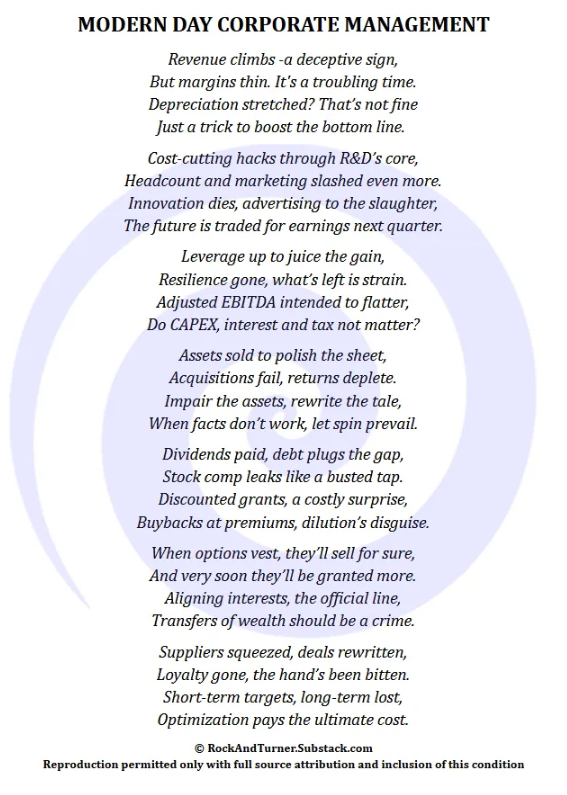
Love this... so true.
James Emanuel tweet media
English
0
0
1
79
James Emanuel รีทวีตแล้ว
Brett Caughran
Brett Caughran@FundamentEdge·
AI won't kill fundamental investing because more information doesn't kill alpha. We have decades of priors here (Excel, Bloomberg, alt data...all democratized analysis & information gathering, and didn't kill alpha). As measured by factor volatility, stocks are less efficient and more alpha-rich than ever (and empirically, the ability of multi-eight figure market neutral multi-managers to consistently grind out 10-15% returns in an idio-maximized way proves this point...15 years ago a $10bn hedge fund was considered to be impossibly large). Innovations in investment process have shifted alpha pools, for sure, and systematic investors have arbitraged many old, reliable fundamental alpha pools. But as the players at the poker table have shifted, the constraints of those new players have created new alpha pools. Long duration fundamental investing has been gutted, and definitionally competing against a group of non-fundamental (quants, factor/thematic investors, indexers) and duration-constrained (multi's) investors should be a huge competitive advantage, long term (however frustrating in the near term). To wit, a 9-month thesis where I "look through" the next two prints is now considered a long-term thesis. Rigorous investment process serves investment judgment, but the real alpha generation fits a power-law distribution and there is some ineffable "nose for money" that the great investors have, that cannot be trained necessarily. Investing is a very hard game, that cannot be distilled to a reinforcement learning sandbox (by the time it is, the regime will have shifted and new drivers move stocks). AI has no sense of materiality, no true discernment, and the lack of context of N of 1 situations (if you haven't noticed, we are living in an N of 1 world!). There is a irreducible element of humanness that is critical to success in fundamental investing, and that won't change. What does this all mean? In my opinion, there is no better time to be starting a careers as an investor. My first year on the desk, I spent a lot of time doing grunt work: updating Nielsen files, updating models for my PM, creating same store sales master files, building question lists for CEO meetings, etc. This is grunt work. I can automate this all now, and get more quickly to the deep, value added parts of learning the investment process. Will AI drive alpha? This is a debate people are having, which I find sort of silly. When used correctly, by the right investor, of course it will. Ask any great investor if they had another 4 hours of research time per day whether the quality of their research would improve? That's kind of a dumb question...of course it will. Compressing the mechanical part of your job to focus more on the artisanal part of the job is Step 1, and with agentic systems accelerating fast is now in the strike zone of possibility. This is before we start to layer in a broader monitoring net and use cases to go deeper and build more rigor, finding signals in unstructured data that were missed before, as well as turning your investment genius into a co-pilot pattern recognition system. The future is very bright for fundamental investing, in my opinion.
English
70
173
1.5K
634.5K
James Emanuel
James Emanuel@Delta9Echo·
@jackimaniel @KobeissiLetter The question that needs to be asked is whether any 'insiders' are exploiting these whipsaw movements. Knowledge of a forthcoming Presidential announcment is MNPI. Whether or not any of this is deliberate for the purpose of wealth generation is something worthy of a formal inquiry
English
1
0
2
357
Jacki Maniel
Jacki Maniel@jackimaniel·
What you are watching is a market that has completely lost its ability to price geopolitical risk because the signal source itself is unreliable. $3 trillion in 56 minutes is not volatility. That is a market being whipsawed by a single actor whose statements have no verifiable relationship to reality. Trump’s post added $2 trillion on zero confirmed facts. Iran’s denial erased $1 trillion on five specific factual rebuttals. The net result is markets are now lower than before the “productive conversations” post, which means the denial did more damage than the original claim did good. The structural problem this chart exposes is profound. Algorithmic trading systems are now pricing presidential Truth Social posts as market-moving events (which honestly they are) in real time. There is no human verification layer between Trump posting and hundreds of billions moving. When the post is false or exaggerated, the correction is equally mechanical and equally fast. You get exactly this chart. The $1 trillion that did not come back is the market applying a credibility discount. It is saying the relief rally was worth $2 trillion but after the denial, the underlying situation is actually worse than before Trump posted because now we know the ultimatum failed AND there are no talks AND Iran is claiming victory AND Hormuz stays closed on Iran’s terms. This chart is also evidence for the bond market thesis. Every episode like this pushes institutional investors further toward the exit on risk assets. The 10Y yield pressure does not relieve from a morning like this. It builds. What is happening here is a president moving global markets with statements Iran is calling psychological warfare. The market just learned that lesson at a $3 trillion tuition cost in under an hour.​​​​​​​​​​​​​​​​ Bloody Hell
English
21
131
549
51.1K
The Kobeissi Letter
The Kobeissi Letter@KobeissiLetter·
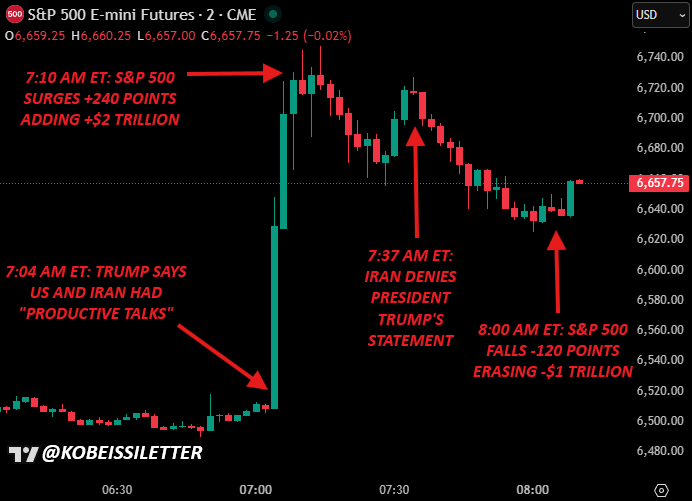
This is absolutely insane: At 7:04 AM ET today, President Trump said “the US and Iran have had productive discussions" to end the Iran War. By 7:10 AM ET, the S&P 500 surged +240 points adding +$2 TRILLION in market cap. 27 minutes later, Iran completely denied all of President Trump's claims and said there has been "no contact" with the US. By 8:00 AM ET. the S&P 500 had fallen -120 points erasing -$1 trillion in market cap. That's a $3 TRILLION swing market cap in 56 minutes, just in the S&P 500. What is happening here?
The Kobeissi Letter tweet media
English
2.3K
7.7K
27K
5.9M