
ทวีตที่ปักหมุด
sats
3.4K posts


@TimUPLend I am not sure I follow 100%. The PL is only estimated strictly in-sample up until time t. There is no look-ahead in the model. Based on past data, the distributional forecast is derived.
English
@Giovann35084111 You should show the same plot on other assets too for comparison.
English

One of the coolest graph ever in all history of Bitcoin. Watch the Veritasium video in the comments to understand the general significance of what is described below.
What it is: At each of the 4,084 consecutive data points, we have a vector Fᵢ = (Δlog t, Δlog P) — just the step the price takes in log-log space. We normalize these to unit direction vectors, then interpolate them onto a regular 40×40 grid across the (log t, log P) plane using scattered data interpolation.
The curl is then computed numerically on that grid:
curl(F) = ∂Fy/∂x − ∂Fx/∂y
Red regions mean the field locally rotates counterclockwise — price is accelerating upward relative to what the field direction would suggest, like the leading edge of a bull run.
Blue regions mean clockwise rotation — price decelerating, bear market structure.
What's striking is the pattern isn't random noise — there's clear spatial structure.
The red and blue regions are organized relative to the power law line (gold), with a tendency for red above and blue below in certain time periods.
This is the rotational component that the Helmholtz decomposition will isolate — the part that represents the boom-bust cycling around the power law attractor rather than motion toward or away from it.

English
@davelund_ honestly I think it’s more likely they do some kind of IOU lending so that btc stays completely in cold storage.
English

@TimUPLend Security is a concern and should be taken seriously. Yield is no free lunch and deploying a hot wallet can be (but isn't always) more risky than cold storage. Check this video out for more on Lightning security x.com/i/status/20351…
Dave Lund@davelund_
How bitcoin treasury companies can earn native yield through Lightning and Ark, without giving up custody. Covers the infrastructure opportunity, OpenArk, and why security is the real moat. If your BTC is sitting idle on a balance sheet, this is for you.
English
English

@c0de4c0ffee @tempo don't get me wrong lightning is still terrible, mainly because a good state channel layer needs a sufficiently scalable base layer to make channel maintenance cheap.
Not to mention the lack of expressivity in bitcoin scripts limiting how flexible you can make watchtowers etc.
English

I think I can rival Luxor’s analytics. Using my modeling of the bitcoin network and miner revenue and load flexibility, I can provide operational insights and revenue forecasting tailored to a given facility’s needs.
I could build that for you, or with you. Let’s talk.
English

rave reviews about this product, likely to lift them into their next round of valuations
x.com/perplexity_ai/…
Perplexity@perplexity_ai
Perplexity Computer now connects to your health apps, wearable devices, lab results, and medical records. Build personalized tools and applications with your health data, or track everything in your health dashboard.
English
Applying Sharpe to an instrument designed for low volatility, plus a period mismatch (annualized returns ÷ 30D vol), et voilà, an inflated Sharpe ratio.
Michael Saylor@saylor
$STRC volatility has reached an all-time low of 1.5%, driving its Sharpe Ratio to an all-time high of 5.37—setting a new standard for risk-adjusted performance.
English
interesting research question
vitalik.eth@VitalikButerin
CC @drakefjustin Basically, to remove the 32 ETH minimum (eg. reduce it to 1 ETH) we would have to be able to handle >1-10m validators in the network (depending on how much ETH is staked). From a raw bandwidth perspective, this *is* theoretically feasible, because you can get the bandwidth overhead of recursive SNARK aggregation down all the way to 1 bit per participant per slot + O(1) overhead. But in practice, that requires conservative parameter choices that increase latency: basically, do perhaps 4 rounds of aggregation instead of 2. This will not affect slot time (as available chain is a separate mechanism). But it will affect finality time (eg. maybe instead of 8-16 second finality we would have 16-32 second finality). So that's the tradeoff that the ecosystem would have to accept.
English
@lukedewolf @stephanlivera @adam3us @SvartHette @Pledditor @TheBlueMatt @Liquid_BTC “don’t know the outcome” but let’s change bitcoin anyway? lol
English

@stephanlivera @adam3us @SvartHette @Pledditor @TheBlueMatt @Liquid_BTC I've seen your math on this. Friction is friction. Cost is cost. And we don't know the outcome until it happens. So either we'll find out, or we won't.
English


@Giovann35084111 ok then I need to check how you defined the label. Could be that the signal came too late to be useful, ie, the market has already gone up/down a lot.
English
@TimUPLend No, it is not in sample. I used 50 % to train and the prediction is out of sample.
English
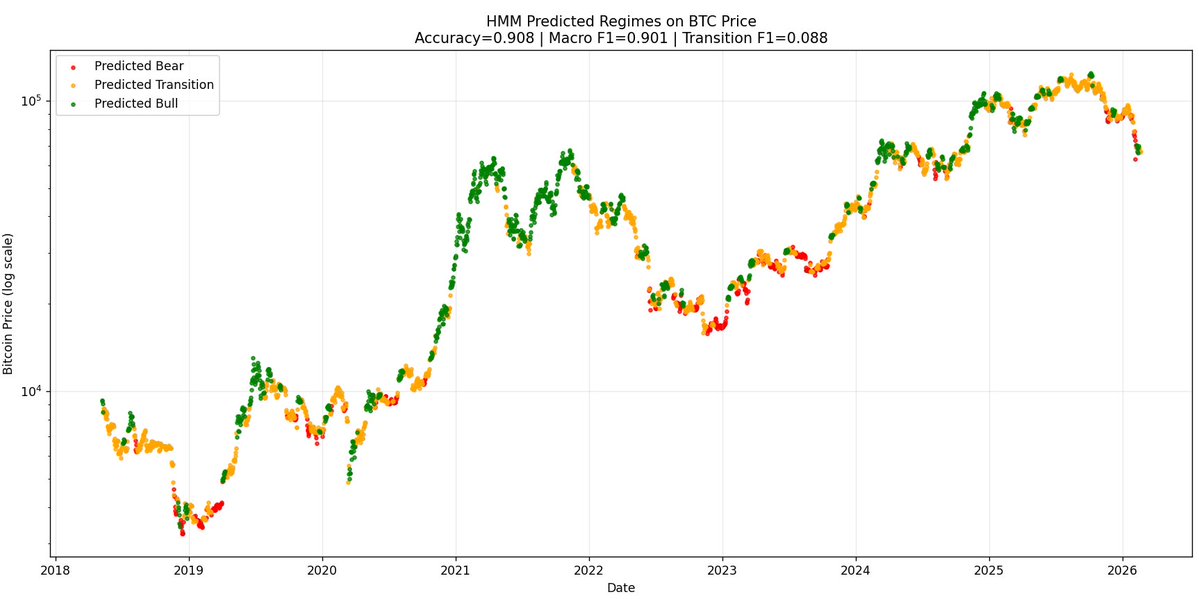
You can build a Hidden Markov Model (HMM) using the slopes of Bitcoin’s growth to identify and predict three regimes: bullish, transition, and bearish. In preliminary tests, this approach can classify the regime with around 90% accuracy.
Below is a link to a Veritasium video that explains how Hidden Markov Models work and why they are powerful tools for prediction problems.
HMMs are widely used in quantitative finance; notably, variations of this technique were reportedly among the methods employed by Jim Simons’ Medallion Fund, one of the most successful trading strategies in history.
English

Once Strategy signals to the market that STRC enables them to be in the market buying Bitcoin aggressively every week.
Likely Bitcoin will reprice based on that information.
English
@phongle @21MMforthe21st @BTCedu I included Bitcoin in all of classes and research, despite the negative view on it. But as a PhD student, there’s even less thing I can do, and looks like noone wants to hire a Bitcoin faculty. This may not be seen by anyone, but if you know where I can go, please let me know.
English

@Blockstream what does it take to implement this in Bitcoin itself? Simplicity softfork?
English

How it works: Simplicity smart contracts enable custom spending conditions on Liquid. Lock your coins to a contract that requires post-quantum signatures to spend. There are now real transactions on Liquid mainnet using SHRINCS, our optimized hash-based signature scheme. The verifier library is open source and available now for wallet developers to integrate:
blog.blockstream.com/blockstream-re…
English
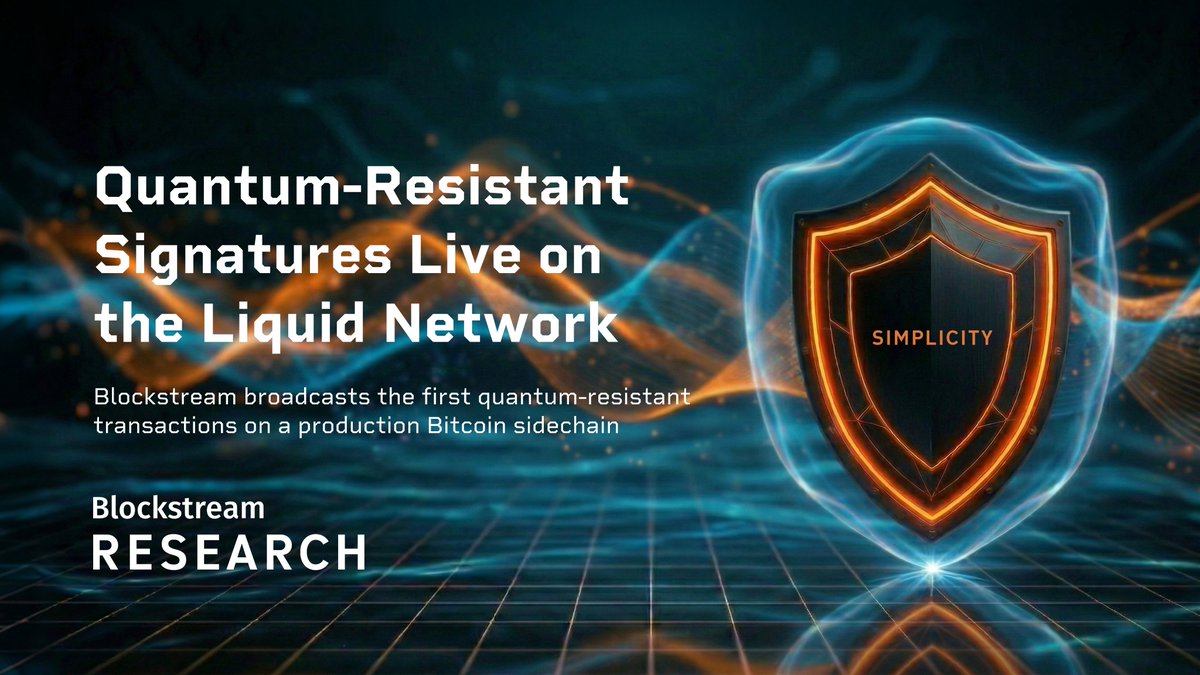
Users can now protect their Liquid Bitcoin and issued assets against future quantum computer attacks.
@blksresearch has deployed post-quantum signature verification on the @Liquid_BTC Network using Simplicity - a first on a production Bitcoin sidechain.
Opt-in quantum protection, available today. No consensus changes required.
English
@MayaPar25 @KristianCsep @printmorebru Block size cap is what keeps validation costs bounded. Re “spam”: Your transactions are spam to me. They’re literally useless on my node.
English

Ok let’s ignore the fact that memory has actually gotten more expensive, I just spun up two nodes and it definitely wasn’t cheaper than a year ago. And definitely took longer to sync. But let’s ignore that. Node survivability depends on predictable resource discipline, not on transient memory prices. That’s why policy filters matter, they keep validation costs bounded regardless of memory market swings.
English

🚨 JUST IN: this image was mined into block 938576 without OP_RETURN, showing Knots filtering does not prevent it.
The transaction was included via MARA Slipstream.
It was created by bitcoin developer Martin Habovstiak, who published a detailed research paper explaining exactly what he did and how anyone can verify it.
RESEARCH TLDR 👇
His goal was to test if stricter filtering rules can actually stop arbitrary data from being embedded on-chain.
Full research: KnotsLies(dot)com 🔗below
WHAT THIS TRANSACTION SHOWS:
• The image is stored contiguously inside a single transaction
• No OP_RETURN was used
• No Taproot was used
• Consensus rules were followed
• The transaction can be independently verified by anyone running a node
His core argument:
• Limiting OP_RETURN does not stop arbitrary data storage
• Policy filters shift the data rather than remove the capability
• If one encoding path is restricted, another can be engineered
• Workarounds are practical, not theoretical
SPAM OR WHACK-A-MOLE?
I’m not a technical expert.
But the more I read about all this, the more it feels like a whack-a-mole game.
You close one door, someone finds another.
I don’t like spam. I don’t like images embedded on-chain.
But it doesn’t seem like there’s an effective way to fully stop it.
What are your thoughts?
-
Full research: KnotsLies(dot)com 🔗below

English
@GautiEggertsson @dandolfa I think the monopoly mostly comes from data access, not knowledge.
English

AI is a game changer for economic research. We will look back and think: before and after.
The junior job market used to place enormous value on technical skills — and rightly so. We wanted to pass on the latest research methods to new PhD students. But the cost of mastering frontier solution techniques has dropped dramatically. I now find myself replicating papers and experimenting with frontier methods in an evening or a few days using Claude Code. That would have taken weeks before — which in practice meant I wouldn’t have done it at all.
So what does the new equilibrium look like? Some are pessimistic: ChatGPT can write PhD dissertations, they say. Maybe. But those dissertations won’t push the frontier or generate excitement.
I take the other side of that bet. We are in the business of figuring out how the world works and generating new knowledge. There is plenty we don’t understand, and no shortage of questions to answer. AI just accelerates the process.
The returns on conceptual thinking and original ideas are now relatively higher compared to the technical grunt work of debugging code and cleaning datasets. I think this is a great development.
My guess is it will also erode the monopoly that top US schools — and a handful of others — have long enjoyed. Part of that monopoly rested on access to knowledge that didn’t travel easily. Person-to-person transmission has always been far more efficient than learning from books or published papers — which are outdated by the time they appear, given publication lags.
Now knowledge transmission is nearly instantaneous. I find myself using techniques I understood in principle but could never justify the time to implement, because other methods were simply faster. That’s no longer true. The same goes for big data work.
One question keeps nagging me though: how should this change how we teach?
English