ทวีตที่ปักหมุด
b.mumpe💡
4K posts


b.mumpe💡
@benjamin_mumpe
engineer, thinker, entrepreneur,…
🇺🇬 เข้าร่วม Şubat 2020
678 กำลังติดตาม610 ผู้ติดตาม
@fahad309m i heard they’re good in areas where they’re setting up. but when they become established in that zone, they become like any other ISP.
#kiugandatekinyuma
English


@GodwinTOKO @KiiraMotors I think a better approach would be to tell @KiiraMotors to include this in their studies.
I believe they have the capacity to pull this off.
English

Habibi, if I were in charge of govt, I’d disband the vanity fair called @KiiraMotors, get in touch with the company producing these simple tractors from China, and redirect the funds from Kiira EV, and all funds from PDM into mass-producing these. Then sell them to Ugandan farmers at a very affordable price - cheaper than a boda - to make them available, & affordable to as many farmers as possible.
For an agricultural nation already earning billions of dollars from coffee exports, these things, in hands of hundreds of tens or hundreds of thousands of our farmers would see our exports skyrocket within a decade. If done well, Ugandans would make a lot of money in exports, and many more people would see reason to get into Agriculture - where we have a competitive advantage in the region.
A whole department at @Makerere’s CEDAT would be dedicated to studying them. Every malfunction would be studied for months to improve them, and we’d invest in making their production ever cheaper. We’d even study different agricultural products and how to make them best adapted to their production. Rice, Matooke, cotton, sugar cane etc. We’d also improve them based on terrain, one model would be great for the hills of Kapchorwa, another for the dry areas of Karamoja, another for the cold hills of Kabale. With time, we’d be exporting these to Kenya, Tanzania, DRC etc and earning extra billions in Forex in addition to agricultural exports.
In twenty or so years, we’d have the money, expertise, and technical knowledge to make bigger tractors, even the kind adapted for making our roads, and building serious projects in Uganda. Who knows, maybe we can then get to a point of making electric buses from
Scratch in 50 years when we can ably compete with Isuzu, Scania, and others. After all, every single car company started very small - something Kiira EV wants us to believe it will not do, then compete even when almost all Auditor General reports show it is nothing but a thorn on the side of taxpayers. A big, white elephant.
English
@TonyNatif @StateDept It seems we had not gotten the memo.
“If you want to make it in today’s world, it’s man eat man.”
Dr. Tugume Nelson O@TugumeNelsonO
Wishing you all a blessed week. Let’s go out and win.
English

@StateDept Oh, wow!
The world is really upside down! How is this the new normal?
English


@chief_Deco @StateDept 😂😂😂I’m not against the POTUS. I don’t agree with some of his ideas.
English

@StateDept Over to you @benjamin_mumpe !! I hope you don’t feel these effects since you are one of those who are against POTUS 😂
English

The steal our taxes and come back to motivate us nyox 😂😂😂💀🚮
Dr. Tugume Nelson O@TugumeNelsonO
Wishing you all a blessed week. Let’s go out and win.
English

@nbstv @fahadmasereka01 You’ll listen to us by force!😂
Joel JAFFER Aita@aitajoel
ENGINEERS IN COMMAND: Why Uganda’s Vision 2040 Demands Technical Leadership By Joel Aita There is a question that rarely gets asked in Uganda’s political conversations, yet it may be the most consequential one of our times: Who should govern a nation that has chosen to transform itself through infrastructure, industrialization, and technology? Uganda Vision 2040 sets out an audacious ambition to lift the country from a low-income, peasant economy to an upper-middle-income nation with a per capita income of $9,500 within a single generation. The roadmap is technical in its very bones. Its six priority pillars infrastructure (energy, transport, water, oil and gas, and ICT), science and innovation, land use, urbanization, human resource development, and security are, at their core, engineering problems. They demand not just political will, but technical comprehension at the highest levels of decision-making. Yet the people most responsible for delivering this vision, cabinet ministers, permanent secretaries, local government chairpersons and mayors, district technical staff are overwhelmingly trained in law, political science, public administration, some District and City Councilors hardly completed Secondary Education, Majority MPs are Senior Six leavers some who performed so badly that they could proceed for higher education. We are asking career politicians to make trillion-shilling decisions about standard gauge railways, nuclear power plants, irrigation schemes, and smart cities. This is the structural contradiction at the heart of Uganda’s development challenge. China’s experience offers a compelling mirror. The Precedence: How China Engineered its Miracle When Deng Xiaoping launched China’s Reform and Opening in 1978, he made a deliberate and consequential decision: he moved engineers into critical government positions. His philosophy was direct — “science and technology are the primary productive forces.” Over the following two decades, technically trained professionals dominated the Communist Party’s leadership at every level. By the 15th and 16th Party Congresses in 1997 and 2002, all members of the Politburo Standing Committee the apex of Chinese power were engineers by training. Presidents Jiang Zemin, Hu Jintao and Xi Jinping all studied engineering at elite universities. The result was not accidental. China built the world’s largest high-speed rail network, lifted 800 million people out of poverty, and became the world’s second-largest economy all within the span of one generation. When engineers sat at the policy table, decisions about infrastructure financing, industrial zones, and technology investment were made with technical rigor, not just political expediency. Singapore, South Korea, and Taiwan pursued similar paths. Their political leadership combined ideological direction with technical education, producing governance systems that could read engineering feasibility studies, interrogate cost-benefit analyses, and hold contractors accountable. Uganda wants the same outcome. It has not yet made the same institutional decision. What Vision 2040 Actually Demands Let us be precise about what Uganda has committed to. Vision 2040 identifies flagship projects including: a hi-tech ICT city; large irrigation schemes across the country; five regional cities Gulu, Mbale, Jinja, Mbarara, and Arua to be developed to world-class standards; a standard gauge railway connecting Kampala to regional capitals and the sea at Mombasa; industrial Parks across Uganda; a 400kV electricity transmission network; a national fibre optic backbone; international referral hospitals in every regional city; and nuclear power connected to the national grid by 2031. Not one of these projects can be adequately designed, procured, supervised, or evaluated without deep engineering knowledge at the point of political authority. A minister who cannot read a geotechnical report cannot meaningfully interrogate why a road is failing. A district chairperson who does not understand hydrology cannot hold a water supply contractor accountable. A parliament that collectively lacks structural engineering literacy will continue to approve projects that collapse literally and financially. The gap between Vision 2040’s ambitions and Uganda’s current governance architecture is not primarily a funding gap. It is a technical comprehension gap. The Case for Engineer-Politicians for Uganda Placing engineers and technically trained professionals in political leadership does not mean replacing democracy with technocracy. It means enriching democratic governance with technical intelligence. The argument has several layers. First, infrastructure is Uganda’s primary development lever. An estimated 70% of Uganda’s Vision 2040 capital expenditure will flow into physical infrastructure. Every shilling of that investment passes through specifications, designs, bills of quantities, procurement processes, construction supervision, and asset management all of which are engineering functions. Political leaders who understand these functions are less susceptible to contractor capture, inflated variation orders, and the quiet corruption of technical ignorance. Second, Uganda’s resource endowments require technical stewardship. The Albertine Graben oil and gas reserves, the mineral wealth of Karamoja, the water resources of the Nile basin, the industrial development, the agricultural potential of the fertile crescent these are all technical assets. Their monetization requires leaders who understand petroleum engineering, mineral processing, hydraulic design, and agronomy. Third, the private sector demands technical interlocutors. As Uganda works to attract foreign direct investment into its energy, transport, and industrial sectors, investors increasingly expect governments whose technical ministries can hold intelligent conversations about bankability, engineering risk, and environmental compliance. Countries whose ministers can engage at that level close deals faster and on better terms. Fourth, Uganda’s local government system is hemorrhaging technical capacity. Under the decentralization framework, district and municipal governments are responsible for road maintenance, water systems, physical planning, and building regulation all technical mandates. Yet most elected local leaders have no technical background, and the technical staff they supervise are chronically underpaid, demoralized, and often bypassed. What This Looks Like in Practice The proposal is not utopian. It is operational and actionable. Uganda should consider a deliberate policy similar to China’s 1983 cadre recruitment reforms requiring that a defined percentage of appointed positions in technical ministries be held by professionals with relevant engineering or scientific qualifications. The Ministry of Works and Transport, the Ministry of Energy and Mineral Development, the Ministry of Water and Environment, the Ministry of Housing and Urban Development, and Minister of ICT should be led by people who understand what they are managing. At the parliamentary level, the Committee on Physical Infrastructure, the Committee on Natural Resources, and the Science and Technology Committee should be chaired by members with relevant technical backgrounds. Parliamentary scrutiny of infrastructure budgets, environmental impact assessments, and technology procurement would be fundamentally stronger. At the district level, the District Engineer currently a technical officer buried under a layer of elected officials with no technical mandate should be elevated in authority and salary, with clear lines of accountability that protect technical decisions from political interference. Uganda should pilot a system in which engineering professionals can run for technical leadership positions at district level on platforms anchored in infrastructure delivery, as has been done with partial success in Rwanda. The Uganda Institution of Professional Engineers (UIPE) and the Engineers Registration Board (ERB) already provide a credentialing infrastructure. What is missing is the political will to connect professional credentials to political and administrative authority. The Objection and the Answer The inevitable objection to this argument is that engineering training does not guarantee good governance. This is true. China itself has produced engineer-politicians who were corrupt, authoritarian, and catastrophically wrong. An engineering degree does not confer wisdom, integrity, or political accountability. But the argument is not that engineers are inherently better people. The argument is that Uganda’s specific development challenges — building $40 billion worth of infrastructure over 15 years, managing petroleum revenues, developing five regional cities, connecting rural Uganda to global markets require political leaders who can understand the technical dimensions of those challenges. The combination of technical competence and political accountability, not one at the expense of the other, is the ideal. Uganda has produced exceptional engineers. Many of them quietly, without recognition are doing the country’s most critical work: designing hospitals, supervising bridges, managing water systems, planning urban expansions. They are technically brilliant and politically invisible. Vision 2040 will not be built by invisible people. A Call to the Engineering Profession Uganda’s engineers must also reflect on their own role. For too long, the profession has accepted a subordinate political status executing decisions made by others, accepting underfunding without public challenge, and retreating into technical silos while politicians make consequential decisions above their heads. The engineering profession must claim its rightful place in Uganda’s public square. This means more engineers running for office. It means professional bodies like UIPE engaging louder and more consistently on infrastructure policy. It means engineering firms building thought leadership publishing, speaking, advocating not just building roads and waiting for the next tender. The Pearl of Africa is not short of gold. It is short of people in power who know how to mine it. Conclusion Uganda Vision 2040 declares the ambition to transform the country from a peasant economy to a modern, prosperous nation within 30 years. That transformation is, at its core, a technical project. It will be built in concrete, steel, fibre optic cable, industrial parks, irrigation channels, and power transmission lines. It will be financed through instruments that require technical due diligence. It will be evaluated through metrics that demand engineering accountability. China’s most productive decades of development were led by engineers. Singapore was built by a Prime Minister who understood urban systems. Rwanda’s infrastructure renaissance is driven by a government that reads engineering reports before it approves budgets. Uganda does not need to copy any of these models wholesale. But it must learn from their central insight: the quality of a nation’s infrastructure is ultimately a reflection of the technical intelligence of its governance. Vision 2040 is the map. Engineers must help drive the vehicle. Joel Aita is the CEO and Chairman of the Joadah Group, a multidisciplinary engineering and technology consultancy headquartered in Entebbe, Uganda.
English

Geologists have raised concerns over emerging cracks and sinking sections along the Kikorongo–Kasese road, linking the damage to underlying seismic fault lines.
@fahadmasereka01
#NBSLiveAt9 #NBSUpdates
English

Gov't suspended the construction of Najjanankumbi–Busabala road (11Km) construction in 2024.
Among other reasons, someone, a PAP wants Ugx 60,000,000,000 as compensation!! 🫢🫢
English
I don’t know what’s wrong with some Ugandans and doing self sabotage on our own infrastructure. The things we are building are OURS but the selfishness.🤦🏾♂️
We need REAL PATRIOTS to build our nation.
Brian The Mixologist🌼@brianmixologist
We all know the truth, Fufa people wanted to be involved in the construction of these stadiums and selection of contractors to eat the money but that opportunity was not given to them. I even know somw group that promised to frustrate the construction. I will expose one by one as time goes on. @TheMutaD look at these chaps, they think we don’t know.
English
@jamesonen man, ukr!😂
who cares about the US president visiting Africa?
English

@IanNdamwesiga @BatteHerbert Dr.,something small to pick your mind🧐
English

English

English

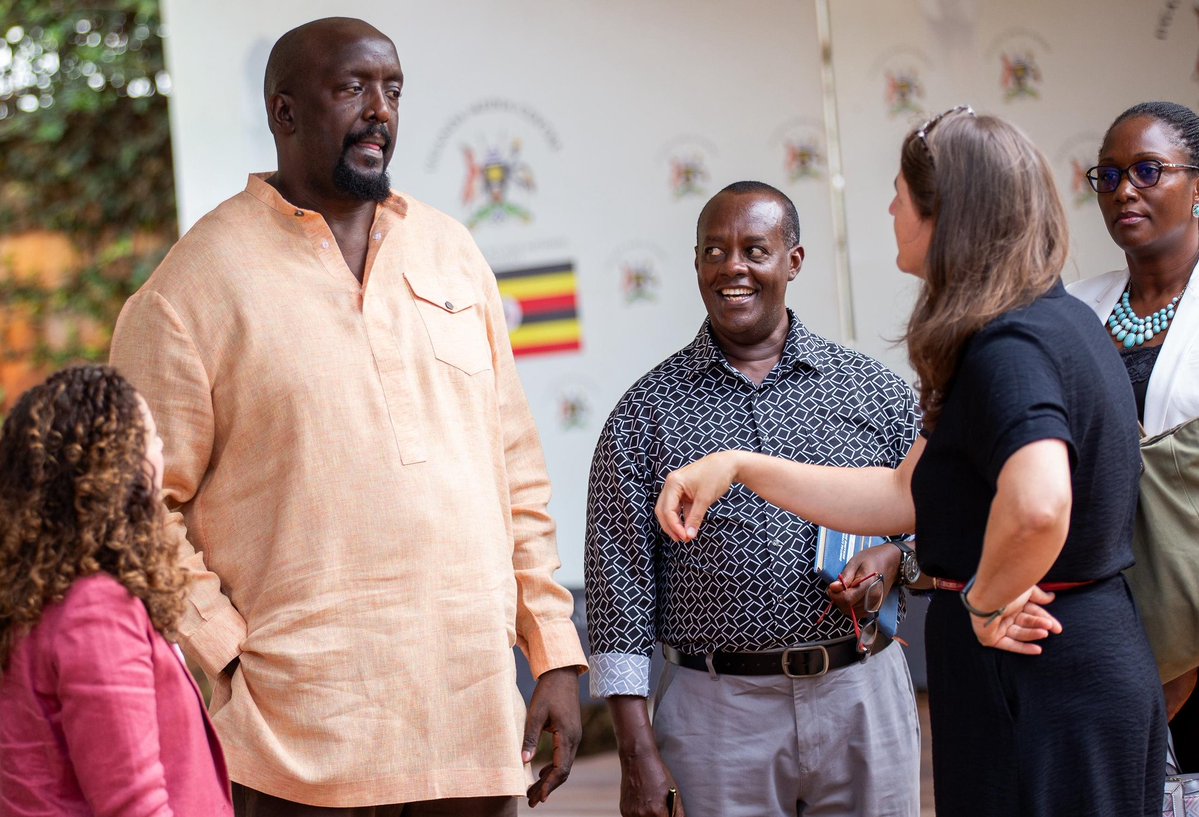
This morning, the Uganda Media Centre - Executive Director, Mr. @kasujja hosted a delegation from the @USEmbassyUganda led by Ms. Yasmeen Hibrawi, Public Affairs Counselor for a courtesy call. The two sides discussed matters of mutual interest and strengthened ties.



English
With Israel continuing to bomb nuclear plants in Iran, and the potential ramifications of nuclear material leakage, some GCC countries might turn out to be uninhabitable.
Real estate prices in East Africa are about to go up.
Al Jazeera Breaking News@AJENews
BREAKING: Rosatom says situation at Iran's Bushehr nuclear power plant continues to deterioriate after multiple Israeli attacks. 🔴 LIVE updates: aje.news/pg663c?update=…
English

@cynthiechoco or he might be playing them….such that they think they have insiders and they waste time looking for them when they’re not there🤔
English

I wish he had kept that information to himself because now the regime knows he was helped by insiders, and they are going to root them out. This delays freedom.
Banange!
Marc Perelman@mperelman
🇺🇬 Uganda opposition leader @HEBobiwine @france24: "I had assistance from security people that I won't mention from within the regime who are not in agreement with the way our country is being run. I was able to escape the country." ▶️f24.my/BoyN
English