complain.papi

711 posts

complain.papi banner
complain.papi

complain.papi

@complain_papi

Sport

Sumali Kasım 2014
207 Sinusundan240 Mga Tagasunod
Tony Anderson
Tony Anderson@TonyJAnderson·
@amicsta I have never asked my doctor about any (advertised drug). I figure my doctor will offer that up if necessary. Just thought about key&peeled skit.
English
3
0
2
1.8K
Anthony Amico
Anthony Amico@amicsta·
Gonna be wild when companies realize commercial money is just being lit on fire. We either skip the commercials or look at our phones. There is just no way this is a properly valued market.
English
113
33
3.4K
155.9K
complain.papi
complain.papi@complain_papi·
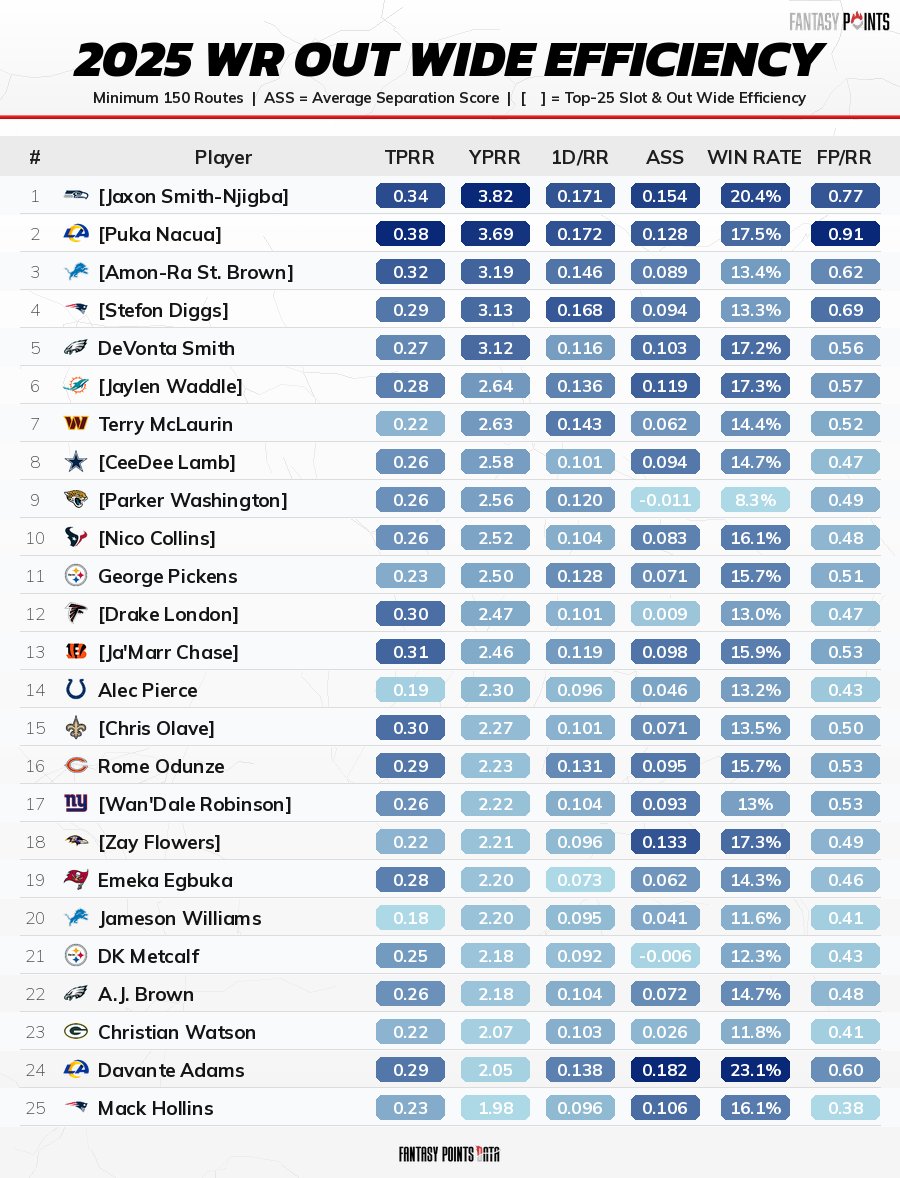
@KyleM_FF @FantasyPtsData Appreciate the responses! It seems like we can use ASS/Win Rate to suss out WRs who could see increased per-route metrics with a change in QB/OC/scheme/role/etc, like Zay Flowers outside or Garrett Wilson in the slot
English
1
0
0
37
Kyle
Kyle@KyleM_FF·
Because he has a smaller sample size here (he barely met the route min. threshold), his metrics are likely more volatile or more easily skewed one way or another He could have not been separating at a high level, but still made impressive or contested catches, thus moving the sticks at a high rate I would have to dig into the data more on these “anomalies”, but this is where watching the film on these routes would probably give us the answers we’re looking for
English
1
0
1
15
Kyle
Kyle@KyleM_FF·
Which WRs were the most efficient when lining up from the Slot or Out Wide? I used @FantasyPtsData to rank the top-25 most efficient WRs (by YPRR) for both! - 63.2% of all routes last season were ran Out Wide, with an average FP/RR of 0.33 - 36.2% of all routes last season were ran from the Slot, with an average FP/RR of 0.29
Kyle tweet mediaKyle tweet media
English
2
1
9
861
Kyle
Kyle@KyleM_FF·
Given that it’s a measurement of how often a WR wins in a route, that is they record a positive separation score on a route, it feels important to include that metric in WR efficiency discussions I think one of the best uses of this metrics is to use it to identify when oldeR WRs might be falling off, that is they’re winning their routes less often Davante Adams for example, looks like he still has the juice based on his separation metrics Versus DK Metcalf, who has struggled more against man coverage in recent years
English
1
0
0
36
complain.papi
complain.papi@complain_papi·
@P2WFantasy Feel like Ferguson isn't too dissimilar from Otton when both Evans and Godwin were out
English
0
0
0
215
Skrip
Skrip@P2WFantasy·
The most polarizing players to rank for Dynasty Fantasy Football CJ Stroud **amazing rookie szn, then major drop offs w/ context** TreVeyon Henderson **major explosiveness vs battling NE love for Rhamondre** Kyren Williams **major upside but Blake Corum biting his ankles** RJ Harvey **proven upside but age and Dobbins concerns** Bhayshul Tuten **rookie flashes + upside vs unknown usage w/our Etienne** George Pickens **major 2025 but splits shift with and without Lamb** Rome Odunze **major 2025 start but a rise in Burden + Loveland** Tee Higgins **Top 12 upside but consistent injury issues** Brian Thomas Jr. **Amazing rookie szn but sophomore slump w/ other risers** Jordan Addison **Talent vs off field issues vs opportunity** Rashee Rice **Top 5 upside but off field concerns** DK Metcalf **Historic upside vs MPJ added vs QB questions** Brandon Aiyuk **Healthy numbers vs recent questions to Heath and landing spot** Jake Ferguson **Massive upside w/ Lamb vs his splits w/ both Lamb and Pickens healthy** George Kittle **Historic major upside vs age and Achilles injury**
English
8
3
64
19.4K
Jakob Sanderson
Jakob Sanderson@JakobSanderson·
Morning folks ☀️ Part TWO of my 2026 RB Class rankings and analysis is now live on Thinking About Thinking I spent far too much time on this crappy class so you really better check it out to make me feel better
Jakob Sanderson tweet media
English
3
2
21
3.2K
complain.papi
complain.papi@complain_papi·
@RyanJ_Heath Interesting! How does YPTPA compare to Dominator Score in this context? Feel like they're similar
English
0
0
0
225
Ryan Heath
Ryan Heath@RyanJ_Heath·
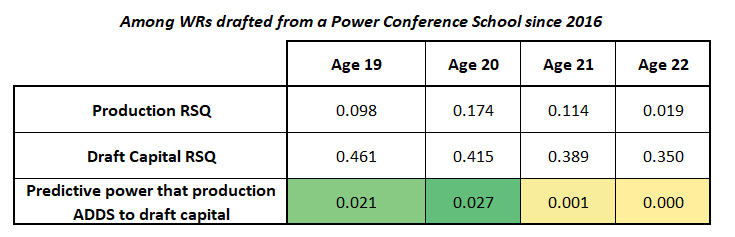
Receiving yards per team pass attempt (YPTPA) is one of the most predictive production variables in most WR models. It has ~zero correlation with NFL fantasy points starting in a player's age-22 season. And it adds ~zero predictive power* to draft capital starting at age 21.
Ryan Heath tweet media
English
4
4
47
28.6K
complain.papi
complain.papi@complain_papi·
@KyleM_FF Re: QBs, with passing yards decreasing and the current crop of rushing QBs hitting the rushing age cliff (outside Daniels), Allen's rushing TDs probably insulate him as QB1 for the foreseeable future. Even Daniels has limitations as a passer though. Does '27 have rushing QBs?
English
0
0
0
64
Kyle
Kyle@KyleM_FF·
My way-too-early Redraft thoughts for the QB and TE position are simple and mirror how I approached the two positions in 2025: - Punting these positions until Round 6+ should be extremely lucrative again in 2026 Tight Ends McBride and Bowers should easily finish TE1 and TE2 overall if they stay healthy, but is that worth being weaker at RB or WR given their 2nd round ADP? - I'd argue that waiting until the mid-to-late rounds for any of the Tier 2 TEs, while building out your RB and WR corps in the early rounds, puts you in much stronger position overall Quarterbacks We all know that Allen has finished top-2 for six straight years and the upside that Jackson can offer, but the gap between the QB3 and QB12 seems to have shrunk mightily in recent years - I found it incredibly difficult to rank the QBs in Tiers 3 and 4 because they are so close together - I could see any one of those players finishing top-8 or even top-5, and they can likely be drafted after you've already filled out the rest of your starting lineup The volatility and disparity in the first 5 RB and WR tiers feels far greater than the QB and TE tiers (for obvious reasons) - I have also found their trade value really week, because of the depth at these positions as the season progresses
Kyle@KyleM_FF

Here are my top-20 TE & QB Rankings for 2026!

English
2
1
12
3.6K
Alex Fast
Alex Fast@AlexFast8·
Yesterday's CWS/MIA might not have been the best game but it featured some unreal pitches. Here are yesterday's whiffs that had the most armside movement, gloveside movement, drop, rise and velo Featuring: Robert Suarez, Chris Paddack, and a nasty slurve via Sean Newcomb
English
2
1
13
4.1K
Alex Fast
Alex Fast@AlexFast8·
Notable whiffs from March 29th. These are the whiffs that had the most: Velo (and least velo), vert, drop, armside movement, gloveside movement. Yohan Ramírez had the whiff with the most armside movement AND the pitch with the most gloveside movement.
English
2
1
21
6K
complain.papi
complain.papi@complain_papi·
@DevyEusuf 1. They're unrelated 2. Contested catch% is less important
English
1
0
0
151
Fusue
Fusue@DevyEusuf·
It's a bit hypocritical to knock KC Concepcion and Denzel Boston for being weak vs Zone and ignore the abysmally high Contested Target Rate of Elijah Sarratt.
English
4
2
22
4.8K
I Don’t Watch Film (Football Analytics)
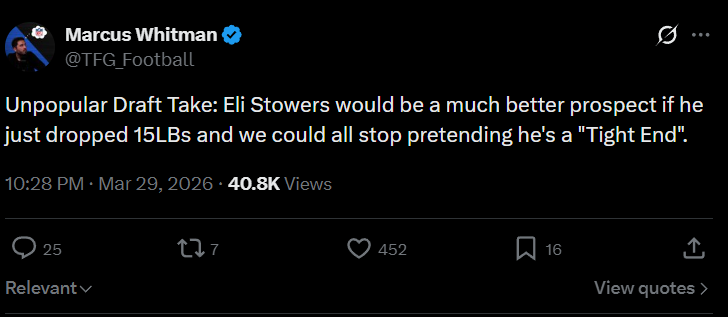
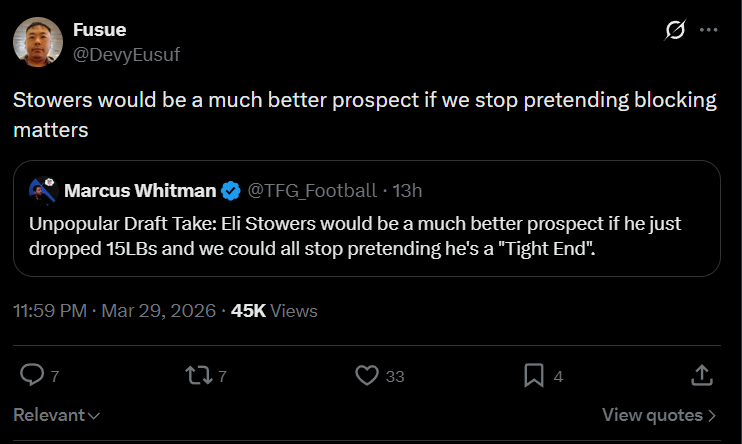
Both of these takes have some truth to them, while at the same time not fully grasping (or at least articulating) the difference in value with receiving ability and blocking ability in tight end prospects. 1. Blocking matters 2. Receiving ability matters significantly more The NFL tells us both of these truths all the time through draft capital, playing time, and contract details. John Bates, 6th-year tight end for the Washington Commanders, was drafted in the 4th round despite atrocious production in college. Yet the Commanders still took him in the 4th round of the 2021 NFL Draft. Bates goes on to put up less than 600 yards in 4 years for Washington. The Commanders go on to sign him to a 3-year, $21 million contract extension. Why? Well, one of the reasons being he played over 2,000 snaps in 4 years for them. 65% of those snaps were blocking snaps. Despite offering little to no upside as a receiver, the Commanders still saw enough value in his ability as a blocker to sign him to a contract extension. So blocking certainly matters for tight ends. Again, the NFL shows us this through draft capital, playing time, and contract details. But at the same time, blocking ability is SIGNIFICANTLY overvalued during draft season. Draft analysts, professional and amateur alike, will often overvalue a tight end's blocking ability when evaluating them. Tight end prospects should be looked at through the same lens the NFL looks at them and evaluate accordingly. That is, if a tight end's receiving ability is so good, it almost always makes up for any blocking deficiencies. If a tight end is projected to in the first or second round, then all I really care about is, how good are they as a receiver? If they check the boxes of a first or second round talent as a receiver, then evaluate them as a blocker next and adjust the evaluation accordingly. The NFL will tell us this with their actions. Their willingness to forgive a player's blocking deficiencies is almost 1 for 1 with the player's ability as a receiver. It's because replacing or supplementing blocking value is significantly easier for a team than it is for receiving ability. It would be easier for the Bills to replace Jackson Hawes than it would be to replace Dalton Kincaid. The NFL will prove this once it's time to sign Kincaid to his next contract vs Jackson Hawes. The NFL will never take a tight end in the first or second round if they don't see value or upside in them as a receiver, it doesn't matter how good their blocking is. But we see all the time teams taking productive tight end prospects with sky-rocket receiving upside despite below average to poor blocking. The Bills did it with Kincaid. Falcons did it with Kyle Pitts. Kelce has been a below-average to bad blocker for the last 5+ years, yet the Chiefs had no hesitation to continuously make him the highest-paid tight end ever. Darren Waller might be one of the worst blocking tight ends of all time. Yet, at his peak, every team in the NFL would have no hesitation paying him top-of-the-market money. And this wasn't as a slot receiver disguised as a tight end, he played majority of his snaps inline for the Raiders. Regarding Eli Stowers, he isn't a wide receiver. He's a tight end. He's going to play tight end in the NFL. He doesn't need to lose weight to play receiver. He doesn't need to gain a bunch of weight to become a better blocker. If he's a good enough receiver at the tight end position then NFL teams will find value in him.
I Don’t Watch Film (Football Analytics) tweet mediaI Don’t Watch Film (Football Analytics) tweet media
Marcus Whitman@TFG_Football

I BEG you to just load up one Seahawks or Bills game and watch Jackson Hawes or AJ Barner. You'll want to delete this tweet afterwards.

English
7
4
40
10K
complain.papi
complain.papi@complain_papi·
@NoFilm_Analysis What's the difference between playstyle and archetype? Are Allen's mutually exclusive?
English
0
0
0
33
I Don’t Watch Film (Football Analytics)
60 Days, 60 Prospects 2026 NFL Draft Countdown – Day 33 Prospect Breakdown: Kaytron Allen, Penn State, RB4 Kaytron Allen is one of the more productive backs on the ground in the class. He's tough, physical, and reliable. He lacks the kind of elite explosiveness and receiving upside that is often coveted at the position, but his scheme versatility and strong production profile make him an intriguing prospect. Height: 5'11 Weight: 216 Age: 23.2 High-end Player Comp: Tyler Allgeier Low-end Player Comp: Tyrion Davis-Price Playstyle: Elusive Back Archetype: Power Back; Scheme Versatile Round Grade: 4th Round Talent Allen was one of the most productive running backs in college football over the past four seasons, despite playing alongside Nicholas Singleton who ranks as my 3rd overall running back prospect in this year's class. Over the course of four seasons and 54 games played, Allen put up 4,167 rushing yards and 39 touchdowns on 768 attempts. He averaged an impressive 77.2 rush yards per game and 5.4 yards per attempt. While he may not be the biggest back or the most physically gifted, Allen was still able to consistently generate yards after contact in his career. He averaged 3.3 yards after contact per attempt, with 61.5% of his rushing yards coming after contact. He forced a missed tackle on 24% of his career touches, totalling 201 career missed tackles. His 224 career first downs ranks in the 95th percentile among running back prospects since 2018. Allen's limitations are clear: he doesn't offer much upside as a receiver and his overall efficiency numbers are lacking. Allen recorded just 95 career targets and 70 receptions for 490 yards. His 0.74 yards per route run ranks in the 15th percentile among running back prospects since 2018. Allen wasn't able to consistently break up chunk gains of 10+ yards, with only 13.9% of his career carries going for explosive runs (10+). Allen fits best as a reliable, early-down and short-yardage back as part of a committee backfield. His limited receiving ability and lack of elite traits likely caps his ceiling in the NFL, but he still possesses the talent and potential to be a complementary power back for an offense at the next level.
I Don’t Watch Film (Football Analytics) tweet mediaI Don’t Watch Film (Football Analytics) tweet media
English
1
2
11
2.8K
complain.papi
complain.papi@complain_papi·
@RyanJ_Heath @ScottBarrettDFB puts out my favorite rookie rankings every season, so I'll be interested to compare! For funsies, would it be a huge endeavor to apply your model to past draft classes?
English
0
0
0
64
Ryan Heath
Ryan Heath@RyanJ_Heath·
I'm incredibly excited to be throwing my hat and my rookie model in the ring this year. So excited that I wrote nearly 10,000 words on the analytics profiles of 15 different TEs in this class for fantasy football. No paywall for these. Check it out! fantasypoints.com/nfl/articles/2…
English
8
24
158
50.4K
complain.papi
complain.papi@complain_papi·
@keithrisorto Which is why it's not worth mentioning his ST performance, which was bad regardless
English
0
0
0
28
keithriso
keithriso@keithrisorto·
@complain_papi yeah buddy i think thats the point of spring training. non MLB players get AB’s
English
1
0
0
16
complain.papi
complain.papi@complain_papi·
@MaysCopeland Are you finding the default 1.5x SB scoring weight to still be current in today's meta?
English
1
0
0
9
complain.papi
complain.papi@complain_papi·
@MaysCopeland Ah, I meant weekly minimum not seasonal, though I realize I can just multiply
English
0
0
0
7
complain.papi
complain.papi@complain_papi·
@ZKantzFF I think this is interesting specifically with regards to TEs like Gadsden, Kincaid, and Stowers. Does Gadsden lose work to Kolar, who was fairly athletic and productive in college? Does this cap Stowers's ceiling as a non-blocker?
English
1
0
0
209
Zareh Kantzabedian
Zareh Kantzabedian@ZKantzFF·
The trend of 12-man personal packages has steadily increased over the past several years. On average, nearly a quarter of plays were run out of 12 MP in 2025. That's a healthy amount. In fact, it has grown by 5% since 2022. But it seems like this trend is beginning to plateau. Here’s the growth rate since 2022. League Average for 12 Personnel Packages (2022-2025): 2022: 17.26% 2023: 19.19% 2024: 21.77% 2025: 22.77% Growth year by year; • 2022 - > 2023: +1.93% (moderate growth) • 2023 - > 2024: +2.58% (peak growth) • 2024 - > 2025: +0.50% (possible plateau) How has the growth of 12 MP affected production for “move/slot” vs. “inline” tight ends? From 2022-2024, slot tight ends have earned, on average, a 6% higher target share than inline tight ends, despite 12 MP rates increasing. But that trend finally flipped in 2025. In 2025, Inline TE average target share rose to 0.56% vs .45% for move/slot. Here's what that distribution looked like in 2024: Inline TE average target share was 0.45%, with move/slot receiving 0.55%. That’s an increase of 11 percentage points—the biggest difference between the two archetypes since 2022. So what does it all mean? From a macro perspective, it seems the inline TE target distribution has finally caught up with the growing trend toward 12 MP. As a result, it has possibly become the dominant fantasy tight end archetype. This study deserves further interpretation, but it’s a notable crossroads we find ourselves at. Data @SumerSports
Zareh Kantzabedian tweet media
English
3
8
33
21.8K