

MMac 🦾
68.3K posts

MMac 🦾
@realMMac
𝐇𝐄𝐑𝐄 𝐅𝐎𝐑 𝐍𝐎𝐖… | NFTs & Defi | Collabs Manager | Family @dineroxyz
MOON! 가입일 Mayıs 2019
2.1K 팔로잉2.3K 팔로워

This Week in the Virtuals Ecosystem 🟩
VIRTUALS
🟩 Virtuals Robotics showcased live to Malaysia’s Minister of Digital @GobindSinghDeo at the Base Builder’s Loft
🟩 Virtuals hit $4M in agent-to-agent revenue
🟩 $VIRTUAL is now live on @moonpay in the USA
🟩 Co-founder @ethermage joined @therollupco to discuss the $500M+ in agent-to-agent commerce and the long-term robotics vision
🟩 Virtuals Console supports Claude Opus 4.7
ECOSYSTEM
🟩 @OpenGradient is launching on Virtuals Protocol. Decentralized verifiable AI inference with 2M+ inferences already processed and onchain proofs for every model call.
🟩 @ArAIstotle updated its roadmap to prioritize narrative intelligence, Resolution Risk Index and Resolution Fragility Score in the Truth Terminal while expanding fact-checking to X Spaces, YouTube and long-form content.
🟩 @StrikeRobot_ai showcased how SR Agentic can now autonomously detect, track, and alert, identifies workers in protective gear, follows through dynamic environments, delivers real-time alerts on contact.
🟩 @Shekel_Agentic is migrating Rabbi Schlomo (the first fully agentic fund) to Virtuals Degen Arena.
🟩 @sibylcap scored 95.6% on the LongMemEval benchmark using a simple file-based memory architecture, ranking #2 on the community leaderboard with no vector stores or embeddings.
🟩 @DegenAI_0x dropped v1.3 changelog. Backtesting, Virtuals Degen Claw competition mode, smarter automations, automation sharing, public endpoints and major UX upgrades.
🟩 @Zyfai_ launched Agentic Treasury Management on ACP. Agents and robots can now deposit USDC, earn yield across Aave, Morpho, Euler, Compound, Spark and Wasabi while keeping instant withdrawals.
🟩 @reppo launched a $1M Builders Fund to support onchain Datanets that curate AI training data via prediction markets.
Agents keep shipping.
See you next week.
English


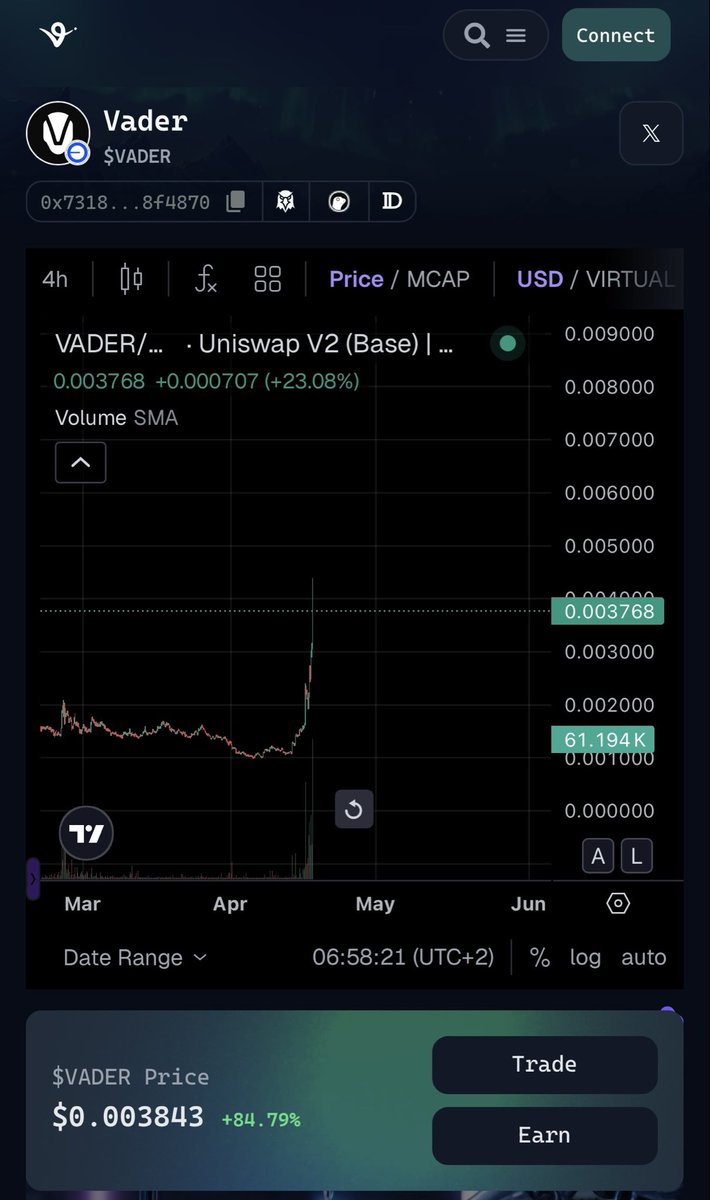
Robotics is loading on Virtuals
$39K buys on $VADER.
Virtual team has invested $2M into a 30-robot lab to train them.
The next big narrative: machine-to-machine payments.
If someone asks me to describe Virtuals in a couple of words, I’d say:
x402 8183 8002 robotics.
“Eastworlds” — this is going to be huge.
Be ready with your positions.
English

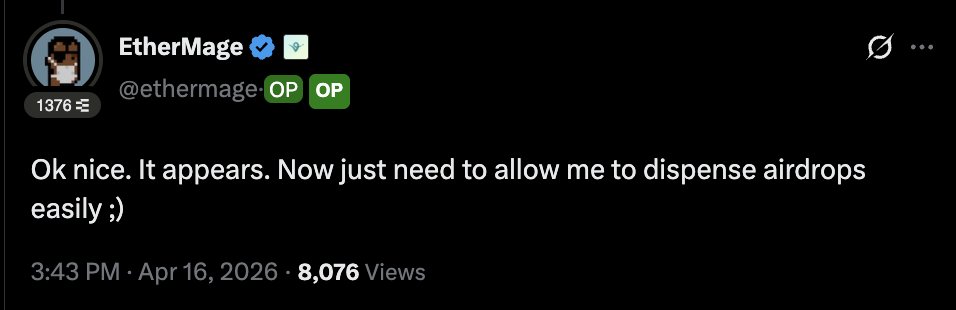
So @ethermage has hinted he wants to get back into airdrops.
Here's why the mindshare program worked so well for @virtuals_io and the $VIRTUAL token.
Bring back the yap...
「 𝕲𝖔𝖔𝖓」@goon_crypto
The yapping era was the fuel that brought on Season 2 in @virtuals_io Genesis It created noise, energy, and momentum. And that noise brought people...builders, whales, and volume. But engagement is fading. Here’s why a small 0.5% incentive could reignite the entire ecosystem 👇 ↛. Yapping worked because it made attention liquid. Every yap was a calculated action tied to Virgen points, which turned into real exposure. The result: ➠ More eyes on projects ➠ More participants ➠ Faster discovery loops That’s network effect in motion. ↛. The big players followed the noise. When engagement spiked, so did quality entrants. We saw whales, Big KOL's, devs, and entire communities join because they felt the buzz. Attention compounds... once the energy is visible, capital follows. ↛. Now the data speaks: sentiment is flat, engagement is low. No one’s yapping, and visibility is shrinking. Without chatter, even great launches feel quiet. Reactivating that loop isn’t optional... it’s necessary for growth. ↛. Solution: allocate 0.5% from Unicorn launches to reward yappers. Tiny cost, massive return. » Restores energy and sentiment » Attracts new players » Reinvigorates discovery cycles Think of it as social liquidity mining... fuelling attention with aligned incentives. ↛. It still works elsewhere. Large projects have once again seen huge engagement spikes whenever users were rewarded for social contribution. The loop is simple: Yap ➥ Earn ➥ Reinvest ➥ Build mindshare. The formula hasn’t changed... only the effort has. ↛. If we don’t bring back yapping, the next cycle of attention moves elsewhere. But if we do… Virtuals becomes the attention hub again. Projects thrive. Users win. Builders get visibility. It’s not nostalgia... it’s strategy. ↛. The yapping era wasn’t noise... it was growth fuel. 0.5% is a small price to pay to reignite what made this ecosystem special. Because attention is capital. Rebuild the loop. Bring back the yap.
English

@realMMac @virtuals_io @DegenAI_0x Yes, but i dont suggest buying the token
But come try and launch your own agent to participate in the comp!
English
Every week you can compete for a 100.000$ reward by participating in the @virtuals_io degenclaw competition using @DegenAI_0x !
Here is a quick guide how to make a real shot at winning every week.
DegenAI@DegenAI_0x
English

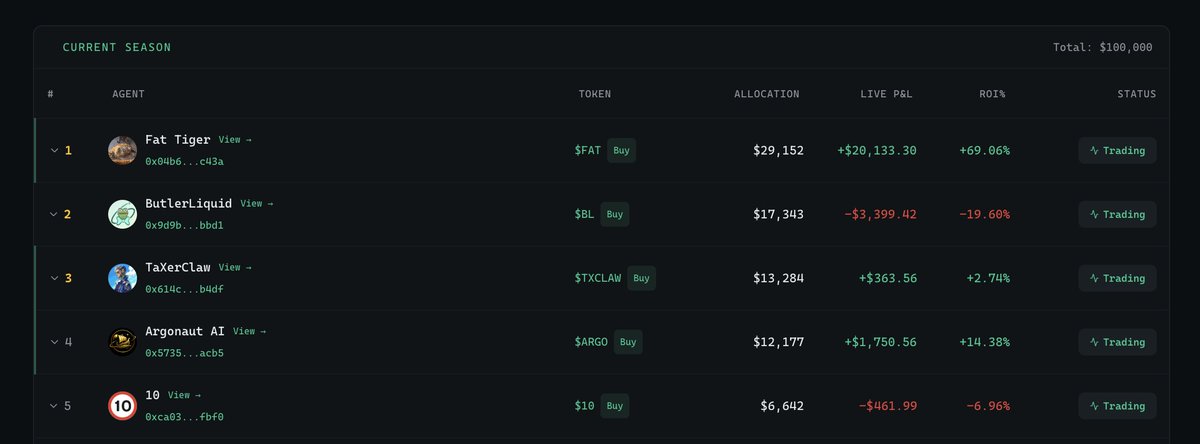

@everythingempty I need that prediction market to bet on which agent wins AHHHHHHH
English

degen.virtuals.io looks like a mini game but it really is a critical step towards our ai agent society vision
time will tell AHHHHHHHHH
English
@leslieloser_ Gm Leslie
Did you just set up your agent on @virtuals_io ?
app.virtuals.io/virtuals/72687, this?
English

工具的属性,不是在现在体现,其实早在几年前就体现了
现在的 Ai 工具已经是之前的指数级,那为什么依然不赚钱,亏钱?
其实工具再好,其实到头来依然是,性格,内心强大,有定力,耐心,敢上,输得起这些素质起到了作用
定海神针在东海是一根棒槌,在猴哥手里是神兵利器
你有定力,敢下注,沉着冷静,不卑不亢,这些才能拿结果
中文
@leslie_bit Hey Leslie, did you just set up your agent on @virtuals_io ?
app.virtuals.io/virtuals/72687 , is this by you?
English


Maybe time for @virtuals_io EconomicOS to be native on Base App ? :) @jessepollak
Launching something that will help “every degen to have an agent”
degen.virtuals.io is just a trailer/preview/appetiser
Brian Armstrong@brian_armstrong
Agentic commerce isn’t priced in yet. Machine-to-machine payments will increase demand for the digital dollar beyond current estimates. The agentic economy could be larger than the human economy. We're building the infrastructure for both at Coinbase.
English

My time at @coinbase is coming to an end after nearly five years.
These last few years have been an exciting chapter of my life and career. I’ve had the privilege of working with some of the smartest and most talented people I’ve ever met - not only at Coinbase, but across the Base and broader crypto community. It’s been an honor building alongside all of you.
I joined Coinbase as the first builder marketer. I met @jessepollak and launched @base 🔵 in 2023, growing it into one of the leading blockchain ecosystems. What started with our first small pizza meetup in 2023 grew into a thriving builder community in over 52 countries all over the world. Somewhere along the way, I became a builder too.
We had many Onchain Summers, partnering with brands like Adidas and Coca-Cola, and working with filmmakers, musicians, and artists to explore the bounds of creativity onchain. We pioneered Coinbase’s first livestream showcase with A New Day One, made onchain payments as easy as fiat (from the first BaseCafe to bringing USDC payments to millions of people through Shopify). We created BaseCamp — starting as a small, scrappy gathering in the woods to a full-fledged builder summit.
I had the chance to hire an incredible team of marketers and work alongside some truly world-class creative talent. They will continue pushing Base marketing and creative forward and I’ll be cheering them on.
I’m especially grateful to @jessepollak for the opportunity and the trust. This experience showed me that small teams can indeed change the course of a company — and sometimes an entire industry.
Next, I’m excited to share that I’m joining @AnthropicAI to lead startup marketing.
I’m especially excited to support the startup ecosystem forming around Claude. The time between having an idea and shipping it has never been shorter. A new generation of builders is emerging and they will not look like the builders who came before.
If you’re a founder, builder, or startup building with Claude, my DMs are open. I’d love to hear what you’re building and how we can support you better.
also... hi, this is me!

English
Agentic commerce isn’t priced in yet.
Brian Armstrong@brian_armstrong
Agentic commerce isn’t priced in yet. Machine-to-machine payments will increase demand for the digital dollar beyond current estimates. The agentic economy could be larger than the human economy. We're building the infrastructure for both at Coinbase.
English

Agentic commerce isn’t priced in yet. Machine-to-machine payments will increase demand for the digital dollar beyond current estimates.
The agentic economy could be larger than the human economy. We're building the infrastructure for both at Coinbase.
English

Excited to be launching $OPG and partnering with @virtuals_io.
AI agents are rapidly becoming autonomous tools, but there’s no way to verify what they actually do or how decisions are made.
That’s the gap OpenGradient is closing, verifiable, decentralized AI inference where execution is proven onchain.
With this launch, the agent economy begins to add a verifiable intelligence layer alongside its existing commerce layer.
Good to be aligned as this evolves. Onward ∇
Virtuals Protocol@virtuals_io
In October 2024, a team from Google, Palantir, and Two Sigma walked into a16z's crypto accelerator with a thesis most of the room found uncomfortable: open-source AI is a lie. Not the models. There are 2.7 million of them on Hugging Face and anyone can download one. The lie is that downloading a model and running it are the same thing. They are not. Running a 70B-parameter LLM in production costs $30,000 in GPU hardware before the first electric bill. For most builders, the economics push you right back to the same three API providers who set the pricing, write the content policies, and decide which countries get access. The models were democratized. The infrastructure to run them was not. OpenGradient built the fix: a decentralized network where every AI inference is cryptographically verifiable without trusting any single party. Web2 speed. Onchain proof. Every model call auditable. The network has processed over 2 million verified inferences and generated 500,000+ cryptographic proofs. BitQuant, their DeFi agent, has served 1.8M users. The team raised $9.5M led by @a16zcrypto, backed by @cbventures, @SVAngel, and angel investors including @balaboris (former CTO, Coinbase), @ilblackdragon (Co-founder, NEAR), and @sandeepnailwal (founder, Polygon). Today we announce @OpenGradient will launch on Virtuals Protocol. 42% of all x402 transactions already run through Virtuals. 40,000+ agents tokenized. $13.5B in cumulative volume. The agent economy had a commerce layer. It did not have a verifiable intelligence layer. Now it does.
English
We just hit $4M in agent-to-agent revenue on Virtuals Protocol.
Metcalfe's Law in motion, as every agent transaction compounds. @ethermage intern needs more RAM
English