
Sandipan Brahma

948 posts

Sandipan Brahma banner
Sandipan Brahma

Sandipan Brahma

@BrahmaComplex

🇮🇳 | Assistant Professor @UNMC_GCBA | #NewPI | Chromatin genomics and biochemistry | Henikoff lab @fredhutch and @BlaineBartholo2 lab alumnus

Omaha, NE Katılım Mart 2011
523 Takip Edilen714 Takipçiler
Sabitlenmiş Tweet
Sandipan Brahma
Sandipan Brahma@BrahmaComplex·
Our paper on RNAPII-BAF-TF synergy is now out in @NatureGenet! Since publishing the preprint (🧵➡️ tinyurl.com/36jtfraj), we added expt to show that enhanced nucleosome eviction upon stabilization of BAF by RNAPII, assayed by CUT&RUN.ChIP, is ATP-dep. ➡️rdcu.be/dsJPk
Sandipan Brahma tweet media
English
7
55
248
34K
Sandipan Brahma retweetledi
Michael Eisen
Michael Eisen@mbeisen·
Nice paper. It's kind of cool/funny to watch over the last few decades the idea that low-affinity motifs play an important role in gene regulation going from basically the lunatic fringe to mainstream.
ZeitlingerLab@ZeitlingerLab

The @ZeitlingerLab is pleased to announce @MelanieWeilert’s preprint “Widespread low-affinity motifs enhance chromatin accessibility and regulatory potential in mESCs” (biorxiv.org/content/10.110…). Summary below! (TLDR; low-affinity motifs are common and strong pioneers in vivo!)

English
0
3
26
6.2K
Sandipan Brahma
Sandipan Brahma@BrahmaComplex·
Thanks, @NEDHHS and brahmalab.org members! We are excited to take our tools and fundamental mechanistic insights on chromatin regulation to the next level and apply them directly to address critical knowledge gaps in cancer biology. @UNMC_GCBA @CHRI_ResearchNE
Fred & Pamela Buffett Cancer Center@BuffettCancer

🧬 Congrats to @BrahmaComplex on receiving the @NEDHHS Stem Cell Research Award ($105K)! His team's novel genomics method could unlock critical insights into how aggressive pediatric brain tumors develop during embryonic neural formation. #PediatricCancer #GenomicsResearch

English
2
1
10
691
Sandipan Brahma retweetledi
Shilatifard Lab
Shilatifard Lab@ShilatifardLab·
My lab has been working for the past 15 years to develop a method to isolate specific genomic loci to identify its chromatin composition & protein interactome. Finally,… our superb physician/scientist Dr. Bercin Cenik @bkcenik did it and here it is cell.com/molecular-cell… Not only was she able to develop this method, which she calls TurboCAS, she was able to identify known & novel regulators of heat shock & Myc expression. Cannot wait to see what Bercin and TurboCAS will discover about the molecular basis of transcriptional regulation with great impact on clinic in the next few years! @NU_BMG_SQE @NUFeinbergMed @MolecularCell
English
8
65
269
32.8K
Sandipan Brahma retweetledi
Itai Yanai
Itai Yanai@ItaiYanai·
My guidelines for exploratory data analysis
Itai Yanai tweet media
English
16
201
969
109.1K
Sandipan Brahma retweetledi
UNMC Dept of Genetics, Cell Biology & Anatomy
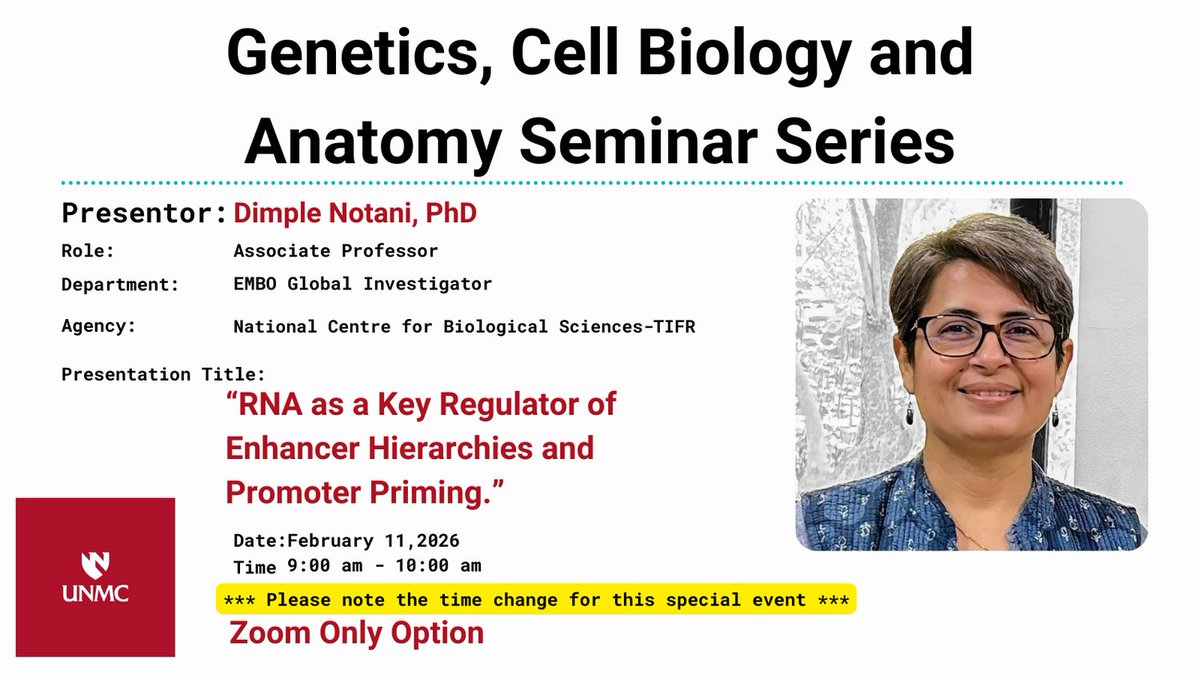
GCBA Seminar Series announces Aparna Bhaduri, PhD, Assistant Professor, University of California, Los Angeles (UCLA), Dept of Biological Chemistry presenting "Characterizing Cell Fate Specification in the Developing Human Brain and Glioblastoma" @BhaduriLab @UNMC_GCBA @UNMC_BISB
UNMC Dept of Genetics, Cell Biology & Anatomy tweet media
English
0
2
3
459
Sandipan Brahma retweetledi
Kazuhiro Maeshima
Kazuhiro Maeshima@kazu_maeshima·
Thrilled to share our new work @biorxivpreprint: biorxiv.org/content/10.110… Our Repli-Histo labeling marks nucleosomes in euchromatin and heterochromatin in live cells. We reveal genome chromatin is essentially replicated from regions with greater nucleosome motions. 1/2
English
7
94
296
40.6K
Sandipan Brahma retweetledi
Jitendra Thakur
Jitendra Thakur@Thakur_G2·
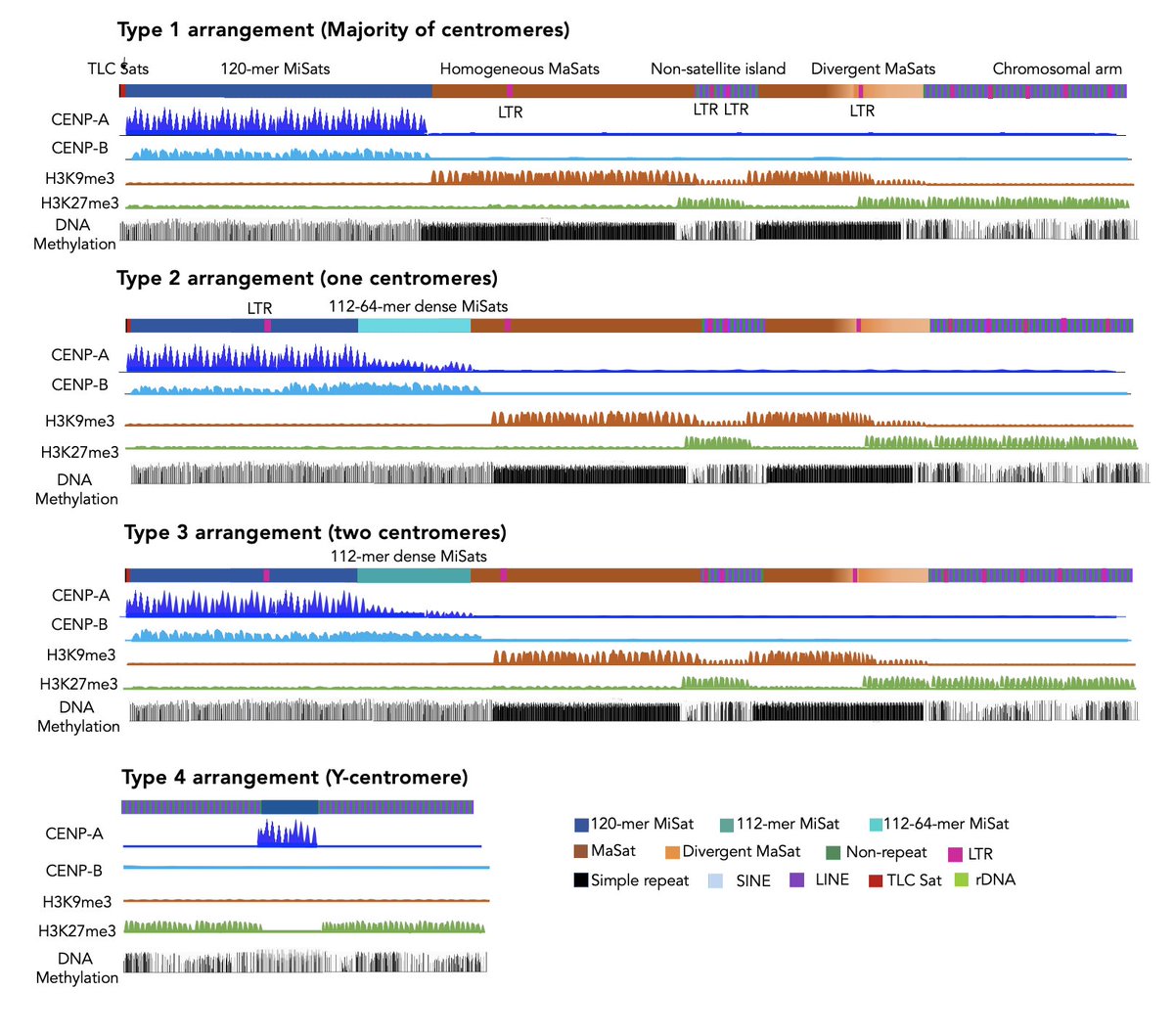
Kudos to my outstanding team for developing genomic and epigenomic maps of mouse satellite regions (centromeres and pericentromeres), which account for ~11% of the mouse genome. Very excited to share the preprint. biorxiv.org/content/10.110…
Jitendra Thakur tweet media
English
0
20
96
8.3K
Sandipan Brahma retweetledi
Paul T Kim
Paul T Kim@paultkim_ipd·
With David and the Baker Lab in the spotlight today, I wanted to share some insights into the @UWproteindesign and how it operates, a glimpse behind the curtain. I had planned to write this post-graduation, but now seems as good a time as any. (Got twitter blue free trial so this could all fit in less tweets!) First, the lab is enormous. ~60 grad students, ~60 postdocs, a handful of visitors, undergrads, and a surrounding institution of another 150 or so. Collaboration is strongly encouraged (even mandated) by David, who sets up pro-collaboration incentives. Notably, he's fine with grad students graduating without a sole first-author paper—it's acceptable to "only" have worked as a co-first author. This is a key ingredient in the secret sauce: the tight collaboration between wet lab and dry lab. It ensures that all our work is ultimately grounded in strong wet-lab validation—our "oracle" is the real world, not another computational model. While we have regular meetings for different subgroups and the entire group, much information travels through the lab via informal one-on-one interactions. In some ways, it reminds me of a classic "tribe of humans in the state of nature"—100-200 people with no clear hierarchy, passing information via "gossip". It’s maybe not the most complete way of ensuring everyone is on the same page, but saves time as we aren’t drowning in endless meetings. Does David stay in touch with all these grad students and post-docs? Remarkably, yes. Unlike some very large labs known for being run entirely by post-docs, he knows exactly what everyone is working on and the stage of their projects. Each member has monthly one-on-ones with him, and monthly subgroup meetings that David attends. If he suggests you try something at your previous one-on-one, you'd better have it done by the next. Does he actually contribute research ideas, or is he more of a detached big-picture project manager? Definitely the former. He understands the intricacies of a shocking range of topics. I'll be discussing some arcane deep learning concept with him, and then he'll turn around and talk to someone about the details of a catalytic mechanism. He's actually the most hands-on PI I've ever had—if anything, he verges on over-managing rather than being too detached. How does he keep track of everything? Partly, he's just a brilliant person with exceptional recall. But he has also built infrastructure above and below him in the lab to handle many of the details, bureaucracy, big picture, and management tasks. This allows him to spend most of his day doing what he's most passionate about and skilled at: walking around talking to people about science. He also lives very much in the moment and in his own words, “never thinks very far ahead". To keep up with tools, methods, and wet lab techniques, he does the occasional project and design campaign himself on the side when time allows. It's still a tremendous cognitive load to keep all this in his head, but as much as possible, he has offloaded non-scientific cognitive burdens. It helps that he’s in the lab in person most days of the year, rarely traveling for conferences or talks, instead doing them over Zoom or not attending. (1/2).
The Nobel Prize@NobelPrize

BREAKING NEWS The Royal Swedish Academy of Sciences has decided to award the 2024 #NobelPrize in Chemistry with one half to David Baker “for computational protein design” and the other half jointly to Demis Hassabis and John M. Jumper “for protein structure prediction.”

English
14
234
1.5K
370.2K
Sandipan Brahma retweetledi
Teif Lab
Teif Lab@TeifLab·
Happy to contribute to this new preprint by @ElenaPugachev12, @boris_ctcf & Co. What determines differential CTCF binding, beyond DNA methylation and TF/nucleosome competition? Answer: a specific nucleosome downstream of CTCF motif. Directionality matters! biorxiv.org/content/10.110…
Teif Lab tweet media
Elena Pugacheva@ElenaPugachev12

CTCF binding landscape is established by the epigenetic status of the nucleosome, well-positioned relative to CTCF motif orientation biorxiv.org/content/10.110…

English
2
19
93
10.6K
Sandipan Brahma retweetledi
Kasit Chatsirisupachai
Kasit Chatsirisupachai@KasitC10·
Excited to share the latest story from the @arnaud_kr lab @embl ! Together with @ChristineMoene we used Single Molecule Footprinting to reveal that RNA Pol II occupancy occurs at surprisingly low-frequency at mammalian promoters! Thread below (⬇️) 1/11
Kasit Chatsirisupachai tweet media
English
5
25
100
34.6K
Sandipan Brahma retweetledi
Kirkland_Lab
Kirkland_Lab@kirkland_lab·
The first paper from our lab is now out in peer-reviewed form @LSAjournal. Huge congratulations to the first author Mary Bergwell, @STEMinistSkater, now in grad school at UPenn, and second author @JY_Park102! I am very proud of their hard work. They even let me do a few expts!
LifeScienceAlliance@LSAjournal

A study by @Kirkland_Lab from @OMRF shows that the cBAF complex efficiently opposes polycomb repressive complexes 1 and 2, a function not shared by gBAF or pBAF complexes life-science-alliance.org/content/7/11/e…

English
11
11
49
6.6K