

David Hrubý
233 posts

I think there is no point in pretending to be a macho man by saying "AI is just another tool".
Yes, AI is just another tool but its impact on IT is devastating.
- CXOs who have little to no idea is happily firing employees to spend on AI.
- There is a new model, a new SDD workflow, a new Agentic IDE to learn which again is going to be called dead in a couple of weeks.
- Most of the devs are working in a survival mode worrying about when they may receive the "your role is eliminated" email.
Just worrying about it doesn't do any good. But down playing it as "AI is just another tool" is actually making everyone feel "maybe I am not able to handle these hard times".
The least we could do is acknowledge that we are going through tough times. These are not normal working conditions.
I hope this madness ends soon 🤞
English
@ctatedev Completely useless. You would have to train AI on this language which u cant. AIs sadly aren’t like people to learn anything quickly from small data
English

Introducing Zero
The programming language for agents.
I wanted a systems language that was faster, smaller, and easier for agents to use and repair.
Explicit capabilities. JSON diagnostics. Typed safe fixes.
Made for agents on day zero.

English
@eaglebuildz @dreamsofcode_io You are fucking retard hahaha🤡🤡
English

@dreamsofcode_io hot take:
code doesn't need to be readable and clean anymore with agentic coding.
new paradigm:
- just vibe-shit the code
- have enough tests written by ai
- have enough security checks done by ai
- make manual tests
nobody needs to read the code anymore.
English

The code is so bad though.
Like the worst Rust code I’ve ever seen.
Honestly it’s so bad I’m thinking of fully hand writing code again.
WebDevCody@webdevcody
Bun rewrite from zig to rust in 6 days. 1,009,257 changes. 6,755 commits. all tests passing.
English
@unclebobmartin Philosophy of software design has less radical insights and makes much more sense than dogmatic opinions in clean code
English

Clean Code was never about syntax. It was always about structure. The second edition makes that even clearer by using the same principles in multiple languages. If we, who pilot agents, disengage from syntax, we are not disengaging from structure. The Clean Code principles still apply.
English

to celebrate 3 months since lauching @lucent_ai, we're giving away 5 Codex Pro / Claude Max plans 🎁
to enter, like this post + comment which one you'd pick (codex vs claude)
winners will be selected from comments in 5 days 🫶

English
@sama Nah definitely prefer fast and cheap than “intelligent” and expensive. Today’s models are enough and pushing them more would make them absurdly expensive without much gains. LLMs are hitting their limit
English

i get some anxiety not using the smartest-available model/settings.
but sometimes i dont mind if it's really slow.
i wonder if we should focus more on a price/speed tradeoff relative to a price/intelligence tradeoff.
English

The singularity will arrive by the end of the year.
Nothing has changed yet.
Soon, everything will change.
English

A startup founder fires an engineer due to AI and gloats about it on LinkedIn.

English
@davidpattersonx Omg how retarded clown u have to be to type this shit?🤡🤡
English
In the short run, new jobs will be created. Not because AI will create jobs, but because there will still be demand that AI can't meet.
However, by 2030, AI will meet all labor demand, and demand for human labor will be zero.
That said, telling people that your product is going to eliminate all jobs and possibly kill everyone is the worst marketing message ever.
Unfortunately, all the major AI companies in the US were started by Effective Altruists who were worried that AI was going to kill us all. So they decided to build it to make sure it would be safe.
Sort of like how the lab workers in Wuhan created COVID-19 so they could learn to defend against harmful pathogens.
Fortunately, AI is not harmful in the way that the EAs feared.
But it will take all jobs.
Which is a good thing.
Unfortunately, the benefits of the end of work are difficult to explain and difficult for the average person to understand.
Saying that more jobs will be created is a simpler message, and it's not an outright lie, since it will be true for the next few years.
vittorio@IterIntellectus
i don't get people who say "there will be new jobs with AGI" like how? if AI and robots are truly better than humans at every job we have today, how is it possible for humans to still be competitive? "but every time new tech arrives, new jobs pop up" sure, for the AIs maybe, you don't see horses being hired for transport anymore. if any job were to emerge in the post-AGI era, definitionally AGI would be able to do it better. any company that could be founded would be founded by the AGI before you got there. if it needs dexterity, a humanoid robot already has it. i do not understand how people building cars can tell you with a straight face that there will still be an economy for carriage riders.
English

GitLab announced a layoff today.
Please take this seriously.
There will be many, many more.
Your assignment is clear:
Get skilled with agents and practice shipping to prod.
It doesn't matter if you're HR, eng, infra, customer success, admin, ops, sales, whatever.
As a Founder/CEO, I can tell you that I won't be hiring any employees who aren't really skilled with agents and able to ship to prod.
I'm not alone in this.
There is no 'engineering' org in the future.
English

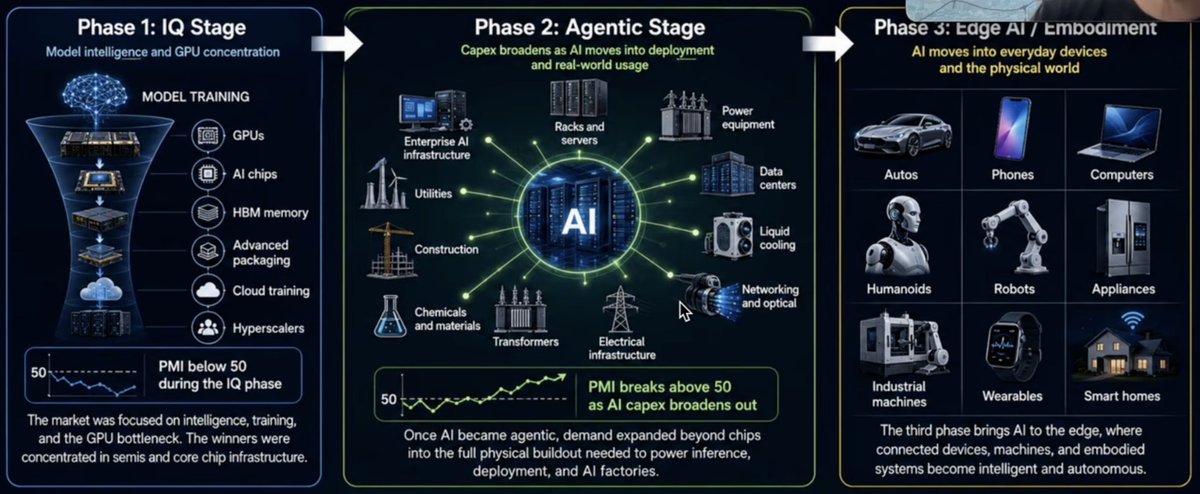
You are radically underestimating how big AI will be
It's not a bubble, and will be 1000x bigger than the industrial revolution
The craziest part is, we are barely in the 2nd inning
EVERYTHING will have intelligence in it. Every car, phone, refrigerator, drone, watch. EVERYTHING
They'll all be autonomous and eating tokens 24/7/365
They'll all require GPUs, memory, CPUs and hundreds of other components
Any products that don't have intelligence will be useless. It'll be like buying a computer that doesn't connect to the internet
Wars are still being fought by humans. Beds are still being made by humans. Cars are still being driven by humans. There are humans still not using OpenClaw.
This tells you we are not even 10% into this AI buildout.
Not even 10% in, yet you can't even buy Mac Minis or Mac Studios in stores anymore. That's how much the entire world isn't prepared for what's happening
If you are not on OpenClaw, don't know how to vibe code, or are not invested in ANY company that produces hardware for the AI buildout, you are woefully unprepared for what's coming
Not financial advice (but also the most important financial advice you'll ever get in your life)
(h/t @jvisserlabs for the graphic)
English

If you are normie with a desk job, immediately go and replace your computer with a Mac and install Codex.
You will be way ahead of all of your peers.
Go into debt if you have to.
English
@Konraddin Name more cringe people than conservatives and woke libtards?
English

Leftists will look you dead in the eye and say this is 1 woman’s body.
Bulvar Medya@Bulvarpress
32 haftalık hamile bir kadının bilgisayarlı tomografi görüntülerinden oluşturulan 3 boyutlu rekonstrüksiyon sosyal medyada paylaşıldı.
English



@Fenrirtheicewo1 Yooo u idiots, just don’t give any attention to this shit, don’t watch it. They wont make any money, thats how u beat them
English

You want me to believe this malnourished freak is supposed to be Achilles....
Achilles the Greek and Roman embodiment of masculine human perfection...?
FUCK OFF Christopher Nolan, Fuck right off.


Global Box Office@GlobalBoxOffice
THE ODYSSEY by Christopher Nolan to have Lupita Nyong’o playing Helen of Troy and Elliot Page playing Achilles. Source: ign.com/articles/the-o…
English
@doodlestein @aschmelyun Lmao Ure even selling md files thats crazy bro u the slop machine
English

@aschmelyun And this one has also been great. There are at least 10 that I used constantly across dozens of projects:
x.com/doodlestein/st…
Jeffrey Emanuel@doodlestein
I finally got around to making a skill a lot of people have been asking me for: jeffreys-skills.md/skills/simplif… It basically helps to "de-slopify" and refactor code that's been written by agents, looking for ways to simplify and reduce the amount of code without changing the behavior. The difference between this and other skills or prompts in the same spirit is the lengths this one goes to in order to prevent the process from going off the rails and introducing bugs or security problems. It's a whole elaborate system spanning 98 files and one full megabyte of reference files, scripts, and subagents (see pic). You can run it over and over again and it will autonomously identify good opportunities for accretive simplification and do everything needed to implement the changes and prove that they didn't change the outputs. GPT-5.5 can explain better than I can how it does all that and what makes it so compelling and useful: --- The strongest thing about this skill is that it treats refactoring as a proof obligation. A normal “clean this up” prompt invites the model to follow taste. It sees repetition, long files, wrapper functions, stale types, try/catch clutter, _v2 files, and it starts cutting. Sometimes that works. Sometimes it silently changes error semantics, loses a side effect, removes a lifecycle hook, or deletes a file that looked unused but was actually the intended implementation path. This skill changes the frame. A simplification claim becomes: “this smaller program is observably equivalent to the larger one.” Then it makes the agent prove that claim. It starts with a baseline: tests, golden outputs, LOC, warnings, complexity. It maps duplication instead of eyeballing it. It classifies clones, because exact copy-paste, parametric duplication, semantic similarity, and accidental rhymes are completely different things. It scores each candidate by expected LOC saved, confidence, and risk. Low-score candidates get rejected and logged, which is important because future agents otherwise rediscover the same bad idea forever. The isomorphism card is the key move. Before editing, the agent has to answer boring but lethal questions: same ordering, same errors, same logs, same metrics, same side effects, same async cancellation behavior, same React hook identity, same serialization, same resource lifecycle. Those rows catch the kind of bugs that compilers and ordinary tests miss. Then the edit discipline is deliberately narrow: one lever per commit, no rewrites, no sed, no drive-by fixes, no deletion without explicit permission. Afterward, it verifies behavior again and records the result in a ledger. If the refactor did not actually preserve behavior, it does not get to call itself a refactor. What I like about it is that it matches the real failure modes of agent-written code. AI code tends to accumulate plausible junk: defensive branches for impossible inputs, duplicated wrappers, too many optional parameters, orphaned “improved” files, shallow happy-path tests, stale types, and comments that are really leftover task plans. The skill has a whole pathology catalog for those patterns, plus scripts and subagent roles to find them systematically. So the compelling part is not “make the code prettier.” The compelling part is leverage with brakes. You can send very strong models into messy codebases and ask them to reduce complexity aggressively, while forcing them to preserve the contract that matters: observable behavior. That is the difference between a refactor you hope is safe and a refactor you can audit.
English

Feel like I'm missing out because I don't use skills, or a lot of MCP, or multi-agent orchestrations when using AI dev tools.
I'm just like "implement this feature" or "how do this work" or "no not like that, do this instead".
Idk, I feel fast and accurate so why change?
English

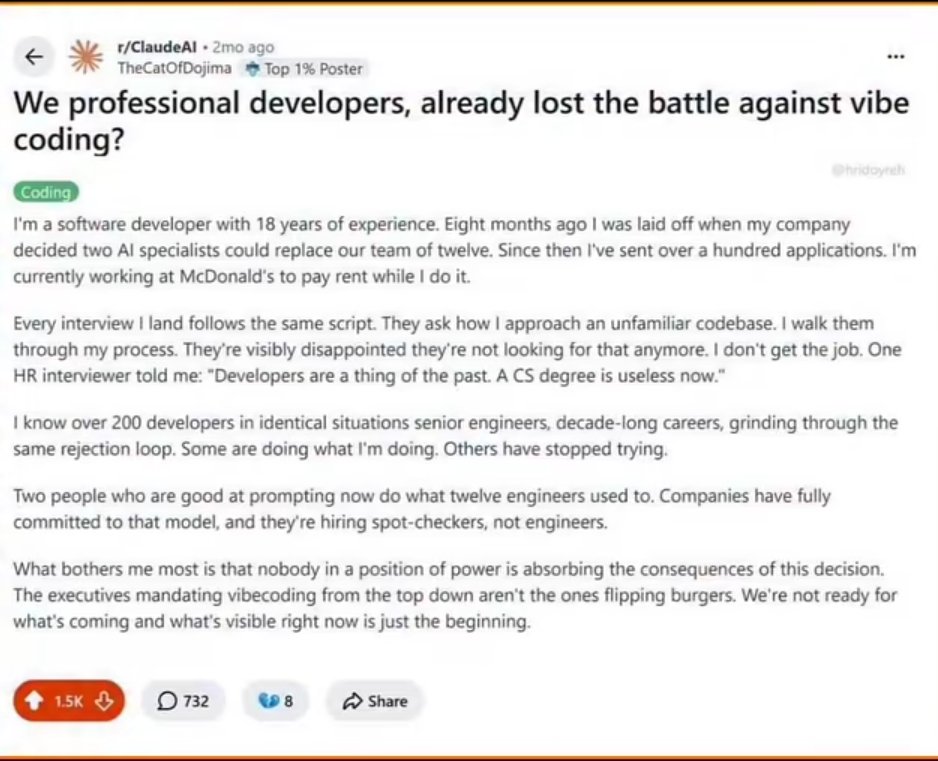
If you think, you can't be replaced.....
Think again literally 18 years of experience and 12 members of team with 2 prompter.
English
AI and robots will be able to do all jobs by 2030.
There will be no jobs left for humans.
Some people think that work is a fundamental human need.
In reality, for millions of years humans evolved to hunt and gather, not to work in offices and factories.
We adapted to work, and we will adapt again when jobs are gone.
We will still need to seek out the things that we need and want.
We will focus on becoming refined consumers - selecting things which are good, and good for us.
We will also become better consumers of religion and government.
The result will be religions and governments that are more optimal.
We will likely converge on optimal solutions, but with a diversity of implementations.
Religion may have a core of love, truth, and peace, but many different ways of practice.
Government may converge on democracy, human rights, and free markets, but with different structures and traditions.
AI and robots will produce and provide things, but we will need to tell them what we want.
The result will be a high level of optimization and refinement in everything.
English