@ArneLutsch Truly that was a class act video of bluebird pack out. Impressive doesn’t even cover it.
English
Dogd🅰️Ze
363 posts
@DogdAZe007
$ASTS Investor. Slowly moving to a more private X account. Been here since NPA and long term hold.


A BlueBird convoy is officially underway. Two BlueBirds are already making their way to Cape Canaveral, with the third close behind. Next stop: the launch pad. 🚀 🚀 🚀 🚀 🚀 🚀 🚀 🚀 🚀 🚀 Built in Texas. Broadband from space. Designed to connect directly to everyday smartphones.🌎📶📱 #ASTSpaceMobile #Broadband #ConnectingtheUnconnected #BlueBirds

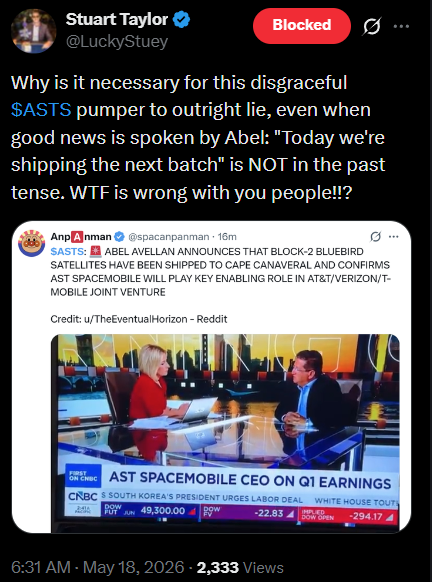
.@AbelAvellan, Chairman and CEO of @AST_SpaceMobile, says the company is leading direct to device satellite broadband and expects rapid growth as space based connectivity expands globally. cnbc.com/video/2026/05/…

A BlueBird convoy is officially underway. Two BlueBirds are already making their way to Cape Canaveral, with the third close behind. Next stop: the launch pad. 🚀 🚀 🚀 🚀 🚀 🚀 🚀 🚀 🚀 🚀 Built in Texas. Broadband from space. Designed to connect directly to everyday smartphones.🌎📶📱 #ASTSpaceMobile #Broadband #ConnectingtheUnconnected #BlueBirds





* $RKLB delays Neutron * “It’s expected, it takes time to develop such complex tech. Space is hard after all” * $ASTS has manufacturing timeline slippage, while developing an entire new satellite design * “Scam stock! Abel is selling snake oil! It’s going to $0” Lol



$ASTS: Real-time short interest now 66.7M, an all time high


$VSAT: I’m on a flight to the west coast and this plane has ViaShat. Absolutely brutal intermittent narrowband connection.
$ASTS GOLDEN DOME ISN’T JUST ABOUT MISSILE INTERCEPTORS. IT’S ABOUT BUILDING A SPACE-BASED SENSING, COMMUNICATIONS, TRACKING, AND DATA NETWORK AT GLOBAL SCALE. That is where @AST_SpaceMobile starts becoming extremely interesting. Most people still look at AST only through the lens of consumer direct-to-device cellular service. But the U.S. government is openly signaling something much larger now: a persistent, resilient, proliferated space architecture capable of tracking, communicating, processing, and coordinating across thousands of assets in real time. The Congressional Budget Office estimate being discussed here is staggering because it reveals the true scale of what Golden Dome may ultimately become. A constellation measured in thousands of satellites is not simply a weapons program. It is an orbital infrastructure buildout. AST already possesses several characteristics that align directly with this future: • Massive phased-array technology proven in orbit • Extremely high power generation capability on spacecraft • Broadband connectivity directly to standard devices • Advanced beamforming and software-defined network architecture • Global cellular spectrum relationships and regulatory positioning • Vertical integration and large-scale satellite manufacturing capability • Existing relationships with AT&T, Verizon, Vodafone, Google, and government entities • Prime contractor status under the SHIELD/Golden Dome ecosystem That last point is important and underappreciated. AST was not randomly mentioned in defense discussions. The company was officially announced as part of the Missile Defense Agency’s SHIELD initiative through a prime contractor award structure. That immediately elevated ASTS from “commercial space telecom startup” into a company now operating adjacent to next-generation national defense architecture. The market still largely prices AST as if it is only pursuing rural cellular coverage. But Golden Dome concepts require exactly the kinds of technologies AST has spent years developing: persistent low Earth orbit coverage, large deployable arrays, resilient communications, distributed sensing, space-based networking, and massive power availability on orbit. And once you begin discussing constellations potentially costing hundreds of billions over decades, the valuation framework for companies participating in that ecosystem changes dramatically. This is why many investors believe AST is evolving into something much larger than a telecom company. It increasingly resembles critical infrastructure for the next era of space-based communications, defense, sensing, AI distribution, and sovereign network resilience. The Business Wire release is worth reading carefully because it confirms AST is already inside the conversation: businesswire.com/news/home/2026…
$ASTS THE FCC JUST TOLD YOU WHO THE REAL DIRECT-TO-DEVICE PLAYERS ARE Today’s FCC release was not subtle. The regulator explicitly framed America’s future in direct-to-device connectivity around only a handful of serious infrastructure players, and @AST_SpaceMobile was named directly alongside SpaceX in the agency’s own messaging. Read the language carefully. The FCC states it already approved AST’s “competitive 248-satellite D2D system” and tied that approval directly to America’s “global leadership in next-gen D2D offerings.” That is extraordinary regulatory positioning for a company many retail investors still treat like a speculative science project. Meanwhile, Brendan Carr is openly talking about a future with “at least three facilities-based providers” in D2D. Not dozens. Not unlimited competition. A small number of national-scale infrastructure winners. And AST is specifically being elevated into that conversation by the FCC Chairman himself. What casual investors are missing is that this FCC document effectively confirms several things simultaneously: • AST now has authorization for a 248-satellite commercial constellation in the United States. • The FCC repeatedly emphasizes “competition” because regulators do not want a single-player monopoly in space-based cellular broadband. • AST is integrated with AT&T, Verizon, and FirstNet using actual carrier spectrum and carrier core infrastructure. • The FCC is signaling long-term regulatory support for D2D as strategic national infrastructure. • The agency is creating clarity around exclusive-use spectrum rights and buildout expectations so companies can invest at massive scale. This is the part the market still does not fully grasp: AST is no longer being discussed as an experimental satellite company. The FCC is discussing it as part of the future architecture of American wireless infrastructure. That changes valuation frameworks completely. The government is openly talking about ubiquitous smartphone connectivity from space, rural coverage, public safety integration, competition policy, spectrum policy, and next generation industrial leadership. Those are trillion-dollar infrastructure themes, not niche themes. And look at the players orbiting this ecosystem now: AT&T. Verizon. FirstNet. Google relationships. Defense implications. National infrastructure implications. Potentially exclusive spectrum structures emerging around D2D. The FCC itself is now effectively validating that direct-to-device broadband from orbit is becoming a permanent layer of the communications stack. Retail still thinks this is a meme stock. The regulators are talking about national strategic infrastructure.

$ASTS: Dear SpaceMob family, Today I laid to rest our dear friend @steve_larrison. I picked this beautiful spot that has two chairs overlooking Kennedy Space Center so friends can sit with him and share fond memories together. Steve, I am so happy that you were able to watch your BlueBirds lift into the heavens and look forward to sharing many more launches together. Godspeed my friend, we all miss you dearly but take comfort knowing that your spirit and kindness continues on in all of our hearts. ❤️ You can join Steve here: maps.app.goo.gl/tPyPZzirBhk3Wh…

$ASTS Sp🅰️ceMob on Bloomberg tv. Who is this Kook that they speak of? 🏄♂️🚀

Announcement: Mid-June launch of three Bluebird satellites aboard a Falcon 9 rocket.🚀🚀🚀🚀🚀🚀🚀🚀🚀🚀 32 next-generation satellites at advanced stages of assembly to be ready for launch. Network deployment with a launch every one to two months on average. Space-based cellular broadband. Built in Texas. 🌎📶📱 #ASTSpaceMobile #Broadband #ConnectingtheUnconnected #BlueBirds