Edward M. Varga

1.9K posts

Edward M. Varga

Edward M. Varga

@EdMarVar

Katılım Temmuz 2011
535 Takip Edilen103 Takipçiler
Edward M. Varga
Edward M. Varga@EdMarVar·
@DineshDSouza Ari Parker was featured on one of @fisherinvest seminars for clients. Very informative and worthwhile review. A fiduciary is best for anyone nearing or in retirement.
English
0
0
0
375
Dinesh D'Souza
Dinesh D'Souza@DineshDSouza·
THE MEDICARE TRAP AMERICANS DON'T SEE COMING Most Americans turning 65 have no idea how complicated Medicare actually is — and one wrong move can cost you for life. I sat down with Ari Parker — Stanford Law grad, Medicare expert, and co-founder of Chapter — to map out exactly what you need to know before it's too late.
English
22
97
278
49.8K
D. Scott @eclipsethis2003
D. Scott @eclipsethis2003@eclipsethis2003·
Karen Bass’s Los Angeles has begun deploying “rapid mobile addict resource centers,” where taxpayer funded NGOs set up across the city to hand out tool kits to addicts, including pipes, straws, needles, and foil, in front of businesses and schools.
English
3
1
2
213
Secretary Markwayne Mullin
This is nothing more than a political stunt by New Jersey sanctuary politicians for fundraising clicks. There is NO hunger strike at Delaney Hall. There are no subprime conditions.   @SenBooker, @SenatorAndyKim, @RepMenendez@RepNellie@FrankPallone@GovSherrillNJ and dozens of New Jersey sanctuary politicians chose to spend their Memorial Day weekend smearing ICE law enforcement. They should be thanking our law enforcement for removing these murderers, pedophiles, rapists, and drug traffickers from their state. Would these sanctuary politicians like to house these criminals in their homes or have them as neighbors?   We need these sanctuary politicians to stop peddling this garbage and cooperate with us to get these criminals out of their state.
Sen. Cory Booker@SenBooker

Immigrants at Delaney Hall are on a hunger strike because they are fighting for their human rights. The conditions there are deplorable. We’re working with our partners in the state to bring an end to this nightmare and I’ll be going to Delaney Hall again to conduct oversight. Enough is enough - not in New Jersey, not anywhere.
English
1.3K
2.3K
8.4K
216.8K
Edward M. Varga
Edward M. Varga@EdMarVar·
@mikeroweworks We were never taught how to toss and catch hot rivets however. A few daring students tried when the instructor wasn't looking 🫣. The loud banging and sound of running compressors told the entire school that shop class was in session! Great memories! 2/2
English
0
0
0
6
Edward M. Varga
Edward M. Varga@EdMarVar·
@mikeroweworks Some old time co-workers who brought this up: Brooklyn Tech had great teachers on job site (architect, sheet metal worker, etc,) when working summers after graduation. Sheet metal worker/teacher had class assembling a truss using real rivets & forming gun.1/2
English
0
0
0
6
Edward M. Varga
Edward M. Varga@EdMarVar·
@Ford Why would my Transit start up if we did not remotely start via fob or app?
English
1
0
0
22
Edward M. Varga
Edward M. Varga@EdMarVar·
@MarioNawfal Jackie Robinson Parkway is in Queens, not the Bronx! Get your geography straight
English
0
0
1
26
Mario Nawfal
Mario Nawfal@MarioNawfal·
🇺🇸 While New York City's drainage systems buckled under the storms, a stranger didn't wait for first responders. He pulled a person out of a flooded car on the Jackie Robinson Parkway in the Bronx. Zero hesitation.
Mario Nawfal@MarioNawfal

🇺🇸 Scenes from New York City, with roads literally turning into rivers and the infrastructure not ready for it. It flooded in 2021 after Hurricane Ida. It flooded in 2023. It flooded tonight. Source: @Arab_Storms, @WhitakerTA_

English
34
37
154
67.7K
DataRepublican (small r)
DataRepublican (small r)@DataRepublican·
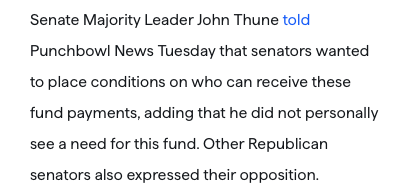
Hello Senator Thune, I'm replying to your post from yesterday: "Despite Democrats' partisan games, we're still going to get the entire federal government funded." Today, you sent the Senate home... not because of Democrats. Because of you. Here's what actually happened. On May 18, the DOJ announced an Anti-Weaponization Fund: $1.776 billion to compensate Americans harmed by Biden-era DOJ abuse. Your own caucus revolted. After a two-hour closed-door meeting, you departed for Memorial Day recess without a vote. ICE and CBP funding, punted to June 1. The "partisan games," it turns out, were yours. Your stated objections: no congressional authorization, no eligibility standards, no legal precedent, executive overreach. Fine. But let's talk about November 2025, when you tucked a provision into the government funding bill. The FBI had quietly seized phone records from eight Republican senators without notice, under an investigation codenamed "Arctic Frost." Your provision gave those senators, and only those senators, $500,000 per violation, retroactive to 2022. The House voted 426-0 to repeal it. The critics weren't opposed to compensating victims of DOJ abuse. They were opposed to senators compensating themselves while doing no other structural reforms. Lindsey Graham held the Senate hostage to preserve it. He delayed a spending deal in January 2026 to secure a floor vote on his revised version. Let's put the two columns next to each other: ➤ DOJ abused senators: $500K/violation payout, senators only, no hearings, no process, no eligibility debate, no floor vote on substance. ➤ DOJ abused Americans: "very legitimate questions," two-hour meeting, Senate goes home, reconciliation punted, June 1 deadline in jeopardy. You told Punchbowl News you "did not personally see a need for this fund." You personally saw a need for the fund when the targets were you. Go cry harder to your Punchbowl friends @JakeSherman and @AndrewDesiderio, because at this rate, they'll soon become the only people who are buying what you're selling.
DataRepublican (small r) tweet mediaDataRepublican (small r) tweet media
English
1.3K
14K
29.3K
398.5K
Leader John Thune
Leader John Thune@LeaderJohnThune·
Despite Democrats’ partisan games, we’re still going to get the entire federal government funded. @SenateGOP is going to ensure our immigration laws are enforced, and criminal illegal aliens are not allowed to live freely in our country.
English
6.4K
284
924
151.2K
John Rich🇺🇸
John Rich🇺🇸@johnrich·
Every time I visit my hometown of Amarillo,TX, I have to swing by here:) Where was I?
John Rich🇺🇸 tweet media
English
503
165
2.8K
60.2K
Edward M. Varga
Edward M. Varga@EdMarVar·
@DisrespectedThe This is event occurred last year and the story is different from what is indicated. Thought you were someone worthwhile to follow. No more. Bye, bye!
English
0
0
1
41
Edward M. Varga
Edward M. Varga@EdMarVar·
@RaymondArroyo Find it strange that your post about Mel Gibson's movie is 35 minutes ago and yet Pope Leo commented on it 9 hours ago?
English
0
0
0
4
Goku
Goku@ProjectGokuu·
Hal Cranmer says assisted living is where the elderly are sent to wait till they pass away. Cranmer owns four assisted living homes in Arizona. When he first got into the business, he noticed something that bothered him. None of the residents were getting better either. They were treated like cardboard boxes at a storage unit - stacked out of the way, forgotten and slowly falling apart inside. He asked everyone in the industry why no one was trying to improve their health. The answer he kept getting was, "Well, they're old, so they don't get better." Cranmer thought that was nonsense. The standard assisted living model includes diaper changes, bingo, showers, three meals a day, and medications managed by outside doctors. Health improvement is not part of the protocol. Cranmer rejected the model and started cutting sugar, adding trainers, and putting his residents on low-carb diets. Nine of them have now moved back home in his decade running it. The industry built itself on managed decline because nobody told the elderly that recovery was still possible. — Hal Cranmer (@HalCranmer)
A Paradise for Parents@HalCranmer

Mikhaila Fuller interviewed me on her podcast a year ago. She wanted to know how we reversed 2 dementia residents in 3 years. The 8 things I told her about our nutrition protocols, the assisted living industry and my residents: 1) Average resident in my home is on 25-30 meds

English
139
1.9K
8.1K
726.3K
Nick Sortor
Nick Sortor@nicksortor·
🚨 NOW: President Trump spotted in THE BEAST as he returns to Washington, DC following his EPIC Commencement Address at the US Coast Guard Academy Usually, 47 takes Marine One from Joint Base Andrews to the White House, but given there was an event on the South Lawn last night, Marine One can't land there. It's a hell of an operation to shut down miles upon miles of major roads to move the President through, which is why Marine One is MUCH preferred by practically everyone.
English
67
412
4.5K
240.3K
Owen Gregorian
Owen Gregorian@OwenGregorian·
This Convicted Felon Gets $1 Million a Year to Sell Obsolete Internet Service. You Pay for It. | Kyle Hopkins, ProPublica Reporting Highlights - Internet Gold Rush: Alaskan companies are getting billions of dollars in public telecom subsidies, yet the state ranks last in internet speed. - Subsidizing a Ghost Town: The federal government pays one company more than $350,000 a year to provide internet to 300 buildings on an island of 80 people. - Operating From Prison: The owner of another company operated his telecom business from behind bars and today gets more than $1 million a year despite faster options for consumers. ... At the beginning of his three-year federal prison sentence for felony tax evasion, Roger Shoffstall lost his telephone privileges when a guard caught him running his small Alaska phone company from behind bars. He’s lost a lot of privileges over the years. Shoffstall, 75, can’t serve on a federal jury. Unlike most Alaskans, he doesn’t receive an annual Permanent Fund dividend check. And he is not allowed to own a gun. One thing never changes, however: Each year, the federal government sends his company, Summit Telephone, more than $1 million. The money comes from a special government subsidy program that Congress created to bring fast, affordable phone and internet service to hard-to-reach places. You help pay for it. Pull up your latest phone bill and look for a line labeled “Universal Service Fund.” Some phone companies list it as a “Universal Connectivity Charge” or fold it into a “Regulatory Programs & Telco Recovery Fee.” It’s all the same thing: a surcharge added to the monthly bill of phone customers throughout the United States. The federal government and phone companies don’t call it a tax — but it acts like one. Carriers must currently contribute 37 cents of every dollar of their interstate and international phone revenues to the fund. In Alaska, where many communities can only be reached by plane or boat, the Federal Communications Commission has given telecommunications companies $4.6 billion in these subsidies since 2016. That’s more than $600 per Alaskan per year. More per resident than in any other state. Yet after all that spending, Alaska still ranks near the bottom for access to the very land-based, high-speed internet service the money was meant to deliver. Some communities have yet to be wired at all. In others, fiber-optic cables or microwave towers offer internet with speeds that were recently clocked, statewide, as the slowest in the country. Even with the subsidies, the service comes at a steep price to customers: often hundreds of dollars a month for internet one-tenth what the FCC considers broadband quality. The federal program has kept money flowing to companies like Shoffstall’s whose operators have troubled pasts. It also gives money to companies like Shoffstall’s regardless of how many people use their services. And fewer and fewer Alaskans have done so since low-earth satellites from Starlink entered the market at better prices. (Satellite internet doesn’t qualify for the subsidy but costs about $90 to $130 per month for download speeds up to 280 megabits per second in the same service area as Summit Telephone. According to Summit’s website, its fastest internet plan in the same region maxes out at 25 Mbps and costs $135 a month.) All of these excesses appear to fall within the program’s rules or the FCC’s discretion. A telecom on the Aleutian island of Adak receives more than $350,000 a year to provide phone and low-speed internet services to 306 buildings, according to FCC records, even though the state Department of Labor says the island is home to fewer than 80 people. One business owner said everyone he knows on the island has moved on to Starlink anyway. GCI, the state’s largest telecom and its largest subsidy recipient, got $466 million just two years after its settlement with the federal government for alleged fraud related to the same subsidy program. (The settlement said it was neither an admission of guilt by GCI nor a concession by the Justice Department that the claims were not well founded.) Shoffstall and his attorney did not respond to repeated interview requests or answer detailed questions sent by email. On Thursday, Shoffstall sent two documents to the Anchorage Daily News and ProPublica asserting that he is a sovereign citizen of the United States, an ideology that the FBI has described as “those who believe that even though they physically reside in this country, they are separate or ‘sovereign’ from the United States.” The FBI has categorized the extremist version of this movement as “domestic terrorism.” Larry Mayes, the owner of Adak Eagle Enterprises, the company that receives the subsidy to provide internet on Adak, declined to answer questions about the funding. “You’ll have to talk to the FCC about that,” he said, hanging up the phone. In a written response to questions, GCI said it and other Alaska telecoms depend heavily on the subsidies to provide services across the state. “Before and after the settlement, GCI continued to work with the FCC and customers to provide high-quality communications services in compliance with all applicable laws and regulations,” the GCI statement said. “The settlement did not change Alaskans’ growing demand for these services, GCI’s willingness to provide them, or the criticality of USF funding to the sustainability of those services.” The FCC did not respond to requests for comment. The agency is weighing the future of the program and recently circulated a proposal to overhaul or potentially sunset elements of the subsidy that funds companies like Summit. Alaska telecom lobbyists and executives said that the state provides some of the most challenging geography to serve in the United States, and that they have made great progress in bringing internet access to Alaska. Christine O’Connor, executive director of the Alaska Telecom Association, said the subsidies have improved access and lowered costs for rural Alaskans. “There is simply no way that rural Alaskan communities could be connected with Anchorage or with the rest of the United States and the world” if consumers living in rural Alaska communities had to pay the full cost, she wrote in a statement to the Daily News and ProPublica. But Daniel Lyons, a former attorney whose law firm represented Verizon and AT&T and who now teaches internet law at Boston College Law School, said the subsidy program is broken. The fundamental problem: No one has ever rigorously tested whether it works. “It’s not proven how successful it is,” said Lyons, who specializes in telecommunications and internet law, “because the FCC is not very good at auditing its program.” In Shoffstall’s case, the FCC pays his company what works out to about $800 per month per customer. Lyons has advocated scrapping this approach and sending the subsidy directly to consumers instead, letting them choose which provider gets their money. In Alaska, that might mean Starlink, though some new users say they are being charged a “high demand” fee of $1,500 to sign up, or its future satellite competitors like Amazon Leo. “If the goal is to make sure everybody gets online,” Lyons said, “you try to find the families that can’t afford service at market rates and you give subsidies to them directly.” Money for Homes With No Internet Alaska’s outsized share of the subsidy traces back to a man memorialized with a life-sized bronze statue in the Anchorage airport. Sen. Ted Stevens — “Uncle Ted” — spent 40 years delivering federal money to Alaska and was nearing the height of his power in 1996 when Congress passed the Telecommunications Act, creating the modern Universal Service Fund. It was before smartphones or Netflix. Most homes in America had no internet, and by the late 1990s “high-speed” service meant 200 kilobits per second — faster than dial-up modems but too slow to play high-definition video. Today, the FCC defines broadband, which is just another way of saying high-speed internet, as 100 Mbps. That’s 500 times faster than in the ’90s. As chair of the committee that controlled the FCC’s budget, Stevens ensured Alaska telecoms received special treatment, according to Carol Mattey, a former FCC official who oversaw efforts to reform the subsidy. “It would be suicidal to do something to make the head of the Appropriations Committee angry at you,” said Mattey, who served as deputy chief of the commission’s Wireline Competition Bureau. Stevens lost reelection in 2008 while under a corruption indictment that was later dropped. He died two years later in a plane crash on a trip from a private lodge owned by GCI, the Alaska telecom giant. GCI’s current president and chief operating officer, Gregory Chapados, is Stevens’ former chief of staff. A GCI spokesperson wrote that while Stevens chaired the Appropriations Committee, he did not at the time chair the Senate Commerce Committee, which drafted the Telecommunications Act and oversees the subsidy program. Chapados, who served as chief of staff for Stevens from 1986 to 1992, was not involved in developing the Telecommunications Act, the company said. The company said it “maintains constructive working relationships with all members of our delegation to advocate on behalf of our customers and all other Alaskans.” Nationally, the subsidy program allows payments to any company that the FCC or state regulators have designated as an “eligible telecommunications carrier.” How much they get depends on whether they want to provide internet to village schools, health care clinics or simply remote communities. In its statement to ProPublica and the Anchorage Daily News, GCI said, “There are no provisions in the Telecom Act extending special treatment for Alaska.” But the state is treated differently in practice. In 2016, the FCC created a program called the Alaska Plan specifically for carriers here, allowing them to negotiate their own performance targets rather than being subject to the same cost models applied elsewhere. Alaska’s geography made it especially difficult for the agency to estimate the cost of serving customers in the state, Mattey said. The FCC assumed the companies would only set goals that they would be able to achieve. They tried to adjust the national formula for distributing money to account for this factor, Mattey said, but Alaska telecoms kept pushing back and FCC officials gave up. “We tried so hard not to treat Alaska differently because our goal was to create defined deployment obligations for all companies, and we failed,” she said of the 2016 reforms. “The political pressure was too strong.” Summit has received $12 million over the past decade by promising to deliver internet to 337 locations across a collection of woodsy, roadside neighborhoods just north of Fairbanks. Filings by Summit report dozens of new connections in some years, a combined total of 271 as of 2025. But according to the FCC’s interactive map of all locations U.S. telecoms report actually serving with internet, the number of customers using Shoffstall’s service is far smaller. In a phone interview, the company’s acting general manager, James Perry, said that Summit has about 120 internet customers and 160 in total. Mattey said the rules of the program say nothing about making sure the lines that a subsidy recipient builds actually get used — only that they get built. Companies that fall behind on building out their network can have their subsidies reduced. But they are allowed to go on collecting cash long after the technology they use has become outdated, customers have moved on to cheaper and faster alternatives or their community has become a ghost town. “They’re playing by the rules, so to speak,” Mattey said. “It’s a flat amount of money the government has decided they are entitled to.” Off the Grid Shoffstall’s penchant for setting his own rules first landed him in trouble in 1996. State prosecutors charged him with a misdemeanor when he mailed documents whose tone and language mimicked court orders to an Alaska bank, demanding money. The trial ended without a verdict when Shoffstall agreed to change his plea from not guilty to no contest. He received a suspended imposition of sentence, a judgment entering a conviction with no jail time, contingent upon completing probation. Over the decades since, he has continued to file paperwork in state court, federal court and with the Alaska Department of Natural Resources claiming to be a sovereign citizen not bound by the same court systems as other Alaskans. An electrical technician by trade, Shoffstall bought the business for about $675,000 in 2000. Shoffstall’s customers live mainly in the hillsides north of Fairbanks. Some right off the highway. Some at the end of snowy roads littered with warning signs like: “You are no longer a trespasser. You are a target.” People moved here when the famously independent and rough-edged city of Fairbanks felt too urbane. They moved here to get off the grid. Not on it. Among Shoffstall’s customers was a Sunday school teacher who’d arrived in Alaska in 1981, answering phones for a small insurance company. In the late 1990s and early 2000s, still the days of landlines and dial tones, Lois Sannes found herself frustrated with a surcharge added to calls in the Summit service area. She began complaining to the Regulatory Commission of Alaska. She wrote so many letters to the governor that someone wrote back. Sannes met with an attorney, who she said told her the IRS had launched a criminal investigation into Shoffstall. Separately, Shoffstall’s company was under scrutiny from the regulatory commission itself. When Summit sought approval for the rates it charged other telecom companies to use its phone lines, the commission allowed them to look at Summit’s unredacted financial reports. A consultant hired by the rival telecom companies testified to the commission that Summit’s spending appeared unusually high, poorly documented and in some cases tied to transactions between the company and Shoffstall himself. Roughly 95% of the company’s revenue around this period came not from phone customers but the federal subsidy program and payments redistributed through the telecom industry itself, according to audited financial statements Summit filed with state regulators. The dispute before the regulatory commission ended when Summit and its competitors agreed to a settlement. The commission issued no findings on whether there were indeed problems with Summit’s books, as the consultant’s report had outlined. But a new legal issue arose for Shoffstall — this time from the IRS, whose investigation Sannes had heard about. On Sept. 15, 2009, a federal grand jury indicted Shoffstall on allegations of felony tax evasion. The charges said he “willfully evaded the payment of his income taxes” for at least eight years beginning in 1996. Shoffstall’s former accountants testified against him. “I told him that he was going to get nailed, that’s not a question,” certified public accountant Garry Hutchison told the jury. “The only question is whether or not it would bring the company down.” A Fairbanks jury found Shoffstall guilty on Feb. 5, 2010, after a five-day trial. The FCC has the power to cut off subsidies to recipients convicted of fraud and other financial crimes related to the subsidy program. How closely related the crime must be to the subsidy payments is up for interpretation by the agency. On one hand, Shoffstall’s indictment said he used his position running a federally subsidized company to obstruct the IRS investigation. On the other, the conviction was for tax evasion related to money he personally owed the IRS. There is precedent for the FCC closely scrutinizing a subsidy recipient who’s been convicted of evading personal income taxes. The FCC Wireline Competition Bureau directed the Universal Service Fund’s administrator to look into whether Hawaii-based Sandwich Isles Communications misused its subsidy dollars. The action followed owner Albert Hee’s conviction on federal tax crimes in 2015. The FCC fined Sandwich Isles and Hee $49.6 million and ordered the company to repay $27 million in what it described as improperly received subsidies. Hee’s attorneys contested the charges, arguing that he had concealed nothing and that the government mistook accounting errors for criminal intent. A jury disagreed. It’s not clear whether the FCC investigated Shoffstall after his conviction; the agency did not respond to questions about the case. But records show that Shoffstall’s company steadily continued to receive Universal Service Fund subsidies, even while Shoffstall was in prison. Two months after his release in January 2013, Summit reported collecting $1.1 million in annual subsidies. When Shoffstall’s probation officer told a federal judge that Shoffstall was ignoring his probation requirements, he was arrested on Dec. 9, 2013, and went back to prison for several months. His company received $859,393 in Universal Service Fund subsidies during that time. In the years that followed, the subsidies to Summit grew. FCC data shows Summit in 2016 received one of the highest levels of federal subsidies per customer in the country. As of that year, Shoffstall’s company paid him an annual salary of up to $121,000 and paid an annual dividend of up to $155,000 to a holding company for which he was the sole shareholder. His company stopped publicly disclosing that information after 2016, as the Regulatory Commission of Alaska stopped requiring detailed annual reporting, leaving far less financial information available to the public. Sannes, the former Summit customer who once pressured state regulators to take a closer look at the company, now lives in Wisconsin. Asked if she was surprised to learn that the company’s subsidies not only continue today, but have increased to $1.5 million a year, Sannes said she had assumed his criminal conviction alone would have been enough to cut off the money. “I’m horrified,” she said. Unplugged Summit Telephone is named for a mountaintop, Cleary Summit, outside Fairbanks. Sled dogs can be heard howling from their plywood houses, and every so often a semitruck barrels down the highway, swirling snow as it hauls gold ore from open-pit mines. In the winter, you might see a rocket launch from a valley a few miles north, from the world’s only rocket launch site operated by a university. The hills are known for world-famous aurora borealis displays, and a collection of Airbnbs and lodges line winding roads. As the subsidies flowed to Summit, Shoffstall continued to create and distribute documents intended to look like court orders. He submitted paperwork in federal court arguing he didn’t have to pay taxes — in one 2017 filing accusing the federal government of “high crimes” against him, in another issuing what he called a “summary judgment” against President Donald Trump for “fraud, collusion and conspiracy.” None of this stopped the state’s telecom industry from spotlighting him as a poster child. O’Connor, the executive director of the Alaska Telecom Association, cited Summit to state lawmakers in 2018 as an example of a company forced to “muddle along with the obsolete technology” rather than upgrade its network due the burden of state overregulation. Raising the rates to provide upgrades would have required Summit to make its case to regulators that the fee increases were necessary. Asked whether it was an appropriate use of public funds for a company like Summit to receive roughly $10,000 per customer per year in federal subsidies, O’Connor did not directly answer. In a written response, the Alaska Telecom Association said the program “is specifically designed to support building and operating telecommunications networks in high-cost areas” and that participating providers “are subject to FCC program requirements, reporting obligations, and oversight.” Asked whether it stood by its 2018 characterization of Summit, O’Connor said her testimony was focused on the challenges facing smaller providers generally. Shoffstall never upgraded to expand its service. According to the FCC broadband map, Summit’s equipment today remains incapable of delivering internet faster than 25 Mbps — one-fourth the FCC’s current definition of broadband. Meanwhile, the internet marketplace has changed. Some Alaskans no longer need or want the slower subsidized service. One recent Saturday, 74-year-old Philip Marshall shoveled a waist-high tunnel through the snow to a cabin near the top of the mountain. A wood carver, he wore a red ski cap decorated with the flag of Denmark. Asked about his internet access, he invited a reporter inside and made a pot of black tea. Marshall said his wife, Janet, moved into this cabin before he met her. The construction boom for the 800-mile trans-Alaska oil pipeline had raised rents so high within Fairbanks’ city limits during the mid-1970s that she moved here out of town. Like many cabins outside Fairbanks, the home is “dry,” meaning there’s no running water. Old-timers hauled the building itself up the side of the mountain on sleds. In interviews, several of Marshall’s neighbors said they have no complaints about the internet speeds Summit provides. One said she pays Summit $95 a month and the internet is fine for her needs. Another, who retired after a career working on remote Alaska radar sites, said he uses the service too. But he’s recently added satellite internet. Others who have opted for the low-orbit satellite dishes, which deliver speeds up to 10 times faster than Summit for about the same price, have dropped their Summit plans altogether. One especially clear evening recently, Marshall stood in the snow and counted 18 satellites passing overhead within nine minutes. “Starlink,” he said. The company and corporate parent SpaceX did not respond to questions and do not publicly release the number of users in Alaska. But Ookla, a company that offers tools people can use to test their internet speed, offered a proxy measure: About 1 in 10 Alaskans who tested their home internet speed through Ookla connected via Starlink, compared with roughly 1 in 67 in California. The Marshalls haven’t felt the need to pay for either service. Their cellphones give five-bar, 5G service from a nearby tower. Finishing his tea, Marshall pulled on his jacket to head back outside. Still have to shovel a path to the outhouse, he said. In the corner of the room, a plastic box the size and color of a concrete brick sat near the floor. It was for the Summit internet line that public subsidies pay the company roughly $10,000 a year to provide. Unplugged and unused. propublica.org/article/alaska…
Owen Gregorian tweet media
English
5
8
38
2.1K