Jesse

26.2K posts

Jesse

Jesse

@Ember421

Process engineer. Energy, infrastructure, industrial decarbonisation, P(🌎net0|☢️📉) less than P(🌎net0|☢️📈). Views my own. Ember42 at m**https://t.co/I5egdcoNEx or BS

Ontario, Canada Katılım Kasım 2018
1.3K Takip Edilen1.6K Takipçiler
Sabitlenmiş Tweet
Jesse
Jesse@Ember421·
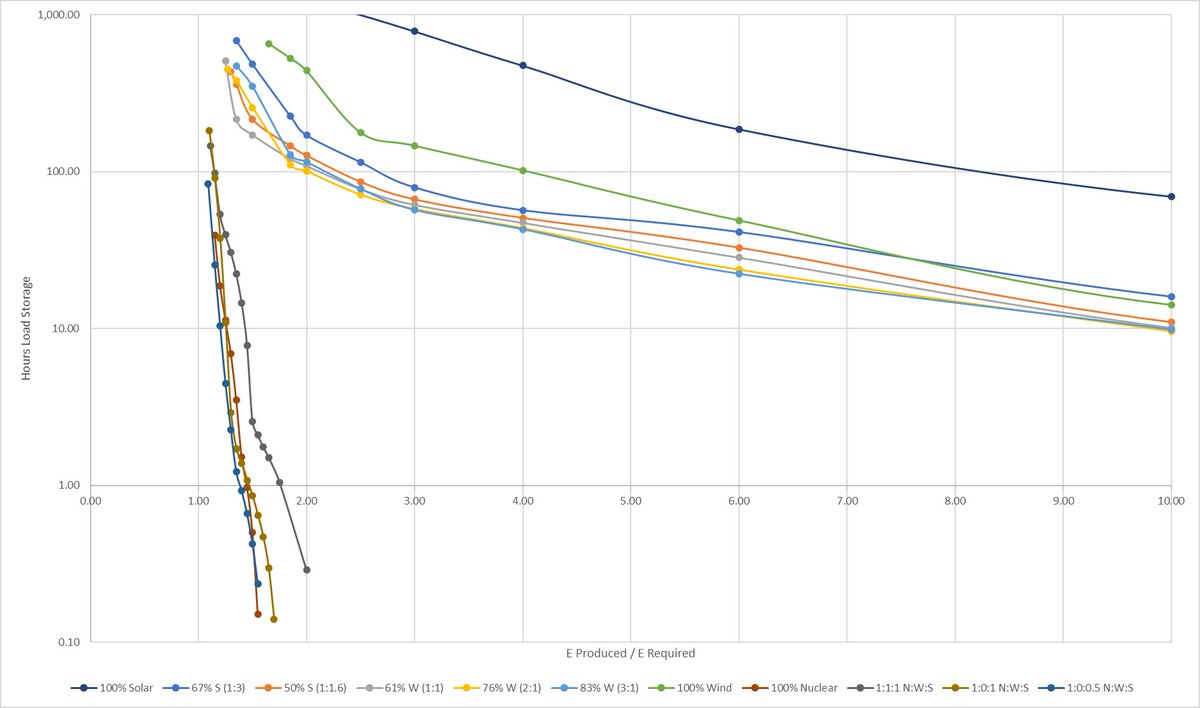
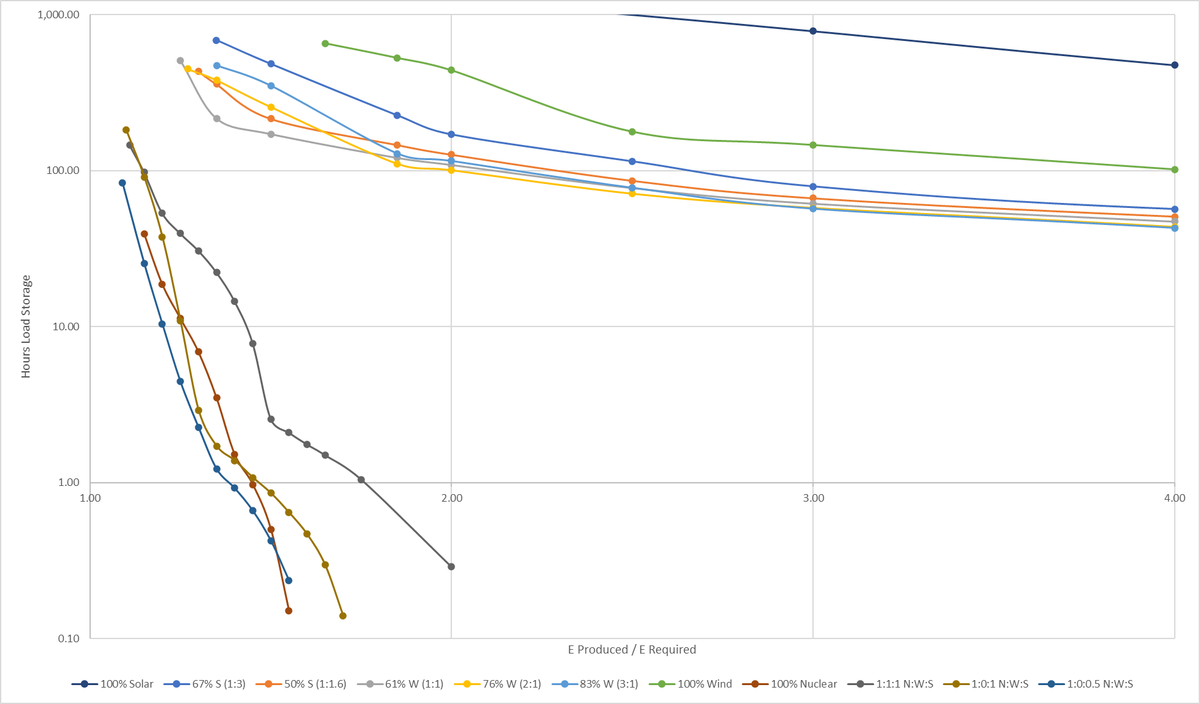
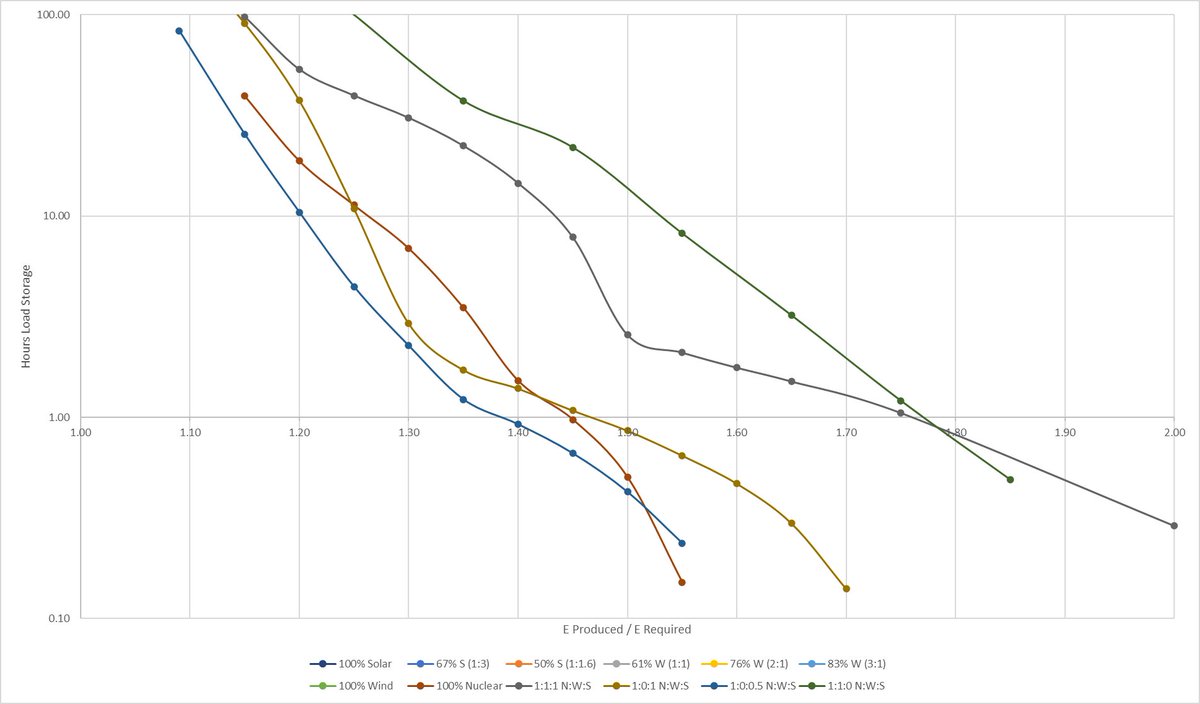
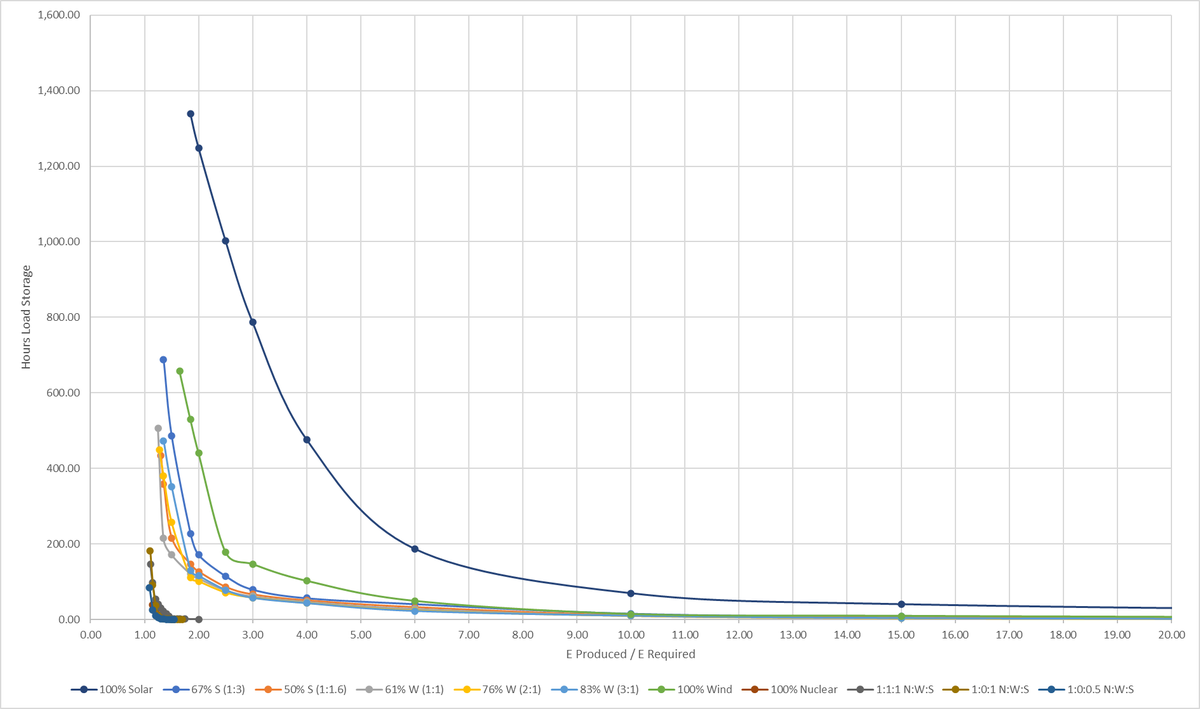
I have been playing around with an interesting concept here - the tradeoff curves of capacity vs storage. First for a completely clean + storage system. This is what we need for Ontario for a no FF system, assuming starting from scratch for clarity.
Jesse tweet mediaJesse tweet mediaJesse tweet mediaJesse tweet media
English
15
11
94
13.8K
Jesse
Jesse@Ember421·
@SwenRoschlau The NG quantity used should be set based on regional availability, and the energy strategy selected should take that into account. Not also that pipeline gas is a terrible fit for 'pulse' use. If industry is electrified, there will not be the base floor to ride power on.
English
0
0
1
3
Jesse
Jesse@Ember421·
@SwenRoschlau Note also, while this will reduce gas consumption, the global supply level will adjust to this and there still won't be much spare capacity (especially for LNG). By it's nature, a LNG supply constraint will always be a crisis.
English
2
0
1
5
Swen Roschlau 🌌🦁🗽🇪🇺
Intermittent renewables means you are trapped w/ natural gas as backup. Even Spain. As Europe doesn't want to frack & can't compete w/ Chinese commoditization of PV, wind, batteries, we will not reach a relevant level of resilience, hence, stay vulnerable. Let us get real, folks.
Daniel Kral@DanielKral1

Super decoupled, sure. Meanwhile, this March gas accounts for 17% of electricity generation in Spain versus 13% in Germany (data up to today mid-day).

English
3
0
2
39
Jesse
Jesse@Ember421·
@PassCombo @Object_Zero_ They often are fueled by the boil off gas. Literally burning the product. Same with the compressors for liquifaction, typically driven by a gas fired gas turbine.
English
0
0
2
6
DigitalFoogazi
DigitalFoogazi@PassCombo·
@Ember421 @Object_Zero_ Transforming use energy but if done before the only cost is transport, which rise costs destroying value but not the gas itself.
English
1
0
0
6
Object Zero
Object Zero@Object_Zero_·
Energy Policy Outlook Renewables don’t really compete with oil, but they do compete with gas. Gas is not priced internationally, it’s priced locally. Transporting it far destroys a large fraction of it, so it’s only shipped when large arbitrage exists. Oil is priced internationally and is easy to transport huge volumes in a stable manner. Energy is a complex space, which is why there are so many conspiracies and poor understanding of the basics. Lots of complexity and nuance for strong hyperlocalised opinions to form and stick. Many countries have laypeople with strong political opinions on the matter, and in democratic countries that introduces policies that are usually counterproductive to the economy and the environment. The best energy policy is to have some sort of social cost enforced to represent the environmental cost to wider society, where environmental burdens exist, and then to have a free and open market on top of that. Pretty standard regulated market stuff. The challenge is that it has so far been too difficult for the international community to reach any sort of mutually enforced environmental cost structure, consensus is necessary as the environmental sink for this industry is not local but is the shared atmosphere of Earth. Anyone adopting such a cost structure locally/unilaterally quickly destroys their own competitiveness and fades their economy toward irrelevance. It’s a prisoner’s dilemma. Humanity is very unlikely to reach a collaborative outcome, so the optimal strategy for any sovereign entity is to outcompete everyone else in a race condition. This is what is happening in the world. Lots of countries who can’t do strategy are doing random, bad, self defeating unilateral things, and a few strategic sovereigns are racing away. Pretty obvious who is who. What the world needs isn’t a political or market solution, those have already failed. China escaped. What we need is a technology solution, and that’s going to be a residential fabric of PV + BESS and high density industrial node of deep nuclear concentration. Oil and gas will only get more expensive as they deplete, the solution is to race the 21st century technologies to the cross over point as fast as possible, so that the switch is economic (competitive) and not political (collaborative). This is the system strategy approach that is going to unfold. But it’s not what is currently underway.
Object Zero tweet media
English
3
5
32
1.3K
Jesse
Jesse@Ember421·
@PassCombo @Object_Zero_ You consume it (or other energy) to run the compressors for liquifaction and the engines on the ships to move it...
English
1
0
2
8
DigitalFoogazi
DigitalFoogazi@PassCombo·
@Object_Zero_ Please explain why transporting gas destroy it? You mean the cost gets too big to make sense?
English
1
0
0
23
Jesse
Jesse@Ember421·
@dr_energy_ @Big_Orrin You don't need to occupy it to do that. You also are removing any reason for Iran to not destroy any scrap of energy infrastructure they can reach...
English
0
0
0
17
DrEnergy
DrEnergy@dr_energy_·
@Big_Orrin wouldn't it be sufficient if iran can no longer use the facility?
English
1
0
0
23
Jesse
Jesse@Ember421·
@PeterMassie Note, inevitably, more of the costs will be fixed costs, with fairly low volumteric rates in off hours.
English
0
0
1
5
Jesse
Jesse@Ember421·
@PeterMassie Prosumer vs. General public... I think the appetite will not be there for mass directe exposure to live prices. A ToU with a 'bonus' method if you can take advantage of low prices would psychologically work better. Plus automated things the user doesn't have to think about.
English
1
0
1
10
Peter Massie
Peter Massie@PeterMassie·
Three more things that help us get more use out of (any) grid: 1. Dual fuel / ground source heat pumps (to grow sales, and minimize peak load) 2. Dynamic line rating (to get more out of wires, not just gens) 3. Better price signals for residential consumers. The tech exists!
Ramez Naam@ramez

Three things that can help us get better use out of the US grid: 1. Energy storage (allows you to fill up when the grid is underutilized, and avoid hitting the grid when it's stresed). 2. Datacenters. (If done cleverly.) 3. Smart charging of electric vehicles.

English
1
2
7
1.4K
Jesse
Jesse@Ember421·
@PeterMassie Summer becomes a recharge season! In my modeling effort, covering heating without either geothermal used this way, or dual fuel is crazy expensive. Like add a whole 1X our current peak more over and above the impact of the rest of electrification. I.e Grid goes 3X instead of 2X
English
1
0
1
16
Jesse
Jesse@Ember421·
@PeterMassie The low temperature's hit on thermal efficiency for power doesn't matter when you only need relatively low temp heat. And you don't need to pay for the power conversion or cooling equipment. And the rock temp depletation is mitigated by only averaging 30-50% of nameplate
English
1
0
0
25
Jesse
Jesse@Ember421·
@McFaul If the 'allies' are to contemplate this, they should demand: -US weapons supply for Ukraine. -No more tarrifs. -Cover the cost of any losses incurred -Pay for the delta between post war fuel costs and pre-war (for the whole country) All of this at a senate confirmed treaty level.
English
0
0
0
15
Jesse
Jesse@Ember421·
@McFaul He needs decoys to soak up Iranian missiles without loosing anyone with political saliince for *him*. Period. Doubtful there will be much enthusiasm in signing up for that...
English
1
0
0
127
Michael McFaul
Michael McFaul@McFaul·
What military assets do we need from NATO allies to reopen the Strait of Hormuz? I thought we had the largest, most effective navy in the world? Or is this all just political? Trump needs the symbolism of allied support for his war? Genuine questions. Post answers.
English
97
49
447
18.9K
Jesse
Jesse@Ember421·
@tallzabby @CoopTory It's the canery, If we can't manage to get nuclear costs under control, there is a whole slew of other aspects we are also not going to get under control either.
English
0
0
1
9
Alex
Alex@tallzabby·
@CoopTory Nuclear is the way if people in Anglo countries can figure out how to build things again. The most capital intensive energy possible, we've never been worse at building it. Hinkley Point C (UK) is expected to cost 4-5x more per megawatt hour than the current electricity prices
English
1
0
3
110
Co-op Tory 🍁
Co-op Tory 🍁@CoopTory·
Renewables have created a quagmire. It’s a more complicated system, that is massively overbuilt, still reliant on fossil fuels, and wastes energy on curtailment. Unsurprisingly, prices have exploded, and are expected to continue rising. Nuclear is the way.
Co-op Tory 🍁 tweet media
Simon Mahan@SimonMahan

The world is changing right in front of us and no one knows it. Texas is running its world-class economy on 70% renewables, right now. Gas is there if we need it, but for today, we can save the fuel for another day.

English
9
0
36
3.9K
TL
TL@tomas_lamy·
@pdaures @HotmSandy Construction, matériaux, semi-conducteurs. Questce qui n’est pas impacte en fait 😅
Français
3
0
3
82
TL
TL@tomas_lamy·
The group 3+/PAO (high end base oils in more or less everything today) oil market in shambles with this loss. This will eventually end with shortages, worse than covid honestly. Probably the same with additives markets. Nobody talk about lubricants, never until they disappear
Susan Sakmar@SusanSakmar

🇶🇦 Qatar is not just LNG - there’s also GTL, helium & more at Ras Laffan. Shell assessing damage at “Pearl GTL, a two-train facility that can process up to 1.6 billion cubic feet per day of wellhead gas, converting it into 140,000 bpd of ‌gas-to-liquids.”

English
3
4
14
1.5K
Jesse
Jesse@Ember421·
@Zackcy @_night_brain__ Definitely going to be more willingness to have under-utilized gas capacity, even at a cost, to minimize consumption...
English
0
0
2
57
Zackcy 🍁
Zackcy 🍁@Zackcy·
@_night_brain__ Intermittency & storage are still real problem. Renewables only really work because of gas back-up.
English
3
0
4
335
night brain
night brain@_night_brain__·
I get that gas and nuclear are epic and based, but Growth and Progress-oriented individuals might discuss accelerating renewables deployment, if that's not too passé
English
9
17
183
6.4K
Jesse
Jesse@Ember421·
@Morticah @Kaikenhuippu You have to put in the equipment to extract it, and the US actually used to have a store of it, but sold it off...
English
1
0
0
18
Dirk Hartmann
Dirk Hartmann@Morticah·
@Kaikenhuippu Isn’t the helium for those only from production surplus that would otherwise go to waste? As you can’t store it for long and it is extracted as byproduct anyway?
English
1
0
0
17
Rauli Partanen
Rauli Partanen@Kaikenhuippu·
This seems annoyingly important. (yes, we should have banned party balloons long, long time ago...)
Shanaka Anslem Perera ⚡@shanaka86

Helium is the only element that escapes Earth’s atmosphere permanently. Once released, it rises through the troposphere, passes the stratosphere, and leaves the planet. It cannot be manufactured. It cannot be synthesised at industrial scale. It accumulates over billions of years in the same geological reservoirs as natural gas. And one third of the world’s supply just went offline because Iran hit the facility that extracts it. Qatar produced roughly 63 million cubic metres of helium in 2025, accounting for 30 to 36 percent of global supply from a total of approximately 190 million cubic metres. QatarEnergy’s three large helium purification plants at Ras Laffan form the world’s biggest helium production base. When LNG production stopped after Iranian drone strikes on March 2 and the subsequent missile damage on March 19, helium extraction stopped automatically because helium is recovered during natural gas liquefaction. You cannot produce helium without producing LNG. The byproduct dies with the primary product. Spot helium prices have roughly doubled since the crisis began. Industry consultants warn that prolonged disruption could push contract prices toward $2,000 per thousand cubic feet. A major industrial gas supplier has already begun assessing customers a helium surcharge. Phil Kornbluth, the most cited helium market consultant, stated the assessment directly: the world cannot compensate for the loss of a third of its helium supply. South Korea imports 64.7 percent of its helium from Qatar. SK Hynix and Samsung operate high-volume fabs producing the DRAM and high-bandwidth memory that power every AI accelerator, every data centre GPU, and every cloud computing cluster on Earth. Helium cools silicon wafers during fabrication. It serves as a carrier gas in deposition and etching tools. It enables leak detection in vacuum systems. Modern extreme ultraviolet lithography requires helium-cooled environments for precise temperature control. Without helium, the fabrication process degrades or stops. SK Hynix and Samsung hold two to three months of helium inventory. Two to three months is not a buffer. It is a countdown. If Ras Laffan remains offline beyond that window, South Korean memory production faces rationing. TSMC in Taiwan is somewhat more diversified but still uses Qatar-linked supply chains. The entire AI hardware supply chain, from HBM3E memory stacks to advanced logic chips, sits inside helium-dependent ecosystems. Beyond semiconductors, helium cools the superconducting magnets in more than 14,000 MRI machines operating worldwide. It pressurises rocket fuel tanks and purges propulsion systems in aerospace. CERN’s Large Hadron Collider depends on helium cryogenic systems. There is no substitute for helium in any of these applications at industrial scale. The United States and Qatar together account for more than 70 percent of global production. The US federal helium reserve and private suppliers offer partial relief, but global prices and spot availability are still governed by Qatar’s market share. Japan’s Iwatani has drawn on US reserves. Canada and the Rockies are seeing renewed investor interest. None of this replaces 63 million cubic metres in weeks. The war hit uranium first. Then oil. Then nitrogen. Then water. Then plastic. Then medicine. Then sulfur. Now helium. Eight layers. Each one deeper. Each one closer to the infrastructure that sustains modern civilisation. The chip that processes your data, the magnet that scans your body, and the rocket that launches your satellite all depend on an atom that leaves the planet when you lose it. open.substack.com/pub/shanakaans…

English
1
1
4
347