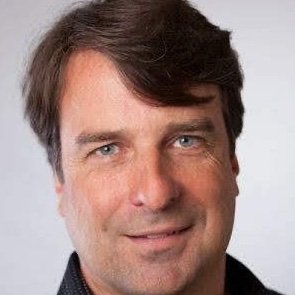
John Furrier

66.2K posts

John Furrier banner
John Furrier

John Furrier

@furrier

Cofounder Co-CEO SiliconANGLE theCUBE; Leading #Enterprise Analyst, events, media, cloud, reporting, digital TV; #SiliconValley #EnterpriseTech

Palo Alto, California Katılım Mart 2007
10.7K Takip Edilen25.5K Takipçiler
John Furrier retweetledi
SiliconANGLE
SiliconANGLE@SiliconANGLE·
Fast token generation emerges as the key differentiator as heterogeneous inference takes hold ift.tt/qszNTrD
English
0
2
4
216
John Furrier retweetledi
Agility
Agility@agilityrobotics·
Physical AI is real, right now. Our Chief Robot Officer Jonathan Hurst sat down with @Furrier on @theCUBE at Machina Summit 2026 in Paris on what's actually changed in robotics — and the one part of the robot we refuse to buy off the shelf. @GemmaAllenSays @bjbaumann2014 Watch the full interview: youtu.be/HBVvcCSk1vw
YouTube video
YouTube
English
2
7
38
6.8K
David Weisburd 🚀
David Weisburd 🚀@DWeisburd·
Refusing to use AI tools is becoming a hiring signal. Not a virtue signal. A negative signal. Kush Bavaria, founder and CEO of Ornn: "we just focus on quality of output and that's the metric we track" The new developer market is not about years in seat. It is output per unit of judgment. Kush says he would rather hire builders already fluent in Codex, Claude Code, and Cursor than retrain people who refuse the tools. At 22, he is building a compute exchange with AI-native engineers. That may be the new hiring bar. Adaptation is the resume.
English
3
1
8
2.8K
@jason
@jason@Jason·
This restaurant, payvllon Paris, is transcendent 🇫🇷
@jason tweet media@jason tweet media@jason tweet media@jason tweet media
English
44
7
588
170.5K
John Furrier retweetledi
Bill Tai
Bill Tai@KiteVC·
YUP. Currently no end to the supply vs demand imbalance in sight for either category of memory. That will change at some point so the question is “what’s priced in relative to reality?” Key variable is w/n the demand side changes or not due to efficiencies or other shortages (energy) limiting deployment. While capacity on the supply side will build and increase substantially; that probably can’t hit in volume til 2Q 2027 <—> 1Q 2028. IF (it’s always an “if”) that is the case; AND IF the upward slope of demand does not decelerate; prices will have positive bias for another 9-12 months before flattening. If demand accelerates.. there won’t be enough capacity for several years. That scenario (a point / static picture in a dynamic, rapidly changing environment) would suggest equity prices for this category (memory stocks) are stable / positive bias through year end. But who really knows?!?? 😊
Jukan@jukan05

UBS raises its DRAM and NAND price forecasts DRAM prices are now expected to rise 32% QoQ in Q3 and 18% QoQ in Q4. NAND prices are expected to rise 30% QoQ in Q3 and 12% QoQ in Q4.

English
2
4
16
8.6K
Palantir
Palantir@PalantirTech·
Our thoughts on the importance of AI sovereignty. 1. Your AI sovereignty dictates your institution’s future. Sovereignty is the precondition for choice. Relinquishing sovereignty transfers the future choices of your institution to others, who are likely to exploit it for their gain and your loss. 2. Data retention is your treasure. Transfer it at your own peril. Your ability to win is dictated by your ability to recognize and use your unique edges, and you keep winning by compounding the underlying data to generate new insights. Transferring that data hands over access to your pre-existing winning plays and yields the means of production for new ones. 3. Tokenmaxxing hijacks your value orientation and decreases your institutional fortitude and intelligence. The pursuit of high token usage incentivizes disposable scripts over robust software — with the addictive feeling of false progress. There is a reason why those selling tokens refuse to charge based on value. 4. Controlling your weights is controlling your fate. Weights are the distilled form of hard-won, accumulated institutional knowledge. If you let others control your weights, you are allowing them to migrate the alpha of your business to theirs. 5. There is no contradiction between sovereignty and alpha. The architecture that maximally preserves sovereignty is one that enables institutions to own their tribal knowledge, and to compound it as alpha. 6. Politicizing the technical issues involving sovereignty is what your adversary wants. Techno-politicization is the wellspring of false sovereignty. Techno-politicization drives decisions that seem to reduce dependency, but ultimately limit agency — especially on the battlefield in the West. 7. Real expertise is existential. Allowing politics or favoritism to determine your technical decisions rewards whoever is best at politics, not whoever is right. Listen to those closest to the problems, not those speaking most compellingly about them. 8. Learn from institutions that are winning or that have consistently delivered. Institutions facing existential threats do not have the luxury of making technical decisions based on political preferences. 9. Only listen to institutions, countries, and people who have a proven record of being right. A track record of correctness is the best and only signal for future correctness. Judging something as right or wrong based on who you like is exceedingly misguided.
English
715
1.8K
10.9K
13.3M
David Sacks
David Sacks@DavidSacks·
Legacy Media types are calling this Alex Karp interview a “crash-out” so that’s your first clue that he is actually saying something extremely insightful. He is articulating what real “AI safety” looks like in the enterprise. Not abstract alignment research or certification by a government-run DMV for AI. Real AI safety for businesses is the ability to control their own data, model weights, and compute — so a frontier lab can’t hoover up their proprietary knowledge and turn it into their next product. As Karp explains, technical customers want “control over their compute, their models, their data stack, and their alpha. They want to know they own the means of production, and it’s not being transferred to someone else.” Don’t think that can happen? Just look at Figma. According to The Information, Anthropic “blindsided” its then-business partner with the launch of Claude Design. Figma’s founder said Anthropic had not been “consistently honest” with them. Anthropic’s chief product officer had even served on Figma’s board until three days before the launch of Claude Design. Figma’s stock has fallen sharply this year while Anthropic’s valuation has surged. This isn’t an isolated example. Anthropic has launched Claude Science, Claude Security, Claude Legal, and of course Claude Code — each expanding into categories previously served by companies building on top of their models. The pattern is consistent: watch where value is being created, then move in directly. Dominate the model layer, then use that position to capture the most lucrative verticals. Dario has argued that open source models powerful enough to compete with Anthropic are “dangerous.” But dangerous to whom? Not to enterprises that want to retain control over their data and workflows. Dangerous to a business model that benefits from customers having few real alternatives at the model layer. As Karp exposes, true enterprise safety isn’t trusting that a lab’s future roadmap won’t include your business. It’s retaining the ability to choose — at the model layer — who gets to see and use your alpha.
Palantir@PalantirTech

Palantir CEO Alex Karp on what customers actually want, the real business of frontier labs, and the importance of open source models: “What the technical customers want is control over their compute, their models, their data stack, and their alpha. They want to know they own the means of production, and it's not being transferred to someone else.” "Who owns the data? Are the prompts secure? Is this being transferred to you?" "If it was so valuable, and I can make you a billion dollars, wouldn't I say I'll make you a billion dollars and I want 30%? Why are they charging for tokens if it's so valuable?"

English
656
1.9K
13.4K
2.1M
John Furrier retweetledi
Sarbjeet Johal
Sarbjeet Johal@sarbjeetjohal·
If one can see it without reality distorting political lenses, THIS IS INSPIRING! A great move! cc @furrier @dvellante @craw @jonfortt @PatrickMoorhead @EdLudlow
Under Secretary of State Jacob S. Helberg@UnderSecE

The U.S. @StateDept is partnering with @Stanford to create Foundry School: a world-class seminar series featuring the luminaries of advanced manufacturing, paired with a first-of-its-kind curriculum. The last decade belonged to those who could write software. The next will likely belong to those who can harness AI to transform the physical world. The future belongs to those who build.

English
0
2
4
574
Harold Sinnott 📱
Harold Sinnott 📱@HaroldSinnott·
I’m pleased to be joining the judging panel for the 2026 SiliconANGLE TechForward Awards. The program recognizes technologies and teams advancing enterprise innovation across AI, security, cloud, data platforms, and blockchain/crypto. For companies considering an entry, want to know what catches the TechForward judges’ attention? Here’s the scoop: ⇨ Business impact over feature lists. Don’t just tell us what your product does. Show the measurable difference it makes. Focus on outcomes, not capabilities. ⇨ Authentic customer evidence. Real customer stories and quantifiable results stand out. Even anonymized case studies carry weight. ⇨ Competitive differentiation. Skip generic “best-in-class” language. Be specific about what makes your approach unique and why alternatives fall short. ⇨ Publication-ready content. Your responses may appear in the TechForward Buyer’s Guide, so write as if you are speaking directly to potential customers evaluating solutions. The extended deadline closes this Friday, June 26 at 11:59 p.m. PT. Learn more and submit: siliconangle.com/awards #TechAwards #EnterpriseTech #B2BTech #AI #Security #Cloud #DataPlatform #Blockchain #Crypto #BuyersGuide @theCUBE @SiliconANGLE @furrier @dvellante
Harold Sinnott 📱 tweet media
English
7
12
34
1.8K
John Furrier
John Furrier@furrier·
@NaveenGRao As we predicted too but a long tail of specialty models again 4 years ago :-)
English
0
0
0
96
Rihard Jarc
Rihard Jarc@RihardJarc·
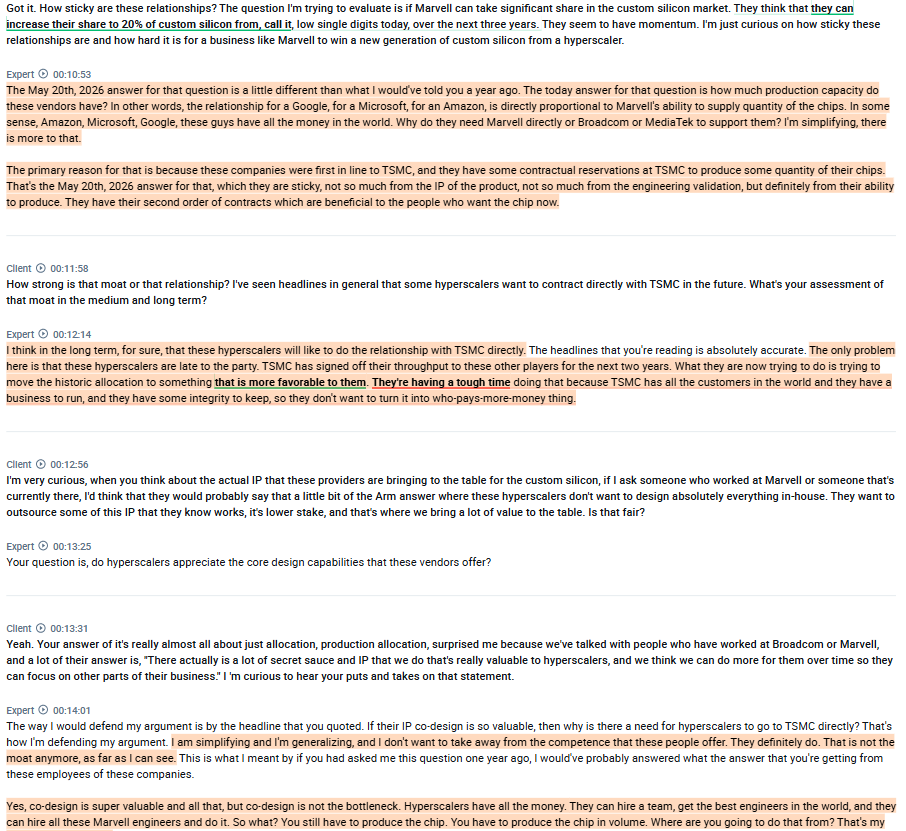
Interview with a $GOOGL employee explaining that the value when it comes to ASIC design from companies like $AVGO, Mediatek, and $MRVL is in their $TSM allocation, not the co-design anymore: 1. When it comes to co-design of chips, he thinks the real value of companies like $AVGO, Mediatek, and $MRVL lies in their $TSM allocation and memory allocation, which they got sooner than everyone else. In the whole process, he sees platform verification and then manufacturing as key. 2. If you could flip a switch and completely reset the $TSM allocation, he thinks the hyperscalers would move 100% to internal co-design and skip the co-designers for that part. There is still value in $AVGO's IP for memory, or in $MRVL's interconnects, but for co-design specifically, he thinks it comes down to $TSM and the memory supply chain allocation. 3. In the future, he thinks hyperscalers will move to direct $TSM relationships. 4. When it comes to $AMZN's Trainium, he thinks the split of IP rev share between co-designer and $AMZN is around 60% $AMZN and 40% co-designer right now. For the OpenAI ASIC, he thinks the split going to the co-designer is much higher, since OpenAI doesn't have an EDA department. 5. The expert doesn't think hyperscalers can bring every part of the accelerator build in-house, things like switching, interconnects, DSPs, etc. But the specific chip design angle he thinks has reached its peak in value. 6. When it comes to interconnects, he thinks demand will continue to grow for both copper and optics, as copper is still and will continue to be cost-effective for smaller distances, while optics will be essentially for longer distances. If copper is 100% today, he thinks it will be 70% copper, 30% optics in the next 2-3 years. That said, it doesn't mean you are reducing copper usage as the whole pie grows. found on @AlphaSenseInc
Rihard Jarc tweet mediaRihard Jarc tweet mediaRihard Jarc tweet mediaRihard Jarc tweet media
English
23
67
526
122.8K
John Furrier
John Furrier@furrier·
What’s the fastest startup time to $10b in sales from zero ? Working on a story
English
1
0
0
459
John Furrier
John Furrier@furrier·
@SemiAnalysis_ Cooper loses energy in extreme scale up on number of switches there is no need (yet) to squeeze more pj/bit out of the rack
English
0
0
0
43
SemiAnalysis
SemiAnalysis@SemiAnalysis_·
Investors have increasingly framed AI networking as a binary debate between copper and optics. Thus they are constantly thinking and evaluating the rotation in and out each theme. We think that the networking landscape can actually be viewed from a simpler lens. As GPU clusters scale, the importance of connecting them efficiently only increases, and that drives demand for more networking content of all types. Copper and optics serve different but complementary roles. Copper remains the preferred solution where it can meet reach, power, cost, and reliability requirements, while optics becomes necessary where bandwidth and distance push beyond copper’s practical limits. Nvidia’s approach has been consistent: use copper where they can, and optics where they must. In other words, this is not an either-or market. The growth of optical interconnect does not mean copper goes away, and the durability of copper does not mean optics will not ramp. As AI systems scale in size and complexity, both copper and optical connectivity should benefit from the increasing importance of moving data between GPUs, switches, racks, and clusters.
SemiAnalysis tweet media
English
32
42
578
81K
John Furrier retweetledi
SiliconANGLE
SiliconANGLE@SiliconANGLE·
Google forms research partnership with A24 Films that’s focused on AI filmmaking tools ift.tt/x89Hads
English
0
1
3
253