
Sabitlenmiş Tweet
Good Dog
7.9K posts


Good Dog
@GoodDog84
GOD🙏 LOVE ❤️ PEACE 🕊 America Land of the free because of the brave
USA Katılım Mart 2020
2.7K Takip Edilen2.4K Takipçiler
@Steve7317532777 @KimberJay85257 @MacFromAZ @complesso2001 @Snaxified @Papaice1950 @SteveEckla73598 @NairZar @KepAmericaFirst @WaterEngineer7 @lizzp1000 @LEXISTARMAGA Thank you for the train.
GIF
English

🇺🇸MAGA FRIDAY TRAIN🇺🇸👉RT/FOLLOW ALL✅
@GoodDog84
@KimberJay85257
@MacFromAZ
@complesso2001
@Snaxified
@Papaice1950
@SteveEckla73598
@NairZar
@KepAmericaFirst
@WaterEngineer7
@lizzp1000
@LEXISTARMAGA
@Steve7317532777

English
🚨 SAVE America Act SHOWDOWN — LIVE 🚨
This isn’t a vote yet.
This is the battle over whether a vote is even allowed.
As of March 20, the Senate is locked in a procedural war over S. 1383:
• Debate opened 51–48 → enough to start
• NOT enough to finish
• 60 votes are required to break the filibuster
• Those votes are NOT there
Now everything hinges on pressure.
What’s happening right now:
• DHS funding vote (~1PM) is tied into this fight
• Cloture motions hit Saturday → Senate likely in session all weekend
• Leadership hesitation signals this is far from resolved
Two paths — both high risk:
1. Talking Filibuster
Force a 24/7 floor hold
Make opposition defend their position publicly
Break resistance through exposure + pressure
But:
Adjournment (not recess) = leadership is hesitating
No full commitment to sustained pressure… yet
2. Nuclear Option
Change Senate rules to bypass the 60-vote threshold
Reality:
Both sides are now eyeing it.
Once that door opens — it doesn’t close.
⚠️ This is the moment that defines accountability.
No vote = no record
No record = no consequences
So here’s the move:
📣 Demand your Senators take the floor and read Unite4Freedom’s findings into the Congressional Record
Put our evidence on record
Force alignment with facts
Eliminate plausible deniability
Because once it’s spoken into history…
there is no pretending they didn’t know.
Tag them. Call them. Pressure them.
@Unite4Freedom
@SenMikeLee
@LindseyGrahamSC
@SenRickScott
@SenTedCruz
@realDonaldTrump
Let the truth be entered into the record.
English

SAVE America Act SHOWDOWN — LIVE IN THE SENATE
As of Friday, March 20, 2026, the Senate is locked in face-off over the SAVE America Act (S. 1383) — and the outcome is still uncertain.
Here’s exactly where things stand as we head into the weekend:
•Floor Action: After remarks from Senators Thune and Schumer, the Senate has resumed consideration of the House message tied to the SAVE Act.
•Key Vote Incoming: A ~1:00 PM roll call vote on DHS Appropriations — now directly tied to the SAVE Act fight.
•Cloture Clock: Additional cloture motions will “ripen” Saturday (March 21) → meaning the Senate is likely staying in session all weekend.
•The Reality: Republicans do NOT have the 60 votes needed to end the filibuster.
•Debate opened earlier this week 51–48
•But that is not enough to force a final vote
Two paths are now colliding:
1. “Talking Filibuster” Pressure
•Led by Sen. Mike Lee (R–UT) and allies
•Strategy: Force Democrats to hold the floor 24/7
•Goal: Break resistance through public pressure + exhaustion
Problem:
Leader John Thune is signaling hesitation.
The Senate is adjourning (not recessing) — a technical move that suggests leadership is not committing to full “around-the-clock” warfare.
2. “Nuclear Option” Talk
•Momentum is building on BOTH sides:
•Sen. John Cornyn (R–TX): Open to rule changes to pass the SAVE Act
•Democrats: Using this fight to push eliminating the filibuster entirely for their own agenda
Tag your Senators - Let your voice be heard.
Call on them to take the floor and read Unite4Freedom’s findings into the Congressional Record.
Put the evidence where it cannot be ignored.
Because once it’s spoken into history…
there is no pretending they didn’t know.
Let the truth be revealed.
Follow us for real-time updates.👇
@Unite4Freedom
@SenMikeLee
@LindseyGrahamSC
@SenRickScott
@SenTedCruz
English
Good Dog retweetledi

Good Dog retweetledi
Two different tactics. Same core problem.
Colorado rewrites the past.
Texas can shape the outcome in real time.
If official election data can change—before OR after certification—
you don’t have a fixed result.
You have a moving target.
And a moving target is not a lawful election.
@SenMikeLee
@SenTedCruz
English
The One Thing about Elections Nobody Want to Talk About
There are two ways to alter an election outcome:
1. Change the records after the fact
2. Change the data while it’s happening
Unite4Freedom has now seen BOTH.
Listen to U4F Chairman, Harry Haury, explain it on WAR ROOM below.
👇👇👇
COLORADO: “Out-of-period” adjustments
After an election is certified, the records are supposed to be final.
That’s the entire purpose of certification.
Yes—states conduct audits. But those audits are meant to verify results against paper records, not silently rewrite official datasets after the fact.
When changes occur after certification, outside of transparent audit procedures, you are no longer validating an election - You are modifying history.
TEXAS: Real-time voter data manipulation
Now compare that to what we’ve observed in Texas:
Early voting data isn’t just a report—
it’s a live operational dataset.
When that data is:
· Incomplete
· Inconsistent
· Changing across releases
…it doesn’t just obscure reality—
It can shape behavior in real time.
And behavior changes outcomes.
These are not separate problems.
They are both Unauthorized changes to official election data.
But here’s the critical difference:
Colorado-style (post-certification changes): Alters the record of what happened
Texas-style (real-time data manipulation): Can alter what is happening
Let that sink in.
One rewrites the past.
The other influences the present.
But most important: Once official data can be changed whether after certification or during live voting You no longer have an election system.
You have a data management system with political consequences.
English
Good Dog retweetledi

Beneficiaries of a broken system, hiding behind its dysfunction — that’s not strength.
That’s weakness disguised as strategy.
Strength stands in the light.
Strength welcomes scrutiny.
Strength votes.
Weakness hides in procedure.
Weakness avoids the record.
Weakness fears the truth being spoken out loud.
If the system is sound — prove it.
If it’s not — fix it.
But hiding behind a filibuster to avoid a vote?
That’s not leadership.
That’s exposure.
@SenSchumer wasn’t this you in the video?
@amyklobuchar
@timkaine
@AlexPadilla4CA
English
The SAVE America Act is now in a Filibuster.
Do people realize what that actually means?
The bill can be stopped without ever being voted on.
Right now, a minority of Senators can stall this indefinitely — not by defeating it, but by refusing to end debate.
No vote = No accountability
There is only one way forward:
60 votes for cloture.
Not to pass the bill —
just to allow a vote.
If that threshold isn’t met, the bill dies quietly.
If it is?
30 hours of debate → final vote → simple majority wins.
The full Outline:
1. The filibuster continues non-stop until the senators want to vote to end it.
2. In order to end it, they need a cloture motion.
3. The Cloture Motion requires the signature of 16 Senators
4. Once the Motion is filed, it has to "lie over' for a day, so basically two days after the Cloture Motion is filed, Cloture will be voted on (they'll need 60 votes to end the filibuster)
5. Once Cloture is invoked, there is 30 hours of 'post cloture consideration' where the debate should continue but no new amendments can be added
6. Once the 30 hours expire, the bill will move to a final vote
7. The final vote requires only a simple majority
That’s the entire path to the finish line.
So this is the moment:
Will Senators allow a vote… or block it from ever happening?
At Unite4Freedom, we’ve completed 35 state election validity scorecards documenting noncompliance with:
•NVRA
•HAVA
•Civil Rights Act
This is evidence — not theory.
Put it in the Congressional Record
Tell your Senator you want the U4F Evidence read aloud during the filibuster
Force the vote
Because if they won’t even allow a vote…
they don’t want the facts on record
Follow us to get updates:
@Unite4Freedom
English



@hernandoarce Actual data may not lie. But liars selectively edit data and put it in service of their lies. Incomplete data may mislead. Data interpreted by idiots and charlatans is generally useless. And of course liars, especially in the "election fraud" crowd, make up data all the time.
English

The enemy is INSIDE the gates of our election system, manipulating all of us. The Texas 2026 primary elections show clear evidence of intolerable manipulation for BOTH the Democrat and Republican primaries. The data does not lie.
Doc Pete Chambers@DocPeteChambers
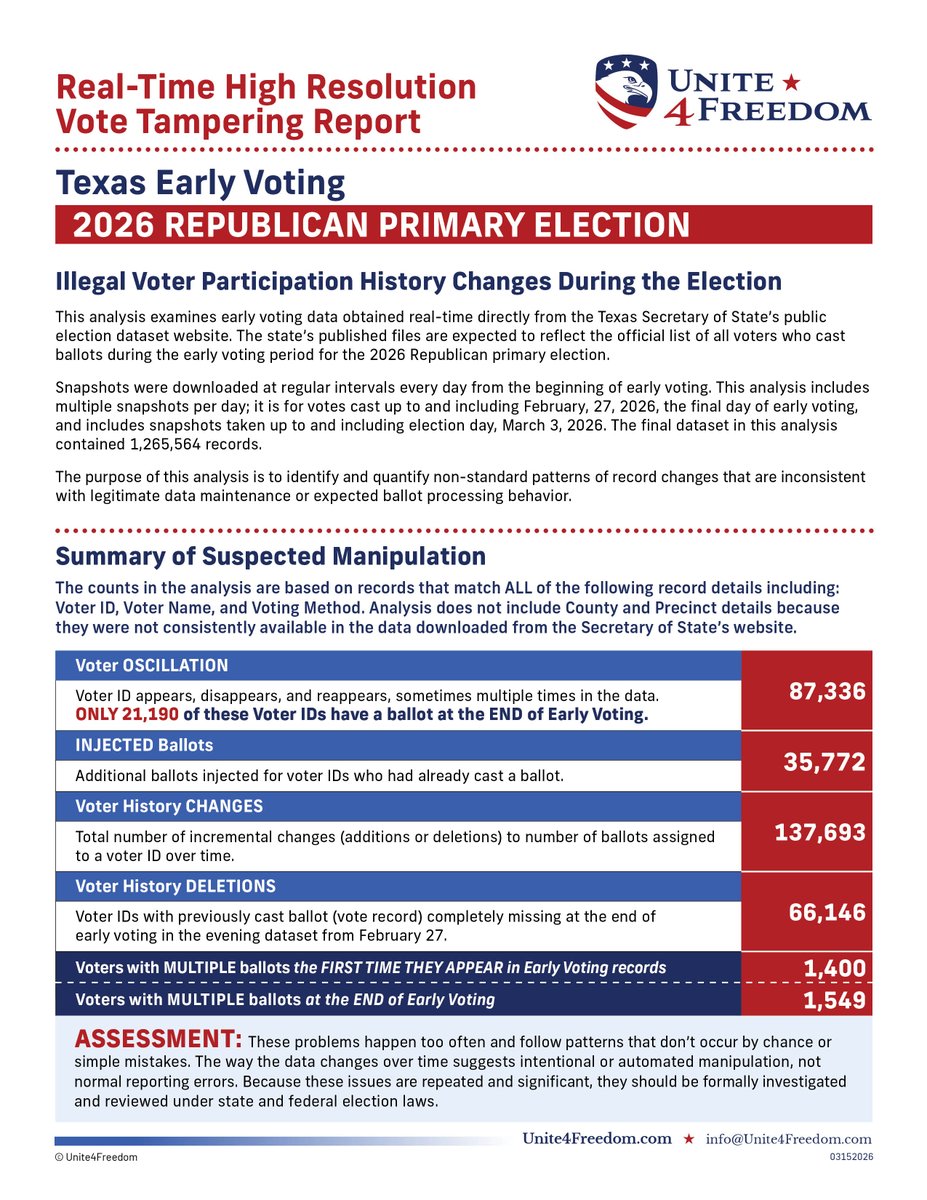
***BREAKING - NATIONAL SECURITY ISSUE*** 66,146 GOP ballots DELETED during TX early voting. 87,336 voters appeared, disappeared, reappeared in state records. The Cornyn-Paxton margin is only 26K. Someone inside the system is picking our nominees. Don’t certify. Audit no, this is too big not to notice. Complacency will end our Constitutional Republic! WHAT HAPPENED? Your vote disappeared. During early voting, thousands of Texas ballots vanished from official state records—then reappeared—then vanished again. In BOTH parties. The data proves someone inside the system is manipulating who wins. We need answers before November. THE PROBLEM IN SIMPLE NUMBERS: REPUBLICAN PRIMARY: •87,336 voters appeared, disappeared, then reappeared in state records •66,146 ballots completely deleted from final count •35,772 extra ballots added to people who already voted •Only 26,000 votes separate Cornyn and Paxton—but 66,000 ballots disappeared DEMOCRAT PRIMARY: •37,039 voters appeared, disappeared, then reappeared •10,558 ballots completely deleted from final count •35,169 extra ballots added to people who already voted •144,000 votes separate Senate candidates—but 10,000+ ballots vanished Why This Matters: •These numbers are bigger than the margins in major races •This affects who appears on your November ballot •Both parties were hit—this isn’t partisan, it’s corruption THREE SIMPLE RULES THEY BROKE: Rule #1: Numbers Should Never Go Backwards •What should happen: Vote totals only go UP as more people vote •What actually happened: On February 17, the vote count went DOWN seven different times •Translation: Ballots were deleted in real-time during voting Rule #2: One Person, One Ballot •What should happen: Your Voter ID gets one ballot recorded •What actually happened: 1,549 Republican voters and 54 Democrat voters had MULTIPLE ballots counted •Translation: The system is stacking extra votes on real people Rule #3: Your Ballot Stays Counted •What should happen: Once you vote, your ballot stays in the record •What actually happened: 66,146 Republican and 10,558 Democrat voter records completely vanished by the end •Translation: Real votes were erased This isn’t a theory. This is downloaded government data from the Secretary of State’s website. Every day during early voting, researchers saved a copy of who voted. When they compared those snapshots, the numbers moved BACKWARDS. That’s mathematically impossible unless someone is inside the system changing records in real-time.” Supporting fact: The Texas Secretary of State changed the data file format multiple times during early voting and made access intermittent—exactly when researchers were watching. Whoever controls our elections controls TRILLIONS in state and federal budgets. This is a national security emergency. Foreign adversaries, cartels, corporate interests—anyone with the resources to breach our systems can now pick our leaders. President Trump, AG Bondi, and DNI Gabbard need to treat this like the cyber-attack it is and lock it down BEFORE November. #TXPrimary #ElectionIntegrity Thank you @Unite4Freedom for your in-depth dive into this National Security issue.
English
THANK YOU @DocPeteChambers, @AbsoluteWithE, @EmeraldRobinson and @laralogan for recognizing the hard work that Unite4Freedom’s data team did in conducting these analyses, generating these reports and exposing this issue in Texas!
The more eyes we get on this issue the better. Based on this information, Texas can NOT certify the 2026 Primary Elections.
Both Democrats and Republicans should be alarmed by these findings and demand and investigation!
x.com/Unite4Freedom/…

English

“VOTES VANISHING IN TEXAS?” Allegations of Deleted Ballots & ‘Oscillating’ Voter Data Rock GOP Primary
66,146 GOP ballots deleted.
87,336 voters appeared… disappeared… then reappeared.
Now the margin between @JohnCornyn & @KenPaxtonTX? Just 26,000 votes ... Let that sink in.
New claims tied to Texas early voting data suggest something far bigger than a “glitch” - raising serious questions about whether someone inside the system is influencing outcomes.
Even more alarming:
➡️ Reports show vote totals moving backwards in real time
➡️ Data pulled directly from official state sources
➡️ Patterns impacting BOTH parties - but shifting margins in critical races
“This is a national security issue.” - @DocPeteChambers
We’ve been warning about this.
Now, the data is raising even more questions.
English
This is the moment.
Not theory. Not debate. Not talking points.
Reality.
While Washington argues, the data already exists.
@Unite4Freedom has analyzed 35 states—with 95+ credentialed data analysts—documenting patterns of noncompliance with federal law (NVRA, HAVA, Civil Rights Act).
This isn’t opinion.
This is evidence.
And here’s what every Senator needs to understand:
If you vote 'No' on the SAVE America Act without reviewing the data—
you are choosing willful blindness over due diligence.
Put it in the Congressional Record.
Force the facts into the open.
Make every vote accountable.
Because once it’s on record…
no one gets to say “we didn’t know.”
English
As the fight to pass the SAVE America Act continues – it is growing more teeth.
Today, Wednesday, March 18, 2026, the SAVE America Act (an updated version of the original SAVE Act) is in the midst of a high-stakes, week-long debate on the Senate floor. Following a successful procedural vote yesterday, Senate Republicans have officially opened the floor for a "marathon" debate aimed at pressuring the minority to defend their opposition.
Current Status in the Senate:
The Procedural Win: Yesterday, March 17, the Senate voted 51–48 to begin debate on the bill. This was a simple-majority threshold vote. Senator Lisa Murkowski (R-AK) was the only Republican to vote with Democrats against taking up the bill.
The "Talking Filibuster" Strategy: Leadership has indicated that they intend to keep the Senate in session through nights and weekends. The goal is to highlight the bill’s provisions—specifically those requiring documentary proof of citizenship (DPOC) for voter registration—ahead of the 2026 midterms.
New Amendments: The "SAVE America" version currently being debated includes several high-profile additions demanded by the White House, such as:
- A nationwide ban on universal vote-by-mail and "no-excuse" absentee voting.
- A requirement for all 50 states to provide unredacted voter rolls to the Department of Homeland Security (DHS) for citizenship verification.
- Provisions related to gender-transition care and participation in sports, which have further polarized the debate.
While the debate is ongoing, the path to final passage remains difficult.
The 60-Vote Wall:
Despite passing the procedural hurdle, the bill still requires 60 votes to overcome a final filibuster and move to a definitive vote. Senate Democrats remain unified in their opposition, arguing the bill would disenfranchise millions of eligible voters, including married women with name changes and rural citizens without easy access to passports.
We the People need to keep the pressure on – Tag your Senators.
Make sure they know: @Unite4Freedom has comprehensive data across 35 states—real evidence that underscores exactly why passage is essential.
@SenMikeLee
@LindseyGrahamSC
@JohnCornyn
@LeaderJohnThune
@SenatorBanks
@SenJohnBarrasso
@MarshaBlackburn
@JohnBoozman
@SenKatieBritt
@SenTedBuddNC
@JDVance
@realDonaldTrump
@elonmusk
English

@Unite4Freedom Since the parties run the primaries, I wonder what @TexasGOP and @texasdemocrats think about this?
English
EXPOSED: The "Double-Agent" Voters of Texas
What if I told you there are thousands of vote records that demonstrate violations of Texas law right under the nose of the Authorities?
In Texas, you don’t pick a party when you register. You pick it at the ballot box. By law, once you take that Primary ballot, you are LOCKED IN for the year. No switching. No double-dipping. It’s even printed as a criminal warning at the top of the signature roster.
"A person commits a criminal offense if the person knowingly votes in a primary election or participates in a convention of a party after having voted in a primary election or participated in a convention of another party during the same voting year."
But the data tells a different story.
An analysis by Unite4Freedom has uncovered a new finding in the primary records:
•3,534 ballot records linked to 1,741 unique voters.
•These individuals appear in BOTH the Democrat and Republican Primary data.
•There are Voters that oscillate but remain and ones that oscillate and disappear, Voters that end up with a record in just one primary, Voters that end up with a ballot record in both primaries and even voters who have ballot records in both primaries but end up with no records in either by the end of early voting.
Why does this matter? It’s not just a "glitch." Under Texas Sec. 162.004, voting in the primaries for two parties is a criminal offense. Yet, the data shows it’s happening at scale.
If the law says it’s impossible, but the data says it’s happening... who is running the system?
Texans deserve answers. Americans deserve valid elections.
Follow us to keep up with the analysis as it's released.
#U4F
#election
#texasprimary
English
Important clarification:
What you’re seeing in this data is not proof that 1,741 Texans intentionally committed crimes.
That would be a reckless conclusion.
What it does show is something far more serious:
The system is producing records that reflect impossible outcomes under Texas law.
Under Sec. 162.004, a voter cannot lawfully appear in both primaries in the same voting year.
So when official records show:
The same voter ID tied to both party primaries
Records appearing, disappearing, and reappearing
Final states that contradict earlier recorded participation
…that is not a “behavioral problem.”
It is a data integrity problem.
And in any regulated system—banking, healthcare, national security— when the records themselves violate the rules of the system, the system is out of compliance.
Two possibilities exist:
The records are wrong
The process controlling the records is unstable
Either way, the burden is on the system—not the voter—to reconcile that conflict.
This is exactly why:
Complete, consistent data formats matter
Chain of custody matters
Legal compliance (NVRA, HAVA, state code) matters
Because without that, you cannot distinguish:
lawful participation
administrative error
or something more serious
This isn’t about accusing voters.
It’s about demanding a system where the records cannot contradict the law.
If the law says “this cannot happen”
…and the official data says “it did”
Then the question isn’t who voted twice.
The question is:
Why does the system allow records that make it appear possible?
English
This isn’t a difference of opinion.
It’s a difference of method.
•If two explanations exist…
•The one that actually engages the evidence requires fewer assumptions than the one that ignores it.
One side spent 2.5 years analyzing millions of data points.
The other is offering conclusions without accounting for that data.
That’s not two interpretations.
That’s analysis vs. assertion.
Now let’s apply Occam’s Razor, the explanation that actually engages the evidence wins—because it requires fewer assumptions, not more.
English

While you suggest the analysis and information provided by Unite4Freedom is misleading. It appears that you are the one that has mastered the art of mischaracterization. Even though the U4F article does a good job defending itself, you have introduced this layer of deceptive and misleading descriptions. You have created the need for a response. Those descriptions need to be corrected.
Only four words into your opinion piece, you are already spinning a narrative. There are no ‘versions’ of the Unite4Freedom reports for the 2026 Texas Primary election. According to your website, you’ve been writing commentary since 2007, so I am sure you are as aware as I am that the passive reference to ‘versions’ leaves your readers wondering about the other ‘versions’ and why they exist (they don’t) – so again there are no ‘versions’.
This ‘versions’ thing is a superficial issue. Of much greater concern is your ‘analysis’ of the U4F findings.
I wonder how much time you spent discussing our article or reports with anyone from Unite4Freedom? Since I am close to the executive team and the data team, I feel confident in estimating that you spent exactly no time discussing the details of our analysis with anyone. With that in mind, you present some bold conclusions and offer some ignorant arguments.
After reading your article, I was set to break it down, a paragraph at a time, but it doesn’t seem right that I spend more time dissecting your article than you spent writing it. So, I will summarize your critique, in parts, and respond accordingly.
Introduction – You introduce the ‘versions’ of reports narrative and deliver the idea that our work is ‘just more noise’:
A team of nearly 100 data analysts, architects and engineers spend two and a half years analyzing data obtained directly from the election authority (those obligated to maintain the data and adhere to the law). Analysis spans from 2020 in some states through the 2024 GE where 35 states have been analyzed so far. Now we are monitoring and analyzing the 2026 election as it unfolds. Thousands of hours of work. You have spent zero hours reviewing the details of our analysis, yet you feel you can reduce our work to ‘noise’ with one stroke of your ‘pen’.
For most of your remaining article, you paraphrase our research and analysis, explain how we are misguided, and then define (inaccurately) the data we are using for that analysis. Your description says the data we are using “is not a ballot ledger, it is an administrative roster”. You present this like the ‘ledger’ you describe would be more meaningful than the ‘roster’; yet ‘roster’ is the only word from your statement that appears in the Texas State Election Code:
I mention this because Texas Election Code, section 87.121, requires clerks to maintain and update a daily ‘roster’ of people who have voted during early voting and to make that information available to the public on a strict schedule. You’ll notice it says ‘people who have voted’
The law is specific. It mandates that the clerk keep a list (roster) of every person who votes early. This is broken down into two categories:
•In-Person Voting: The roster must be updated daily. For most elections, this information must be made available for public inspection no later than 11:00 a.m. the following day.
•Mail-In Ballots: For ballots cast by mail, the information must be made public by 11:00 a.m. on the day after the clerk receives the voted ballot.
The law also specifies exactly what the public is to see on these rosters to balance transparency with voter privacy:
•Voter's Name
•Voter's Address (unless they have a protected "confidential" status)
•VUID (Voter Unique Identifier) number
•Precinct number
•Date the person voted
Then in 2021, the Texas Legislature passed Senate Bill 1, which includes provisions for tracking compliance and establishing a system for the public to file complaints if the data is not being made available as required by law.
So the failure of the state to provide this data does not raise reason to question our analysis, it raises the point that separate from our findings, this is another situation where it appears the State is violating the State code.
This data we are working with is not some casually compiled list. This is a list that is legally mandated and the mandate defines what is included; that by each day at 11:00 AM, the events of yesterday are to be on the list; and the people on the list are there because they have voted.
This means your story about the woman requesting a ballot and showing up on the list is another false narrative. She would only show up once her ballot was received by the election authority – once she had voted.
Your story about this voter ‘curing’ her mail-in ballot is valid, but nearly half of the records in the democrat primary and more than half of the records in the republican primary that demonstrate oscillation are in-person early votes.
There are considerations related to provisional ballot processing that might impact in-person votes, but in a primary election there are typically about 5,000 to 10,000 provisional ballots cast across both parties. The numbers we are seeing are many times that.
None of these explanations account for seeing one voter with multiple records, since each record represents a ballot, and seeing that number of ballots change over the early voting period. We have found voters with ballot records for multiple voting methods, for multiple county/precinct combinations and for different ways of writing their name. We have found voters with multiple ballot records that match exactly – sometimes 2 or 3 records, sometimes 6, sometimes 70. These findings defy explanation.
This is why our reports state that the frequency and magnitude of these findings are not consistent with legitimate data maintenance or expected ballot processing behavior. This is also why our reports and our article call for a formal investigation. Here we seem to agree though you work hard to make it seem like we don't.
For all the analysis completed by U4F and for every report that we share, it is important to understand that Unite4Freedom does not make specific accusations of election fraud, by name or role. We are not asserting when we share our findings that every single record represents a criminal act. What we are saying is that the data demonstrates problems. Problems that look like violations of State and Federal law. Problems that are big enough to impact outcomes of elections. Problems that must be investigated.
English

@Unite4Freedom @amuse You cannot debunk what you refuse to measure.
English
The Art of What’s Real
To truly determine if an analysis is valid, you must examine three pillars: the Source, the Methodology, and the Magnitude.
The Legal and Technical Nature of the Source
The first step in evaluation is identifying the "DNA" of the data. There is a fundamental difference between administrative data (informal, internal tracking) and statutory data (records mandated by law with specific fields, update frequencies, and public transparency requirements).
•The Trap: Critics often mischaracterize statutory data as "rough drafts" or "noise" to lower the expectation of accuracy.
•The Reality: If the data source is legally required to be a "Daily Roster" or a "Final Ledger," any deviation from that standard is not a clerical fluke—it is a compliance failure. You cannot evaluate the analysis if you do not first respect the rules governing the data being analyzed.
The "Black Box" of Methodology
Methodology is the bridge between raw data and a conclusion. A common logical fallacy is to critique a conclusion while spending "zero hours" reviewing the transformation steps that led to it.
To evaluate methodology, one must ask:
•Time-Series Integrity: Does the analysis track changes over time, or is it a static "snapshot"? Snapshots hide "oscillations" (records appearing, disappearing, and reappearing) that only longitudinal study can catch.
•Unique Identifiers: Does the analysis rely on fuzzy matching (names), or does it use "Hard Keys" (Unique IDs, VUIDs, or Serial Numbers)?
•The Narrative Shield: Beware of critiques that introduce "superficial variables"—such as claiming there are multiple "versions" of a report to imply inconsistency—without providing evidence that those versions exist.
Frequency vs. Anomaly (The Magnitude Scale)
In data science, the "One-Off" is an anecdote, but "Frequency" is a system. A critic might use a single "human interest story" to explain away a data discrepancy. However, a rigorous analysis is built on the magnitude of the findings.
If an analysis reveals identical records appearing 5, 10, or 70 times for a single entity, the "human error" explanation collapses. Without reviewing the actual results—the specific rows and columns where these multiplications occur—there is no intellectual basis to dismiss the work.
You cannot debunk what you haven't detailed. An evaluator who refuses to look at the "ledger" while claiming the "debt" doesn't exist is avoiding the work of true analysis.
The goal of high-level analysis is to identify patterns that defy explanation. The role of the evaluator is not to provide a "story" that sounds plausible, but to provide a data-driven counter-argument that accounts for the same volume and scale.
Anything less is the actual noise.
#U4F
#ElectionDay
#ElectionValidity
English
Good Dog retweetledi
