Matthew Bromberg@MBromberg
Folks. Can I explain something about world models? Seems like today might be a good day for that.
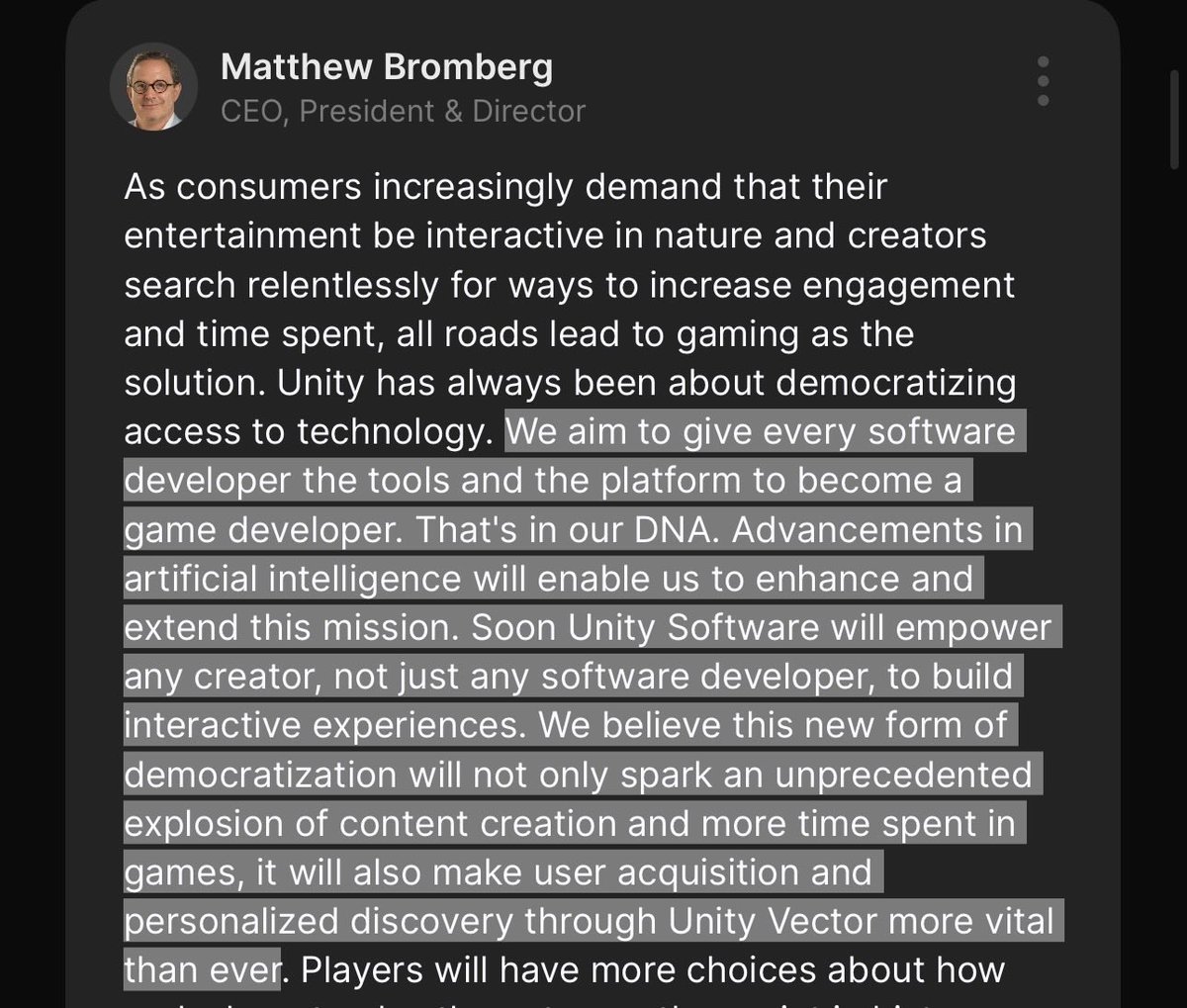
Advances in large-scale “world models” — whether developed by partners like Google or others — materially expand the frontier of interactive content creation. These models can generate high-quality, interactive, video-like experiences from natural language or minimal input.
Today, they are primarily editable through prompting, which limits the level of determinism and precision required for production-grade game mechanics. As a result, their outputs remain probabilistic and non-deterministic, making them unsuitable on their own for games that require consistent, repeatable player experiences.
Rather than viewing this as a risk, we see it as a powerful accelerator. Video-based generation is exactly the type of input our Agentic AI workflows are designed to leverage—translating rich visual output into initial game scenes that can then be refined with the deterministic systems Unity developers use today. Our agents already generate high-quality scenes from static video. Interactive, camera-controllable video from world models would further enhance this pipeline and materially improve the fidelity and speed of early-stage content creation. We believe this represents a meaningful step forward for AI-driven development across the industry.
Unity’s role is to operationalize these advances. Outputs from world models are ingested into Unity’s real-time engine, where they are converted into structured, deterministic, and fully controllable simulations. Within Unity, creators define physics, gameplay logic, networking, monetization, and live-operations systems to ensure consistent behavior across devices and sessions.
This combination enables developers to move faster from concept to scalable product: AI accelerates environment and asset generation, while Unity provides the execution layer that transforms generated content into reliable, monetizable experiences.
As a result, world models expand content supply and reduce development friction, while Unity remains the system of record for runtime, distribution, and long-term operations. This dynamic broadens Unity’s addressable market and reinforces its central role in the interactive ecosystem.