Lawrence

929 posts

Lawrence

Lawrence

@Lawrence_Ou

Did VC FoF | Now building something to help private markets liquidity

A DM away Katılım Mart 2011
725 Takip Edilen540 Takipçiler
Sabitlenmiş Tweet
Lawrence
Lawrence@Lawrence_Ou·
Seeing a lot of good takes about VC and also a lot of bad ones too, particularly when it comes to all things LPs. So I've decided to write about it. If interested, the newsletter is at lpperspectives.substack.com where I cover the basics of venture all the way to things I'm seeing in the market. I'm open to feedback and comments. Below you'll find threads that I've written over time. Tracker below to help with quick finds: docs.google.com/spreadsheets/d…
English
1
0
4
3K
Lawrence
Lawrence@Lawrence_Ou·
Funny watching the comments about investors talking up the one they backed. What else are they supposed to say? "We screwed up and backed the wrong one."?
English
0
0
1
61
Lawrence
Lawrence@Lawrence_Ou·
All the stuff we're seeing in private credit is because these vehicles are horribly designed. The product is the investors and the winners is the asset managers milking the 3%+ fees on undeployed cash and on the overvalued NAV. Ditto for all the other private market vehicles.
English
0
0
0
10
Lawrence
Lawrence@Lawrence_Ou·
Getting into private market/ illiquid assets and expecting some sort of regular liquidity is dumb. The cost of liquidity is half your cash setting in money market at 1%+ management fee. So pay illiquidity premium, have cash sit in MMF and wonder why returns are bad.
English
1
0
1
65
Lawrence
Lawrence@Lawrence_Ou·
The Angelist incentive is to funnel retail cash to Angelist GPs/funds. More cash to more GPs means more funds on Angelist. So the incentive isn't really to generate the best returns (no carry explains that). It's to fund funds so Angelist can monetize other aspects of their biz.
English
1
0
1
29
Lawrence
Lawrence@Lawrence_Ou·
1/ No carry is framed as a positive. But what's the incentive then? The incentive isn't to back the best funds/companies. It's not really to stack fees either (even if 1% management fee for a FoF can be framed as a lot).
English
1
0
0
29
Lawrence
Lawrence@Lawrence_Ou·
Not a fan of the Robinhood one. Not a fan of this one either.
AngelList@AngelList

Announcing: USVC AngelList exists to power the innovation economy. To date, we have powered $125 billion in assets, 25,000+ funds, and 13,000+ startups. Today, we’re opening it for retail access. @usvc_ is a regulated fund that holds stakes in promising private companies. There are no accreditation requirements and anyone can get started with as little as $500. Early portfolio includes xAI, Anthropic, OpenAI, Sierra, Vercel, Crusoe, and Legora. Own a stake in the companies defining the future. Learn more: usvc.com

English
1
0
3
658
Lawrence
Lawrence@Lawrence_Ou·
There's a price point where companies turn to human employees for things again. Probably happens when increased productivity vs cost doesn't make sense anymore. For a while anyway until we figure out how to make costs reasonable for each unit of intelligence. Interesting times.
Marc Andreessen 🇺🇸@pmarca

Magical OpenClaw experiences that use frontier models cost $300-1,000/day today, heading to $10,000/day and more. The future shape of the entire technology industry will be how to drive that to $20/month.

English
0
0
1
34
Lawrence
Lawrence@Lawrence_Ou·
@pavelprata Disagree on point 3. As an LP if you have the choice, it’s better to come in late but not because of who else commits. It’s more so you can see how the portfolio looks. At worst you pay late fees. At best, you dodge a portfolio with not great looking companies.
English
1
0
1
60
Pavel Prata
Pavel Prata@pavelprata·
Mostly true for startup fundraising, but it plays out a bit differently once you’re raising from LPs. At the GP/founder level, momentum is basically everything – if you miss the early round and the valuation runs away, you’re not just “late,” you’ve effectively broken your fund model, so investors are wired to move fast or risk being shut out of the best outcomes entirely. With LP checks, that same type of FOMO just isn’t there in the same way, and it’s mostly structural: 1/ you can always come back in Fund II if you missed Fund I, so the downside of waiting is much lower 2/ investment processes are just slower by design if you’re not dealing with HNWIs (ICs, internal approvals, pacing, etc.) 3/ and from what I’ve seen, a lot of less sophisticated LPs don’t even want to be in the first close – they’d rather wait, see who else commits, and then jump in closer to final close So the surface-level behavior looks “slow,” but it’s not always the same as lack of interest. At the same time, urgency absolutely still exists on the LP side, it just shows up in more subtle ways, and you kind of have to learn how to read those signals: 1/ quick follow-ups right after the meeting (not weeks later) 2/ intros across their internal team or broader network 3/ requests for deeper materials instead of just “keep me posted” Those are usually the moments where you feel they’re actually pulling the process forward rather than passively sitting in it. And then the last layer is that this really depends on the type of fund you’re raising: - for EMs, urgency tends to be much higher because the LP base (HNWIs, FOs, FoFs) behaves more like a network and reacts to momentum, so the dynamic starts to look closer to startup fundraising - for more established funds, the process is naturally slower and more structured, largely because the LP base is institutional (endowments, pensions), where speed is constrained by process and mandate rather than pure conviction So it feels like the better lens here (VC/LP) isn’t really “fast vs slow,” because slow doesn’t necessarily mean no in LP land.
Brett Berson@brettberson

When you’re in a fundraising process, if an investor isn’t pulling you forward and urgently driving next steps, it’s safe to assume they’re never going to invest, so it’s best to move on and focus your energy on other investors.

English
2
1
23
4K
Pavel Prata
Pavel Prata@pavelprata·
Monthly VC/LP debrief. What I actually saw in March: 1/ Spoke with a multi-billion fund. Their thesis is simple: fund size follows the size of the prize. When @SpaceX is tracking toward $1T still private, a $300M fund can't matter. They raise in months, not years, and build IR teams like corporates. The gap between how mega funds operate and how everyone else does is wider than most people think. (h/t @jkhamehl) 2/ The Midas List doesn't look the way most people expect. Only ~35–42% have operator/founder backgrounds. ~25–35% came from finance. The rest from engineering, journalism, career VC. Great investing is about temperament, not resume. (via @kwharrison13) 3/ @cartainc's data across 2,904 US funds is sobering. Most vintages are at or below water on TVPI. DPI for anything post-2019 is near zero. The 2021 vintage top decile sits at 1.71x TVPI – with virtually no distributions. Even the 2017-18 top 10% returned only 1.35x DPI after 7-8 years. That's the actual bar. (via @PeterJ_Walker) 4/ The LP market is bifurcating fast. Late-stage AI co-invest has unlimited demand, but is full of unsanctioned SPVs and fees that can kill returns (one example seen: 15% upfront + 20% carry + 30% over 2x). Meanwhile, the top 10-20 multi-stage brands are oversubscribed. For emerging managers without a spinout story or a strong operator brand, it's the hardest fundraising environment in a decade. (via @Samirkaji) 5/ LP selection is portfolio construction in reverse. The most expensive LP mistakes aren't the ones who say no – they're the ones who say yes and then behave like owners: demanding co-invest on every deal, quarterly calls, board visibility on 20% of your fund. Rule of thumb: every LP should make Fund II easier to raise, not harder. (my observation) 6/ UTIMCO's disclosures show the power law in its most extreme form: @ThriveCapital's 2022 fund at 126%+ IRR on @OpenAI and @cursor_ai. @notablecap swinging from -48% to 96% IRR in one year on @AnthropicAI. All paper. The caveat nobody says loud enough: this cycle's returns are almost entirely a story of who got into 2-3 AI companies at the right time. (via @maddierenbarger) 7/ One 5x fund doesn't make a great VC. On a $5M fund, a single lucky bet can look like genius. What separates @usv and @foundersfund isn't a blowout vintage – it's consistency across multiple funds, cycles, and GP generations. For LPs, the job is finding franchises worth backing repeatedly, not hunting whoever got lucky last. (via @Lawrence_Ou) 8/ Venture may be having its Nifty Fifty moment. In 1972, Wall Street was right about the companies (Disney, Coke, McDonald's all won) but catastrophically wrong about price. Buyers underperformed the market for 26 years. Now 60%+ of global VC dollars in Q1 2025 went to $500M+ rounds. @OpenAI raised $110B – bigger than any IPO in history. Being right about the company has never been enough. You also have to be right about the price. (via @Jeffreyw5000) 9/ After 25 years of Lean Startup and customer development, startup survival rates haven't improved – and seed-to-Series A conversion has actually collapsed. The culprit is the Red Queen: when everyone runs the same playbook, no one wins with it. Winning requires doing something different, not executing the shared framework better. (via @patrick_oshag) 10/ @RonConway's actual value-add: showing up at Airbnb during COVID, OpenAI during its governance crisis, and across the ecosystem during SVB's collapse – in an hour, when the founder needed it. Not a deck. Not a platform slide. Thirty years of compounding relationships where the people he backed in 2005 are the ones who matter in 2025. That's the seed fund model that actually works. (via @jaltma) Every month I track new fund launches, LP events, market reports, and what's actually moving in VC/LP. All of it in the @murphcapital newsletter: murphcapital.substack.com/p/edition-11-3…
Pavel Prata tweet media
English
13
17
230
75.6K
Lawrence
Lawrence@Lawrence_Ou·
@edsuh No. Any LP worth anything will discount fund A’s marks on the SAFE. And will then question all the other marks.
English
0
0
1
176
Ed Suh
Ed Suh@edsuh·
A tale of two funds: - Fund A invests in a startup's pre-seed round at a $10M cap. The startup goes through an 8 week accelerator. The first few seed investors come in at a $20M cap. Within a day, the round is oversubscribed. A new fund, desperate for allocation, agrees to a new SAFE at a $100M cap with a 50% discount. The pre-seed investor is delighted & marks their position up 10x. The company has not changed meaningfully in 8 weeks and is still pre-launch, zero revenue. - Fund B invests in a startup's pre-seed round at a $10M cap. The company launches & is instantly profitable. They get to $200M of revenue, spit off cash, but never raise again. Fund B keeps the co marked at $10M. On paper, Fund A has much better performance than Fund B: higher TVPI, IRR, more likely to be "top quartile" or "top decile". But are they really? These are made up cases, but based on real world examples. There is a lot more beneath the surface of VC marks.
English
26
10
159
34K
Lawrence
Lawrence@Lawrence_Ou·
Invest in OpenAI at $830B+? Or in Anthropic at $350B+? Seems like such a no-brainer to do the latter instead of the former
English
0
0
1
79
Lawrence
Lawrence@Lawrence_Ou·
Apartments in the centre of Stockholm are built with this idea. Had one when I lived there. Loved it. Are of smaller scale than the one proposed here, but beats towers and sprawl. Should build this in Canada. Current housing shortage really is an opportunity to rethink how we live.
Alicia, Courtyard Urbanist@UrbanCourtyard

hello, I want to **UPDATE** my followers on Twitter and supporters of the Courtyard Urbanist project on plans for 2026 and beyond. First, I am beyond grateful for the engagement and support of so many in my work. It’s thrilling to see how many people care about improving the urban fabric and quality of life for families -- in the US, which is my focus, but also around the world. Courtyard urbanism is obviously resonating on so many levels (eg, x.com/UrbanCourtyard…). And well it should! Speaking up for what matters is important, and you’ve amplified that and made it count. Thank you. And what an exciting time for this work! Yes, there are lots of barriers to progress, but there are also powerful actors and thinkers today who are CLOSE to understanding the value of reimagining urban spaces and homes and how they are designed, built, valued, used. For example, I think the call by @patrickc and @tylercowen for A New Aesthetic is a timely contribution to not just debate but actual progress. I support this, and I want Courtyard Urbanist to accelerate the best of this conversation, and to be a bridge both across political and institutional divides, but also from ideas into practice. I’ve been asked both publicly and privately to contribute in these ways. So I’m happy to share that this year I will gradually be doing the following, in addition to the usual content, conversation (and provocation!): -Inviting followers of my work to join more structured community and network of collaborators to help, inform, and grow the Courtyard Urbanist project. -Gathering advisors around the Courtyard Urbanist project to inform research, design, planning and development themes. -Adding commercial services, with partners, such as design, planning and strategy advisory related to Courtyard Urbanist. -Experimenting with tools, technology and collaborations to support communication and evolution of Courtyard Urbanist ideas and practices. -Exploring a podcast format (surprise!) to see if this helps support the community, conversation, and these initiatives. I am cautious but excited by the potential here, and am looking forward to learning from and being guided by experts, professionals and other enthusiasts -- including you. I don’t imagine that all of these efforts will work, or everyone will agree with the outcomes. Also I don’t have all the resources I need yet, so support of all sorts including financial is welcome. BUT I do believe it’s right to act, it’s what I believe in, and in the end, even while listening and collaborating, I will stand up for my own very firm beliefs about housing, cities, and the needs of families. As first step, and to welcome in the New Year, I am: 1) inviting everyone interested to be more informed and involved in the Courtyard Urbanist work to sign on to my Substack (courtyardurbanist.com) (updating! use link in bio if down!). This is partly to share more timely updates, but also enabling feedback, discussion and collaboration. You’ll be invited in a sign-up survey to indicate if you only want information, or if you want to explore more concrete collaboration. If you’ve already signed up to my Substack, you can use this link urbancourtyard.substack.com/survey/3627859 2) incrementally launching some tools, together with @treasury_space, a spatial design company founded by architects, and to help everyone to imagine and communicate, and ultimately plan and design, the urban courtyards they want to live in. See the image below for an example of the Courtyard Composer (composer.courtyardurbanist.com) under development, with very special thanks to @ArcolTech. **I will invite an initial group of testers from Substack community to help me evolve these tools, and then expand access to them in the coming weeks, in particular to see how Courtyard Urbanist themes and concepts can contribute the The New Aesthetic conversation ignited by Patrick Collison and Tyler Cowen.** If you can’t or don’t want to do substack, write Courtyard Composer! in a reply to this tweet, and I’ll include include you as soon as I can! So: I am looking forward to developing the Courtyard Urbanist conversation, and I hope you will appreciate the new ways to collaborate that I'm developing. Finally, please note: while I am confident in my voice & ideas, and I am becoming truly expert in the issues of urban courtyards, I am still very busy parenting and teaching! I hope you’ll receive my efforts positively and support them in whatever way as they unfold: becoming more visible on Twitter, and attempting to use my voice to influence real things in the built world, are both known to be risky! THANK YOU in advance for your grace and support. Here’s to a new year filled with Courtyard Urbanism, and shared progress towards a New Aesthetic! ❤️Alicia

English
1
4
19
1.8K
Lawrence
Lawrence@Lawrence_Ou·
@credistick @cartainc @PeterJ_Walker Been banging my head against the wall telling new GPs that giving LPs a pref with a catch up makes raising easier and nets out to the full 80-20 split if they deliver ~12% ish. No one listens 😂
English
0
0
4
113
Dan Gray
Dan Gray@credistick·
Great data in @cartainc’s 2025 Fund Economics report, covering GP commit, capital calls, deployment pace, fees, carry and expenses. Carry hurdles are a lot less common than I would have thought. carta.com/data/fund-econ…
Dan Gray tweet media
English
8
5
56
6.1K
Lawrence
Lawrence@Lawrence_Ou·
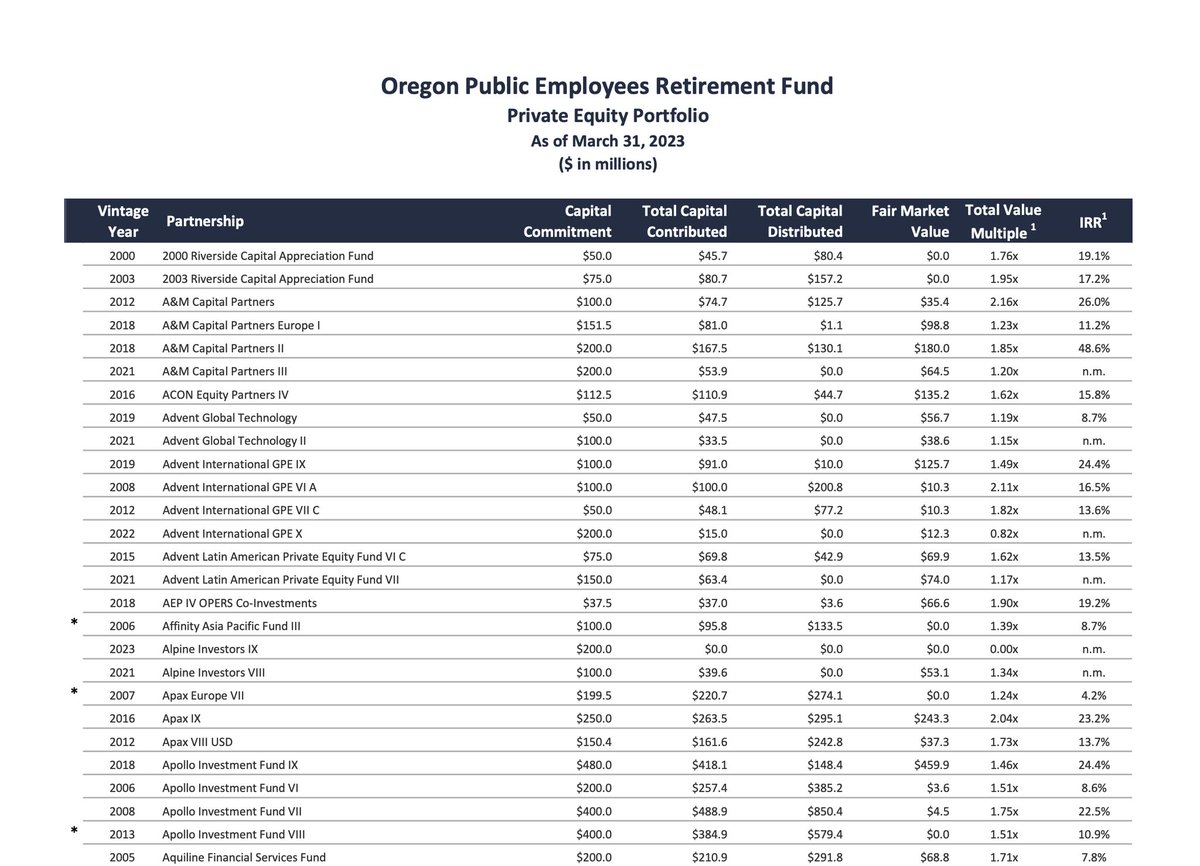
@pavelprata FYI your analysis and conclusions are wrong in a lot of places. Wont list them all: Fund size isn’t what makes an EM. Fund # is regardless of size LP commit. in your docs is not fund size. It’s Oregon’s commit. So Apollo 9 isn’t 480M like you state but ~25B.
English
1
0
1
37
Pavel Prata
Pavel Prata@pavelprata·
I analyzed Oregon's $61B portfolio spanning 400+ VC/PE funds. Here are 10 insights I’ve found 👇
Pavel Prata tweet media
English
3
3
27
6.2K
Lawrence
Lawrence@Lawrence_Ou·
@mikewchan Just re-read your post. It could also be that the larger CC later coming LPs you've seen is to account for equalization of payments + interest. Can't say definitively though without the details.
English
1
0
1
12
Lawrence
Lawrence@Lawrence_Ou·
@mikewchan Pretty standard in all that I've seen and worked with. Late coming LPs get called up to the amount so that they are equalized as the older LPs. Then pay interest to those LPs It's also why some GPs try and delay CCs if they know new LPs are coming in. To avoid the above.
English
1
0
1
17
Mike Chan | Deep Ventures 🤘
Why can't VC funds reward early LPs with higher upside, like startups do? All other things being equal, the younger a startup is, the lower their valuation is when they fundraise. This makes sense - most pre-seed startups haven't made much progress, so their valuation will reflect that. In turn, the investors who invest at this stage take more risk but have much greater potential upside. This is not the case for Limited Partners (LPs) who invest in VC funds, which sucks for everyone involved. Let's walk through each scenario. If you're a startup, you might raise a Pre-Seed round at a $10M valuation. There is a ton of risk but potentially immense upside for VCs who invest in this round. Then as your startup grows, its valuation increases. You might raise a Seed round at a $25M valuation, Series A at $75M, Series B at $300M, etc. Investors in the earliest rounds take more risk but have higher upside. Later investors take less risk but have less potential reward. Now let's take a venture fund. The LP who invests right before the fund closes gets the SAME EXACT BENEFITS as the LP who cut the first check into the fund. This could be up to two years after the first LP invested in the fund! The VC could have invested in dozens of deals already, and the last LP would still get payouts from all of these deals executed before they invested in the fund. There is basically no benefit for getting in early in a fund - only more risk. How is this fair to early LPs?
English
3
0
10
247