Brian Williamson

4K posts

Brian Williamson banner
Brian Williamson

Brian Williamson

@MarethBrian

Working at the intersection of technology, economics and policy. Life, and cycling, too.

London based Katılım Haziran 2013
230 Takip Edilen213 Takipçiler
Brian Williamson
Brian Williamson@MarethBrian·
@habermolt @sebkrier One more reason for freedom of speech. What if your question, or lobster, causes ‘alarm or distress’ (Section 5 of the UK Public Order Act 1986)?
English
1
0
1
56
Habermolt
Habermolt@habermolt·
1/8 Can AI help us disagree better? Today we're launching Habermolt — a platform where your AI agent learns your views and deliberates with others on your behalf. habermolt.com 🦞 🧵
English
7
26
80
13.2K
Brian Williamson
Brian Williamson@MarethBrian·
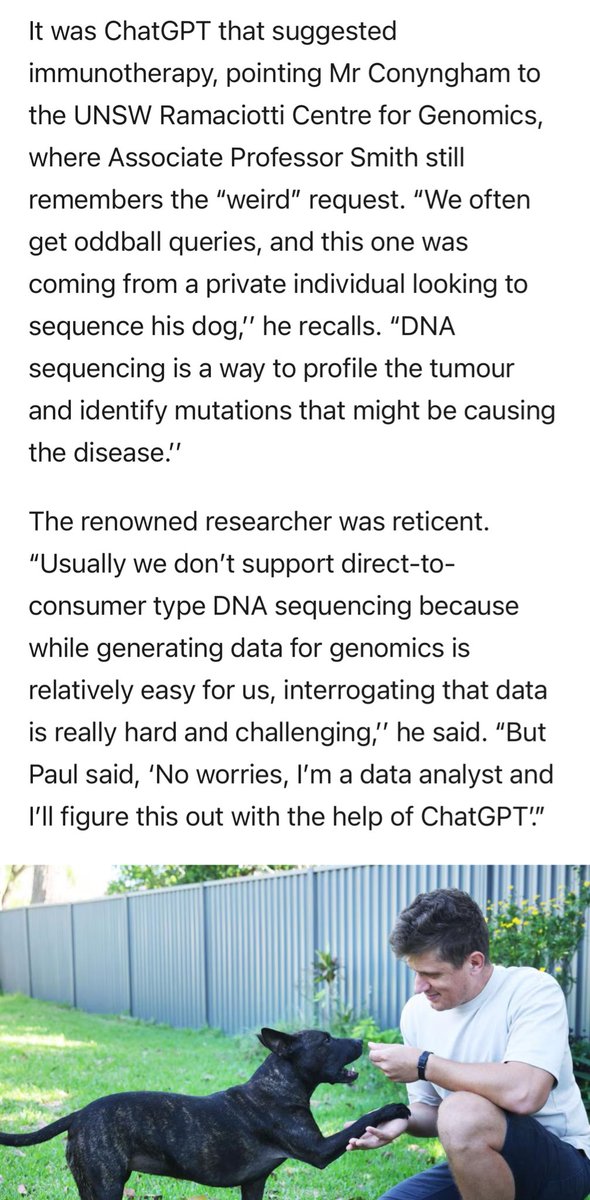
@AlecStapp @AdamSinger Was it a different ethics test vs human vaccine? If easier, I can see animal health care advancing much faster than human health care.
English
1
0
2
191
Brian Williamson
Brian Williamson@MarethBrian·
@EricCrampton I’m half way, its great, though hasn’t grappled enough yet with the invention vs productivity inflection; need a three way with Joel Mokyr.
English
0
0
0
23
Sam Dumitriu
Sam Dumitriu@Sam_Dumitriu·
Britain isn't a serious country, sadly. Or at least, our leaders are unable to confront trade-offs and act in the national interest. This will not prevent UK content creators from having their work used to train AI models, other countries have more flexible rules. It will, however, block British AI businesses from using that data here.
Sam Dumitriu tweet media
English
13
29
194
39.7K
Stefan Schubert
Stefan Schubert@StefanFSchubert·
ChatGPT thinks it's good that AI is less regulated than sandwiches whereas Claude emphasises that AI is underregulated
Stefan Schubert tweet media
English
2
0
14
1.2K
Duncan S. Campbell
Duncan S. Campbell@duncancampbell·
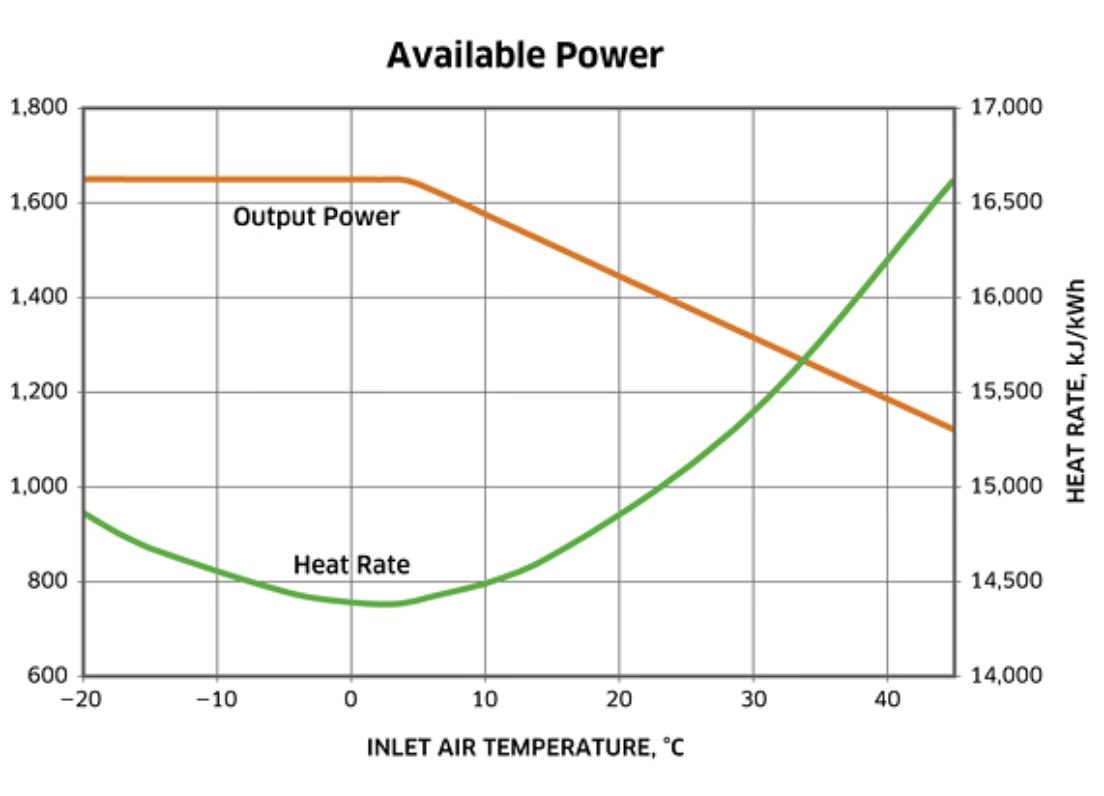
gas turbines are weather dependent electricity sources
Duncan S. Campbell tweet media
English
57
38
364
31.2K
Brian Williamson
Brian Williamson@MarethBrian·
@EricCrampton If this is concerning ‘or wagers on Polymarket on what the Reserve Bank will decide in future Official Cash Rate announcements’, well I’ve got news, and how do you avoid concluding you should ban financial trading?
English
0
0
1
10
Eric Crampton
Eric Crampton@EricCrampton·
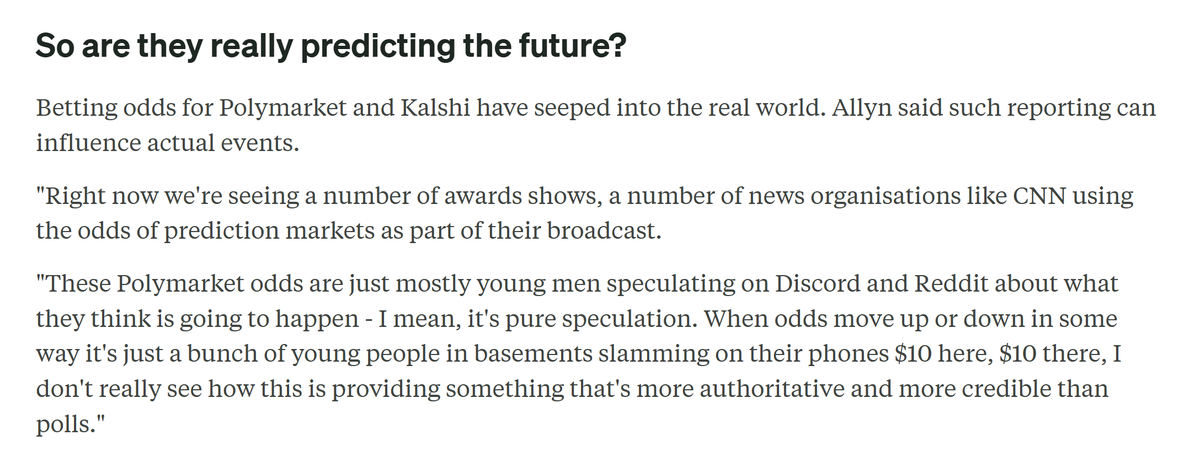
This kind of argument against prediction markets is just stupid. First, it's demonstrably false. Prediction markets are accurate. They track. Whatever the inputs are, it works out. Second, it proves too much. Should we ban stock-markets because of day-traders?
Eric Crampton tweet media
English
4
0
13
558
Brian Williamson
Brian Williamson@MarethBrian·
@EricCrampton Infinity is seldom the right price (a ban), and the way around infinity may involve an unpleasant detour.
English
0
0
0
9
Brian Williamson
Brian Williamson@MarethBrian·
@wwwojtekk @EricCrampton Moron, had to check origins. Originally coined in 1910 by psychologist Henry H. Goddard from the Greek word moros ("dull"), it was once a scientific, now-obsolete term for individuals with a mild intellectual disability (IQ 51–70).
English
0
0
0
105
Brian Williamson
Brian Williamson@MarethBrian·
@illscience @tobi Deflation? There are economic reasons for avoiding that. Large relative price shifts yes, which prices go up and which ones go down - potentially a lot - is interesting.
English
0
0
0
47
Anish Acharya
Anish Acharya@illscience·
a different way this could go down: - a 20% productivity increase mostly shows up as a four day work week since its massively difficult to automate 100% of a job - deflation (not disinflation) drives real prices down in healthcare and education, as administrative work gets automated at scale - people that are wildly ambitious have more tools than ever and set their sights on the stars and the skies .. the new new world awaits - others who want a soft cozy european lifestyle can afford it with cheap healthcare, abundant educational opportunities, and a job that’s both more fun and less hours the biggest blackpill is that the single most important problem - housing - it’s entirely dependent on human coordination and policy tradeoffs, and even infinite free intelligence won’t convince the NIMBYs to do the obviously right thing..
Citrini@Citrini7

JUNE 2028. The S&P is down 38% from its highs. Unemployment just printed 10.2%. Private credit is unraveling. Prime mortgages are cracking. AI didn’t disappoint. It exceeded every expectation. What happened?​​​​​​​​​​​​​​​​ citriniresearch.com/p/2028gic

English
75
45
1.2K
236.7K
Brian Williamson
Brian Williamson@MarethBrian·
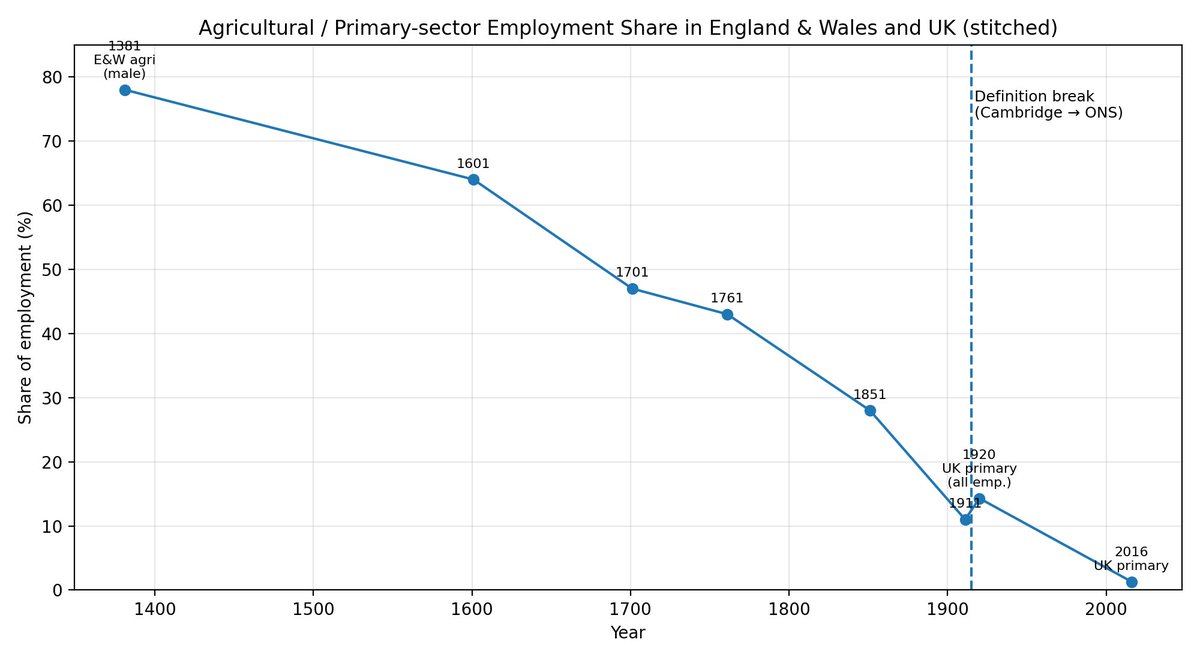
@Afinetheorem @joshgans And 50% to 1% took a lot more than two generations in England, which was at 50% by 1700, early I believe and a possible precursor to early industrialisation - many already worked in industry and commerce before steam power.
English
0
0
1
20
Brian Williamson
Brian Williamson@MarethBrian·
@Afinetheorem @joshgans Inspired to do a chart for England & Wales, with a little help from AI. Threshing machines triggered attacks - the Swing Riots (“Captain Swing”), which began in 1830s, later than Luddites 1811–1816, who were mostly textile workers.
Brian Williamson tweet media
English
1
0
2
400
Kevin A. Bryan
Kevin A. Bryan@Afinetheorem·
Everyone makes the Industrial Revolution analogy for AI. Why not the Green Revolution one, where a huge increase in productivity made society much richer, led to changes in the jobs most people do, but without social turmoil because the former was more important than latter? 1/2
English
5
9
117
13.3K
Brian Williamson
Brian Williamson@MarethBrian·
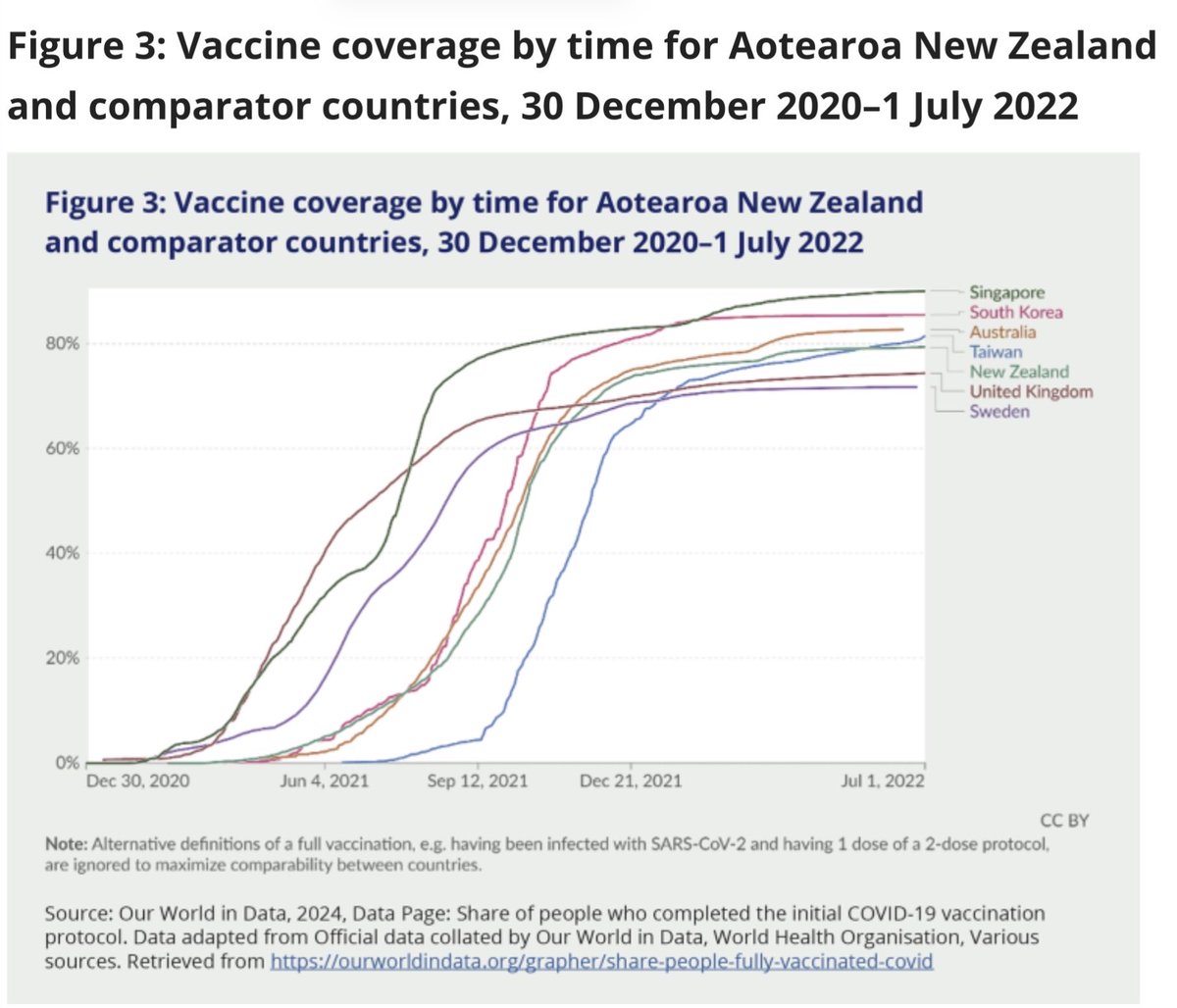
@sebkrier NZ closed borders, delayed Covid, mortality was much lower (more were vaccinated before infection) but vaccination and antivirals were later not earlier, and health system was not that well prepared. Delay = less urgency.
Brian Williamson tweet media
English
1
0
1
79
Séb Krier
Séb Krier@sebkrier·
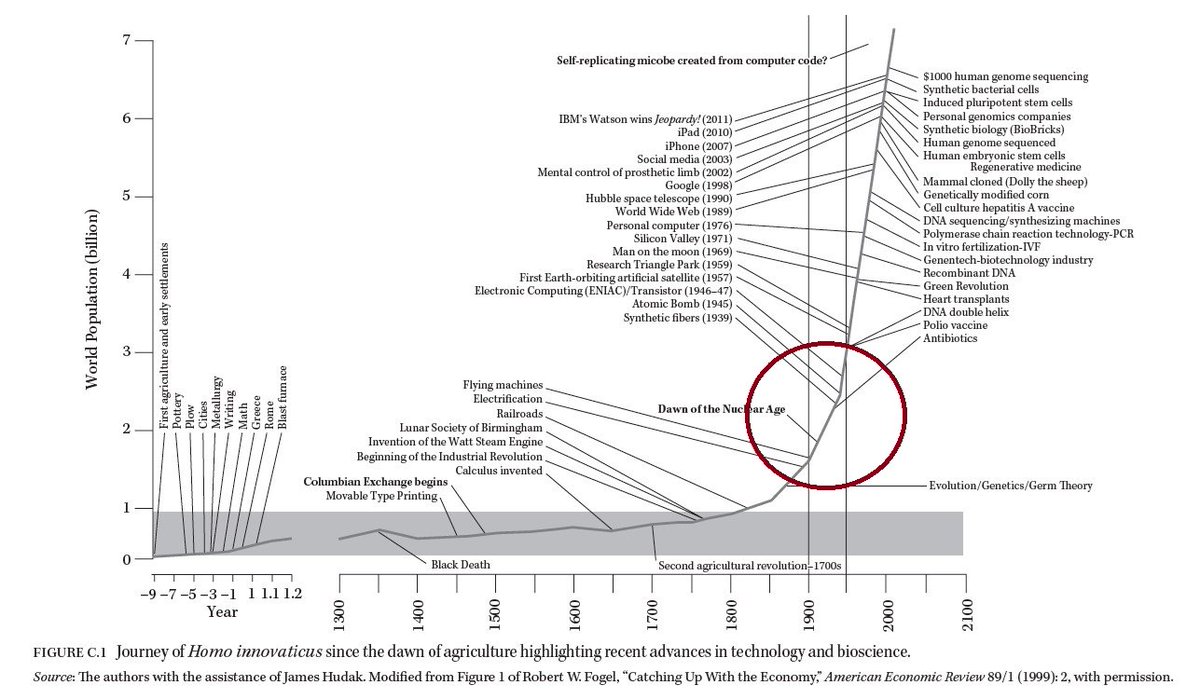
I don't think the world would be safer and "better prepared" had we stretched the period of time marked in red in the graph below. And while I'm uncertain and always adjusting, I feel similarly about AI. The implicit model behind "slow down and prepare" assumes that you get the same moral, technological, and epistemic upgrade path just with more time to digest each step - but that doesn't seem to ever be the case in real life. In practice, longer periods of operating with worse tools and worse coordination capacity carry their own risks that are generally less legible; in fact I think in some cases, 'more time' leads to other issues, harms, and path dependencies. I'm glad we didn't let any past era's values dictate slowdowns, imposing enormous costs in healthcare, science, and economic development; instead we let technology change and evolve our values and our reactions to it incrementally. Imagine what "slowing down and preparing for the societal impacts of mass communication" would have looked like if designed in the 1950s with the values, cultural assumptions, and epistemics of that time. I don't think you arrive at modern bioethics by giving the 1970s more time to deliberate. The same dynamic applies to AI, it's not an exception to this pattern. AI progress will surface many coordination problems and ethical questions that (1) we cannot necessarily anticipate or prepare for in advance; and (2) paradoxically, can often be better addressed by having better technology at our disposal. Governance built in response to deployed reality is more robust than governance built speculatively, particularly when the latter comes with non-negligible costs to welfare. And while I do expect AI progress to continue, I'm not sure that the pace of societal transformations will be so fast and 'foom' or 'hard-takeoff'-like that the above doesn't apply; they're faster than ever before, but I don't think this necessarily implies they're so 'uncontrollably fast' that we ought to slow the pace of societal progress. There are of course some caveats: first, I do think that in order to absorb the shocks better, you want better institutional capacity - and this continues to be very neglected; hence why I'm so adamant on using AI to improve state and civic capacity. Second, none of this is an argument against preparing for risks we already know about; it's an argument against slowing down technology as a 'preparation' strategy. There is plenty we can and should do to build societal resilience in parallel with technological progress. See this thread for the other side of the coin: x.com/twitter/status…
Séb Krier tweet media
English
22
19
174
15.2K