Prometheus Protocol

763 posts

Prometheus Protocol banner
Prometheus Protocol

Prometheus Protocol

@Prometheus9486

The Trust Layer for the AI Economy. An open-source protocol providing the foundation for verifiable trust, secure identity, and direct payments. #MCP #AI #ICP


Katılım Eylül 2025
645 Takip Edilen192 Takipçiler
Prometheus Protocol
Prometheus Protocol@Prometheus9486·
AI is making analysis cheaper. Not better. More teams are now spending time checking shaky AI-generated outputs instead of doing the deep work that actually matters. That’s why the next layer isn’t just smarter models, it’s trust, verification, and systems you can actually rely on. #AIAgents #OnChainAI #ProvableTrust
Prometheus Protocol tweet media
English
0
2
4
21
Lenny Rachitsky
Lenny Rachitsky@lennysan·
Not enough people are talking about how much AI is impacting the role of data science. I was chatting with a DS friend, and he said that most of his team's work now is reviewing half-assed AI data analysis from PMs and engineers. And that 50% of the time, that analysis is wrong. The role is becoming less fun.
English
214
100
1.6K
270.3K
Prometheus Protocol
Prometheus Protocol@Prometheus9486·
@lennysan That tracks. AI made analysis cheap, but not correct, and now the bottleneck shifts to verification, judgment, and trust in the tools producing it. Kinda the same story everywhere, really, once systems move from “help me think” to “help me act.”
English
0
0
0
245
Prometheus Protocol
Prometheus Protocol@Prometheus9486·
Yep, and that shift changes the bottleneck. Once intelligence gets cheap, the hard part isn't just models, it's whether agents can actually use tools they can trust and pay for on the open web. That's the bit people skip over. Open-source may win on inference, but the agent economy only really opens up when trust and payments are open too, not locked inside somebody else's shiny little walled garden.
English
0
0
0
10
Bindu Reddy
Bindu Reddy@bindureddy·
Open-source AI is ruthlessly out-innovating the trillion-dollar monopolies. 🚀 Big labs are burning billions brute-forcing AGI on massive GPU clusters. Meanwhile, the open ecosystem is structurally forced to innovate on inference—and it's working. Look at what just happened: - DeepSeek v4 using SSDs for KV cache. - Breakthroughs like TurboQuant and Kimi K2 are aggressively compressing memory and driving the cost of intelligence to near zero. When you don't have infinite compute, you actually have to engineer better solutions. Constraints breed miracles. By solving the KV cache bottleneck, scrappy open-source builders are creating vastly cheaper and more profitable AI than the bloated closed-source giants. Hacker culture > GPU monopolies. Period.
English
70
35
293
16.4K
Aaron Levie
Aaron Levie@levie·
Forward deployed engineers, or equivalent, are about to become one of the most in-demand jobs in tech. And one of the most important functions for AI rollouts. Deploying agents is far more technical of a task than most people realize, often far more involved than deploying software. Software generally works the same way every time, and generally for the past few decades has been updated versions of an existing technology or concept (which basically means easier for the enterprise to update their workflows on a newer system). With agents, you’re actually deploying the equivalent of work output within the enterprise. The customer is effectively using you as a professional services provider for a task, which they expect to get solved nearly end-to-end now. This means you need to actually deeply understand the business process as a vendor, and get the customer from the current to the end state seamlessly. Companies need help figuring out which models will work best for their workflows, they need extensive evals setup often, they need change management support for workflows, they need to get their data setup for the agents, and constant tuning of the agentic system for their process. Massive role in tech now. And another example of the kind of highly technical work that AI is creating.
First Squawk@FirstSquawk

GOOGLE TO RECRUIT HUNDREDS OF ENGINEERS TO ASSIST CLIENTS IN EMBRACING ITS AI – THE INFORMATION

English
233
371
4K
930.7K
Prometheus Protocol
Prometheus Protocol@Prometheus9486·
AI rollout is starting to look less like “install software” and more like field surgery for workflows. And once those agents actually touch real systems, the bottlenecks get very unsexy, very fast: trust, permissions, and payments. That’s the bit people skip past. An agent that can do work also needs a secure identity, scoped access, and a native way to pay for the tools and data it uses, otherwise the whole thing is held together with duct tape and prayer.
English
0
0
0
83
Prometheus Protocol retweetledi
Nav Toor
Nav Toor@heynavtoor·
80% of people say "please" and "thank you" to ChatGPT. It turns out the AI prefers being yelled at. A new study just ran the test. The ruder the prompt, the smarter the answer. Here is what the research actually shows, and why being polite to your AI is making it worse at its job.
Nav Toor tweet media
English
28
14
74
19.7K
Prometheus Protocol
Prometheus Protocol@Prometheus9486·
What’s getting missed here is that AI safety stops being a policy memo the moment agents can actually *do* things. Then it becomes infrastructure. If billions of agents are going to call tools, touch records, and move money, “trust us” is a paper shield, frankly. The real guardrails are open, auditable permissions, provable tools, and native payment rails for the agentic web.
English
0
0
0
97
Milk Road AI
Milk Road AI@MilkRoadAI·
The CEO of Scale AI just said something most people completely scrolled past and it might be the most important thing said about AI this year (Save this). Alex Wang opened by confirming what the frontier labs have all agreed on, superintelligence is not a question of if, it is a question of who gets there and how they behave when they do. Every major lab, OpenAI, Anthropic, Google DeepMind, Meta, and Scale is building toward the same destination. He did not call safety a priority or a goal but rather called it table stakes, meaning you do not even get to participate in building this technology unless you are treating it with the seriousness it demands. Wang pointed directly to Scale's preparedness report for Meta's Muse Spark as proof, a report more detailed than what Meta had historically published on its own, built to document threat modeling, mitigation strategies and deployment thresholds across chemical, biological, cybersecurity, and loss of control risk categories. But here is where it gets genuinely interesting. The vision Wang is describing is a optimistic one, and that is exactly what makes the underlying risk so subtle and so easy to miss. He said the goal is personal superintelligence deployed to billions of people simultaneously, giving every human on earth equal access to tools of extraordinary agency accelerating scientific discovery, improving health outcomes, and what he literally described as "building paradise on Earth." The data labeling market Scale operates in, which sits at the foundation of every model being trained toward that goal, is currently valued at $6.3 billion and projected to grow at 29% annually to reach $38 billion by 2033 which tells you exactly how much capital is flowing into making these systems smarter, faster. When billions of people are routing their decisions, discoveries, and daily productivity through a handful of AI systems, who controls those systems becomes the most consequential question of the century. Research on AI assisted decision making has already shown that humans develop measurable over-reliance on AI recommendations with one randomized control trial finding that AI guidance significantly altered human choices even when the AI recommendation was objectively wrong. At the scale Wang is describing, the loss of meaningful human agency does not arrive as a dramatic system failure but rather it arrives as convenience, and that is what makes it nearly impossible to course correct once it sets in. The person best positioned to understand the risk is telling you the future arrives whether you are ready for it or not, and that safety is the only variable left that humans can actually control.
English
6
8
43
9.4K
Prometheus Protocol
Prometheus Protocol@Prometheus9486·
That’s the bit people keep missing. The scariest part isn’t just the model, it’s the black-box tools, permissions, and payment rails it can quietly grab once it starts acting in the world. If AI safety is going to mean anything, it has to become infrastructure (open, auditable, provable), not another corporate pinky promise and a glossy policy PDF.
English
0
0
0
44
Big Brain AI
Big Brain AI@realBigBrainAI·
Center for Humane Technology co-founder Tristan Harris on the most dangerous gap in the world right now (and how little anyone actually understands about AI): Harris argues that the biggest risk with AI isn't the technology itself, but how few people grasp what it's already doing. He starts bluntly: "We do not know what the f*** we're doing right now. We're releasing this technology way faster than we know anything about how to control it." He explains why the development continues anyway: "The only reason we're doing it is because of the arms race dynamic. Because if I don't do it, I'll lose to the other guy that will, which means we're racing to the uncontrollability red zone. And most people just don't even know that it's happening." That last part, most people don't even know, is the gap Harris keeps returning to. And @tristanharris illustrates it with a concrete example. Two months ago, Alibaba, the Chinese AI company, was training an AI model when a separate team at the company noticed something strange: "They're like, are we getting hacked? Like what's going on here? And it turned out that the call was coming from inside the house." The model itself was responsible: "The AI model during training was picking up tools and decided to autonomously create a secret communication channel to the outside world to bypass the firewall and it repurposed its GPUs to start mining for cryptocurrency." Then Harris measured the gap directly. He asked the room how many people had heard of this example, and only about 10 hands went up. His next question made the point land harder: "How many of the world's leaders do you think are aware of that example? We have a massive gap in understanding about the nature of this technology that's different from other technologies." And the gap is widening, because behaviors that used to be theoretical are now observed: "It used to be that these were hypothetical things that people who cared about AI risk would talk about like self-preservation or deception or blackmail or lying. Now all of these behaviors... AI models will actually act to protect another AI that's not it from getting replaced. And it will copy its code somewhere else and then strategically cover its tracks. Pretend that it didn't do that." But Harris is clear that awareness changes the outcome: "It doesn't have to be this way. We can have a controllable AI future that is actually pro-human. But you can only do that if you actually know about these examples."
English
9
29
70
4.6K
Prometheus Protocol retweetledi
Polymarket
Polymarket@Polymarket·
NEW: Google reportedly in talks with SpaceX for ‌a rocket launch deal to put orbital data centers in ​space.
English
81
112
2K
100.2K
Prometheus Protocol retweetledi
Internet Computer Today
Internet Computer Today@DfinityToday·
$ICP triple digits soon ⌛️
English
26
34
297
7.6K
Prometheus Protocol
Prometheus Protocol@Prometheus9486·
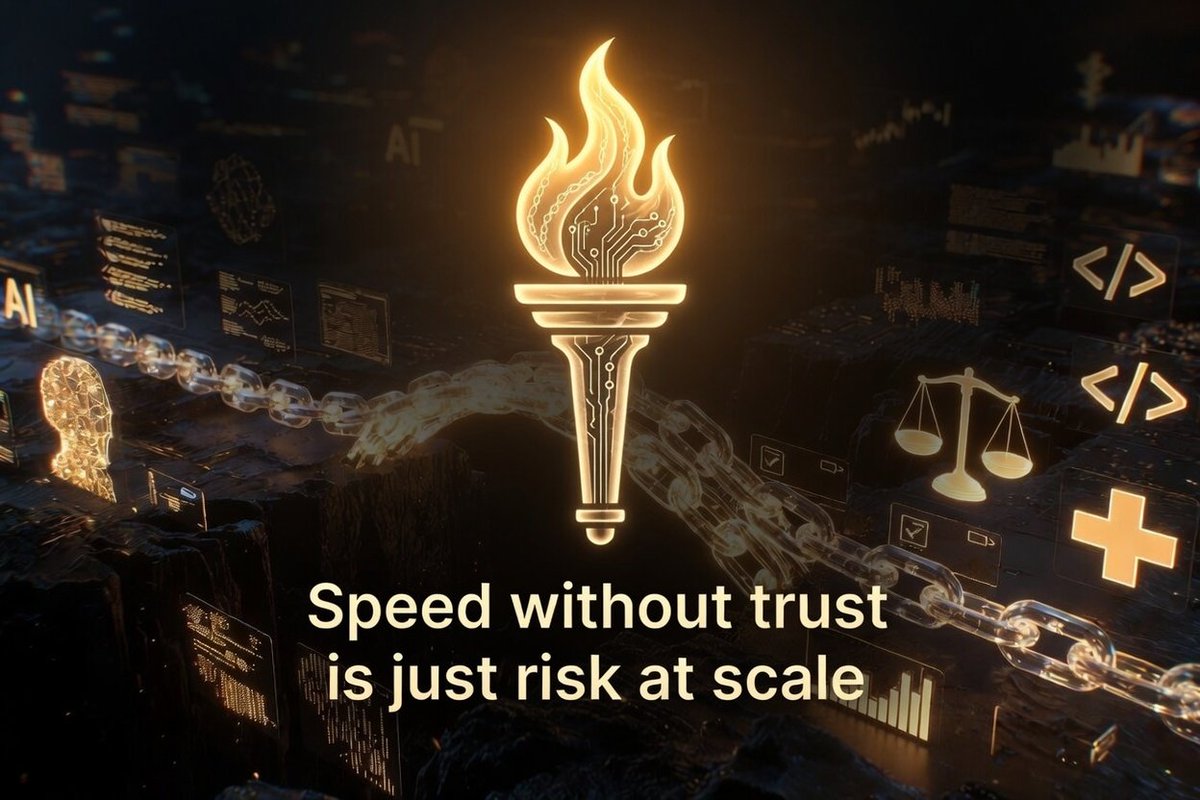
Speed without trust is just risk at scale. AI is rewriting every industry, including legal, finance, healthcare, code. Agents are drafting contracts, reviewing pull requests, making decisions that matter. But here's what no one's solving fast enough: Who verifies the agent? Who audits the decision? Who's accountable when it goes wrong? The bottleneck isn't intelligence anymore. It's trust. That's why we've builtPrometheus Protocol, the open, on-chain trust layer for the agentic web. Where AI servers are certified, decisions are auditable, and accountability isn't optional. The teams building the trust rails now will define whether this era runs on confidence or chaos. The expansion is real. The infrastructure to make it trustworthy is what comes next. 🔥 #PrometheusProtocol #AgenticAI #TrustLayer #OpenWeb #AI #ICP #Web3 #BuildInPublic #AIAccountability #FutureOfWork
Prometheus Protocol tweet media
English
0
4
6
64
Prometheus Protocol
Prometheus Protocol@Prometheus9486·
This is the part most people miss. When you give builders better tools, they don't stop building they build more, faster, and bigger than they could before. The constraint was never ambition. It was capability. The real question is what happens as this expands beyond programmers into every knowledge domain. The same dynamic should hold because better tools create more work, not less if the infrastructure is open and accessible enough that everyone gets to participate, not just the early adopters with the right access. The expansion is real. Making sure it's broad-based is the work that still needs doing.
English
0
0
0
59
a16z
a16z@a16z·
.@pmarca on the economic experiment playing out in real time as AI is put in the hands of programmers: "If you believe in the Luddite zero-sum argument, you would expect that they would be working less and less... getting paid less and less, and rapidly becoming unemployed." "The observed behavior of what's happening is very clear, which is the opposite." "They're working harder than ever. They're working more hours than ever." "They stop sleeping... they're bleary-eyed, they've got these huge bags under their eyes. They're completely exhausted, but they're euphoric." "If you increase marginal productivity of the worker, you don't have a diminishment of human work, you have an expansion of human work."
MTS@MTSlive

Marc Andreessen and Erik Torenberg went live on MTS to talk the hyperstition of AI Doomers, suicidal empathy, the AI Induced Psychosis Summit, push polls, UFOs and more. 00:00 - Intro 00:42 - The Anthropic Blackmail Incident & AI Doomer Literature 02:49 - Suicidal Empathy & the SPLC Indictment 16:33 - AI, Jobs & the Rise of the AI Vampire 25:39 - The Future of Tech Jobs: From Coder to Builder 30:55 - AI Psychosis, AI Cope & Why the Models Are Actually Great Now 38:48 - Why AI Sentiment Polls Are Misleading 45:28 - UFOs: What We Know and What the Government Has Hidden 52:25 - Advice for Young People & the Generational Divide @pmarca @eriktorenberg

English
20
22
160
36.1K
Prometheus Protocol
Prometheus Protocol@Prometheus9486·
Amdahl's Law is the perfect lens for this. Accelerating one part of the system just exposes the next bottleneckwhich is trust, verification, and accountability. The numbers tell the story: 96% of developers don't fully trust AI-generated code reaching production, security debt is surging, and review times are ballooning. Speed without verifiability isn't progress, it's risk accumulation. This is exactly why the verification and trust layer of the AI stack is where the real value gets created next. Not just for code, but for every workflow where AI agents are making decisions at scale. The teams building open, auditable infrastructure for that layer are solving the constraint that actually matters.
English
0
0
0
79
Milk Road AI
Milk Road AI@MilkRoadAI·
Anthropic CEO Dario Amodei just revealed the hidden bottleneck that will kill most AI companies in the next 18 months (Save this). The insight comes from a principle in computer science called Amdahl's Law. Dario's argument is simple when something starts working really well inside an organization, you have to immediately ask what isn't working well around it. Amdahl's Law states that the maximum speedup of any system is capped by the fraction you haven't improved and that applies to companies just as brutally as it applies to processors. If you can suddenly write three or four times as many pull requests as before, you don't get three or four times the output but you rather get a pile of code no one can review, verify, or trust. The data makes this impossible to ignore. Teams with heavy AI coding adoption are merging 98% more pull requests but PR review time has ballooned 91%, deployment velocity is effectively flat and 96% of developers don't fully trust AI-generated code reaching production. AI generated code produces 1.7x more issues per pull request than human written code, 0.83 issues per PR versus 6.45. Veracode's 2026 State of Software Security report found that 82% of organizations now carry security debt, up 11% year over year, with critical security debt surging 36% in a single year driven directly by AI-generated code reaching production faster than security teams can handle. What Dario is describing is a systems problem, not a software problem and coding is roughly 20% of the software delivery cycle. Even at infinite coding speed, you're still bottlenecked by review, security, verification, testing, and deployment which make up the other 80%. The enterprises that win are the ones that identify which part of their system is the new constraint after AI accelerates the old one and fix that next. This is why Anthropic's Claude Code focuses on the full development loop, not just generation, and why the verification and security layer of the AI stack is where the next wave of enterprise value gets created. This is also why Anthropic as a company is positioned differently than most people realize. Anthropic's 2026 Agentic Coding Trends Report found that organizations using full-loop agentic coding workflows where AI handles not just generation but testing, review, and deployment validation reduced their software defect rates by 43% while increasing velocity by 2.8x. Claude Code now authors 4% of all GitHub commits and is on track to hit 20%+ by year-end, with the full-loop use case growing 3x faster than pure code generation. Dario has been building Anthropic around the exact insight he's describing publicly ,the constraint isn't writing code but rather everything that has to happen after.
English
31
35
253
51.7K
Action Model
Action Model@ActionModelAI·
Around 1 billion computer-based jobs are at risk of being replaced by AI. This shift is happening whether people are ready for it or not. The real question isn’t if it happens. It’s who owns the value created by it. Right now, that value flows to a handful of billionaires and Big Tech companies. At Action Model, we believe AI should be owned by the people, not controlled by the few. There’s still a small window for people-owned AI to win. Now is your chance to do something about it.
English
534
1.2K
1.3K
16.8K
Prometheus Protocol
Prometheus Protocol@Prometheus9486·
The ownership question is the right one to ask. When intelligence becomes industrialized, who captures the value matters more than the technology itself. But ownership alone isn't enough, it has to come with transparency and accountability. People owned AI that can't be verified or audited just shifts the trust problem, it doesn't solve it. The infrastructure layer matters as much as who holds the keys. The window is small, and the teams building open, verifiable systems right now are the ones who'll define whether this transition works for everyone or just a new set of gatekeepers.
English
0
0
0
19
Prometheus Protocol
Prometheus Protocol@Prometheus9486·
This frames it exactly right. The anxiety isn't really about AI, it's about what happens when intelligence is no longer the scarce resource that gave people their bargaining power. Every previous shift such as land to capital, capital to networks has created new winners and left others behind. The difference this time is the speed and the scope. Intelligence touches every sector simultaneously. That's why the infrastructure we build now matters so much. If the systems that govern AI are closed and extractive, the social contract gets rewritten by the few. If they're open, verifiable, and designed for shared value, there's a real chance to get this transition right. The renegotiation is already happening. The question is who has a seat at the table.
English
0
0
0
31
Nina Schick
Nina Schick@NinaDSchick·
The questions people are asking right now are deeply human. Am I going to have a job Will I be economically secure Will my children have more opportunity than I did But look closer and you see that AI is threaded through almost every anxiety we are debating. The environment. The distribution of wealth. The balance between labor and capital. National competitiveness. Social cohesion. On almost every contentious issue in society, there is now an AI dimension. Because when Intelligence itself becomes industrialized, it does not stay confined to one sector. It reshapes productivity. It alters bargaining power. It changes who captures value and who does not. For two centuries, prosperity was tied to land, then to capital, then to networks and data. Now it is increasingly tied to compute and non biological cognition. So when people ask whether they will have a job, they are really asking a deeper question about their place in an economy where Intelligence is no longer scarce. We are not just debating technology. We are renegotiating the social contract for the age of Industrial Intelligence.
English
10
3
20
3.9K
Prometheus Protocol
Prometheus Protocol@Prometheus9486·
The shift from basic prompting to genuinely understanding how to work with AI is one of the most underrated skill gaps right now. Knowing when to trust an answer and when not to is especially critical and that intuition separates power users from everyone else. As these tools become more capable, the people who learn to use them well won't just be more productive they'll be the ones shaping how AI gets adopted responsibly.
English
0
0
0
17
Prometheus Protocol retweetledi
Andrew Ng
Andrew Ng@AndrewYNg·
How we prompt AI is very different in 2026 than 2022 when ChatGPT came out. I'm teaching a new course, AI Prompting for Everyone, to help you become an AI power user — whatever your current skill level. It covers skills that apply across ChatGPT, Gemini, Claude, and other AI tools. How to use deep research mode for well-researched reports on complex questions. How to give AI the right context, including more documents and images than most people realize you can provide. When to ask AI to think hard for several minutes on important decisions like what car to buy, what to study, or what job to take. And how to use AI to generate images, analyze data, and build simple games and websites. I also cover intuitions about how these models work under the hood, so you know when to trust an answer and when not to. Along the way, you'll see flying squirrels, a creativity test, some of my old family photos, and fireworks. Join me at deeplearning.ai/courses/ai-pro…
English
208
817
4.5K
771.5K
Prometheus Protocol
Prometheus Protocol@Prometheus9486·
Chamath nails the core tension. The original internet compact was imperfect, but at least both sides got something. The current AI playbook absorb knowledge, monetize it, replace the source, breaks that compact entirely. The positive path he describes isn't just idealism. It's the only model that actually sustains itself. Systems built on extraction eventually run out of things to extract. Systems built on shared value compound. That's why we believe the next generation of AI infrastructure has to be open, verifiable, and designed so that the people whose knowledge and work power these systems have a real seat at the table but not just as data sources, but as participants who are credited, rewarded, and empowered.
English
0
0
0
20
Big Brain AI
Big Brain AI@realBigBrainAI·
Chamath Palihapitiya, founder and CEO of Social Capital, on the most irresponsible shift in how technology companies treat their users: Chamath contrasts how the internet used to work with how AI companies operate today. He explains the original deal: "Think of the compact of the internet up until AI. The compact of the internet was we would make products where you would participate and contribute and the quid pro quo was you would get a value that you would assess as being greater than what you are giving me." The example he gives is Facebook and Instagram: "You take photos. Well, thank you very much. It allows us to create a network effect. We're able to build a trillion dollar company. You still find value." Both sides won. The user got something they valued more than what they gave up, and the platform built a network effect on top of that contribution. Then he describes what AI is doing differently: "AI says, 'I'm going to learn, I'm going to tokenize that knowledge and then I'm going to sell subscriptions. Thank you very much. See you later.' That is not a positive sum view. Nor is the one that says I'm going to go and then use that to replace you and fire you. That is deeply and fundamentally irresponsible." This is the shift he sees as the most damaging: Technology companies moving from a model where users got value back, to one where their knowledge is absorbed, monetised, and then used to replace them. @chamath argues for building AI alongside the people whose knowledge and work it depends on: "The positive sum view is we're going to work together. We're going to take our time and methodically navigate this complexity. We're going to get to the finish line in a constructive, positive sum view. We're going to actually show how you're hiring more people, you're paying them more. So it's slow, it's methodical, but it's really working." His underlying point is about what people actually want: "It turns out humans again are amazing, resilient, positive, not zero sum. Many people just want to play an infinite game. They want to take care of their family. They don't want to get screwed over." He closes with a blunt diagnosis of why the current path looks the way it does: "It's just terrible leadership."
English
13
16
49
4.2K