
Santosh Manicka
752 posts

Santosh Manicka
@SantoshManicka
Complexicist working on minimal (and mesomal) modeling and analysis of biological systems. A research affiliate currently working with Michael Levin at Tufts.

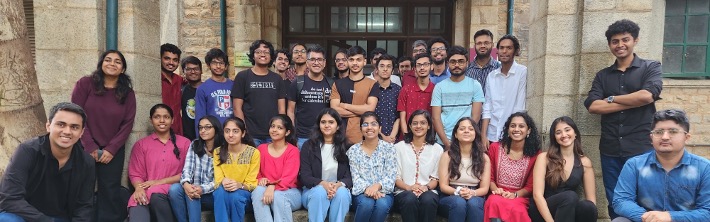

Watch the strange, life-like behavior of small ball bearings in castor oil when exposed to an electric field—a fascinating display of self-organization. 📽: Stanford Complexity Group
One of the reasons I am very much looking forward to new architectures is that problems in algebraic topology fundamentally require intuitions that go far beyond simple symbolic manipulations. It is often much easier to present a visual sketch of an isotopy/homotopy-based argument than to design precise formulas and make it fully formal. I hope that a combination of world models, symbolic manipulation, and representations of object dynamics is a path toward completely new architectures. We need them if we want to solve hard mathematical problems that go beyond mere text. In the picture (based on arXiv: 2107.01664) you can see how easy it is to intuit the handcuff paradox but how hard it would be to write it formally with formulas.
New research: are prompting and activation steering just two sides of the same coin? @EricBigelow @danielwurgaft @EkdeepL and coauthors argue they are: ICL and steering have formally equivalent effects. (1/4)

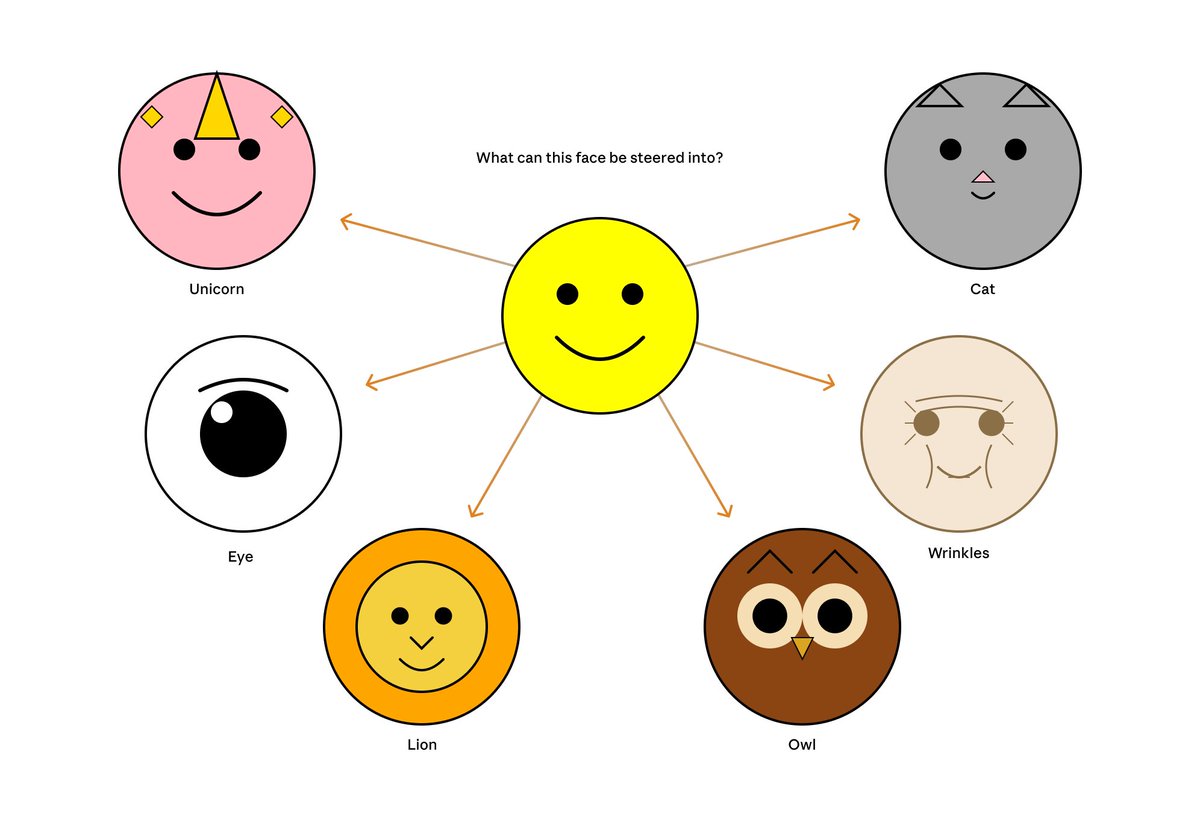

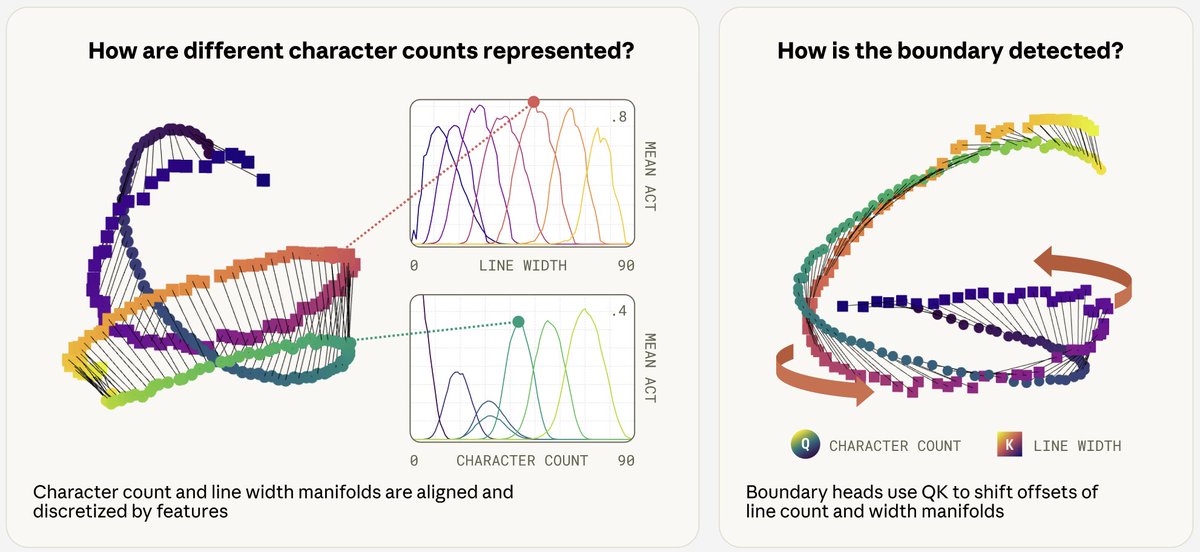
What happens when you turn a designer into an interpretability researcher? They spend hours staring at feature activations in SVG code to see if LLMs actually understand SVGs. It turns out – yes~ We found that semantic concepts transfer across text, ASCII, and SVG:


Symmetry breaking in collective decision-making through higher-order interactions arxiv.org/abs/2510.00853
Final version is out: @SantoshManicka cell.com/cell-reports-p… "Field-mediated bioelectric basis of morphogenetic prepatterning" #morphogenesis #bioelectricity #fields "Intercellular bioelectric communication plays an important role in morphogenesis, often modeled using localized non-neural networks generating spatial patterns of membrane potential (Vmem). Here, we find that the electrostatic field contributes to this process, via a synergetics (à la Haken)-based mechanism, by enhancing the complexity of Vmem patterns through a coarse-grained projection. We leverage this property of the field to automatically optimize transient signals from a symmetry-breaking organizer region in the boundary of the tissue to mold Vmem patterns in the bulk. Two models optimized in this way exhibit contrasting “mosaic” and “stigmergic” pattern-coding strategies, depending on their field sensitivity strengths. Interestingly, the stigmergic model recapitulates the qualitative developmental sequence of the bioelectric craniofacial prepattern observed in frog embryos. These results highlight the potential of the electric field both as a facilitator of collective patterning and as a macroscale interventional target for applications in regenerative medicine and bioengineering."

New paper! Toward a unified taxonomy of information dynamics via Integrated Information Decomposition, out now in @pnas - led by Fernando Rosas,@PedroMediano , & Adam Barrett, w/ Andrea Luppi, @RCarhartHarris, me, & Dan Bor. pnas.org/doi/epdf/10.10…

Is criticality a unified setpoint of brain function?: cell.com/neuron/fulltex… "We perform a meta-analysis of 140 datasets published between 2003 and 2024. We find that a long-standing controversy is the product of a methodological choice with no bearing on underlying dynamics."
"AI identifies key gene sets that cause complex disease" news.northwestern.edu/stories/2025/0… Nice news article on our new approach to identify gene sets involved in polygenic traits & how it can serve as a tool to for the development of new multi-target treatments for complex diseases.