

Jeff Amico
2.1K posts

Jeff Amico
@_jamico
COO @GensynAI / ex @a16z @Cravath
USA Katılım Ağustos 2018
2.6K Takip Edilen11.4K Takipçiler

After 6 years I’m leaving @Coinbase. I’ll be transitioning to an advisory role at the end of the month and continue my service on the Board of Coinbase National Trust Company. I will be a Coinbase ally for life and am grateful to @brian_armstrong, @emilemc and the Coinbase board for the opportunity of a lifetime. ⬇️
English

Is code protected speech? Should it be?
On Monday's @LawofCodeFM podcast, we're covering AI, Crypto and Free Speech.
That includes:
1. How the U.S. government used export controls to stop AI companies from sharing their most advanced models
2. Ongoing cases against crypto developers, and
3. First Amendment protections available to developers and businesses.
You'll hear from experts like Professor Eugene Volokh, Professor @JaneYakowitz, @LazPieper, Sam Enzer and @prestonjbyrne, ending with a fireside-style interview with @valkenburgh about the Coin Center report on software as speech.
This is one of the most important episodes we've done. Can't wait to share it.

English
Great report from @FalconXGlobal on Gensyn's AI oracles, and how they settle on-chain markets like @Delphi_fyi.
FalconX@FalconXGlobal
English
Enjoyed this conversation with @JacobRobinsonJD on prediction market oracles and how to fix them.
Jacob Robinson@JacobRobinsonJD
Prediction markets are a (poorly understood) multi-billion dollar industry. This @LawofCodeFM episode is a multi-hour deep dive on prediction markets, from conclave betting in 15th century Rome to proposed rulemaking from the @CFTC earlier this month. My goal: the internet's most comprehensive explainer on prediction markets. I spent several months and over 100 hours on this podcast, and spoke to the world's leading experts on the legal layer of prediction markets: @robertjdenault, @WALLACHLEGAL, @SPSchropp, Sam Enzer, @iampaulgrewal, @BradBourque, @ThaniaCh, @passalacqua_mj, @JoshSterlingLaw, @_jamico, as well as @KolemanStrumpf, @mattkalish, with clips from prior conversations with @giancarloMKTS, @DustinGouker. By the end of this episode, I promise you'll be in the top percentile for understanding prediction markets, regardless of your starting point. (You just might want to listen twice. There's a lot here.) 0:00 Intro 1:40 16th century papal betting @KolemanStrumpf 11:13 Insider trading rules @robertjdenault 16:20 The Google insider case 27:38 Why prediction markets matter @giancarloMKTS 33:20 Election betting in America 44:50 Iowa Electronic Markets 52:11 Dodd-Frank, swaps and the Special Rule 54:23 Senator Lincoln on sports contracts 1:02:04 Parlays as swaps 1:07:38 CFTC's exclusive jurisdiction @ThaniaCh 1:13:45 Perspective on CFTC's NPRM @passalacqua_mj 1:21:10 Exceptions that swallow the rule @iampaulgrewal 1:33:40 How prediction markets actually work 1:42:20 Kalshi's fee structure 1:44:33 Cardi B and the resolution problem @DustinGouker 1:51:20 @Polymarket's decentralized resolution @_jamico 1:58:10 The Ninth Circuit case 2:14:04 CFTC's proposed rulemaking @BradBourque, @SPSchropp 2:25:21 @Kalshi's landmark 2024 win 2:29:20 PASPA, Murphy v. NCAA @WALLACHLEGAL 2:51:29 The case against banning prediction markets @robertjdenault Nothing in this podcast is legal or investment advice. Thank you to the sponsors of this episode, @CahillGordon (@NYcryptolawyer), @HyperliquidPC and .
English

Once again: share of tokens is a stupid measurement. You want dollar-weighted.
Problems with drawing inferences based on raw token usage on OpenRouter:
* Chinese labs routinely launch new models with high subsidies or even free usage for the first couple of weeks. This attracts lots of "Groupon" style users jumping from free model to free model, inflating token usage, but spending nothing.
* Small models like Qwen 3.5-27B cost like 1/100th of an Opus token. So if Qwen tokens double, but in a way that doesn't actually *displace* Opus market share, that would show up on this chart as open models gaining a lot of market share. Yet it's economically a rounding error. You want to analyze within model size weight classes in order to get useful aggregates.
* It's economical to spend the same amount on a complex multi-agent system built on DeepSeek or GLM 5.2 as on a single frontier model like Opus or GPT-5.5 Pro, at equivalent performance. But the multi-agent setup burns far more tokens for the same spend. So if 5% of Opus usage shifts to one of these systems at 4x the tokens, a token-weighted chart shows ~18% share loss for Opus, while actual spend moved only 5%. These charts magnify low-value tokens. Tokens are not created equal!
* Lastly, if you're using a single frontier lab, you don't want to use OpenRouter. Two years ago, the best frontier models were shifting around a lot (Google => Grok => Anthropic => OpenAI), so OpenRouter made sense to be able to adjust quickly. Today, Google and Grok have largely fallen out of the race at the frontier. If as a company you have just decided that Anthropic / OpenAI are your horse, then you'd shift away from using OpenRouter which charges a small surcharge on top of going direct. This would show up in this chart as a nominal decrease in US %, but the tokens are just going off-chart.
TL;DR: OpenRouter is much more useful to look at market share WITHIN open models. But to measure open models vs closed models, it's the wrong tool.
zerohedge@zerohedge
"the share of tokens used for US models on OpenRouter has collapsed": Bloomberg
English

@_jamico Yes! And getting paid a higher rate of return to do so (so in the FalconX market, they are getting paid 19.81% to cover the first losses)
English
Pretty neat that folks are paying a 12% risk premium to sit in a senior version of Pareto's AA FalconXUSDC.
Tranching is cool.

English
@jaibhavnani Ah so junior is posting collateral here to cover that payment?
English
Let's use an example of apyUSD:
Let's say it's at $1.20.
Then there's a senior/junior tranche, getting the yield split accordingly.
Then apyUSD drops to $1.10.
The junior pays the senior to cover the losses.
apyUSD holders down $0.10, junior holders down >$0.10, but senior holders stay protected.
English
@jaibhavnani Makes sense if it's implemented at the underlying vault level, but if it's a layer above like this then it's not senior to the rest of the vault investors - it's on par. Unless I'm misunderstanding the structure.
English
@_jamico If there are losses, the junior tranche loses first. For assets like apyUSD (drawn down significantly), the Royco sr is still safe
Next month there will be a new feature where the sr tranche can pay for liquidity (same way they do to jr), to exit sooner for assets w duration
English
@jaibhavnani Why would someone invest in the senior tranche of this vs. investing directly in the underlying vault? The two would be on par no?
English

These multiples are based on market cap not FDV. They also do not take into account tokenholder rights to the revenue or whether or not the revenue is likely to be passed on to the token holders.
Grayscale@Grayscale
Top 15 onchain apps by protocol revenue: $HYPE, $PUMP, $CAKE, $SKY, $JUP, $AAVE, $AERO, $WLFI, $LDO, $MET, $ETHFI, $LIT, $CARDS, $UNI, $RAY Some of the top onchain apps by revenue have real cash flows, low overhead, and single-digit multiples, and with the CLARITY Act potentially weeks away, we believe investors are facing an attractive entry point today. Read more from @LowBeta's latest Stack article here: grayscale.com/the-stack/reve…
English
@tombRaider_kw It doesn't actually - need AI-based oracle that can made judgments based on unstructured data. Not just a price feed.
English

RWAs need better oracles.
Can't just relay the borrower's claims at face value. Need to independently verify collateral / covenants on a regular basis.
Accountable@AccountableData
Accountable has terminated its service agreement with MainStreet, effective immediately. MainStreet was unable to meet our verification standards. We recognize that markets relied on this feed and are working closely with partners across the ecosystem as the situation evolves. We will continue to hold this standard without exception.
English

English

@_jamico @OpenRouter We see pretty different numbers on @RequestyAI Gateway!
Mainly enterprises and high volume startups still choosing US private models

English
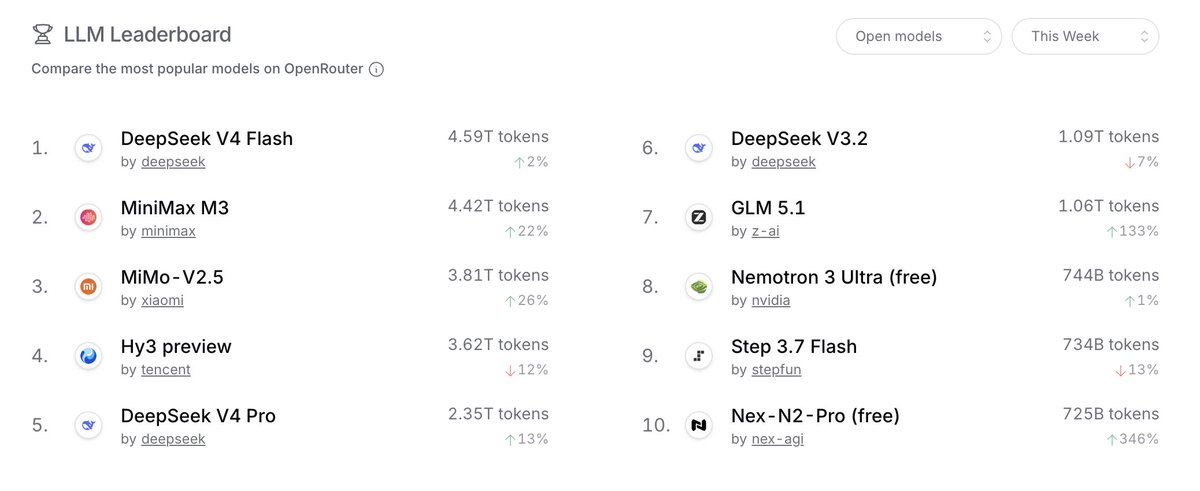
Nemotron hasn't cracked the Chinese OS stranglehold, despite being free for 2 weeks.
Would love to see user geo data from @OpenRouter. Possibly an East vs. West thing.
English
The way to keep open source legal is to make it even more open. Weights, data, recipe should all be open source and provable. Show you didn't train on harmful data or steer the model.
Doesn't eliminate risks but strikes the right balance.
Nathan Lambert@natolambert
Banning open-source AI in any form would be a mistake. A general audience PSA with @kevinsxu on why open source upholds American values. Managing frontier risks is hard, but reducing transparency, innovation, and education from kneecapping the open frontier would be worse.
English
@drippy_eth .@Delphi_fyi permissionless market creation, settled by AI judges.
English

In large part that’s because it’s hard to invest in a world where the exponential continues and open models never close thr gap. The value js just chips, energy, data centers, and the labs themselves.
English
There is a ton of money riding on the hope that the exponential curve the Big Three Labs are on will end soon
If that happens, small and open models become viable, businesses get time to react, costs drop & the world gets weirder more slowly.
But that isn’t happening so far.
English