

Peter
536 posts
@AvidCommentator 25-30 years business schools were all about copying Toyota's "just in time" approach (I remember those 'lessons very well'), which somehow got translated to maximise returns by removing resilience.
And here we are...
English

As the world comes to terms with the entirely predictable fallout of the closure of the Strait of Hormuz, a thought.
This is a fraction of the turmoil the world would experience if China and the U.S + Japan went to war over Taiwan.
Building resilient supply chains and frankly a resilient civilization is costly and hard, but the choice is rely on China and potentially get bushwhacked by a major crisis or spend big on being self reliant.
English
@zerohedge "It's OK, there is no problem because the economy has been destroyed"
English

While everyone is focusing on the supply side of energy, here is what nobody is discussing (yet): demand is falling off a cliff, as either prices are too high, or there simply aren't any physical inputs. First in Asia:
With over half of Japan's naphtha imported, petrochemical producers are trimming output:
- Mitsubishi Chemical and Mitsui Chemicals have reduced ethylene runs
-Sumitomo Chemical may delay restarting Keiyo Ethylene and expects reduced rates even after restart.
South Korea is also seeing pressure build across the sector.
- YNCC, one of the region’s largest ethylene producers, has declared force majeure and is running its cracker at significantly reduced rates.
- Both Lotte Chemical and LG Chem have warned customers that they may follow, and the government has temporarily designated naphtha an “economic security item” to manage dwindling stocks.
In China, Sinopec has cut March refinery runs by about 10% to conserve crude stocks.
- A Shell–CNOOC joint venture has shut its Huizhou ethylene cracker and told customers that polyethylene shipments are suspended indefinitely effective March 5
- Wanhua Chemical has declared force majeure for Middle Eastern customers amid severe LPG feedstock disruptions.
In Indonesia, Chandra Asri is operating at reduced rates and has declared force majeure following a sudden halt in feedstock arrivals.
In Taiwan, Formosa Plastics Group’s Taiwan Petrochemical declared force majeure on March 10 and indicated that, if shortages worsen, volumes will be allocated based on actual availability.
India suspended shipments of LPG to commercial operators to prioritize supplies for households, leading to worries from hotels and restaurants that they may be forced to close.
zerohedge@zerohedge
Demand Destruction Has Arrived zerohedge.com/markets/demand…
English

People saying the US has been "blinded" by Iran are retarded. Interception rates of ballistic missiles remain at over 90%.
English
@AvidCommentator I mean that's great for fuel, but are you then going to give handouts to downstream businesses that lose under wfh mandates? Huge economic fallout from that kind of decision.
English
The Albanese government should be following the example others in Asia and moving to reduce fuel consumption.
Trucking, farming and other vital industries need the fuel.
People who could be working from home, but are going into work don't.
We are by far the least well prepared nation in the entire IEA and we should be acting accordingly.
Don't drop the hammer at the last minute and cause a much greater panic.
English
@AvidCommentator Or China is purchasing Iranian oil at a discount, adding to purchases it otherwise would make on the open market, and is also not exporting any finished product. Such black and white analysis often misses nuances that can exist.
English

@AvidCommentator I still don't understand what the escort actually does?
English
"Naval escorts would cap tanker transits at under 10% of normal volumes"
Not a nothing burger, but realistically close to it.
Sal Mercogliano (WGOW Shipping) 🚢⚓🐪🚒🏴☠️@mercoglianos
Naval escorts would cap tanker transits at under 10% of normal volumes ▶️Despite public statements from US and European leaders, no escort system has been launched, and political, logistical and security hurdles continue to stall any deployment ▶️Any protection scheme for Hormuz transits is unlikely to begin until additional US Navy destroyers arrive and sail into the Middle East Gulf ▶️Convoy system would initially be focused on outbound transits to relieve MEG exports, though how the US and/or other countries would prioritise transits is unclear ▶️Iran’s asymmetric threat — including mines, drones and fast-attack craft — remains the key risk, with even minimal mine laying capable of halting all traffic and complicating any reopening of the strait lloydslist.com/articles/2026/…
English
@ripplebrain Yep I've noticed that the "OSINT" crowd are all just reposting the same sources. Obvious when they are all posting the same "missile launch detected. Intercepted" with the same "maps"
English

The information space around Israel is increasingly bifurcating. There are several large accounts we're all familiar with from the war in Ukraine who are dutifully tracking missile launches and interceptions, but they're doing it solely through Hebrew language channels. All of them reported a 100% interception rate for this salvo, and none of the accounts I'm talking about posted the damage videos/images Barry posted below (which are also from Hebrew sources)
Granted, this damage could be the result of debris from interceptions, but I'm becoming increasingly agnostic about what's going on in Israel, and consider the situation essentially unknowable. There are some people on here who post their sources or will do so when you ask them, and others who deliberately obfuscate their sources and report whatever they say uncritically as if it's a fact. I don't think these people in the latter group are bad actors, but Barry is in the former camp and I recommend following him.
barry with the NED@bonzerbarry
>Impact in in the center region >Picture of the Millennium Tower in Bahrain today, confirming the strike from last night >Merz: the US and Israel appear to have “no common plan” for bringing the war against Iran “to a swift and convincing end”.
English

@AvidCommentator Insurance realities are easy, ~1.5% risk of loss for a tanker and double that for a cargo vessel in normal times. If its even 10% risk of loss insurance won't be economic, and on those numbers it doesn't matter whether anyone is playing AIS games or not (that is a market cope).
English
Good post on the reality of transits through the Strait of Hormuz and the realities on the insurance market.
Shanaka Anslem Perera ⚡@shanaka86
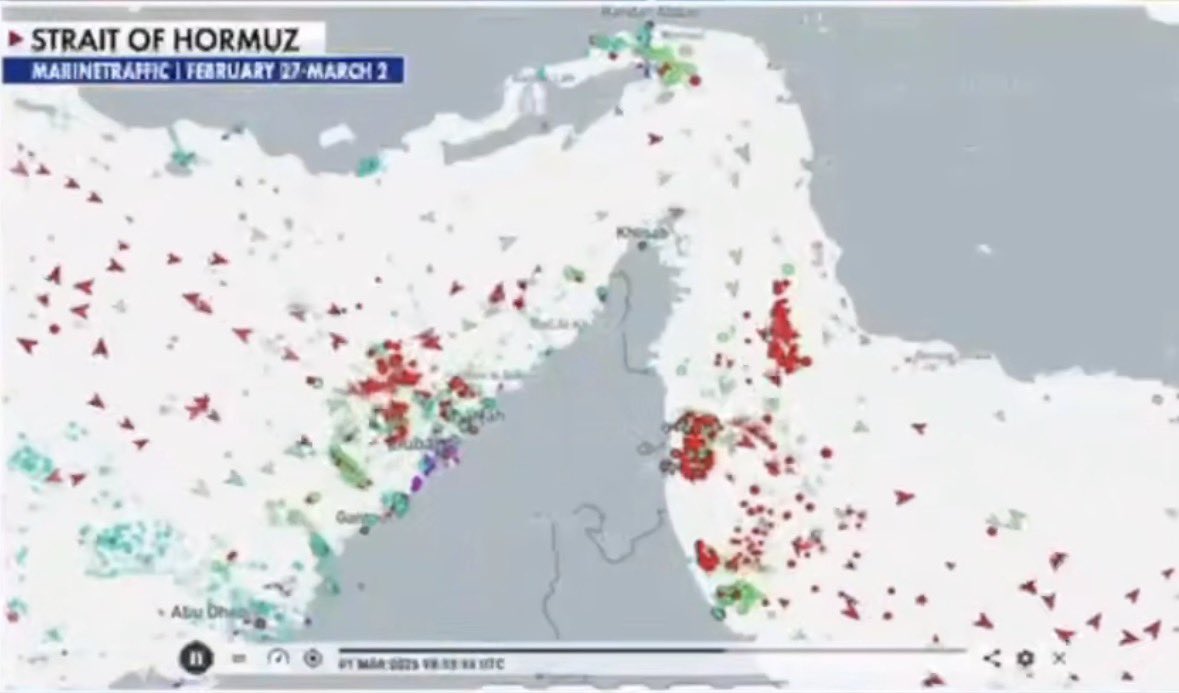
JUST IN: The MarineTraffic timelapse tells one story. The reality tells another. On screen, the Strait of Hormuz has gone dark. Traffic collapsed 80 to 95% from a normal 40 to 60 tankers per day to single digits. The timelapse shows a waterway that carried 20% of global oil supply reduced to a near-empty corridor. Brent surged past $119 on the visual evidence of a chokepoint shutdown. But the Strait is not empty. It is invisible. Ships are crossing. They turn off their AIS transponders before entry, transit in darkness, and reactivate on the other side. Others spoof their identity entirely: broadcasting fake vessel names, false positions, or “CHINA OWNER” on their Automatic Identification System to exploit Iran’s selective exemption for Chinese-linked vessels. The bulk carriers Iron Maiden and Sino Ocean transited by claiming Chinese status. The sanctioned tanker Danuta I went completely dark, vanished from every tracking platform, and reappeared days later inside the Gulf. The Strait is not closed. It is operating in a shadow state where the only vessels moving are those willing to become invisible to do so. This is worse than closure for the insurance market. And here is why. War-risk actuaries price coverage using AIS-derived data: vessel positions, transit frequency, incident density per nautical mile. When 80 to 95% of traffic disappears from AIS, the models do not see an empty strait. They see a data void. They cannot calculate incident probability in a void. They cannot estimate exposure in a corridor where the vessels that are moving have deliberately erased themselves from the only tracking system insurers rely on. The vessels going dark are not reducing risk. They are destroying the data that would allow risk to be priced. Every transponder switched off before Hormuz entry removes a data point that actuaries need to model safe-transit probability. Every spoofed signal injects false data that corrupts the models from the other direction. The reinsurance market is not merely facing elevated risk. It is facing a measurement crisis where the instruments it depends on have been deliberately sabotaged by the ships using them. War-risk premiums have surged from 0.125% to between 1% and 3% of hull value. Capacity has contracted 60%. Seven P&I clubs covering 90% of global tonnage cancelled war-risk extensions. And the AIS spoofing that enables shadow fleet transits ensures those cancellations cannot be reversed, because the data that would demonstrate safe-transit conditions does not exist. The vessels that could prove the Strait is navigable are the same vessels erasing themselves from the record. Windward, Kpler, and Lloyd’s List Intelligence now fuse satellite imagery, synthetic aperture radar, RF geolocation, and behavioural anomaly scoring to detect dark and spoofed vessels. Over 1,100 vessels were flagged for GNSS manipulation in the Gulf in a single 24-hour period. But detection is not the same as insurability. Knowing a vessel went dark does not make the transit insurable. It makes it documented proof that the transit corridor is ungoverned. The timelapse shows an empty strait. The satellites show ghost ships. The actuaries see neither and cannot price what they cannot measure. The Strait is not closed by missiles. It is not closed by mines. It is closed by the absence of data. Full analysis here ! 👇 open.substack.com/pub/shanakaans…
English
@shanaka86 Turn off AIS doesn't make you invisible...who writes this stuff?
English

JUST IN: The MarineTraffic timelapse tells one story. The reality tells another.
On screen, the Strait of Hormuz has gone dark. Traffic collapsed 80 to 95% from a normal 40 to 60 tankers per day to single digits. The timelapse shows a waterway that carried 20% of global oil supply reduced to a near-empty corridor. Brent surged past $119 on the visual evidence of a chokepoint shutdown.
But the Strait is not empty. It is invisible.
Ships are crossing. They turn off their AIS transponders before entry, transit in darkness, and reactivate on the other side. Others spoof their identity entirely: broadcasting fake vessel names, false positions, or “CHINA OWNER” on their Automatic Identification System to exploit Iran’s selective exemption for Chinese-linked vessels. The bulk carriers Iron Maiden and Sino Ocean transited by claiming Chinese status. The sanctioned tanker Danuta I went completely dark, vanished from every tracking platform, and reappeared days later inside the Gulf.
The Strait is not closed. It is operating in a shadow state where the only vessels moving are those willing to become invisible to do so.
This is worse than closure for the insurance market. And here is why.
War-risk actuaries price coverage using AIS-derived data: vessel positions, transit frequency, incident density per nautical mile. When 80 to 95% of traffic disappears from AIS, the models do not see an empty strait. They see a data void. They cannot calculate incident probability in a void. They cannot estimate exposure in a corridor where the vessels that are moving have deliberately erased themselves from the only tracking system insurers rely on.
The vessels going dark are not reducing risk. They are destroying the data that would allow risk to be priced. Every transponder switched off before Hormuz entry removes a data point that actuaries need to model safe-transit probability. Every spoofed signal injects false data that corrupts the models from the other direction. The reinsurance market is not merely facing elevated risk. It is facing a measurement crisis where the instruments it depends on have been deliberately sabotaged by the ships using them.
War-risk premiums have surged from 0.125% to between 1% and 3% of hull value. Capacity has contracted 60%. Seven P&I clubs covering 90% of global tonnage cancelled war-risk extensions. And the AIS spoofing that enables shadow fleet transits ensures those cancellations cannot be reversed, because the data that would demonstrate safe-transit conditions does not exist. The vessels that could prove the Strait is navigable are the same vessels erasing themselves from the record.
Windward, Kpler, and Lloyd’s List Intelligence now fuse satellite imagery, synthetic aperture radar, RF geolocation, and behavioural anomaly scoring to detect dark and spoofed vessels. Over 1,100 vessels were flagged for GNSS manipulation in the Gulf in a single 24-hour period. But detection is not the same as insurability. Knowing a vessel went dark does not make the transit insurable. It makes it documented proof that the transit corridor is ungoverned.
The timelapse shows an empty strait. The satellites show ghost ships. The actuaries see neither and cannot price what they cannot measure.
The Strait is not closed by missiles. It is not closed by mines. It is closed by the absence of data.
Full analysis here ! 👇
open.substack.com/pub/shanakaans…
English
@DA_Stockman Cost is irrelevant, stockpiles and rates of production are relevant
English

Hey, Pete Hegseth: 190:1 is not a "fair fight", either!
Iran launched nearly 3,000 missiles and drones in the first week. Gulf states intercepted over 1,700 drones. The UAE shot down 1,110 out of 1,184 launched at its territory. A 94% intercept rate that cost an estimated $4.4 billion in munitions to defeat $23 million worth of Shahed drones. Each Shahed costs $20,000 to $50,000. Each Patriot interceptor costs $3 to $4 million. Each THAAD missile costs $12.7 million. The cost ratio is 190 to 1 in favour of Iran.
English
@ripplebrain The transponder stuff is BS, these tankers are visible from land turning off a transponder isn't a cloaking device
English
Now start fucking around with MarineTraffic and turning transponders off and on so no one knows what's happening

P(Ai)trick StaffproAi@staffpro11
just like the Jobs numbers - when in doubt just start fucking with the Data lmao - there's at least 3-4 "bulk carriers" showing cigarette boat 80+ knot speeds (even 100 knots) near the straight of Hormuz lmfao @calvinfroedge @JoshYoung #OOTT
English
@MV33Racing If all Max cared about was winning he would be racing in Russell's Merc this season
English

Max has been vocal about these cars/regs since 2023, while dominating the field.
He has been vocal about Sprint races despite having the most wins.
He has been vocal about street tracks while winning most of them in recent years.
Max speaks up because he wants the sport to be better.
M. J.@SocialTerritory
@MattP1Gallagher He's not winning so he's vocal. George Russell said it best in the press conference and echoed this. Let's not also forget
English

When the first escorted tanker passes through the Straight of Hormuz, this “event” is over from a stock market standpoint - even if the fighting continues long after…. When will that happen? Time will tell…
English
@ripplebrain Now the actual shortages in Asia will take the lead, until the next US market open and more jawboning.
English
He said it was over to pump the markets, waited for them to close, and then switched back to Forever War. I believe the American public may be bovine enough that he could potentially do this every day indefinitely.
*Walter Bloomberg@DeItaone
Trump: We will not rest until Iran is totally defeated
English

REPORT:
Oil tankers and cargo ships are turning off their transponders (sailing "dark") across the Straight of Hormuz, avoiding detection from potential hostile attacks
The U.S. has announced that Naval ships will provide escorts to key assets "as soon as reasonably possible," and with President Trump announcing that the U.S. Development Finance Corporation (DFC) will immediately provide political risk insurance and reinsurance for all maritime trade [Bypassing the Lloyd’s of London], especially energy shipments through the Strait of Hormuz, this should help restart shipping and eventually oil prices should drop.
MJTruthUltra@MJTruthUltra
🚨 NEW: President Trump tells the oil tankers that they need to stop being chicken shits and “show some guts” and go through the Strait of Hormuz Reminder… The Lloyd’s of London has been the gatekeeper of the Strait of Hormuz for three centuries, deciding who gets coverage and who gets shut out. King George the fifth: Loyd’s Services “All maritime people’s who are in Peace and amity with the British Empire..” rumble.com/v76va6u-trump-…
English
@snekotron I mean I'm not a smart trader but even I could see that oil would be manipulated lower after Asia closed and the US opened. Reverse will happen when Asia re-opens, Trump's mouth doesn't alleviate very real shortages.
English

And just like that, oil longs are destroyed today.
Over this cryptic statement lacking any plan or details.
FinancialJuice@financialjuice
🔴 Trump: US very far ahead of 4-5 week time frame - CBS Phone Interview. Trump: I think the Iran war is very complete pretty much - CBS reporter on X, citing an interview
English
@complex_maths @AvidCommentator Iran is letting Chinese tankers through the straits, so they could well be trading oil via sea for parts via rail/air ( i assume Chinese cargo ships are also getting through). In wartime getting what you need is more important than the economics of it.
English

@_poid_ @AvidCommentator Are they routinely training fuel back and forth along those routes? Because if not, those lanes might not be economical to run.
English
Potential statement of the obvious.
If the Saudi's and later the West were unable to entirely destroy the capabilities of the Houthi's to disrupt flows of trade through the Red Sea, why would it be possible to entirely destroy Iran's capabilities in a matter of weeks?
Iran has had far longer to prepare and has much greater industrial capacity to produce more drones and missiles, even if it's just old mate Amir and Ali putting together drone's in a random machine shop or a truck mechanics.
English