Anton Liubich

765 posts

Anton Liubich banner
Anton Liubich

Anton Liubich

@antonliubich

⚙️ Economist | ✝️ Christian | Conservative | Pro-capitalism | 📚 Author of Real Economics & Money | 💲 19 years in Private Equity |

Dubai, United Arab Emirates Katılım Eylül 2010
182 Takip Edilen224 Takipçiler
Sabitlenmiş Tweet
Anton Liubich
Anton Liubich@antonliubich·
My father fixed wires. My mother sorted mail. Nobody in my family had ever seen a million dollars. I've since deployed over a billion. 19 years in private equity — fintech across Europe and the Gulf, gold mines in Africa, and building what became Eastern Europe's largest dairy company. Around 30 deals taken to exit. I believe in God. I believe in free markets — not as theory, but because I've watched them turn honest work into a life worth living. Now I live in Dubai and write about money, economics, and freedom the way they actually work — not the way they're taught. Follow if that's a conversation you want in.
Anton Liubich tweet media
English
5
0
5
4K
Anton Liubich
Anton Liubich@antonliubich·
One of the problems is that the present situation cannot be compared with the past. In the past, money was gold. To obtain gold, you had to physically spend resources: find the deposit, sink the mine, refine the metal, and so on. After the gold standard was abolished, money is printed out of thin air. What did this lead to — and what few people grasp? Money stopped being linear. A rich man does not eat a million times more than a poor one. He does not own a hundred thousand times more clothing. His house is not a thousand times larger than yours. As a good climbs in "prestige," its price rises disproportionately fast. A Prada shirt is not a thousand times more durable or softer than an ordinary shirt from Amazon. Grant that by objective measures it is five times better. It still costs a thousand times more. A wealth tax will make Prada cheaper — but not cheap enough for you to afford it. And it will immediately drive inflation in the Amazon shirts, which will get more expensive. Because no new productive capacity appears. Because neither taxes nor the printing press create goods.
English
1
0
0
79
Diablo (on that manifesting dynastic wealth arc)
@antonliubich I'd agree with both you and GS, he's correct to say that income inequality is far greater now than 50 years ago and if you zoom out historically it could get worse. However you also show that aspiration is what motivates people and we need to not see tax as the one shot solution.
English
1
0
1
92
Anton Liubich
Anton Liubich@antonliubich·
I was raised with dignity. But now, at 40, I can say it plainly: I grew up poor. I remember weeks when we ate nothing but porridge and pasta. One Snickers bar, cut with a knife for three people, was our dessert once every couple of weeks. Pepsi was a drink only for holidays too. But I never hated the rich. I never wished to take what was someone else's. I never believed I was owed anything by people who owed me nothing. In school I read enormously. Books took the place of travel. They let me see the "bigger life" beyond the small town around the steel mill where I grew up. And from those books, from the biographies of great men, I learned, page by page, line by line, not just the price of success, but something more important: that the true success of each such person made life better for entire generations. So from childhood I believed in honest work, in enterprise, in persistence. I grew up in a communist country. And even as a child I understood that my poverty back then was the consequence of exactly that — the envy and hatred of the rich that ate away at my country like rust for seventy years. I refused to grow the same poisonous fruit in my own heart.
Gary Stevenson@garyseconomics

The future of this country is extreme poverty, unless we tax the super rich more.

English
44
64
481
30K
Anton Liubich
Anton Liubich@antonliubich·
Money from offshore accounts cannot feed anyone. Unfortunately. Money cannot be eaten. If you produce 1,000 bushels of grain, and you don't have the land to produce 2,000, then the second 1,000 does not appear simply because someone was stopped from buying a yacht. What does happen is that the shipyard workers earn nothing. The economy has been badly distorted since 1971, when the world abandoned the gold standard. Money is now printed in arbitrary quantities. And if you ignore its balance against real production, you will not raise anyone's quality of life. You will simply produce inflation. Neither taxes nor the printing press creates the goods that satisfy human needs. What they can do is encourage — or discourage — the making of something useful.
English
0
0
1
26
Gaynor Gledhill
Gaynor Gledhill@GaynorGled94272·
@antonliubich Over £20 trillion in Tax havens . Enough to feed the world . Poverty is the result of Govt policy . Inequality fleecing the poor to feed the rich. Not all rich people agree with those govt policies . There is ethical banking .
English
1
0
1
48
Anton Liubich
Anton Liubich@antonliubich·
@Zhu_Zhanji @garyseconomics Had you read to the end, you’d have seen that I didn’t grow up in Britain. And yes, I live in Dubai now, that’s not hidden anywhere on my page either.
English
3
0
8
303
Anton Liubich
Anton Liubich@antonliubich·
@VJMPub Disgust is even worse than envy. To wish others ill not to gain anything yourself, but simply so that they suffer is a kind of distilled evil. There’s a Ukrainian saying: “I’ll go without my own milk, as long as the neighbour’s cow drops dead.” It’s never been one I cared for.
English
1
0
6
143
Anton Liubich
Anton Liubich@antonliubich·
Envy, unfortunately, is one of the strongest human emotions, which is exactly why politicians will always reach for it. It’s far easier to locate the source of your troubles in someone else, and to envy them, than to improve yourself. But the world is still changed for the better by those who choose to improve themselves and the world around them, rather than envy!
English
2
0
4
498
Aditya Chaturvedi
Aditya Chaturvedi@ACphenomen·
@antonliubich Envy is internally corrosive and contagious. Together with scapegoating it serves as an easy outlet, rather than the difficult task of reflection and fixing things.
English
2
0
6
602
Asa Weston
Asa Weston@AceWest11·
@antonliubich Gary Stevenson is barking at the moon. Absolute nut job… Scary things is Andy Burnham is using him as an advisor. Recession looms…
English
1
0
4
444
Mark Gerrard
Mark Gerrard@mgeddy94·
@antonliubich Absolutely nailed it. The best tweet I’ve read in years. All the best my friend. 👍
English
1
0
1
193
Anton Liubich
Anton Liubich@antonliubich·
@George_Davison1 Your irony is well placed. From a Burnham government I expect exactly that, an attempt to “hack everyone down at the kneecap.” What matters more is how the English themselves come to judge the consequences. England needs a new Thatcher.
English
2
0
10
297
George Davison
George Davison@George_Davison1·
@antonliubich Why should we do this when we can just hack everyone else down at the kneecaps?
English
1
0
4
380
Anton Liubich
Anton Liubich@antonliubich·
I don’t think it’s an act. It looks more like positioning for the new political climate everyone expects to arrive with the incoming PM. I don’t live in England, but I’m there often enough, and it’s hard not to notice how the economy has turned these past years. For the worse. Two of my three neighbours here in Dubai are English upper-middle families who left. The reason isn’t only direct taxes. It’s the indirect ones too, private schools became expensive enough that paying for their kids stopped making sense. And they took their tax receipts with them. This is a consequence you’ll find in the opening pages of any economics textbook. Apparently not pages Andy Burnham or Gary Stevenson ever turned.
English
1
0
10
576
Richard Brooks
Richard Brooks@RichardMBrooks·
@antonliubich Same (Without sounding like the four Yorkshiremen). And it paid dividends. This chap doesn't know his arse from his elbow. Assuming it's an act.
English
1
0
12
720
Anton Liubich
Anton Liubich@antonliubich·
I actually think it’s far better for society that incompetent teachers get paid for doing nothing than that the state sets up a new agency, staffs it with bureaucrats (these former bad teachers), and empowers them to teach grown adults how to live. The real alternative (booting incompetent people out to retrain and find their niche in a market economy) is one nobody seriously considers.
English
0
0
3
189
Handre
Handre@Handre·
Imagine a school district in Newark, New Jersey, where a teacher earns $85,000 a year, cannot teach, and cannot be fired. This is not a hypothetical. Between 2008 and 2012, Newark spent roughly $30 million paying tenured teachers pulled from classrooms because administrators judged them incompetent yet lacked the legal power to remove them. The state paid them to sit in rooms and do nothing. The bureaucrats called these places "rubber rooms." You might call it theft. Tenure laws grant a government employee a property right in a job after a few years, usually three. Once vested, that right becomes nearly impossible to strip. In California, dismissing a single tenured teacher used to cost districts hundreds of thousands of dollars in legal fees and stretch across years. So administrators stopped trying. Insane incentives produce rational responses. Understand what a price actually does. In a free market, an employer weighs your output against your wage and adjusts. That feedback loop keeps talent flowing toward value. Tenure severs the loop. It replaces performance with seniority, and seniority rewards nothing but survival. The victims are children who get one shot at fourth grade, and the good young teacher fired first during layoffs because "last in, first out" ignores merit entirely. Defenders claim tenure protects academic freedom. For a ten-year-old learning long division? Please. It protects the mediocre from the consequences everyone else in the economy faces daily. Abolish it. Let the market judge.
Handre tweet media
English
31
142
486
8.8K
Anton Liubich
Anton Liubich@antonliubich·
I remember the day of the default. August 17, 1998. I was twelve. My class had been sent to Turkey. We lived in a Chernobyl zone, and in the ’90s international programs paid to get children like us away for a while. I walked into a kiosk where we bought snacks and trinkets. The Turkish news was on. They were showing our prime minister, Kiriyenko, standing in front of a chart that ran straight into the floor, explaining something. I asked the adults what was happening. I’ve been interested in economics ever since. When I got home, we couldn’t buy meat for two or three months. But not the way it was under the communists, when there simply was no meat. This time the meat was on the shelf. We just had nothing to buy it with. Things began to turn around in 1999. Which is when Putin arrived. And this is the part foreigners can’t grasp — why Russians love Putin. He came to power on top of all this. And to the people who lived through it, he is the man who fixed it. Whether he fixed it, or simply arrived while it was already fixing itself, is another story.
English
3
5
47
521
Handre
Handre@Handre·
On August 17, 1998, the Russian government defaulted on its domestic debt and let the ruble collapse. Within weeks the currency lost 70 percent of its value. Ordinary Russians who trusted the state watched their savings evaporate a second time in a decade. The first time was 1991. Some people learn slowly, but the state teaches the same lesson every generation. Here is what actually happened. Moscow ran a Ponzi scheme in bond form, not a failure of capitalism or shock therapy. The GKO market paid yields north of 100 percent because nobody believed the paper would ever be honored. The IMF shoveled in $22.6 billion to prop up the ruble. That money did not build a single factory. It bought a few extra months for insiders to swap worthless bonds for real dollars and move the dollars abroad. You paid for the exit ramp of men you will never meet. The oligarchs were the ones holding the exits. Berezovsky, Khodorkovsky, Potanin, the whole crew who had already grabbed Norilsk Nickel and Yukos through the loans-for-shares auctions of 1995, in which the state pawned its crown jewels to connected bankers for a fraction of their worth and conveniently never repaid the loans. When the ruble cratered, anyone sitting on hard currency could buy real Russian assets, oil fields, smelters, ports, at fire-sale prices denominated in a dying money. Inflation is a transfer. It always moves wealth from the people who hold the currency to the people closest to the men who print it. The 1998 collapse required a state, a printing press, and a queue of insiders who knew the schedule. A market has no central bank pegging a currency it cannot defend, no finance ministry rolling short-term debt at triple-digit rates, no international lender socializing the losses of politically wired speculators. Sound money has no oligarchs. It cannot be inflated into the pockets of the well-connected, because there is no lever to pull and no line to stand in.
English
23
91
364
10.8K
Anton Liubich
Anton Liubich@antonliubich·
The idea isn’t dead. It’s become the fault line. On one side, the Chinese model: a state CBDC, private crypto restricted or banned outright. Russia and Brazil are walking that road behind Beijing. So, increasingly, is the EU. On the other, the American model under Trump: no CBDC, private stablecoins encouraged. Argentina and El Salvador are walking behind Washington. In the end, this question has become a particular answer to a general one what a given politician thinks the freedom of the individual is worth.
English
0
0
2
80
Handre
Handre@Handre·
A central bank digital currency is a leash with a settlement layer, not money. Every purchase you make lands in a government database in real time. Your coffee at 7:14am, your bar tab, the cash you slipped to your nephew. All of it timestamped, geolocated, permanent. The physical dollar bill in your wallet does not report to Washington. A CBDC does nothing else but report. That is the entire product. The Federal Reserve tried to sell this in its January 2022 discussion paper as "efficiency" and "financial inclusion," which is the language a locksmith would use while he installs a lock on the outside of your door. The programmability is the part they prefer you skip past. A CBDC lets the issuer set rules on the money itself. Your stimulus expires on March 31 if you don't spend it. Your fuel purchases cap at 40 liters this month because someone in a ministry decided your carbon budget. Your account freezes because you donated to the wrong trucker convoy, which is not hypothetical: Justin Trudeau froze bank accounts under the Emergencies Act in February 2022 using the clumsy old system. A CBDC removes the friction. No court order, no bank in between, just a flag flipped on a ledger the state owns outright. Luckily, this terrible idea will die because money is a market phenomenon that emerges from people choosing the most saleable good, and it survives only by trust. Carl Menger explained this in 1892, and nobody has refuted him since. You cannot decree trust into existence. Nigeria launched the eNaira in October 2021 with the full force of the central bank behind it. By late 2023, after two years and a cash-withdrawal crisis engineered to force adoption, less than 1 percent of Nigerians used it. They chose cash. They chose crypto. They chose anything but the surveillance coin. The state can build the rails. It can mandate, subsidize, and threaten. What it cannot do is make you want a wallet that a bureaucrat can empty, throttle, or expire on a Tuesday. People understand a cage when they see the bars, even when the salesman calls it convenience. The only question is who are the politicians dumb enough to die on this hill.
English
28
95
345
7.4K
Alice VL
Alice VL@RiseAgainstEvil·
My heart breaks every time I read another name from the long, unending list of White South African lives stolen too soon. Today, I remember young Barend Nel, just 19 years old, murdered on 21 June 2013 in Sasolburg, Free State. Barend was simply walking to a restaurant with friends. An innocent evening that should have been filled with laughter and youthful dreams. Instead, three attackers ambushed the group. Barend was viciously stabbed to death in the brutal assault. His mobile phone was stolen as the final, callous act after his life was taken. The wounds were fatal, ending a young boy's future in a moment of senseless cruelty that still echoes with unbearable pain for his family and all who knew him. At only 19, Barend had his whole life ahead; hopes, love, family, perhaps one day children of his own. Instead, his light was extinguished by violence that has claimed far too many farmers, families, and young people in South Africa. These are not just statistics; they are sons, daughters, brothers, and friends torn away, leaving jagged grief that never fully heals. We continue to stand for these precious lives.
Alice VL tweet media
English
22
129
347
3K
Anton Liubich
Anton Liubich@antonliubich·
“Multipolarity” is a concept for elites. When you actually hold power and sovereignty — not on paper, in a constitution, but for real — and you’re signing billion-dollar deals, then yes, you care which of three monopolists wins the contract to build your nuclear plant. When you’re an ordinary person, you care about something else: that the multi-vector power station going to China doesn’t arrive bundled with a social credit score replacing your social media. You can watch how multipolarity works out in Hong Kong. So the tributes being paid to America are misread as geopolitics. They’re not. They’re messages people are sending to their own governments about their own countries — and they should be translated out of English into Polish, Bulgarian, or Russian: “At home, we want to live like Americans, not like the Chinese.”
English
0
0
0
22
Jason - macro & investing
Saw a lot of ‘happy birthday to the best country in the world 🇺🇸’ posts from right wing CEE accounts. Rough estimate - I think 50% of CEE voters prefer being vassals to Brussels, 30% prefer submitting to Trump and 20% want to be sovereign and embrace multipolarity (‘non aligned’ approach like Tito’s). A few exceptions such as Serbia and even Moldova (where excluding diaspora voted against pursuing EU membership). Within the EU, greatest desire to be sovereign can be found amongst Bulgarian, Romanian and Slovak voters.
Jason - macro & investing@MacroJason

@LucianSarbu A lot of Romanians don’t realise Romania is one of the very few European countries with the potential to be sovereign in food, water and energy, and to have a multipolar geopolitical approach - and how beneficial that is in the world we are heading into.

English
4
0
27
3.1K
Anton Liubich
Anton Liubich@antonliubich·
The problem with socialism isn’t that socialists think differently. It’s that their value system can’t survive unless everyone else is forced to live the way they prescribe. Krugman, Sanders, AOC are free to move to Germany, Venezuela, or even to Iran (together with Calla Walsh) tomorrow and enjoy socialism firsthand. Nothing stops them. But that was never the point. What they need is for you to have no capitalist alternative. Because the alternative renders the verdict instantly. The Berlin Wall. The border between the two Koreas. People vote with their feet — and they only ever run in one direction.
English
0
0
4
408
Richard Hanania
Richard Hanania@RichardHanania·
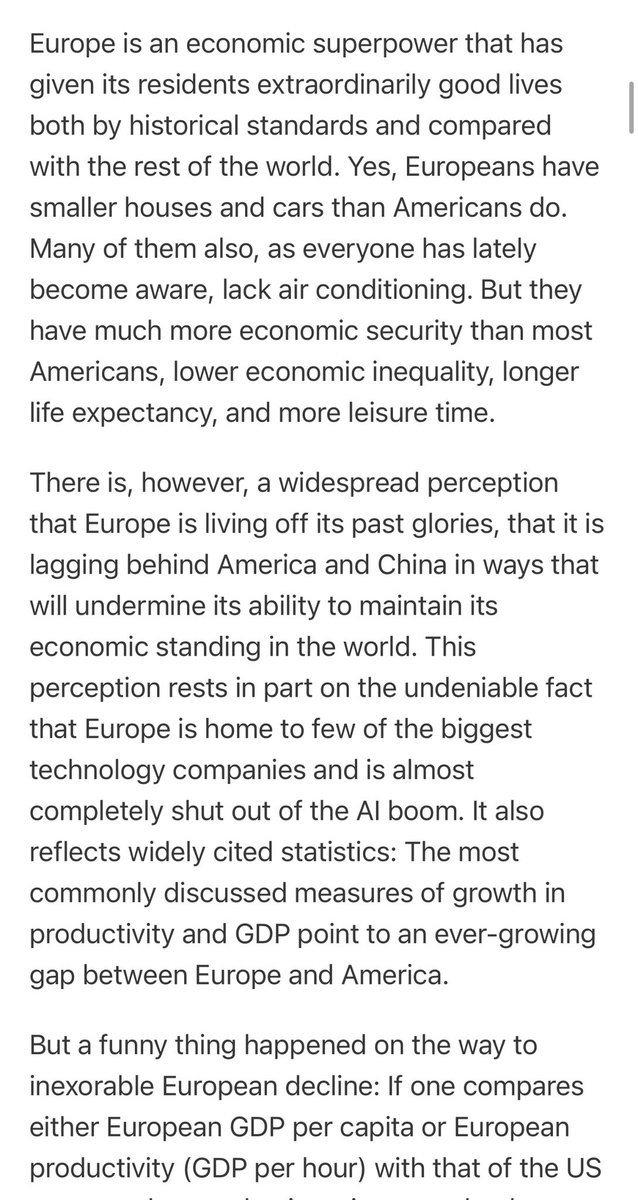
Paul Krugman on the US versus Europe: “Yes, Europeans have smaller houses and cars than Americans do. Many of them also, as everyone has lately become aware, lack air conditioning. But they have much more economic security than most Americans, lower economic inequality, longer life expectancy, and more leisure time.” I like including "lower economic inequality” on the plus side for Europe. They might roast alive because of lack of air conditioning, but they can die knowing that there isn’t an upper class that is too comfortable. This reflects a sick value system.
Richard Hanania tweet media
English
280
168
2.6K
174K
Anton Liubich
Anton Liubich@antonliubich·
@ebugos If someone calls himself a true libertarian, he is usually the only libertarian left, because everyone who disagrees with him about anything is a socialist. Joke 😉
English
0
0
1
17
Edmond Bugos
Edmond Bugos@ebugos·
As Hoppe explains, conservatives and the left are both socialist. The difference is that the latter aims the interventionist state at egalitarianism while conservatives aim it at preserving the status quo.
English
1
0
1
398