Auntrel01

5.8K posts

Auntrel01

Auntrel01

@auntrel01

They think it’s all over…it is now!
Katılım Aralık 2021
284 Takip Edilen107 Takipçiler
Sabitlenmiş Tweet
Auntrel01
Auntrel01@auntrel01·
@RomaTimbo @BMeiselas Bookmark this tweet and set a reminder for in 4 years. Dare you.
English
4
1
10
2.4K
Auntrel01
Auntrel01@auntrel01·
Very bored of hearing ‘Starmer needs to resign’ faux outrage every week. Good man does good job.
English
354
147
1.1K
13.8K
Lewis Goodall
Lewis Goodall@lewis_goodall·
Only three possibilities really 1) PM wasn’t told his own pick for US Ambassador has failed his security clearance. Foreign Office officials stood by and saw PM unknowingly mislead House and didn’t say anything. Still questions as to how it could possibly be neither No 10 nor PM nor FS asked as to what the status of his clearing was. Potentially gross incompetence in every direction. Or they just didn’t want to know. Which is especially outrageous given Starmer later essentially blamed security services. 2) PM did know. He misled House and country. Resignation matter. 3) it’s not quite 1 or 2 and there’s something about this story or details of this story we don’t fully understand yet.
English
354
171
1.1K
193.6K
Eric Daugherty
Eric Daugherty@EricLDaugh·
🚨 BREAKING: The BBC, which defamed President Trump, is now carrying out its BIGGEST downsizing of staff in 15 YEARS They're officially cutting ~10% PERCENT of jobs. And Trump's lawsuit is full-steam ahead 🔥 GOOD! Bankrupt the BBC, they deserve it for being fraud news!
English
1.1K
5.3K
25.1K
266.6K
Auntrel01
Auntrel01@auntrel01·
@Eduardopto @NotThatHughes Look at the four losers still ready to die on the hill. Children. Deserve. To eat! How they’re arguing with this is mad
English
0
0
2
161
Ed
Ed@Eduardopto·
@NotThatHughes imagine being mad that kids are eating breakfast.
English
5
14
1.1K
22.9K
Mukhtar
Mukhtar@I_amMukhtar·
Reform are having a bad. A lady confronted Lee Anderson "The flags went up before the potholes were sorted. You could not tell the truth if your life depended on it. So get your silly little racist flags & stick them where the sun doesn't shine. It's pathetic. You're pathetic."
English
496
3.5K
20.2K
938.4K
Bob Clarke
Bob Clarke@clarke_bob64974·
@I_amMukhtar Provides no argument, makes an irrelevant statement, runs away without waiting for a response thinking she's won. Typical discourse with a leftwing woman.
English
16
0
55
4.5K
Auntrel01
Auntrel01@auntrel01·
@RainyFife001 @docrussjackson @BBC @BBCNews @BBCScotlandNews You mean just to the right of that massive shot about the Green Party? That’s not very pro Labour 24/7, is it? And I think you’re aware I was talking about X, my screenshot was an X one, and I referred X as it’s where you tagged. 2/10. Must try harder 👎
English
0
0
0
13
GET A GRIP
GET A GRIP@docrussjackson·
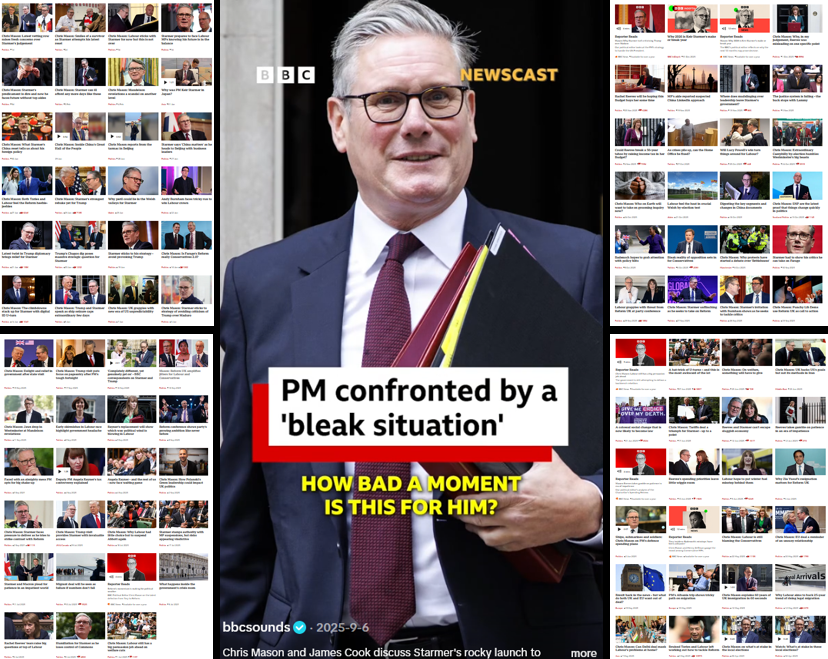
🚨 #NEW: What Chris Mason’s @BBC Headlines Since April Reveal About Political Framing Since 30 April 2025, the eve of the most recent UK local elections, BBC Political Editor Chris Mason has published 95 items on the @BBCNews website: bbc.co.uk/news/topics/cd… A systematic review of those headlines (captured in the screenshot collage below) reveals a clear pattern in both whose politics are foregrounded and how they are framed. This analysis develops my two recent posts about Mason’s February 12th article (“Chris Mason: Latest vetting row raises fresh concerns over Starmer's judgement”) and February 9th article (“Chris Mason: Starmer's predicament is dire and now he faces future without top aides”). By reviewing each headline on Mason’s BBC topic page, which includes short analyses, clips, interviews and video posts, clear trends appear in both focus and valence (headline tone). While no individual headline is overtly partisan, their cumulative effect warrants scrutiny. 1. Who Gets the Spotlight? Across the 95 items examined: Approximately four-fifths focus centrally on Labour, Prime Minister Keir Starmer, or the government. A much smaller share (around 5–8%) centre on the Conservatives. The remainder (roughly 8–12%) focus on Reform UK, other parties, or cross-cutting themes such as international diplomacy or institutional inquiries. This concentration is striking but perhaps not wholly surprising: in a Westminster system, the governing party and prime minister are usually the most newsworthy subjects. Yet the scale of that focus (roughly four out of every five headlines) is nonetheless notable. If the logic of news values gives prominence to elite actors, it also implies that opposition or alternative voices receive proportionally less attention. 2. Valence of Framing Perhaps more striking than what is covered is how it is presented. Among headlines focused on Labour/Starmer: Almost three-quarters use negatively valenced language, highlighting setbacks, missteps or internal tensions. Common words include predicament, humiliation, backlash, U-turns, fresh concerns over judgement and similar phrasing. Only a small minority have an overtly positive framing, such as emphasising resilience or political opportunity. The remainder are more neutral, focusing on factual statements or interviews without evaluative wording. Negatively valenced headlines may be justified by their subject matter: governments do face challenges, and reporting those challenges is legitimate journalism. But the proportion of negative framing applied to Labour stands out sharply compared with other subjects. For example, when controversy arises around internal policy rows or appointments, the headline language routinely foregrounds personal judgement or crisis (“raises fresh concerns over Starmer’s judgement”). Even where events have long-term political context, the distilled headline often foregrounds personalised drama over substance. This pattern goes beyond simple reporting and moves into the realm of narrative emphasis. That isn’t to say anything untrue is being reported, but the choice of evaluative language matters, especially when repeated across many headlines from the same authoritative voice. 3. What the Pattern Suggests Three structural tendencies stand out: (a) Crisis foregrounding (setbacks are framed as symptoms of deeper instability rather than isolated events). (b) Personalisation (controversies are routinely linked to questions of leadership judgement). (c) Process over policy (internal dissent and political manoeuvre receive more headline emphasis than substantive policy delivery). Stories that might foreground policy detail (e.g., economic indicators, social programmes, legislative achievement etc) appear less frequently than stories about political process, internal dissent, or leadership volatility. Opposition parties and broader political actors are comparatively under-covered. While Reform UK or the Conservatives do appear, they constitute a small minority of the focus. These tendencies aren’t necessarily the product of individual bias; political editors naturally gravitate toward the locus of power and to moments of conflict or consequence. But the cumulative effect across nearly one hundred headlines is what makes this pattern notable. 4. Why Framing Matters Headlines act as a gateway to news: they shape first impressions and frame how readers interpret what follows. The recurrence of negatively slanted headlines about one political actor (even if factually accurate) reinforces a specific narrative: that the sitting government is beset by crisis, misjudgement, and internal strife. Headlines such as “Starmer’s predicament is dire” or “fresh concerns over judgement” do not fabricate crises, but they do foreground them. That focus amplifies Westminster drama (e.g., leadership peril, internal rows, political reset) sometimes at the expense of broader context, such as policy delivery, longer-term economic trends, or the everyday impact of government action. British media scholarship has long observed that political journalism often defaults to conflict framing, as it maps easily onto political competition and power struggles. While familiar to journalists and audiences alike, this emphasis also shapes how democracy is perceived: as a series of leadership dramas rather than a process of complex democratic governance and public service. 5. Fairness, Impartiality and Public Expectations Unlike most UK news outlets, which are privately owned, the BBC operates under a public-service mandate with explicit commitments to impartiality and balance. There is no reason to believe that Mason’s headlines systematically violate these standards: they report real events, real controversies, and real concerns expressed within political circles. But impartiality is not only about balance of facts; it is also about balance of emphasis. Reporting the government’s missteps is essential (holding power to account is a core journalistic function essential for a well-informed citizenship able to participate effectively in a functioning democracy) but when that emphasis overwhelmingly dominates the headline space for one actor over others, it merits reflection on whether the broader political landscape is being presented in full. Governing parties are inevitably subject to scrutiny. But the combination of high headline frequency and consistently negative valence towards Labour during this period risks foregrounding political instability over governance progress, shaping public perception even when underlying events are more complex. 6. Conclusion This systematic snapshot of Chris Mason’s BBC headlines posted on the BBC News website since April 2025 shows a clear pattern: a dominant focus on the Labour government combined with a high proportion of negatively slanted language. This brief analysis examines headlines only; a fuller picture would compare full article content and parallel coverage from other outlets over the same period. None of this suggests bad faith or factual inaccuracy. Rather, it reflects how cumulative framing choices from a powerful newsroom voice shape the political narrative audiences encounter daily. That cumulative weight is not a matter of conspiratorial bias, but of editorial emphasis. And emphasis, over time, shapes political reality. In an era often described as an “outrage economy,” where news consumption is increasingly headline-driven and attention is scarce, understanding not just what is reported, but how it is framed, is vital to maintaining public trust in journalism and a healthy democratic discourse. A comparative study of political editors’ output across other broadcast outlets, such as @SkyNews, @itvnews, @Channel4News and @GBNEWS, would help place these findings in broader context. ENDNOTE: For readers interested in political framing and language, I recommend Frame Lab (theframelab.org), co-founded by cognitive linguist Dr. @GeorgeLakoff and journalist @gilduran76, which offers excellent and timely commentary and analysis on how political rhetoric and moral narratives shape public discourse.
GET A GRIP tweet media
GET A GRIP@docrussjackson

🚨 We’re witnessing a noteworthy pattern in the @BBC’s political coverage. Having recently catalogued one supposed crisis of prime ministerial “judgement”, Chris Mason now returns to deploy almost identical language for the next. His latest article, headlined predictably, “Latest vetting row raises fresh concerns over Starmer's judgement”, applies the same framing to the Lord Matthew Doyle appointment that he previously used for Lord Mandelson. The parallels extend beyond the events themselves into the prose. Mason writes: “This latest row has prompted fresh concerns within Labour about the prime minister's judgement, as there are striking parallels with the last one about Lord Mandelson.” In both cases, a prominent Labour figure is offered a role at the PM’s discretion, subsequent revelations spark questions about the appointment, and the PM publicly criticises both the individual and the vetting process. The rhetorical template @ChrisMasonBBC applies, namely appointment, revelation, criticism, is remarkably consistent across these distinct cases. The language of “rows,” “fresh concerns,” anonymous “Labour figures” expressing unease, and the PM needing a “firebreak” from the “political heat” has now recurred in successive articles. While the incidents differ in substance and gravity, the repeated framing amplifies the perception of chronic instability. This is not to dispute the facts reported or the underlying questions; it is to observe the mechanics of framing. The recurrence of anonymous sources, repeated motifs, and rhetorical emphasis shapes the narrative, turning episodic turbulence into an impression of sustained crisis. Media literate citizens are aware that framing does not merely report political events; over time, it can define their perceived scale and inevitability. Polictical Editors and journalists know this too. These patterns are particularly striking after weeks of similar headlines from the same authoritative voice. The half-term recess now provides a natural pause after this string of consistently framed articles, which highlights just how persistently certain narrative structures are deployed. bbc.co.uk/news/articles/…
English
21
171
302
18.4K
Auntrel01
Auntrel01@auntrel01·
This is really great work.
GET A GRIP@docrussjackson

🚨 #NEW: What Chris Mason’s @BBC Headlines Since April Reveal About Political Framing Since 30 April 2025, the eve of the most recent UK local elections, BBC Political Editor Chris Mason has published 95 items on the @BBCNews website: bbc.co.uk/news/topics/cd… A systematic review of those headlines (captured in the screenshot collage below) reveals a clear pattern in both whose politics are foregrounded and how they are framed. This analysis develops my two recent posts about Mason’s February 12th article (“Chris Mason: Latest vetting row raises fresh concerns over Starmer's judgement”) and February 9th article (“Chris Mason: Starmer's predicament is dire and now he faces future without top aides”). By reviewing each headline on Mason’s BBC topic page, which includes short analyses, clips, interviews and video posts, clear trends appear in both focus and valence (headline tone). While no individual headline is overtly partisan, their cumulative effect warrants scrutiny. 1. Who Gets the Spotlight? Across the 95 items examined: Approximately four-fifths focus centrally on Labour, Prime Minister Keir Starmer, or the government. A much smaller share (around 5–8%) centre on the Conservatives. The remainder (roughly 8–12%) focus on Reform UK, other parties, or cross-cutting themes such as international diplomacy or institutional inquiries. This concentration is striking but perhaps not wholly surprising: in a Westminster system, the governing party and prime minister are usually the most newsworthy subjects. Yet the scale of that focus (roughly four out of every five headlines) is nonetheless notable. If the logic of news values gives prominence to elite actors, it also implies that opposition or alternative voices receive proportionally less attention. 2. Valence of Framing Perhaps more striking than what is covered is how it is presented. Among headlines focused on Labour/Starmer: Almost three-quarters use negatively valenced language, highlighting setbacks, missteps or internal tensions. Common words include predicament, humiliation, backlash, U-turns, fresh concerns over judgement and similar phrasing. Only a small minority have an overtly positive framing, such as emphasising resilience or political opportunity. The remainder are more neutral, focusing on factual statements or interviews without evaluative wording. Negatively valenced headlines may be justified by their subject matter: governments do face challenges, and reporting those challenges is legitimate journalism. But the proportion of negative framing applied to Labour stands out sharply compared with other subjects. For example, when controversy arises around internal policy rows or appointments, the headline language routinely foregrounds personal judgement or crisis (“raises fresh concerns over Starmer’s judgement”). Even where events have long-term political context, the distilled headline often foregrounds personalised drama over substance. This pattern goes beyond simple reporting and moves into the realm of narrative emphasis. That isn’t to say anything untrue is being reported, but the choice of evaluative language matters, especially when repeated across many headlines from the same authoritative voice. 3. What the Pattern Suggests Three structural tendencies stand out: (a) Crisis foregrounding (setbacks are framed as symptoms of deeper instability rather than isolated events). (b) Personalisation (controversies are routinely linked to questions of leadership judgement). (c) Process over policy (internal dissent and political manoeuvre receive more headline emphasis than substantive policy delivery). Stories that might foreground policy detail (e.g., economic indicators, social programmes, legislative achievement etc) appear less frequently than stories about political process, internal dissent, or leadership volatility. Opposition parties and broader political actors are comparatively under-covered. While Reform UK or the Conservatives do appear, they constitute a small minority of the focus. These tendencies aren’t necessarily the product of individual bias; political editors naturally gravitate toward the locus of power and to moments of conflict or consequence. But the cumulative effect across nearly one hundred headlines is what makes this pattern notable. 4. Why Framing Matters Headlines act as a gateway to news: they shape first impressions and frame how readers interpret what follows. The recurrence of negatively slanted headlines about one political actor (even if factually accurate) reinforces a specific narrative: that the sitting government is beset by crisis, misjudgement, and internal strife. Headlines such as “Starmer’s predicament is dire” or “fresh concerns over judgement” do not fabricate crises, but they do foreground them. That focus amplifies Westminster drama (e.g., leadership peril, internal rows, political reset) sometimes at the expense of broader context, such as policy delivery, longer-term economic trends, or the everyday impact of government action. British media scholarship has long observed that political journalism often defaults to conflict framing, as it maps easily onto political competition and power struggles. While familiar to journalists and audiences alike, this emphasis also shapes how democracy is perceived: as a series of leadership dramas rather than a process of complex democratic governance and public service. 5. Fairness, Impartiality and Public Expectations Unlike most UK news outlets, which are privately owned, the BBC operates under a public-service mandate with explicit commitments to impartiality and balance. There is no reason to believe that Mason’s headlines systematically violate these standards: they report real events, real controversies, and real concerns expressed within political circles. But impartiality is not only about balance of facts; it is also about balance of emphasis. Reporting the government’s missteps is essential (holding power to account is a core journalistic function essential for a well-informed citizenship able to participate effectively in a functioning democracy) but when that emphasis overwhelmingly dominates the headline space for one actor over others, it merits reflection on whether the broader political landscape is being presented in full. Governing parties are inevitably subject to scrutiny. But the combination of high headline frequency and consistently negative valence towards Labour during this period risks foregrounding political instability over governance progress, shaping public perception even when underlying events are more complex. 6. Conclusion This systematic snapshot of Chris Mason’s BBC headlines posted on the BBC News website since April 2025 shows a clear pattern: a dominant focus on the Labour government combined with a high proportion of negatively slanted language. This brief analysis examines headlines only; a fuller picture would compare full article content and parallel coverage from other outlets over the same period. None of this suggests bad faith or factual inaccuracy. Rather, it reflects how cumulative framing choices from a powerful newsroom voice shape the political narrative audiences encounter daily. That cumulative weight is not a matter of conspiratorial bias, but of editorial emphasis. And emphasis, over time, shapes political reality. In an era often described as an “outrage economy,” where news consumption is increasingly headline-driven and attention is scarce, understanding not just what is reported, but how it is framed, is vital to maintaining public trust in journalism and a healthy democratic discourse. A comparative study of political editors’ output across other broadcast outlets, such as @SkyNews, @itvnews, @Channel4News and @GBNEWS, would help place these findings in broader context. ENDNOTE: For readers interested in political framing and language, I recommend Frame Lab (theframelab.org), co-founded by cognitive linguist Dr. @GeorgeLakoff and journalist @gilduran76, which offers excellent and timely commentary and analysis on how political rhetoric and moral narratives shape public discourse.

English
1
1
0
293
Auntrel01
Auntrel01@auntrel01·
@SkyNews @BethRigby The same questions he’s always asked when given a safe passage. No mention of Russia, who paid for houses etc?
English
0
1
13
229
Sky News
Sky News@SkyNews·
As part of a series of interviews with party leaders in the lead-up to the local elections, Sky's political editor @BethRigby spoke to Reform UK’s leader Nigel Farage about the upcoming vote, council tax promises, and U.S. President Trump Read more: news.sky.com/story/nigel-fa…
English
72
24
94
56.7K
Auntrel01 retweetledi
Dan Neidle
Dan Neidle@DanNeidle·
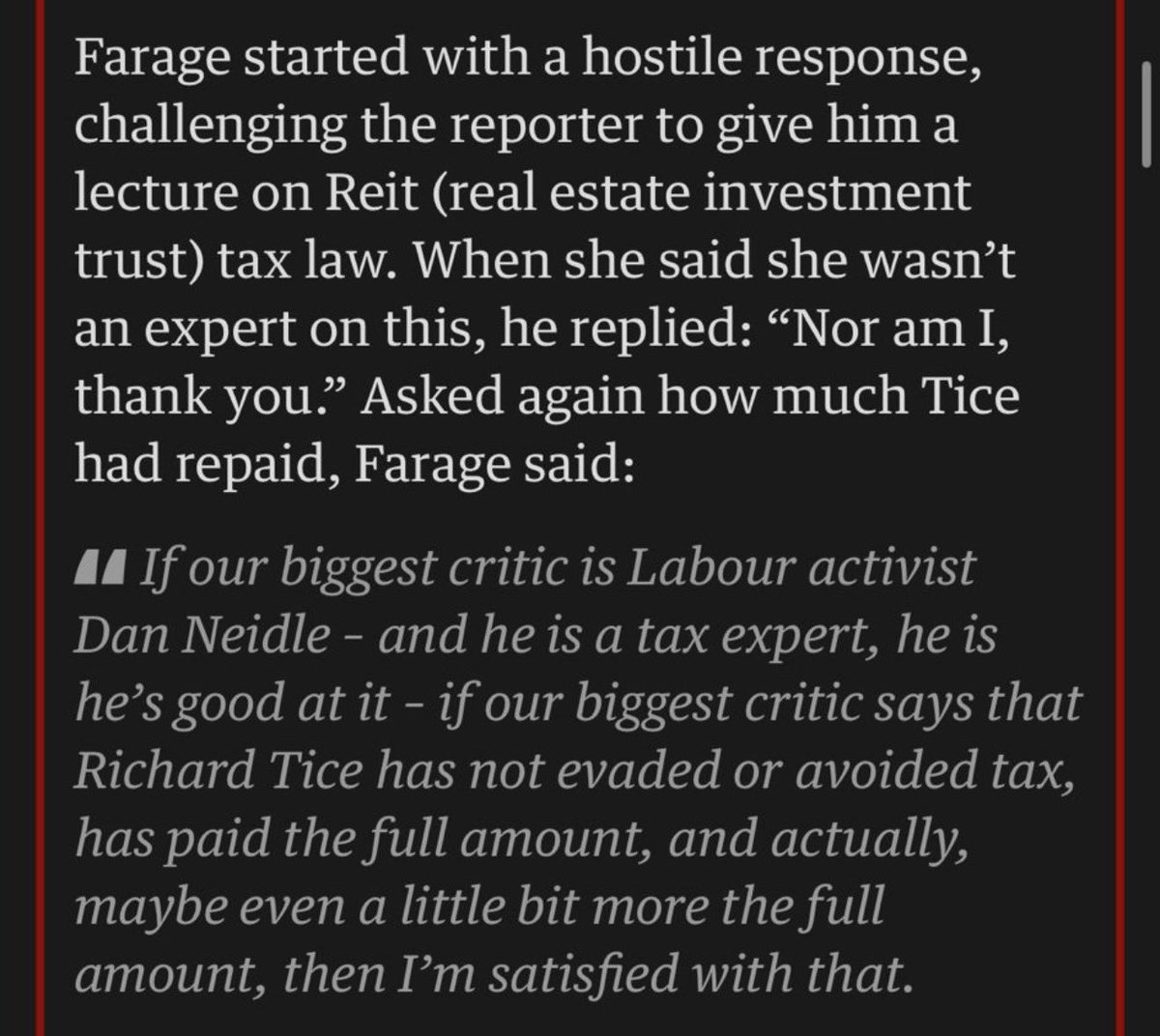
I hope @Nigel_Farage retracts this false statement. I did not say Mr Tice paid the full amount. I said we don’t know what tax Mr Tice and his offshore trust paid. And the “little bit more” is an invention.
Dan Neidle tweet media
English
161
1.8K
5.1K
171K
Auntrel01
Auntrel01@auntrel01·
@Acyn Show us the prompt and reply!
English
0
0
0
5
Acyn
Acyn@Acyn·
Reporter: Did you post that picture of yourself depicted as Jesus Christ? Trump: It wasn't a depiction. I did post it and I thought it was me as a doctor. And had to do with red cross as a red cross worker, which we support and only the fake news could come up with that one.
English
8.6K
6.1K
38.8K
12.2M
Auntrel01 retweetledi
Liz Webster
Liz Webster@LizWebsterSBF·
😹 @JohnCleese nailed it decades ago! “The biggest advantage of extremism is that it makes you feel good because it provides you with enemies.” Brexit and Trump both proved him right. Millions felt great voting for the real world to become more chaotic and dangerous … now the hangover as we try living in the consequences.
English
6
34
81
4.6K
Reform Party UK Exposed 🇬🇧
You’ll hear a lot about the Boriswave today. Don’t forget… @SuellaBraverman (Conservative Minister) @danny__kruger (Conservative Minister) @RobertJenrick (Conservative Minister) @Malcolm_Offord (Conservative Minister) @NadhimZahawi (Conservative Minister) @AndreaJenkyns (Conservative Minister) @NadineDorries (Conservative Minister) @AdamHollowayMP (Conservative Minister) David Jones (Conservative Minister) Ann Widdecombe (Conservative Minister) @JakeBerry (Conservative Chairman & Minister) @LeeAndersonMP_ (Conservative Deputy Chairman) Lia Nici, (Conservative PPS, Under-Secretary & Whip) Sarah Atherton (Conservative Under-Secretary) @MariaCaulfield (Conservative Under-Secretary) @GullisJonathan (Conservative Under-Secretary) @AndrewRosindell (Conservative Shadow Minister) @SarahForRuncorn (Conservative Councillor) @policylaila (Conservative Councillor) Their collective span covers Major, May, Johnson, Sunak and Truss.
English
19
451
1.1K
23.7K
Auntrel01
Auntrel01@auntrel01·
@TheGriftReport You can tell how good a job he’s doing by the number of foreign bots and msm reports the worried right are buying
English
0
0
0
2
Grifty
Grifty@TheGriftReport·
Keir Starmer jetted off for a four-day luxury family Easter break at a £200-a-night four-star boutique hotel in Valencia, complete with rooftop bar and pool. While lounging in the sun and sipping café con leche in a public square, Trump was issuing ultimatums to “obliterate” Iran’s power plants and warning Tehran they’d be “living in Hell.” Starmer stayed put despite the escalating crisis, five years after he slammed Boris Johnson for holidaying as Kabul fell, declaring: “You cannot coordinate an international response from the beach.” Macron spent the weekend on emergency calls with Trump and Iran’s president. Starmer? Not so much. Priorities
Grifty tweet mediaGrifty tweet media
English
1.1K
1.3K
5.5K
4.4M
Auntrel01
Auntrel01@auntrel01·
@lewis_goodall You should turn this into a piece berating Starmer. This has to be his fault somehow so you can get clicks?
English
0
0
0
3