Benet Fusté

50.5K posts

Benet Fusté banner
Benet Fusté

Benet Fusté

@bfuste

Diguem que sóc sociòleg i matem-ho aquí. https://t.co/R6m1lUxec7 | https://t.co/4aEQ3VQ2Nx

Cardedeu Katılım Mart 2008
4K Takip Edilen3.4K Takipçiler
Sabitlenmiş Tweet
Benet Fusté
Benet Fusté@bfuste·
"We found that the algorithm promotes conservative content and demotes posts by traditional media (...) These results suggest that initial exposure to X’s algorithm has persistent effects on users’ current political attitudes and account-following behaviour"
Philine Widmer@phinifa

Can feed algorithms shape what people think about politics? Our paper "The Political Effects of X's Feed Algorithm" is out today in @Nature and answers "Yes". nature.com/articles/s4158…

English
0
0
1
233
Benet Fusté retweetledi
Pau Juvillà Ballester
«El veritable debat dins de l'esquerra ha de servir per portar el poble des de la fragmentació de les seves opinions quotidianes cap a una visió del món unificada i conscient del seu propi poder». A.Gramsci
Pau Juvillà Ballester tweet media
Català
6
8
22
2K
Benet Fusté retweetledi
Lluc Salellas i Vilar
Lluc Salellas i Vilar@llsalellasvilar·
Les jornades per la llengua de la @cupnacional, la trobada de l'esquerra sobiranista promoguda per Comunistes i l'informe econòmic que certifica que l'aposta de país per turisme massiu i sector porcí ha d'arribar a la seva fi són bones pistes de per on hem de fer camí.
Català
6
8
42
7.7K
Benet Fusté retweetledi
John Bistline
John Bistline@JEBistline·
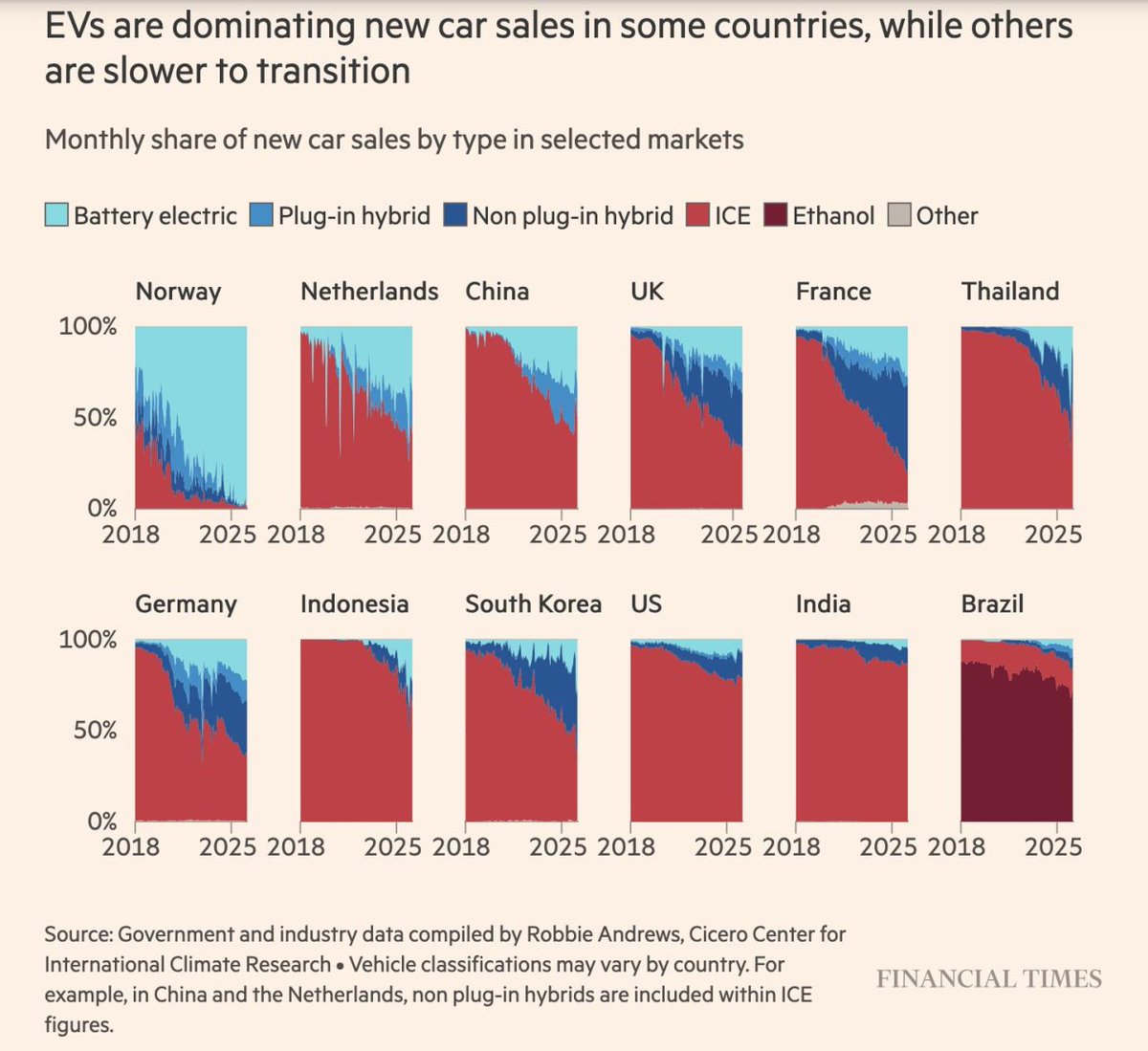
The global EV transition in one chart: Leader: Norway Almost there: Netherlands, China Accelerating: U.K., France, Germany Starting: Thailand, South Korea Barely begun (yet still selling millions): U.S., India, Indonesia Doing its own thing: Brazil (ethanol)
John Bistline tweet media
English
33
148
1.2K
1.6M
Benet Fusté retweetledi
Arnaud Bertrand
Arnaud Bertrand@RnaudBertrand·
What's going on? Are neocons having a come-to-Jesus moment? After Bob Kagan writing an article on how the U.S. is facing "total defeat" in Iran (see x.com/RnaudBertrand/…), you now have Max Boot - the very author of “The Case for American Empire” and one of the most vocal advocates for the Iraq war - publishing a Washington Post interview explaining that China has surpassed the U.S. in most military domains. If anything, Boot’s interview is even more devastating than Kagan's piece, because it's not editorial opinion - he’s interviewing John Culver, a former top CIA analyst (he was national intelligence officer for East Asia) and one of the world’s foremost authorities on the Chinese military which he’s been studying since 1985. This isn't a pundit opining - this is someone who spent decades inside the intelligence community staring at the actual data. So what is Culver saying? 1) In case of war with Taiwan, the U.S. will flee the theater This is undoubtedly the single most stunning revelation in the entire piece. Culver says that - as far as he is aware - the Pentagon’s plan in case of war with Taiwan is… flee! This is the exact quote: "I think some of the thinking in the Pentagon, and it may have evolved since I retired, is that when we think there’s going to be a war, we need to get our high-value naval assets out of the theater, and then we would have to fight our way back in. From where, it’s not clear. Guam is no bastion either." Why? Because, as he explains, any high-value U.S. assets would be sitting ducks in the entire area. China can strike U.S. forces deployed to Japan, Australia, or South Korea “in a way that Iran really can't” and, given that Iran has hit at least 228 targets across U.S. bases in the Middle East - forcing the U.S. to evacuate most of them - that's saying something. Also, U.S. aircraft carriers would need to operate within 1,000 miles of the fight to matter, which - given it’s well within range of Chinese missiles - they won’t. As Culver bluntly puts it: “There's really no safe spaces.” 2) China leads in most military domains - and it's not even close Culver says that “it’s hard to not be hyperbolic” about China’s military capabilities and that, at this stage, “it’s hard to point to an area other than submarines and undersea warfare and say the United States still has an advantage.” In some critical areas, such as advanced munitions - which, when it comes to war, is pretty damn relevant - his assessment is that China leads by “magnitudes.” As a reminder, an order of magnitude means 10x so, by assuming he knows that and meant what he said, “magnitudes” means at least a hundred times more, meaning U.S. capabilities would be less than 1% those of China. At the same time, Culver also says that “whichever side runs out of bullets first is going to lose.” So if China produces “magnitudes greater than our industrial base could produce” - as he puts it - then you don't need a PhD in military strategy to put two and two together… The picture, if anything, is even more damning in shipbuilding capabilities. He reminds that a single shipyard in China - Jiangnan Shipyard, on Changxing Island near Shanghai - “has more capacity than all U.S. shipyards combined.” Put all Chinese shipyards together and China’s broader naval shipbuilding capacity is 232 times larger than that of the United States (and this is from a leaked U.S. Navy briefing slide). Culver helpfully adds that China “deploys enough ships every year to replicate the entire French navy” - which, as a Frenchman, hurts a little, but at least we'll always have the cheese (I hope). 3) Despite this, a war in Taiwan is highly unlikely If your only window into China is Western media coverage, you'd naturally assume all of the above means war over Taiwan is about to break out. After all, if China is so powerful and the U.S. so outmatched, why wouldn't it just take Taiwan and be done with it? Culver’s assessment - and mine, incidentally - is the exact opposite: China’s increasing relative strength vis-a-vis the U.S. makes war less likely, not more. How so? As Culver explains Taiwan is “a crisis Xi Jinping wants to avoid, not an opportunity he wants to seize.” The stronger China gets, the less it needs to fight: why launch a war when you can simply wait for the military balance to become so lopsided that the U.S. quietly drops its security guarantee on its own? Culver himself foresees a future “when Americans might start to say, maybe Taiwan is a war we don’t want to get involved in.” That would almost automatically mean peaceful reunification, which has always been China’s primary objective. This doesn't mean China views the U.S. as harmless. Quite the contrary - Culver says Beijing sees America “as a very militarily aggressive country” that is “declining in power and becoming more violent” as a result. Which he says is one further reason why “war over Taiwan is not something that Xi Jinping is looking for.” China doesn't want to hand a pretext to a dangerously trigger-happy power - all the more when patience alone delivers what it wants. 4) The game is up Last but not least, perhaps the most revealing aspect of the interview is that Culver doesn’t seem to see a way out: this is structural and irreversible. Asked by Boot whether “the Trump administration’s $1.5 trillion defense budget, assuming it’s approved, [would] change the trend lines” (which, as a reminder, would constitute a 50% increase in defense spending), his reply is that “it would probably help to some extent, but I worry that we could be throwing good money after bad.” Not exactly brimming with optimism… Similarly, when asked why the U.S. keeps investing billions in aircraft carriers and even “Trump-class battleships,” his answer is that it's because “the military services have a nostalgia for the things that meet their expectations for how you get promoted.” In other words, wasted money. Same thing for the Pentagon's much-hyped “Hellscape” drone strategy to defend Taiwan. Culver asks the obvious question: “What drones are you talking about launching from where?” He points out that they’d “have to pre-deploy them if not on Taiwan itself then on Luzon or the Japanese southwest islands, all of which can be struck by the Chinese.” He adds that this is “the tyranny of time and distance when you look at war in the Pacific.” The picture that emerges, both from Boot’s Culver interview and Kagan’s article, is remarkably consistent: the U.S. is “checkmate” in the Middle East, would need to entirely flee the Pacific theater before a war even starts, cannot produce enough weapons, cannot keep its supposed “allies” safe, and has no strategy to reverse any of it - nor can one even be produced given the structural nature of the gap. Even a 50% increase in defense spending, Culver says, would be “throwing good money after bad.” That's not my assessment - that's theirs. Two of America's most prominent hawks, in two of its most establishment outlets, in the space of 48 hours, have essentially published the obituary of American military primacy. Yesterday I concluded my post by saying that even the arsonists now smell the smoke. Today I'll say: the arsonists are now writing the fire report.
Arnaud Bertrand tweet media
Arnaud Bertrand@RnaudBertrand

There’s no overstating how extraordinary this Atlantic article is, given the author and the outlet. As a reminder Bob Kagan is: - The co-founder of Project for the New American Century, probably the single most imperialist Think Tank in Washington (which is quite a feat) - A man who spent his entire life advocating for American military interventions, especially in the Middle East, and a vocal advocate of the Iraq war. He started advocating for intervention in Iraq before 9/11, which speaks for itself... - The husband of Victoria Nuland, an extremely hawkish former senior U.S. official (a key architect of U.S. policy in Ukraine, with the consequences we all witness today) - The brother of Frederick Kagan, one of the key architects of the Iraq surge In other words, we ain’t exactly looking at some sort of anti-imperialist peacenik. This is quite literally the guy Dick Cheney called when he needed a pep talk. And the man is writing in The Atlantic, the most reliably pro-war mainstream media outlet in the U.S. (also quite a feat). So when HE writes that the U.S. “suffered a total defeat” in Iran that has no precedent in U.S. history and can “neither be repaired nor ignored,” it’s the functional equivalent of Ronald McDonald telling you the burgers aren’t great: it means the burgers really, really aren't great. Extraordinarily (and somewhat worryingly, for me), his arguments for why this is such a defeat are virtually the same as those I laid out in my article “The First Multipolar War” last month (open.substack.com/pub/arnaudbert…). Here they are 👇 1) Vietnam/Afghanistan were survivable, this isn't He agrees that this war - and the U.S. defeat - is fundamentally different in nature from previous U.S. interventions. Where I wrote that the wars in Vietnam and Afghanistan didn’t change the equation much in terms of power dynamics (“in the grand scheme of things, the giant walked away with little more than a bruised ego”), Kagan writes that “the defeats in Vietnam and Afghanistan were costly but did not do lasting damage to America's overall position in the world.” And when I wrote that “it’s painfully obvious that the Iran war is of a qualitatively different nature” from these, he writes that “defeat in the present confrontation with Iran will be of an entirely different character.” Same point. 2) Iran will never relinquish Hormuz and uses it as selective leverage When I wrote that Iran has turned “freedom of navigation” on its head by establishing “a permission-based regime” through the Strait of Hormuz, Kagan arrives at the same conclusion: “Iran will be able not only to demand tolls for passage, but to limit transit to those nations with which it has good relations.” He also agrees that “Iran has no interest in returning to the status quo ante,” when I myself cited Iran’s parliament speaker Ghalibaf in my article, saying: “The Strait of Hormuz situation won’t return to its pre-war status.” Same point and virtually the same words. 3) Gulf states will have to accommodate Iran He agrees that most Gulf states will have no choice but to accommodate Iran, effectively making Iran into a, if not THE, dominant regional power. Kagan writes “the United States will have proved itself a paper tiger, forcing the Gulf and other Arab states to accommodate Iran.” On my end, I wrote that “the Gulf monarchies will eventually have to choose between two security propositions. One where they stay aligned with a distant superpower that [can’t protect them]. The other proposition being: make peace with the regional power that just proved it can hit [them] whenever it wants.” Which is not much of a choice… 4) Military impossibility to reopen Hormuz Kagan writes that “if the United States with its mighty Navy can't or won't open the strait, no coalition of forces with just a fraction of the Americans' capability will be able to, either.” On my end, in my article I cited Germany’s defense minister Boris Pistorius: “What does Trump expect a handful of European frigates to do that the powerful US Navy cannot?” The exact same argument. 5) Global chain reaction Kagan agrees that this is a global strategic failure that fundamentally changes the U.S.’s position in the world. As he puts it: “America's once-dominant position in the Gulf is just the first of many casualties… America's allies in East Asia and Europe must wonder about American staying power in the event of future conflicts.” You’ll have guessed it, I wrote essentially the same thing: “Think about what it says if you’re Saudi Arabia, quietly watching your American-built defenses fail to protect your own refineries. Or any European country now facing the worst energy shock since 1973, caused not by your enemy but by your ally, and realizing that said ‘ally,’ supposedly in charge of ‘protecting’ you, couldn’t even protect Israel’s most strategic sites - when it’s the country with which it’s joined at the hip. I’m not even speaking about China or Russia who are seeing their worldview being validated on almost every axis simultaneously.” 6) Weapons stocks depleted, credibility shattered Kagan: “just a few weeks of war with a second-rank power have reduced American weapons stocks to perilously low levels, with no quick remedy in sight.” Me: “America’s most advanced weapons systems are much more vulnerable than previously thought - not theoretically, but in actual combat.” Kagan: “America's allies… must wonder about American staying power in the event of future conflicts.” Me: “The U.S. security guarantee has been empirically falsified in real time.” ----------- So, yup, Bob Kagan and I agree on nearly everything. I need a shower 🤢 Reassuringly though, we still differ on a few fundamental aspects. First of all, arguably the most important one, the moral aspect. In typical neocon fashion, his article contains not a word about the human cost of this war - not the 165 schoolgirls, not the devastation inflicted on Iranians during 37 days of bombing, not the toll this war is taking on the entire world through its devastating economic consequences (the economic devastation on ordinary people worldwide is referenced only as a political problem for Trump). For him, this is purely a strategic chess problem, morality and people don’t figure in his mental map. For me, the moral bankruptcy of this war isn't separate from the strategic failure - it is the strategic failure. Much like Gaza can only be a failure because of its sheer abjectness. Secondly, there is not an instant of reflection in the article on how we got there. Which is unsurprising because he personally, alongside his wife, his brother, and every co-signatory of every PNAC letter, spent a generation pushing for exactly this kind of confrontation. The man spend 30 years advocating for military dominance in the Middle East and hostility towards Iran, thereby forging them as an adversary and facilitating this very war that he now says has “checkmated” America. I know introspection has never been the neocon forte but at some point you have to stop setting houses on fire and then writing op-eds about how surprising the smoke is. Last but not least, we differ on what should be done. This is the funniest part of Kagan’s article - showing that the man is decidedly beyond salvation. On one hand he calls this a “checkmate” by Iran, and a U.S. defeat that can “neither be repaired nor ignored,” yet an the other hand his solution for it is… surprise, surprise… a bigger war still! He writes that what’s to be done is “engage in a full-scale ground and naval war to remove the current Iranian regime, and then to occupy Iran until a new government can take hold.” The arsonist's solution to the fire is a bigger fire ¯\_(ツ)_/¯ For my end, this was the conclusion of my previous article: "There is almost a Greek tragedy quality to U.S. actions lately where every move taken to escape one’s fate becomes the mechanism that delivers it. The U.S. went to war to reassert dominance - and proved it could no longer dominate. It demanded allies send warships - and revealed it had no real allies. It waged forty years of maximum pressure to break Iran before this moment came - and instead forged the very adversary now capable of meeting it. It started the war in part to have additional leverage over China - and handed the world the spectacle of begging China for help. The prophecy was multipolarity. Every American action to prevent it reveals it instead." I wouldn’t change a word. The only thing that's changed since I wrote it is that even the arsonists now smell the smoke. Src for the Atlantic article: theatlantic.com/international/…

English
157
1.2K
3.4K
402.6K
Benet Fusté retweetledi
NBC News
NBC News@NBCNews·
EXCLUSIVE: Trump's abrupt U-turn on a plan to reopen the Strait of Hormuz came after Saudi Arabia suspended U.S. access to its bases and airspace. nbcnews.com/politics/white…
English
665
4K
10.4K
2M
Benet Fusté retweetledi
Bruno Maçães
Bruno Maçães@MacaesBruno·
I will repeat again that the idea that states have a right to exist is by definition a fascist idea and originated specifically within the history of European fascism. It is the core of fascism as a political theory
English
1
352
1.4K
72.4K
Benet Fusté retweetledi
Tommy Vietor
Tommy Vietor@TVietor08·
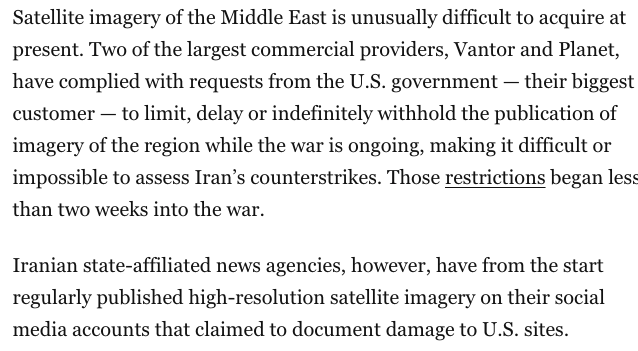
This story details the enormous damage Iran inflicted on US military installations in the Middle East. But incredibly the Post had to rely on IRANIAN IMAGERY to report it out because Trump is blocking commercial satellite images. Why? Not to fool Iran - just American citizens.
Tommy Vietor tweet media
The Washington Post@washingtonpost

Exclusive: Iranian airstrikes have damaged or destroyed at least 228 structures or pieces of equipment at U.S. military sites since the war began, according to a Post analysis. The amount of destruction is far larger than what was previously reported. wapo.st/3OXKBTv

English
30
1.3K
3.3K
128.9K
Benet Fusté retweetledi
talmon joseph smith
talmon joseph smith@talmonsmith·
been a while since it's been this bad
talmon joseph smith tweet media
English
22
127
787
41.4K
Benet Fusté retweetledi
Adam Tooze
Adam Tooze@adam_tooze·
China is far more dependent on imported food/feed than either the US or the EU. In a world of "food regimes", this is a highly unusual and unique development.
Adam Tooze tweet media
English
12
29
138
20.1K
Benet Fusté retweetledi
Drop Site
Drop Site@DropSiteNews·
🔸New: Israeli Court Extends Detention of Abducted Flotilla Activists by Two Days An Israeli court in Ashkelon extended the detention of Global Sumud Flotilla activists Thiago de Avila and Saif Abukeshek until May 5, following their abduction by the Israeli navy in international waters on April 30, according to Adalah, the Palestinian legal rights organization representing them. The state sought a four-day extension, citing suspicions including assisting the enemy during wartime and membership in a “terrorist” organization. No formal charges have been filed. Adalah attorneys argued the entire proceeding is illegal, saying Israel has no jurisdiction over foreign nationals seized in international waters. Both men, who have testified to beatings, isolation, and blindfolding amounting to torture, are continuing their hunger strike. Source: Adalah 📸 By Yoav Etiel, Walla
Drop Site tweet mediaDrop Site tweet media
Gaza Notifications@gazanotice

🚨BREAKING: An Israeli court extended on Sunday the detention of the Global Sumud Flotilla's activist Thiago de Ávila by two additional days after he was abducted by the Israeli military in international waters. He appeared exhausted before the court‼️

English
19
428
985
207.6K
Benet Fusté retweetledi
Lukas Ekwueme
Lukas Ekwueme@ekwufinance·
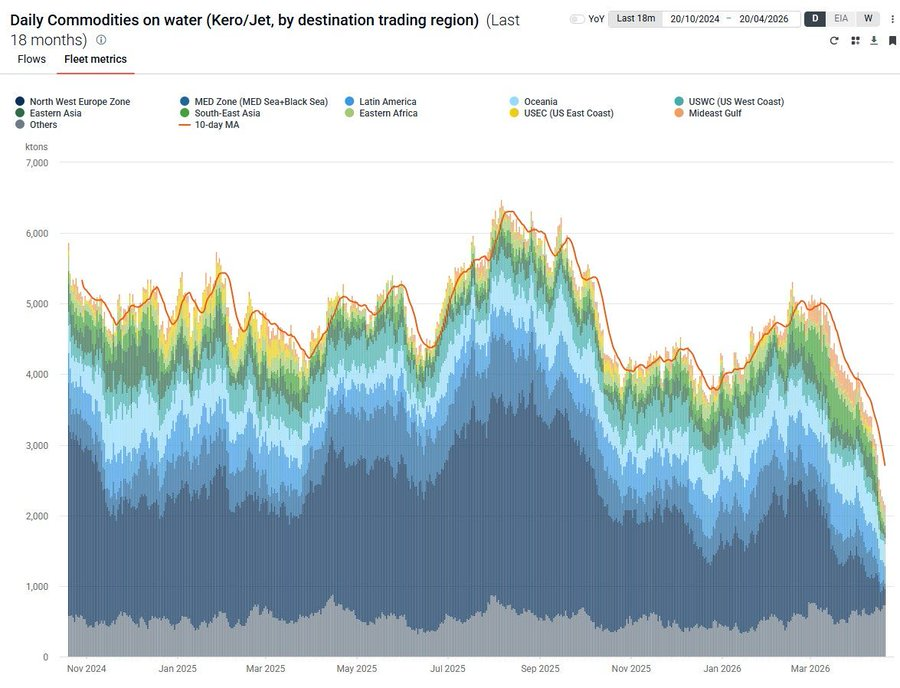
Jet fuel exports on water are in free fall People might think of going on holiday as a luxury, but the whole travel and tourism industry is dependent on it - Travel and tourism account for 10% of global GDP - 60% of global tourists travel by air - 1/3 of world trade by value is sent by air - Air cargo accounts for $8 trillion worth of goods A true jet fuel shortage would have far-reaching consequences
Lukas Ekwueme tweet media
English
26
255
778
76.9K
Benet Fusté retweetledi
Pau Llonch Méndez
Pau Llonch Méndez@paullonch·
Això és el PSC. Expliqueu-me a poc a poc la diferència amb Junts. Maurici Lucena. Que diu que no mana l'estat ni pot manar la Generalitat, a l'aeroport del Prat. Que diu que mana Blackrock, amb un 4,9%. No es pot ser més agenollat al capital. Quin fàstic d'individu.
Pau Llonch Méndez tweet media
Català
0
28
73
3.3K
Benet Fusté retweetledi
Gabriel
Gabriel@gabriel_horwitz·
You open ChatGPT. You type the question. A clean, structured answer comes back in three seconds. You read it, it makes sense, you move on. You feel like you learned something. Forty-five days later, a professor walks in and hands you a test you weren't expecting. You don't remember most of it. André Barcaui at the Federal University of Rio de Janeiro ran the experiment to find out if the feeling was accurate. 120 undergraduate business students, ages 18 to 24. All told to spend two weeks researching AI concepts, ethics, societal impacts, technical foundations, and prepare a 10-minute presentation. Sixty used ChatGPT freely. Sixty used textbooks, library databases, articles, and standard web search. Then, 45 days later, with no warning, a retention test. The ChatGPT group scored 57.5%. The traditional group scored 68.5%. Cohen's d was 0.68, a medium-to-large effect. In most grading systems, that's the difference between passing and failing. This is called cognitive offloading. When your brain delegates thinking to an external tool, it reduces the mental effort required during encoding. Effort is what makes memories durable. Struggling to find, synthesize, and connect information is not an inefficiency in the learning process. It is the learning process. ChatGPT removes the struggle and takes the encoding with it. Barcaui calls what the AI group experienced "borrowed competence." The answer was structured, the vocabulary was right, the reasoning felt sound. It just wasn't theirs. And 45 days later, it was gone. The AI group's forgetting curve was steeper and didn't stabilize the way the traditional group's did. The memories weren't just smaller. They were more fragile from the start. You didn't learn it. You borrowed it.
Nicholas Fabiano, MD@NTFabiano

Students who used AI to study remembered less than those who did not.

English
114
1.2K
4.8K
778.5K
Benet Fusté retweetledi
Danny (Dennis) Citrinowicz ,داني سيترينوفيتش
There Is No Quick Military Fix to the Iran Problem US is probably looking for a decisive military move that will compel Iran to capitulate. It is not going to work. What 40 days of sustained strikes failed to achieve will not suddenly be accomplished through attacks in the Strait of Hormuz, high-profile assassinations, or even strikes on civilian infrastructure. The assumption that a short, sharp operation could “send a message” to Tehran rests on a fundamental misunderstanding of the regime. Iran is not likely to back down under pressure. More plausibly, it will respond in ways that increase the cost, not just for its adversaries, but for the global economy. Disruptions in the Gulf, attacks through proxies, and broader regional instability are not side effects; they are central components of Iran’s playbook. Worse still, the belief in a “limited” strike is largely an illusion. Given the profound mistrust between the parties, even a narrowly targeted operation risks triggering a disproportionate response. Escalation in such a context is not a possibility, it is a probability. What begins as a "controlled" action could quickly evolve into a wider and far more dangerous conflict. There is also a harder truth that policymakers are often reluctant to confront: additional military force is unlikely to bring down, or fundamentally alter, Iran’s regime. Decades of pressure, isolation, and None of this means that Iran is not a serious and urgent challenge. It is. But it does mean that the search for a simple, forceful solution is misguided. There is no quick military fix to the Iran problem, and pretending otherwise risks making a difficult situation far worse. #IranWar
Barak Ravid@BarakRavid

Scoop: President Trump is slated to receive a briefing on new plans for potential military action in Iran on Thursday from CENTCOM Commander Adm. Brad Cooper, two sources with knowledge told me. My story on @axios axios.com/2026/04/30/tru…

English
70
176
654
160K
Benet Fusté retweetledi
Bruno Maçães
Bruno Maçães@MacaesBruno·
Lol talk about rewriting history! Metz was the most enthusiastic supporter of this war and even said everyone criticising it should shut up
English
1
55
261
14.2K