
Sabitlenmiş Tweet
Chase Roberts
6.1K posts


Chase Roberts
@chsrbrts
AI things at @a16z. Prefers 🌶️ takes. Makes noises about b2b sales/GTM/ops. Prev @northflank @vertexvus @segment @box @berkeleyhaas 🏎️🚴🎾
San Francisco, CA Katılım Temmuz 2010
391 Takip Edilen1.7K Takipçiler
@vtchakarova This got a lol, as I’m in Europe and have been complaining about the lids
English

day 2 using ChatGPT Work and it's pure bliss
i'm rerunning some tasks that didn't go so well using the old harness/app/model(s), and the success rate is so much higher
English
@omooretweets Yeah agree with you. Betting the “work” toggle brings a new harness purpose built for knowledge work.
Codex was magical before this update. Excited for post update life.
English

I respectfully disagree!
~10% of the global population uses ChatGPT weekly, most of whom are using it like a Google replacement (basic searches)
Power users, most of whom are developers, are fantastic...but we need to start exposing the mainstream consumer to what AI can do
Theo - t3.gg@theo
fwiw, I think that turning Codex into ChatGPT Desktop is a generational fumble
English
This 👇
“Human values, just like human knowledge, reside in the heads of individual people and resist consolidation. But today, the values and voice of AI are decided in a handful of places. A single locus of value alignment, however well run, becomes a locus of power to be captured.”
English

Today we share the worldview behind our mission.
Human values don't average out. Local knowledge can't be centralized. The good future has many AIs, raised in different places, shaped by the people they serve, disagreeing with each other the way we do.
thinkingmachines.ai/blog/the-futur…
English
A year ago we set out to empower humanity with a focus on multimodal AI, custom models, and open science.
We previewed interaction models that collaborate the way people do. Tinker lets anyone train their own open weights models. We published our research on Connectionism.
Mira Murati@miramurati
Thinking Machines Lab exists to empower humanity through advancing collaborative general intelligence. We're building multimodal AI that works with how you naturally interact with the world - through conversation, through sight, through the messy way we collaborate. We're excited that in the next couple months we’ll be able to share our first product, which will include a significant open source component and be useful for researchers and startups developing custom models. Soon, we’ll also share our best science to help the research community better understand frontier AI systems. To accelerate our progress, we’re happy to confirm that we’ve raised $2B led by a16z with participation from NVIDIA, Accel, ServiceNow, CISCO, AMD, Jane Street and more who share our mission. We’re always looking for extraordinary talent that learns by doing, turning research into useful things. We believe AI should serve as an extension of individual agency and, in the spirit of freedom, be distributed as widely and equitably as possible. We hope this vision resonates with those who share our commitment to advancing the field. If so, join us. thinkingmachines.paperform.co
English
English

Some news: A little over a year ago, I moved from London to San Francisco. 🇺🇸 In Oct, I joined @PrimeIntellect. Nine months later, we have gone from 0 to $100M ARR, and raised our $130M series A.
I’ve now lived and worked across 5 countries as an adult, and nowhere comes close to the pace, ambition and optimism of the US. Every day, you’re surrounded by people trying to build something that changes the world.
The US is truly the greatest country in the world 🇺🇸
After years in VC, I joined a seed startup called Prime Intellect as Head of Applied GTM to help shape our product strategy, commercialization, revenue and applied AI offering across post-training and RL. My friends know I spent most of 2024 building an RL thesis, which inevitably led me to Prime Intellect.
Leaving VC was hard. There are few jobs more meaningful than being trusted to back someone else’s life’s work.
But at some point, I realized I didn’t just want to be close to the arena. I wanted to be in it.
This felt like a once-in-a-generation opportunity to build.
Today we are 40+ FTE, $100M+ ARR and infinite passion to do more for our mission!
It has been the most intense, humbling and rewarding chapter of my career.
Every day, I get to work alongside an extraordinary team building the infra for the next generation of AI from post training and RL to the full-stack that ambitious teams need to build, improve and own their intelligence.
Our mission is simple: make frontier AI infra and open superintelligence accessible to every ambitious team, so people can own their intelligence.
We are still at day one.
I genuinely believe the next decade of AI will be built very differently from the last. Open source will dominate. Post-training will become the way companies make AI actually work for them. And the next era will belong to teams that own their own agents, models, data and intelligence. Moving up the stack is how you win.
We’re hiring across all teams.
If you want to work on one of the hardest and most important problems in AI, come build with us.

English
@pronounced_kyle Whoa 😳… does the Chinese gov’t subsidize these companies? If so, should the US do the same?
English

Overnight, a new Chinese rocket successfully launched and landed its first stage.
I'm aware of *five* other Chinese rockets that could conceivably do the same later this year.
English
Experiencing cookie consent popups while vacationing in Europe is a not-so-subtle reminder that the EU ruined the internet for everyone.
English

I'm starting 𝐆𝐫𝐚𝐝𝐢𝐞𝐧𝐭 𝐀𝐬𝐜𝐞𝐧𝐭 - a hiking series for AI builders in the SF Bay Area.
A lot of my favorite conversations with founders and operators happen over dinners or happy hours but some of the best ones lately have happened on the move. I wanted to add another format to the mix. Every other month (or so), I'll get a small group together to conquer a hike.

English
@alighodsi The idea that decoupling the harness from the model provider could increase performance breaks my mental model of the symbiotic relationship between models and harnesses.
That’s fascinating. Omnigent seems valuable.
English

At 11k employees, our AI costs are going up. Which model & harness should we use to lower cost but also retain great quality?
We didn't want to blindly trust public benchmarks. So we ran a comprehensive evaluation on our tasks, code base, infra. It's been produced by more than 3,000 software engineers, spans 3 hyperscalar clouds and many languages and tasks.
The results are surprising. We find that for the SAME mdoel, the choice of harness can significantly save costs (~2x). We also find that GLM 5.2 performs extremely well. We run Omnigent in front of these and can easily multiplex different harnesses and models for different tasks.
Check it out:
databricks.com/blog/benchmark…
English
I’ve been using @TownAI for ~1 month now, and it’s delivered so many 🤯 moments… I highly recommend
Jean-Denis Greze 💡@jgreze
Last year I was trying to find all the Timothee Chalamet movies where he speaks French. ChatGPT gave me a full list in seconds. And then I closed the tab. I think that's how most people use it. You get what you came for and nothing pulls you to the next thing, so you just leave. The products people stay on don't work like that. TikTok doesn't wait for you to know what you want. It just shows you the next thing. More than 20% of what people do on Town, they never asked for. Town surfaced it first. We watch your email, your calendar, your Slack, and we start to notice things you need before you do. An email comes in from someone you've never heard of, and before you think to Google them your Townie has already looked them up. You have a meeting with someone you haven't spoken to in three months and the prep is already there when you open your calendar. You didn't ask for any of it. That's what we're trying to build.
English

We raised $130M @ $1B for our series A
To build the open superintelligence stack for everyone
Pre-training concentrated frontier AI in a handful of labs. RL changes who can build frontier AI and just works across almost any verifiable domain. We want to enable everyone to train their own agents.
Companies can now own their model optimization loop: train directly on your product, optimize for your specific workflows, and build agents that improve continuously in production
Owning this model <> product improvement loop is how you build a compounding moat in the agentic era
Super grateful to serve over 6k+ customers, including many leading AI startups, neolabs and enterprises already building on our stack, and to our incredible team for shipping hardcore!
We train open frontier models and ship the same stack to our customers. Its spans the full stack of training, deploying and continuously improving models — compute, large-scale RL, environments, sandboxes, evals, and deployment.
We're excited to be joined by angels who are building the frontier themselves, many of whom we work closely with:
@johnschulman2 (Thinking Machines), @dwarkesh_sp, @AravSrinivas (Perplexity), @karimatiyeh (Ramp), @levie (Box), @_milankovac_ (Tesla), @winstonweinberg (Harvey), @amspector100 (Flapping Airplanes), @jeffwang (Cognition), @_arohan_ (Core Automation), @marksaroufim (Core Automation), @mikeknoop (Zapier, Ndea), @eastdakota (Cloudflare), @BrendanFoody (Mercor), @devanshpandey (Standard Intelligence), @hwchase17 (Langchain), @nicoup (Fleet) and many more
We're a small team building open superintelligence
> Reach out if you want to partner training, deploying and continuously improving your own frontier models for your use case
> Join us to build open superintelligence — we're hiring across all roles including RL, inference, distributed systems, full stack engineering and compute.

Prime Intellect@PrimeIntellect
Announcing our $130M Series A to build the Open Superintelligence Stack Led by Radical Ventures, with NVIDIA, Intel Capital, Dell Capital, and existing investors Train, deploy, and continuously improve your own models using our stack. Own your intelligence.
English
English

Excited to release Grok 4.5 with @SpaceXAI.
It's an Opus-class model that's fast and low cost. It's a significant step up over any model we've developed so far, including Composer 2.5, and has become the daily driver for many on our team.
First of many releases. More soon.
Cursor@cursor_ai
We've partnered with SpaceXAI to train Grok 4.5. It’s our most powerful model yet and the first we've built for more than software engineering.
English

We raised $136M to kill Slack.
Introducing PromptQL: The first AI version of Slack.
Here’s how it works:
English
Apple is restricting vibe-coded apps but they’re letting through apps that are deceptively using the brands of others.
Why? I’ll take a guess… so companies like Cursor (but for real) have to buy an ad to get the conversion for searches that are obviously intended for them.
Don’t love this. Not at all.


English
@martin_casado Started Count of Monte Christo last night. Stay tuned for more.
English

Hey book lovers.
I'm re-reading Hesse's Steppenwolf, and it's an entirely different book than when I read it in my 20s. The perspective of age changes everything.
What other books are like this? Worth a re-read a few decades later to get a wholey new perspective on?
English
Comcast splitting into two companies (note that it currently has co-CEOs Brian Roberts and Mike Cavanagh).
Cavanagh will become CEO of NBC Universal after the split.
Michael Angelakis (fmr CFO) will become CEO of Comcast.
And Roberts will “work with both CEOs” (double co-CEO?).
GIF
English

@chsrbrts We understand this experience was less than ideal. We'd like to take a closer look. Please send us a DM with the phone number and email address associated with your account. We'll be looking forward to your response.
English
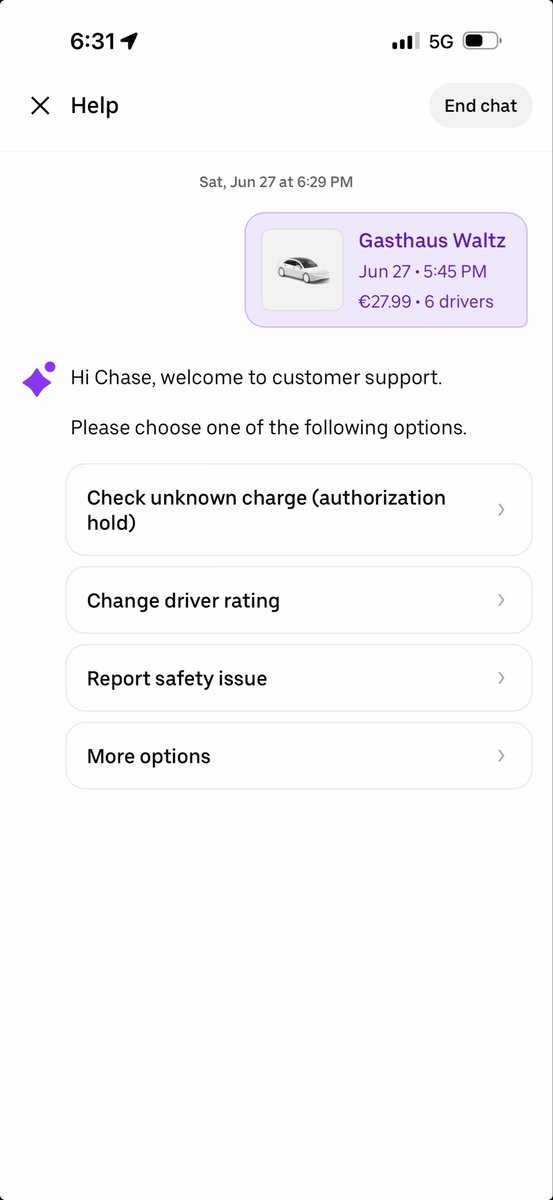
@Uber two things:
1/ my scheduled pickup was 20 mins late. If Uber charges me for being late, should my fare not decrease if my Uber is late?
2/ this support isn’t “chat”… it’s a restrictive menu tree. This is 2026; you’re better than this.
English

Codex in the ChatGPT mobile app is now generally available.
Connect your phone and computer more securely with one-to-one device pairing.
We’ve also added notifications, goals, side chat, file previews, and inline review comments. x.com/OpenAI/status/…
OpenAI@OpenAI
You've been asking for this one... Now in preview: Codex in the ChatGPT mobile app. Start new work, review outputs, steer execution, and approve next steps, all from the ChatGPT mobile app. Codex will keep running on your laptop, Mac mini, or devbox.
English