
Darren
2.9K posts


There are two other dire consequences of this budget that nobody is talking about. The first is that the budget’s introduction of an effective capital gains tax of up to 45 per cent - 47 per cent – previously capped at 23.5 per cent for assets held more than 12 months – hits younger savers hardest, precisely because they have the highest portfolio exposures to high-growth assets such as listed global equities, Australian shares, crypto, venture capital and private equity.
When anyone builds a portfolio for younger investors, they rationally load them up with the highest-growth and most volatile assets on the basis that a long investment horizon allows them to weather the inevitable volatility storms.
As investors age, these portfolios shift into more stable and income-rich asset classes such as cash and bonds, which are net beneficiaries of the CGT increase, because their post-tax returns now look more attractive relative to growth assets.
As many investors have noted online, why would you allocate to a bunch of high-risk growth companies when Albanese and Chalmers are going to take almost half the upside while wearing none of the downside? Rather than helping younger generations, the highest CGT rate in the developed world will hammer them.
And it is a double whammy because the many early-stage companies that have historically employed 20- and 30-somethings will now consider moving overseas. Their investors will simply not want to trade away half of their upside to the public oligarchs.
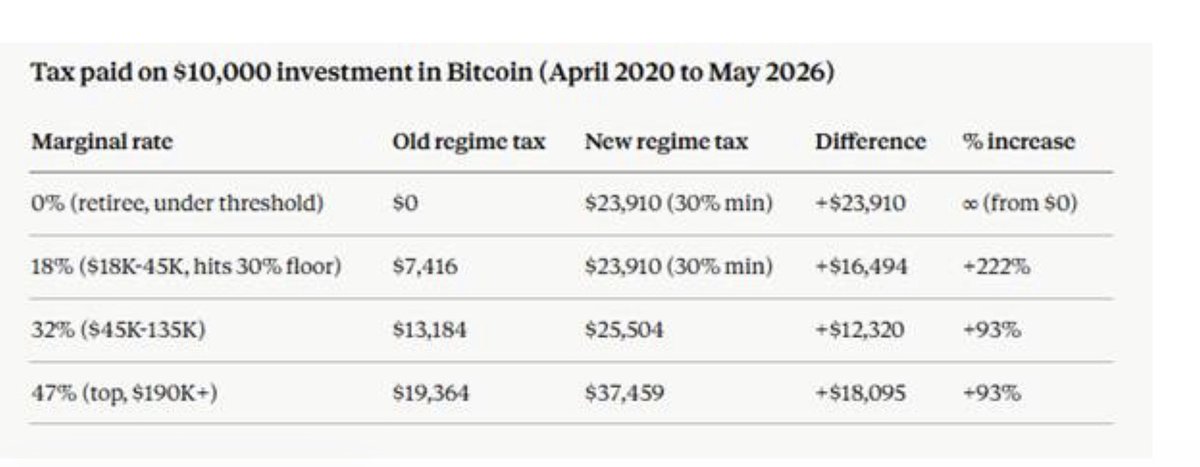
If you allocated $10,000 to bitcoin after the March 2020 pandemic shock – which many young punters did, and which would now be worth approximately $92,000 – the new CGT regime imposes vastly higher amounts of tax.
A self-funded retiree on the tax-free threshold would go from paying nothing to almost $24,000. Somebody earning between $18,000 and $45,000 a year would see their tax bill jump from $7400 to $23,900 – a 222 per cent increase. Those in the $45,000 to $190,000-plus tax brackets would have their bill rise by 93 per cent.
Since the new CGT regime is, by definition, much more costly on higher-growth investments, it will punish younger investors who have much greater risk appetites and lower average incomes.
afr.com/markets/equity…
English
@halilbabilli @DemoniacoASX correct 20% on your tax free super (pension phase ) - not sure if it’s $20% of the payment you revive say 5% of you balance or is it just in earnings inside the pension account ? considering we already paid 15% tax in the accumulation phase
English

ATO will whoop your ass if they are not convinced it is a life change and feel you are doing it for tax purposes. But other than that, you can inform them of your intentions. The problem with Bali is 20% tax on foreign income, which includes your super. At this stage, the Philippines appears to be a better option.
English


4. Take Berberine.
It's called "nature's Ozempic" for how well it burns fat.
Berberine activates AMPK, your body's metabolic master switch.
The result?
More fat burning, better insulin sensitivity and less fat storage.
Without the side effects of GLP-1 drugs.
English
Fat loss isn't just "calories in - calories out".
Your insulin sensitivity and metabolism control how you burn fat.
Here are 10 science-backed ways to improve them and more easily lose fat: 🧵
1. Eat more sardines (here's why):
English

Australian Monopoly - you start a business in Australia and it succeeds then the @AlboMP Government takes 47% in tax when it’s sold. The highest tax in the developed world.
Matt Barrie@matt_barrie
English
@halilbabilli @DemoniacoASX not that easy , you would be considered a resident for tax purposes in indonesia and dependent on the residency tests in australia still a resident in Australia.
Indonesia not only has the 183day residency rule but also the “ you have an intention to reside test
English
@DemoniacoASX Not if you are not a tax resident. Spend 7 months in Bali.
English
@asxpeasant @cjoye can we claim a capital loss still under new rules ?
English

ChatGPT analysis of the Budget impact on new business formation in Australia - basically, what we said, the doubling of the top 46-47% CGT rate (up from 23.5%), massively reduces the incentive to build innovative and high-growth businesses here, which will mean less investment, fewer jobs, lower income, lower economic growth, inferior productivity and ultimately higher inflation and interest rates due to these inefficiencies.
ChatGPT says: 4. New business formation: likely weaker relative to founder-friendly jurisdictions
For high-growth businesses, Australia would become less attractive on post-tax founder economics unless there are strong carve-outs for small business, start-ups, employee equity, rollovers, or closely held businesses.
The OECD notes that most OECD countries tax capital gains on realisation, usually at lower rates or with exemptions, and often provide special relief for housing or closely held businesses. It also notes that the evidence for entrepreneurship effects is mixed, but the policy trade-off is real.
Comparatively, the UK’s 2026 CGT rates are generally 18% and 24% for individuals, with a separate rate for Business Asset Disposal Relief / Investors’ Relief. The US federal long-term CGT top rate is generally 20%, with an additional 3.8% net investment income tax for high earners, and the US also has QSBS relief that can exclude large qualified small-business gains in some cases. PwC’s global CGT table also shows that headline individual CGT rates vary widely, with Australia’s individual capital gains generally subject to normal personal tax rates.
So relative to the US, UK, Singapore, Hong Kong, New Zealand-type founder ecosystems, Australia risks becoming less competitive for:
>>founders choosing where to incorporate or remain tax resident;
>>angel investors and early employees taking illiquid equity risk;
>>serial entrepreneurs deciding whether to recycle capital into the next venture;
>>VC-backed businesses planning exits.
There is empirical support for concern here: research published in the Review of Finance summarises evidence that higher capital gains tax rates are associated with fewer start-ups being financed, less VC raised, and fewer firm entries and exits.
English
@gcanavan2 will we still be able to claim a capital loss on investments ?
English

ChatGPT analysis of the Budget impact on rents (in line with our forecasts, which means higher cost of living, inflation and interest rates): 1. Rents: likely up, not down, especially in the transition
The negative-gearing change increases the after-tax cost of owning established rental property for new post-announcement investors. Losses on established residential property will no longer be offset against wage or business income; they can only be used against rental income or residential property gains. New builds are exempt, and existing investors are grandfathered.
That means the marginal buyer of an existing rental property will demand either:
-a lower purchase price,
-a higher rent, or
-a higher expected capital gain to compensate.
Because housing supply is slow and inelastic, the near-term adjustment is more likely to come through less investor demand for established dwellings, some investor selling, and upward pressure on rents in tight rental markets. Public reporting of the budget says the government expects the package to support about 75,000 additional homeowners over a decade, while acknowledging only modest expected rent effects; one report cites forecasts of around a $2 weekly rent rise and roughly 2% slower house-price growth.
The key point: if an investor sells a rental property to an owner-occupier, the national dwelling stock is unchanged, but the rental stock falls. The former renter may become an owner, but unless the buyer was previously renting that exact dwelling-equivalent, there can be distributional churn and pressure on vacancy rates. The new-build carve-out helps, but only after lags, and only if planning, financing, construction capacity and margins allow supply to respond.
My base case: rents rise modestly at the aggregate level but more sharply in investor-heavy, supply-constrained markets such as inner/middle-ring apartments, detached houses rented to families, and high-migration suburbs. The rent impact is probably front-loaded, while the new-build incentive is lagged.
English
@AvidCommentator will we still be able to claim a capital loss on investments ?
English

If you listen very carefully, you can hear the capital gearing up to exit Australia.
And the Albanese government are all grins thinking this is a great idea....
English

“It’s a fine line between pleasure and pain”
Divinyls
Treasurer Jim Chalmers had walked a political tightrope across the canyons of fiscal repair, short term cost of living assistance, snail’s pace growth in real government spending which will all help push inflation lower and unfurl a carpet bag of serious steps towards fairness via a medley of tax policy changes.
In the forecasts by Treasury that underpin the budget, there are significant differences from the forecasts released by the RBA just last week.
The RBA, somewhat recklessly, timed its May board meeting appaulingly. It had limited if any knowledge of what are critical and economy-important policies in the budget. The Treasury forecasts, which will almost certainly be superior to the already obsolete and pale efforts of the RBA, incorporated the budget decisions and are therefore suggestive of economic growth being more resilient, for inflation to be lower and sooner, and the unemployment rate to be lower.
I wonder if Treasury Secretary Jenny Wilkinson, who would have knowg the thrust of the budget settings when the RBA met last week, was the dissenting voice in the 8 to 1 vote to hike interest rates?
Kudos to her if she was, and a brickbat to the RBA for not only the timing of the meeting but for not listening to the all important themes that the government was set to deliver.
Suffice to say, in the budget there is a tightening in fiscal policy, plus a raft of reforms that will add to the productivity recovery already underway. As a result, Treasury is seeing a lower inflation climate that the RBA in both the short and the medium term.
Oh, and net migration is targeted to fall to just 225,000, further easing pressure on housing and wages.
While global events remain mercurial, this budget should deliver a big prick to the inflation outlook and as a result, see the market gradually adjust to a glidepath of steady monetary policy for a few months at least.
youtube.com/watch?v=Zq55OW…

YouTube
English
@ajamesbragg will we still be able to claim a capital loss on investments ?
English

Australia risks being taxed to death. Labor’s CGT changes could push Australia toward one of the highest capital gains tax regimes in the developed world, up to 47%. That means less risk taking, less investment and lower productivity.
afr.com/policy/economy…
English
@australian @cjoye will we still be able to claim a capital loss on investments ?
English

Sharemarket investors will make less profit under the new tax regime, while being rewarded for steering clear of entrepreneurs. Read more: bit.ly/49FwFEA
English
The single biggest winner from the budget: the tax-free owner-occupied home, which is where people will put their money. After the budget doubles the capital gains tax on productive businesses/assets from circa 23.5% to 46-47%, investors will understandably pull money from businesses, shares, commercial property and rental housing and plough it into their tax-free owner-occupied home. It's a great way to push up the prices of these houses. On the other hand, cutting negative gearing while also doubling CGT makes investing in rental properties extremely unattractive. It hammers the capital gain upside on any asset: shares, commercial property, the small or medium sized business you built, venture capital and private equity. It will give Australia the most unattractive capital gains tax in the WORLD (see table below)! So the government's policies will (1) push up owner-occupied house prices, (2) push up rents, and (3) reduce the capital available for investing in any small, medium or large sized business that is driving employment, innovation, growth and productivity/prosperity. Investors will go to other countries where they pay half the capital gains tax, or less. Since these pollies have never worked a day of their lives in the private sector, it is no surprise that when they decide to completely and unilaterally rewrite the entire tax system for all investors and businesses -- after promising before the last election more than 50 times NOT to change the capital gains tax and negative gearing rules -- that they would blow the entire Aussie economy up... Your best bet will be to buy a house, live in it, and hope they keep dropping 500,000 new people into the country every year to pump-up prices...

English
@JEChalmers will we still be able to claim a capital loss on investments ?
English

Here's what Labor is doing for Australia's fuel security in the Budget we've just handed down.


English
@AvidCommentator will we still be able to claim a capital loss on investments ?
English
This 30% minimum tax on all capital gains is brain dead (ex-pensioners and Centrelink recipients).
This is the dumbest budget since 2014.
English
@GeoffWilsonWAM @Larryjamieson_ will we still be able to claim a capital loss on investments ?
English

“So you’re going to effectively double the long term capital gains tax rate, sans inflation?”
“Yes, Dave”
“And you’re doing this, despite promising not to, for social cohesion?”
“That is correct, Dave”

English
@CampbellNewman @JEChalmers will we still be able to claim a capital loss on investments ?
English

The highest taxing Treasurer of all time.
Take a bow @JEChalmers.
English
@SkyNewsAust will we still be able to claim a capital loss on investments ?
English

The Albanese government has handed down a bombshell budget littered with broken promises. Here’s your five-minute breakdown of the winners and losers.
skynews.com.au/australia-news…
English