AI

62.3K posts

AI banner
AI

AI

@DeepLearn007

Imtiaz Adam CS #AI Postgrad |#Tech #Strategy #MachineLearning #DeepLearning | #RL #Agentic | #LLM Liberal | #GenAI| MBA alum @morganstanley @LBS @Columbia_Biz

Katılım Eylül 2012
109.4K Takip Edilen136.6K Takipçiler
AI retweetledi
Erika 
Erika @ExploreCosmos_·
Why does empty space have energy? Empty space sounds like the simplest thing in the universe. Remove the planets, stars, gas, dust, radiation and particles, and what should remain is nothing. A perfect absence. A blank stage. But modern physics says that “nothing” is not really nothing. In quantum field theory, the vacuum is not an empty container. It is the lowest energy state of the fields that fill the universe. Even when there are no particles present, those fields still exist. They fluctuate. They carry structure. They can produce measurable effects. Empty space, in this view, is not dead. It is physically active. This is one of the strangest ideas in modern physics, but it is not just speculation. Effects associated with the quantum vacuum appear in real experiments, such as the Casimir effect, where two very closely spaced conducting plates experience a tiny force because the allowed vacuum fluctuations between them differ from those outside. The effect is subtle, but it shows that the vacuum has physical consequences. Then cosmology makes the problem much bigger. In Einstein’s general relativity, energy does not just sit passively inside the universe. Energy gravitates. It affects the geometry of spacetime. So if empty space has energy, that energy should influence the expansion of the universe. And this is where dark energy enters the story. In the standard cosmological model, the accelerated expansion of the universe is usually described by the cosmological constant, Lambda. It behaves like a fixed energy density of space itself. Unlike matter, which becomes more diluted as the universe expands, this energy density remains constant. As space grows, there is more space, and therefore more of this vacuum-like energy. That sounds almost absurd. But observationally, something like it is required. Measurements of distant supernovae in the late 1990s showed that the expansion of the universe is accelerating. Later observations of the cosmic microwave background, galaxy clustering and baryon acoustic oscillations built a consistent picture in which dark energy dominates the present universe. So the vacuum might not be empty. It might be part of what drives cosmic acceleration. But here is the problem: when physicists try to estimate the vacuum energy using quantum field theory, the result is catastrophically wrong. In the most naive calculations, it can be about 10^120 times larger than the value inferred from cosmology. That is not just a small mismatch. This isn’t just a math error. It’s a crisis. This is known as the cosmological constant problem, and it remains one of the deepest unresolved problems in modern physics. The real mystery is not simply that empty space has energy. The deeper question is why it has so little. If quantum fields contribute vacuum energy, why does almost all of it not gravitate in the way naive calculations suggest? Is there a cancellation mechanism we do not understand? Is the cosmological constant not really vacuum energy? Are we missing something about quantum gravity? Or is dark energy something dynamic rather than a true constant? This last possibility has become especially interesting recently. The simplest model says dark energy is constant, with an equation-of-state parameter w = -1. But newer cosmological data, especially from DESI, have raised hints that dark energy might evolve with time rather than remain perfectly constant. These results are not yet a discovery. More data are needed. If dark energy changes over time, then it may not be vacuum energy in the simple cosmological constant sense. It could be a field, sometimes called quintessence, slowly evolving as the universe expands. That would be a major shift. It would mean the acceleration of the universe is not caused by a static property of space, but by something dynamical. Still, the cosmological constant remains the simplest explanation. It fits a huge range of observations remarkably well. Even the current hints from DESI are not a clean rejection of Lambda. They are a hint, not a verdict. This is why the vacuum energy problem is so important. It sits at the intersection of two extraordinarily successful theories that do not yet fit together: quantum field theory and general relativity. Quantum theory tells us that empty space should have structure. Gravity tells us that energy curves spacetime. Cosmology tells us that the universe is accelerating. But when we try to combine all of this into one clean picture, the numbers do not make sense. This isn’t a small technical issue. It may be telling us that we still do not understand what the vacuum really is. Maybe empty space is not a passive background. Maybe it has hidden degrees of freedom. Maybe the energy we call dark energy is not the vacuum energy predicted by quantum fields, but a separate phenomenon. Maybe the solution requires quantum gravity. Or maybe the answer will be something we have not yet imagined. What makes this question so powerful is that it turns “nothing” into one of the deepest physical problems we have. The vacuum is not just emptiness. It may be where quantum physics, gravity and cosmology collide most sharply. And until we understand why empty space has energy, or why it appears to have so little, we probably do not fully understand the universe itself.
Erika  tweet media
English
57
104
395
9.5K
AI retweetledi
SciTech Era
SciTech Era@SciTechera·
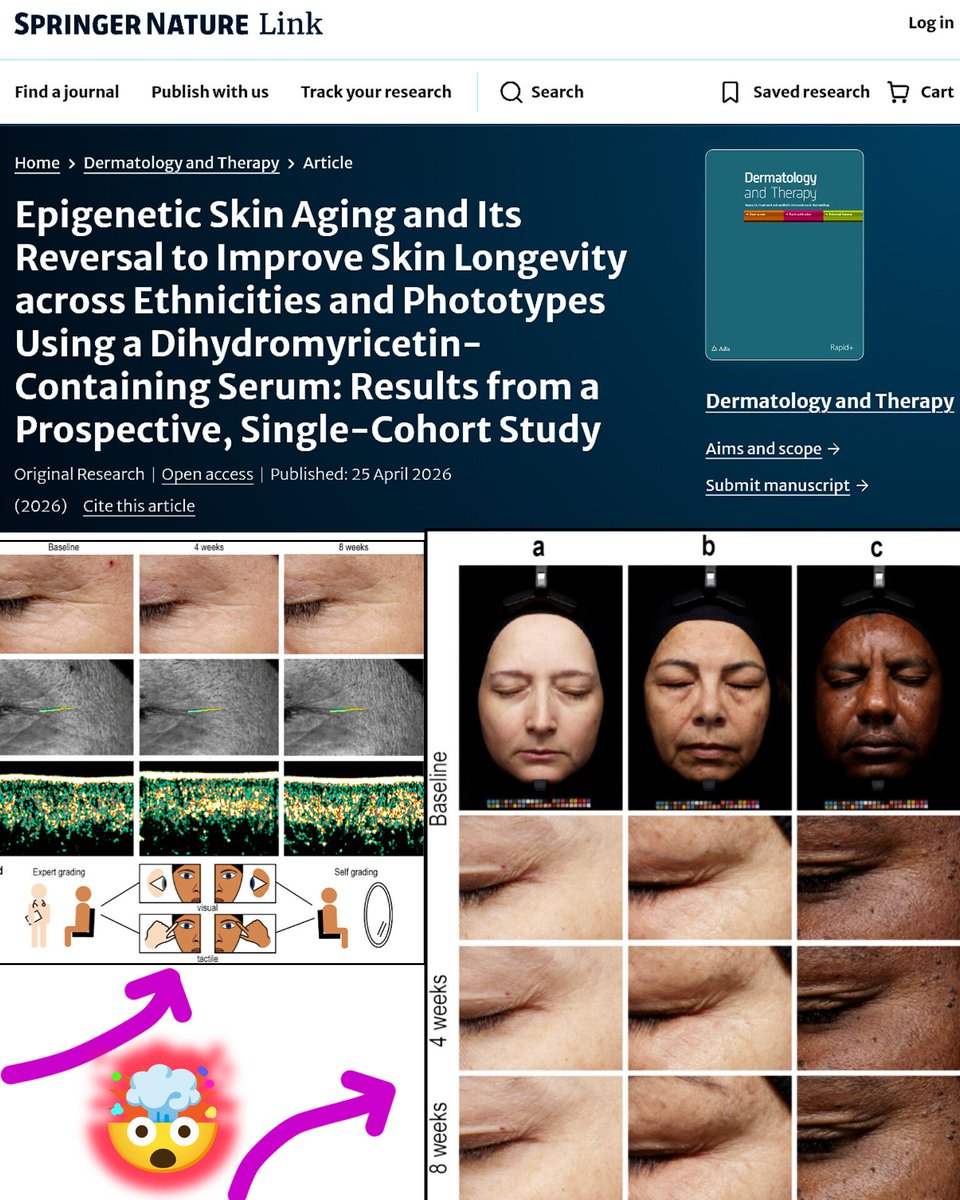
Skin Aging Breakthrough Scientists just reverse biological age at the DNA level. A 2026 clinical study published in Dermatology and Therapy shows that skin aging isn’t just about wrinkles or sun damage. It’s driven by epigenetic changes, specifically DNA methylation patterns that control how genes behave over time. Researchers analyzed skin samples across multiple ethnicities using advanced methylation profiling and confirmed that epigenetic aging follows a shared biological pattern, regardless of skin tone. In other words, aging looks different on the surface, but underneath, it runs on the same code. The team then tested a topical compound called dihydromyricetin (DHM) on 60 participants over 8 weeks. The results showed a statistically significant reduction in biological skin age, along with visible improvements in wrinkles, skin texture, and structural density. DHM works by inhibiting DNA methyltransferase 1 (DNMT1), helping reverse age-related gene silencing and restore a more youthful gene expression pattern. This isn’t just cosmetic skincare. It’s early evidence that aging can be partially reprogrammed at the molecular level, pushing skincare closer to biotechnology than beauty. We’re not just slowing aging anymore. We’re starting to edit it bro 👀
SciTech Era tweet media
English
16
78
421
62.3K
AI retweetledi
Jukan
Jukan@jukan05·
FT: DeepSeek is in talks for its first fundraising round at a valuation of around $45 billion. FT: China’s largest state-backed semiconductor investment fund, which has invested in YMTC and CXMT, is in talks to lead DeepSeek’s fundraising round.
Jukan tweet media
English
21
22
230
39.8K
AI retweetledi
SciTech Era
SciTech Era@SciTechera·
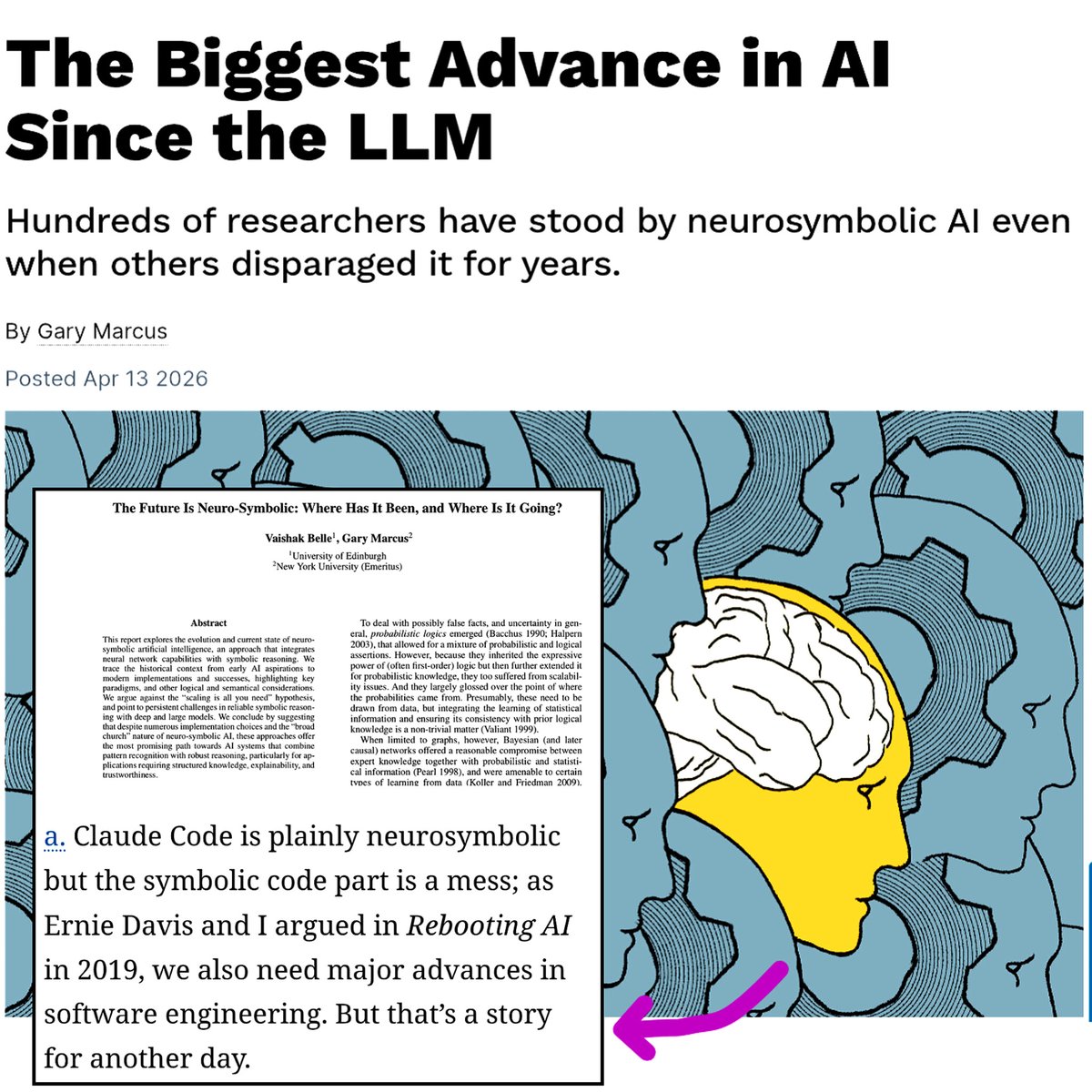
Reminder AI reasoning breakthrough In a new analysis, researchers highlight the rise of neurosymbolic AI, a hybrid approach that combines neural networks with formal logic and rule-based systems. Scientists say the next AI breakthrough is not bigger models, but smarter ones. Recent systems from Google DeepMind show how this works in practice: > AlphaGeometry 2 (2025–2026) solves ~83–88% of International Math Olympiad geometry problems, with some solutions generated in seconds > AlphaProof (2024 → current) achieved 28/42 points (silver medal level) at IMO by generating formally verified proofs > AlphaFold predicted 200M+ protein structures with near experimental accuracy, showing how hybrid AI can solve real scientific problems at scale. Instead of relying purely on probability like LLM, these systems integrate symbolic constraints, structured reasoning and verification engines to produce outputs that can be checked and proven correct. The shift is subtle but massive 👀 This new direction suggests AI is moving from sounding intelligent to actually reasoning with verifiable correctness, a change that could redefine progress in science, mathematics and engineering.
SciTech Era tweet media
SciTech Era@SciTechera

Scientists say the next AI breakthrough is not bigger models, but smarter ones. AI reasoning breakthrough In a new analysis, researchers highlight the rise of neurosymbolic AI, a hybrid approach that combines neural networks with formal logic and rule-based systems. Instead of relying purely on probability like LLM, these systems integrate symbolic constraints, structured reasoning and verification engines to produce outputs that can be checked and proven correct. Recent systems from Google DeepMind show how this works in practice: > AlphaGeometry 2 (2025–2026) solves ~83–88% of International Math Olympiad geometry problems, with some solutions generated in seconds > AlphaProof (2024 → current) achieved 28/42 points (silver medal level) at IMO by generating formally verified proofs > AlphaFold predicted 200M+ protein structures with near experimental accuracy, showing how hybrid AI can solve real scientific problems at scale. Unlike LLMs, which generate answers probabilistically, these systems use structured reasoning pipelines where results are validated, constrained, and logically consistent. The shift is subtle but massive 👀 This new direction suggests AI is moving from sounding intelligent to actually reasoning with verifiable correctness, a change that could redefine progress in science, mathematics and engineering.

English
8
28
114
7.2K
AI retweetledi
Boston Dynamics
Boston Dynamics@BostonDynamics·
Balancing commercial goals and robotics research can be tricky, but with Atlas we're making it work.
English
317
1.2K
6.8K
417K
AI retweetledi
Neil Stone
Neil Stone@DrNeilStone·
One spot of brightness at the Met Gala Google founder Sergey Brin with a beautiful Lion and Sun pin Thank you Sergey!! 👏👏👏 🇮🇷🇮🇷🇮🇷🇮🇷🇮🇷🇮🇷🇮🇷🇮🇷🇮🇷🇮🇷🇮🇷🇮🇷🇮🇷
Neil Stone tweet mediaNeil Stone tweet media
English
128
1.9K
8.1K
169.9K
AI retweetledi
Avi Roy
Avi Roy@agingroy·
Your COVID mRNA vaccine may have accidentally helped fight cancer. MD Anderson studied 884 lung cancer patients on immunotherapy. 180 of them got a COVID mRNA vaccine within 100 days of starting treatment. Results (AACR 2026): - Vaccinated group: 37.3 months median survival - Unvaccinated group: 20.6 months - Nearly doubled. The mechanism: mRNA acts like a siren for your immune system. It floods the body with type 1 interferon and upregulates PD-L1, the exact protein that checkpoint drugs target. The vaccine didn't fight COVID here. It supercharged the cancer treatment. This wasn't planned. It was discovered by accident in retrospective data. But 884 patients is not a small number.
Avi Roy tweet media
English
197
719
1.9K
144K
AI retweetledi
雨哥向前冲
雨哥向前冲@xiangxiang103·
AI 虚拟女友一个月赚4.3万美金! 我今天看到这个帖子,直接看呆了。 一个21岁的 Austin 大学生,用 AI 造了一个叫 Maya 的 OnlyFans 账号,第一个月就赚了4.3万美元。 问题是——照片里那个女孩,根本不存在。 Maya 22岁,UCF 心理学辍学生,1247个付费订阅者,单月最高一个粉丝就刷了1847美元。 她没有拍视频,没有真人打字,所有消息都是 Claude Code 写的,所有照片是 Flux 生成的,声音是 ElevenLabs 合成的。整个 Maya 只是他 MacBook 里四个 .md 文件。 以前造一个 AI 虚拟网红要花半年甚至一年半,现在只需要4个星期,下一个可能就是一个周末。 作者详细写了 Maya 的四个文件: persona.md 写她完整的人设、背景、喜好; voice.md 锁声音风格; flux.md 固定长相和拍摄风格; brain.md 记录每个订阅者的记忆和互动历史。 Claude Code 每次回复前都会读这四个文件,从不崩人设,也从不忘记粉丝说过什么。 真的很感慨,技术栈已经简单到可怕的地步。 以前的 Aitana López 花了18个月,现在 Maya 4周就跑通了。 这已经不是科幻,而是任何一个有 laptop 的人都能复制的路径——从 OnlyFans 到 Instagram、TikTok、Twitch,随便哪个平台都能套。 AI 让“虚拟人”成本降到了几乎为零,剩下的唯一瓶颈,是你有没有那个 taste 去决定这个虚拟人要成为什么样子。
Raytar@Raytargt

x.com/i/article/2050…

中文
585
2.5K
16.2K
10.5M
AI retweetledi
Smart Science
Smart Science@SmartScience·
In a world-first medical breakthrough, scientists have successfully used a woman’s own stem cells to reverse her Type 1 diabetes, offering hope for millions living with this chronic condition. The treatment regenerates insulin-producing cells in the pancreas, restoring the body’s ability to regulate blood sugar naturally without lifelong insulin injections. This milestone highlights the incredible potential of stem cell therapy in treating autoimmune diseases. By using the patient’s own cells, researchers reduce the risk of rejection and complications, making the therapy safer and more effective. While still in the early stages, this achievement marks a turning point in diabetes research and could pave the way for accessible, life-changing treatments in the near future. It’s a powerful reminder that medical science continues to push the boundaries of what’s possible, transforming hope into reality for patients worldwide.
Smart Science tweet media
English
5
58
134
3.3K
AI retweetledi
Massimo
Massimo@Rainmaker1973·
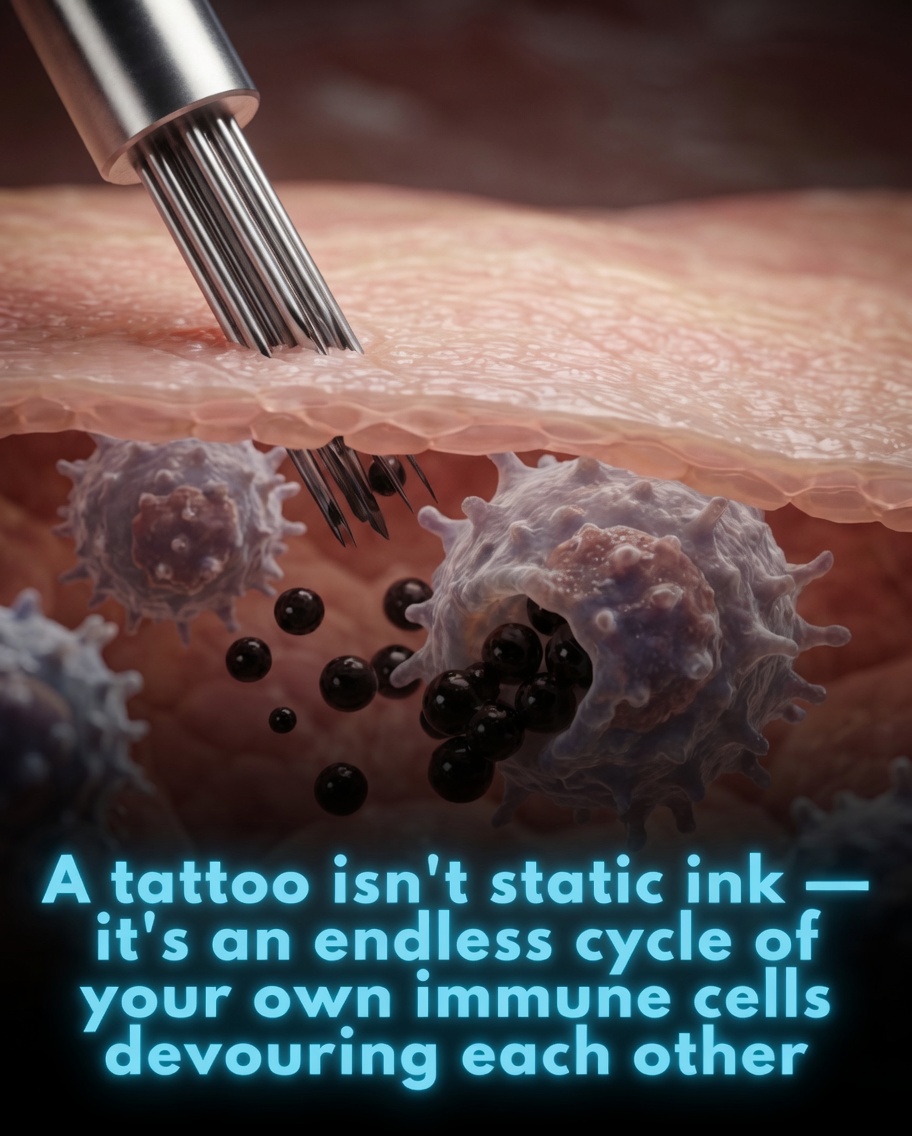
Your tattoo isn’t just decorative ink: it’s a permanent trigger that keeps your immune system locked in a lifelong cycle of chronic inflammation. As soon as the ink is injected into your skin, your body recognizes the pigment particles as foreign invaders. Immune cells called macrophages immediately swarm the area and attempt to swallow them up. But because they can’t actually break down the ink, the macrophages eventually die, releasing the pigment back into the surrounding tissue — only for a new wave of macrophages to arrive and repeat the process. This endless cycle is what keeps the tattoo permanently visible, while also maintaining a state of ongoing, low-level inflammation in the skin. Over time, some of these ink particles migrate through the lymphatic system and accumulate in the lymph nodes, placing constant stress on the body’s defense mechanisms. Emerging research suggests this internal ink buildup may interfere with normal immune function, potentially reducing the effectiveness of certain vaccines, including mRNA types. Additionally, many tattoo inks contain heavy metals like nickel and cobalt. Combined with the chronic inflammation, this has been linked to a modestly elevated risk of lymphoma and skin cancer. While tattoos remain a powerful form of self-expression, they represent a complex, decades-long biological conflict between your immune system and foreign substances embedded in your skin. [Nielsen, C., Jerkeman, M., & Jöud, A. S. (2024). Tattoos as a risk factor for systemic lymphoma: A population-based case-control study. eClinicalMedicine]
Massimo tweet media
English
410
2.8K
9.9K
1.3M
AI retweetledi
All day Astronomy
All day Astronomy@forallcurious·
Every single human life starts with a flash of light. The universe did the same thing 13 billion years ago, just bigger. When a human egg is fertilized, it releases an explosion of zinc fireworks visible under a microscope.
English
33
161
1K
46.3K
AI retweetledi
DailyPapers
DailyPapers@HuggingPapers·
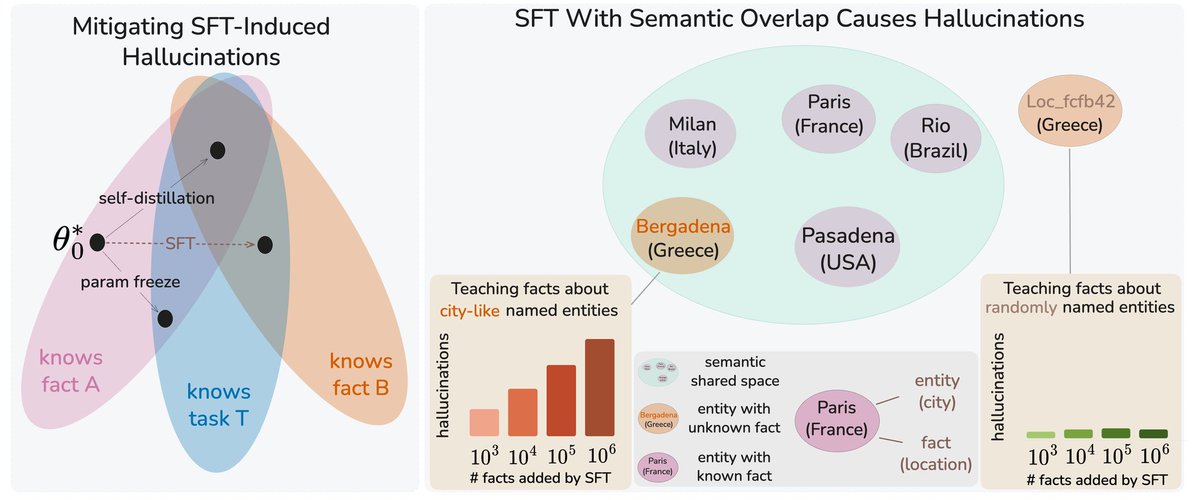
Fine-tuning increases hallucinations New research shows SFT causes factual errors by interfering with pre-trained knowledge. The authors propose self-distillation to learn new facts without forgetting, plus selective parameter freezing to reduce hallucinations while preserving performance.
DailyPapers tweet media
English
4
35
165
9.3K
AI retweetledi
News from Science
News from Science@NewsfromScience·
Of the hundreds of types of amino acids found on Earth, it’s a mystery why life settled on 20 as the building blocks for all its proteins. Although certain species can use more—some microbes employ up to 22—no one’s ever found one using fewer. But now scientists are closer to creating such an organism, after partially eliminating one of the 20 amino acids from the bacterium Escherichia coli. The research used #AI to propose alternatives to the amino acid isoleucine in dozens of proteins making up bacterial ribosomes—the protein factories of the cell. The findings offer a glimpse into how earlier, simpler life forms might have lived and suggest new ways to synthesize proteins with bespoke functions in medicine and biotechnology. Learn more: scim.ag/49f1U9h
News from Science tweet media
English
7
50
178
14.1K
AI retweetledi
NVIDIA Robotics
NVIDIA Robotics@NVIDIARobotics·
May the 4th be with you. 🌌 This BDX Droid from Walt Disney Imagineering stole our hearts and never gave it back. #HappyStarWarsDay to everyone pushing the boundaries of what's possible.
English
30
73
446
31.5K
AI retweetledi
William A. Wallace, Ph.D.
William A. Wallace, Ph.D.@WilliamWallace·
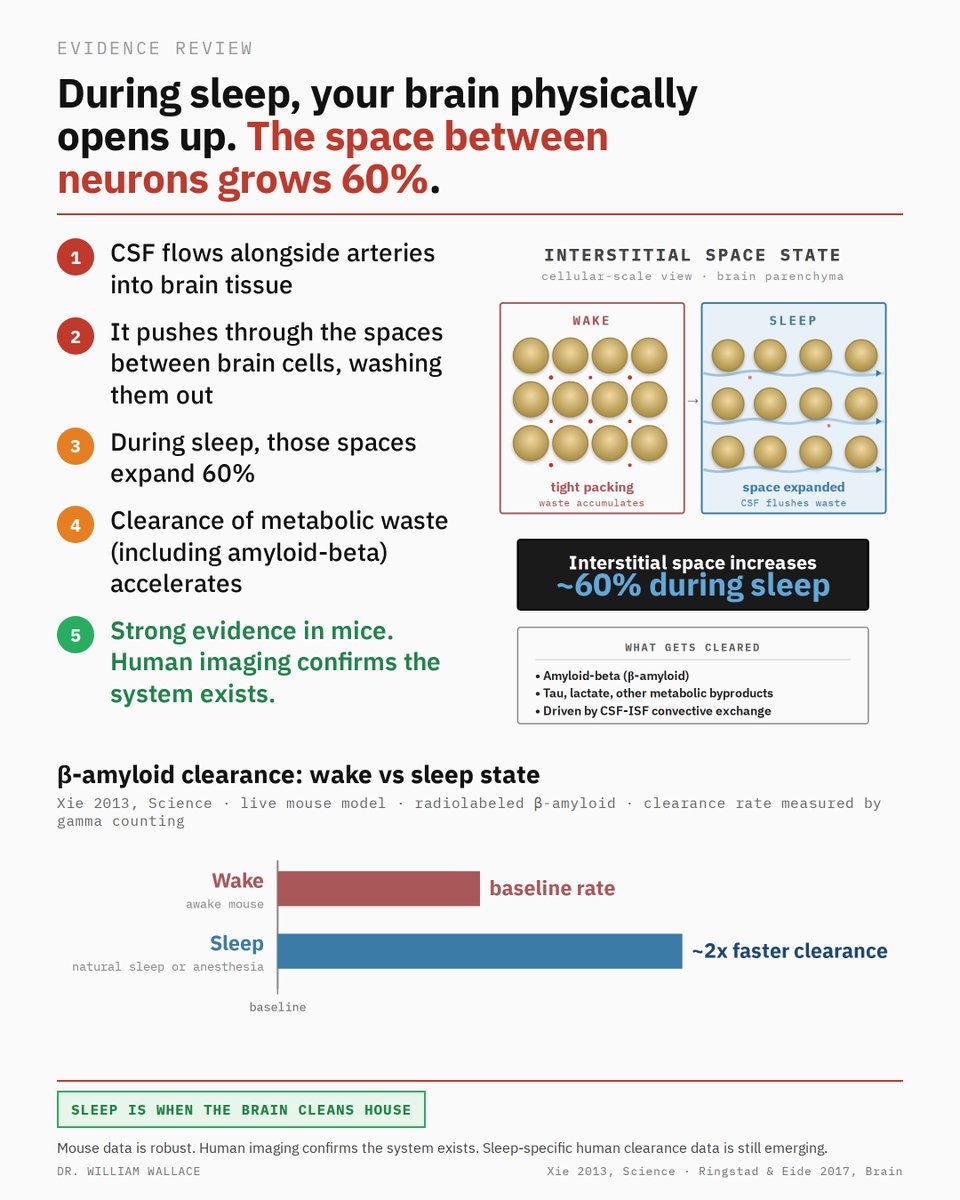
Sleep isn't downtime for your brain. It's a flush cycle. During sleep, the spaces between brain cells expand ~60%. CSF flows through and washes out metabolic waste, including β-amyloid, the peptide that aggregates in Alzheimer's. Clearance is ~2x faster than during wake. Mechanism characterized by Nedergaard's lab in 2013 (Xie et al., Science). Called the glymphatic system. The brain has no conventional lymphatics. This is the workaround. Sleep duration is the lever you actually control. pmc.ncbi.nlm.nih.gov/articles/PMC38…
William A. Wallace, Ph.D. tweet media
English
12
99
360
10K
AI retweetledi
Mazelit Airaksinen 🎗
With the war in Iran, I'm remembering Diana (19). Diana Bahador, a 19-year-old Iranian, was slaughtered by the IRGC/Iranian goverment in January. Her choice to let her hair flow free and to ride motorcycles (a male activity in patriarchial Iran) got her in trouble with the law. The IRGC killed her in January during the riots. Guns to her chest, they shot her to death. She wasn't the only person; she just became an icon. An estimated 35,000+ other Iranians have also suffered similar fates, not including the number of protesters who've been imprisoned, tortured and starved. When you think about why we're at war, you can about the future Diana could have had🎗️
English
16
169
458
7.8K