Edoardo Acabbi

4.7K posts

Edoardo Acabbi

Edoardo Acabbi

@eacabbi

Assistant Professor of Econ at UMannheim. Harvard alumn. Juve, Varese Basket and Celtics fan.

Mannheim, Germany Katılım Mayıs 2009
2.3K Takip Edilen925 Takipçiler
Edoardo Acabbi retweetledi
Sylvain Catherine
Sylvain Catherine@sc_cath·
Reminder that among the many issues with this graph, the silliest methodological one is that many social transfers register as increasing the tax rate at the lower end of the income distribution. This is why nowadays the same methodology gives a tax rate above 100% for the poor in France. In the case of the US, programs like the earned income tax credit (EITC) and child tax credit (CTC), which reduce the tax bill of the poor, register as doing the opposite under this methodology. Why? Essentially because the credits are not netted out of the tax bill, while the sales tax on the increased consumption they fund is added to it. The denominator, meanwhile, is pre-tax, pre-transfer income. The more you receive transfers from the government, the highest will be the cost of sales tax relative to your pre-transfer income. If you apply this methodology to retirees, their tax rate can also be extremely high since they pay income tax and sales taxes on their social security benefits, which is not part of their pre-transfer income at the denominator. A more complicated issue is the inclusion of payroll taxes that fund Social Security and represent the biggest chunk of taxes on the lower half of the distribution. When workers (employer share is allocated to workers on this graph) pay Social Security taxes, they accumulate individualized claims to future Social Security benefits. The true tax is the differential between the actuarial value of the claim obtained and the tax paid to obtain it. Here the entire tax is counted without regard for the claim. If you take these graphs seriously, you'd therefore conclude that privatizing Social Security, Medicare and Medicaid would make the fiscal system much more progressive since it would massively lower taxes in the bottom 80%. Of course, that's a silly conclusion. But at the end of the day, this is what this graph is about: welfare state denialism.
Simon Kuestenmacher@simongerman600

If you have this weird gut feeling that the rich pay little tax in the US, your gut is spot on... Source: nytimes.com/interactive/20…

English
9
92
515
40.6K
Edoardo Acabbi
Edoardo Acabbi@eacabbi·
Given the Hormuz chaos, it is worth pointing out airlines will try to look for petty excuses to leave you stranded. Last night @lufthansa canceled my lh242 flight from Fra to Rome due to extreme weather conditions. Funny that @Condor and @easyJet did not encounter them
Edoardo Acabbi tweet mediaEdoardo Acabbi tweet media
English
19
6
12
2.1K
Edoardo Acabbi retweetledi
Jesús Fernández-Villaverde
Jesús Fernández-Villaverde@JesusFerna7026·
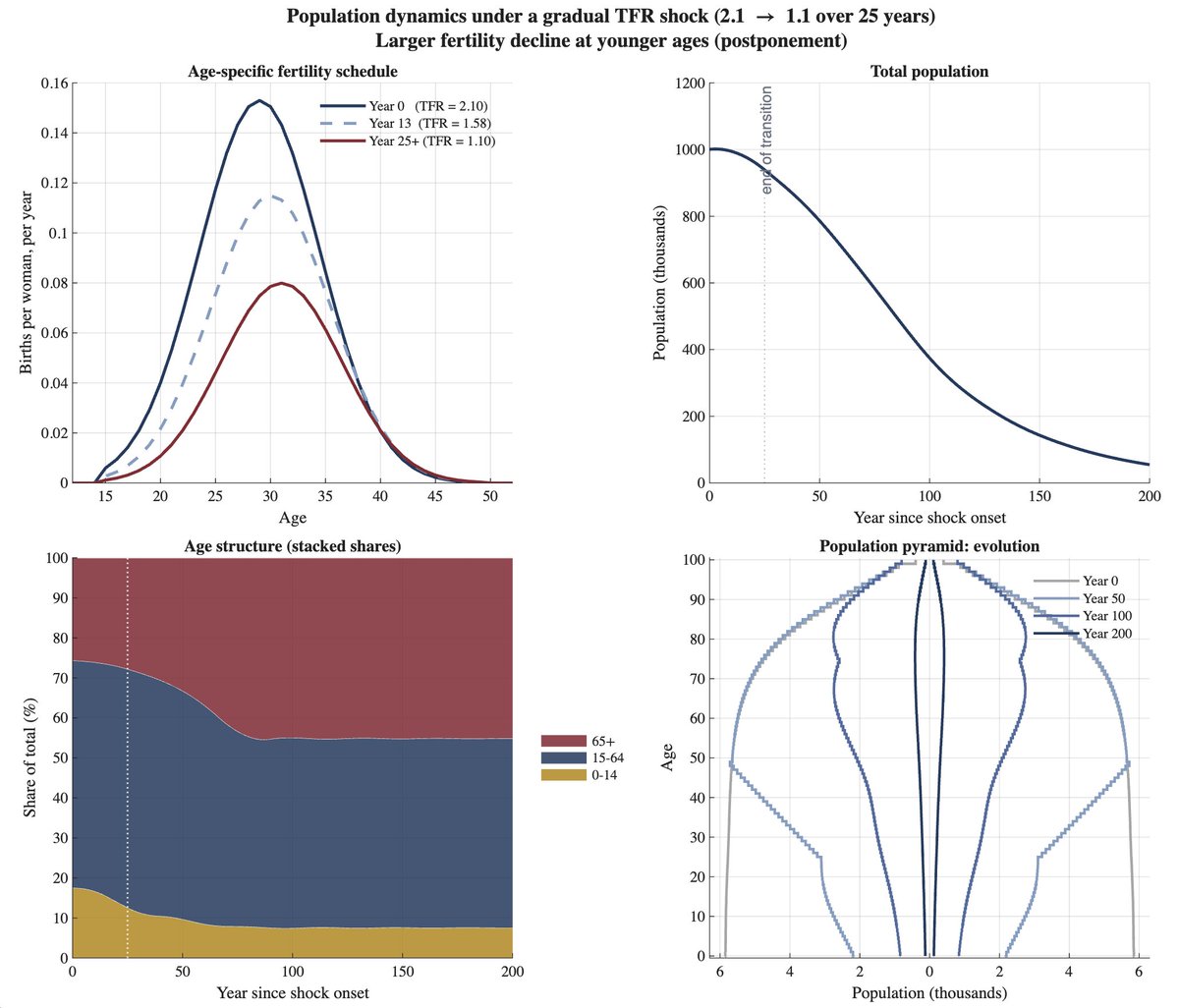
When I write about the long-run consequences of population decline, I’ve noticed that most people cannot grasp what a total fertility rate (TFR) of 1.1 means. Many of my readers look at 1.1 and treat it as not that different from 2.1. This is the wrong way to think about it: TFRs are like interest rates; they compound over time. To make the point, I ran the following simulation. I built the population structure of a country with 1 million inhabitants, a TFR of 2.1 (just at replacement level), and a life expectancy of 85 (with realistic survival rates). Thus, this country has a stationary population over time. I then hit this country with a reduction in the TFR from 2.1 to 1.1. The reduction, which takes 25 years to complete, is similar in size and duration to what we’ve seen in many advanced and middle-income economies. It is also concentrated among younger women, with fertility postponed to later years. I plot the initial, middle, and final TFR in the top-left panel of the figure. I then simulate the next 200 years of this population. By the year 200, the original 1 million has fallen to 54,900, a 95.5% reduction. The top-right panel illustrates this evolution. This is not a minor adjustment: it means closing 95 of every 100 universities, hospitals, and shops. Since the population is likely to concentrate in a few remaining cities, nearly the whole country becomes a population desert. The bottom two panels show the population structure and pyramids. The population stabilizes at a median age of 61 and an old-age dependency ratio of 95.21%. You might argue that TFR is unlikely to remain at 1.1 for so long because higher-fertility subgroups (e.g., the highly religious) would grow as a share of the population. Fair enough. But I am not offering this simulation as a forecast. I am illustrating how, at current rates, countries of 50 million people (roughly South Korea or Spain) would become countries of 2.75 million, ignoring immigration. These are the issues for the next century.
Jesús Fernández-Villaverde tweet media
English
77
359
1.3K
131.1K
Edoardo Acabbi retweetledi
Carlo Calenda
Carlo Calenda@CarloCalenda·
Politici contrari al TAP quando combattevo al Ministero per fare il TAP: tutti i 5S, Meloni, Salvini, Berlusconi, D’Alema, tutta SEL, Emiliano, Bonelli, Fratoianni. Politici contrari al TAP oggi: 0. Una parola di scuse? Non pervenuta. Questa è l’Italia populista. L’abbiamo votata massicciamente. Se oggi non avessimo il TAP saremmo al disastro. Forse è una storia da ricordare.
Jack Prandelli@jackprandelli

🇮🇹🇦🇿 Azerbaijan supplies 16% of Italy's gas. SOCAR just bought 4,500 Italian fuel stations. This is what energy security looks like when Hormuz closes. While the world watches the Strait Italy just rewired its energy architecture northward. The Meloni-Aliyev meeting, what was agreed? First Italian PM visit to Azerbaijan in 13 years. Framed explicitly as a "reliable partnerships" discussion during Middle East instability. → Azerbaijan exported 25 bcm of gas in 2025 7.5 bcm to Italy → Italy: top EU buyer of Azerbaijani gas → TAP cumulative deliveries: 47.5 bcm since startup → TAP covers ~16% of Italy's total gas demand → Both leaders: agreed to push volumes higher via TAP expansion Aliyev: TAP expansion "has already started but must continue" Meloni: Azerbaijani gas has been "decisive for Italy's energy security" and Hormuz makes it more critical still. The infrastructure behind the words The Southern Gas Corridor: Caspian → Azerbaijan → Georgia → Turkey → Greece → Albania → Puglia. TAP annual flows: 9.5 bcm and rising. Recent compressor upgrades: +1.2 bcm/year added capacity. Technical ceiling with full expansion: toward 20 bcm/year. Every bcm that comes through TAP is one bcm that doesn't need to come through Hormuz. The SOCAR downstream move This is where it gets structural. SOCAR Azerbaijan's state oil company just acquired 99.82% of Italiana Petroli (IP): → 10 mt/year refining capacity across 2 Italian refineries → 4,500 service stations across Italy → Aviation fuel, bitumen, logistics assets included → EC approved: February 2026 Gas flows in via TAP. Oil and products flow out via IP's refineries and retail network. SOCAR now has a vertically integrated position inside the EU's 3rd largest economy. Bilateral trade: €10.2 billion in 2025 Italy is Azerbaijan's largest commercial partner. Azerbaijan invested €2.5 billion in Italy. That's an energy alliance formalised by war. The EU wants Russian gas gone. Gulf supply is physically disrupted. The Caspian route via Azerbaijan is the one clean corridor left that avoids both. The Italy-Azerbaijan-SOCAR triangle is the EU's northbound hedge: Caspian gas in via TAP. Azerbaijani oil out via Italian refineries and 4,500 fuel stations. The map of European energy security is being redrawn not in Brussels, but in Baku.

Italiano
92
468
2.6K
74K
Edoardo Acabbi retweetledi
Andrea Gilli
Andrea Gilli@aa_gilli·
Believe it or not, this is how soccer works in Italy. Fiorentina was relegated to the third/fourth league but promote back to the second or first league due to “historical” merits. Inter Milan used fake passports, cooked the books, spied on players and adversaries, exerted pressures on referees: it should have been relegated to the fifth or sixth league, it was awarded two championships despite coming third and by a former board member, then president of the Italian soccer championship’s main sponsor, a company owned by a shareholder and sponsor of Inter Milan.
Financial Times@FT

A top envoy to Donald Trump suggested the swap to Fifa president Gianni Infantino and the US president, as leader of the country co-hosting the tournament, arguing that Italy’s four World Cup titles in the tournament's history justify awarding it the slot. ft.trib.al/Vq3rPmE

English
243
361
2.6K
614.9K
Edoardo Acabbi retweetledi
Richard Stengel
Richard Stengel@stengel·
You know what would be amazing if Vance and his team can negotiate an agreement where Iran doesn't enrich above 3.67% (far below weapons grade); gets rid of 98% of its stockpile of enriched uranium; has weekly inspections by the IAEA; keeps the straits open without charging anyone; and commits to all of this for at least ten years. Oh, yeah, that was the Obama Iran deal.
English
1.9K
6.6K
33.9K
1.4M
Edoardo Acabbi retweetledi