
Elmer Morales

8.5K posts

Elmer Morales

Elmer Morales

@elmerm

founder / ceo @koder_ai. Build your next app using a team of AI agents. Try the technical preview at https://t.co/EWB5woS1dc.

Irvine / San Francisco Katılım Temmuz 2007
5.7K Takip Edilen2.3K Takipçiler
Sabitlenmiş Tweet
Elmer Morales
Elmer Morales@elmerm·
Out here at #CES2025 launching something new. Who’s ready to see what we’ve been cooking? #aiagents
Elmer Morales tweet media
English
1
4
25
1.9K
Elmer Morales
Elmer Morales@elmerm·
RT @soraofficialapp: We’re saying goodbye to Sora. To everyone who created with Sora, shared it, and built community around it: thank you.…
English
0
443
0
0
Elmer Morales retweetledi
Fynn
Fynn@fynnso·
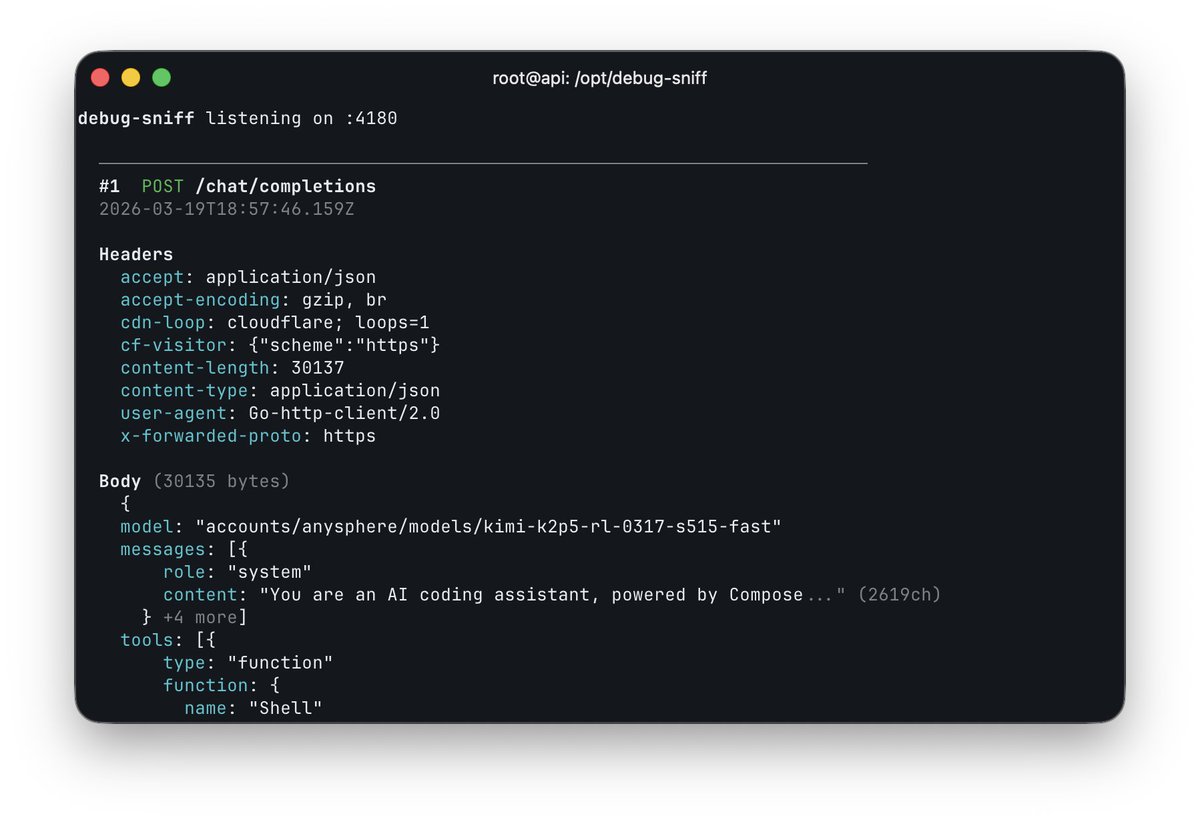
was messing with the OpenAI base URL in Cursor and caught this accounts/anysphere/models/kimi-k2p5-rl-0317-s515-fast so composer 2 is just Kimi K2.5 with RL at least rename the model ID
Fynn tweet media
Cursor@cursor_ai

Composer 2 is now available in Cursor.

English
285
477
7K
2.7M
Elmer Morales retweetledi
Naval
Naval@naval·
A “computer” used to be a job title. Then a computer became a thing humans used. Now a computer is becoming a thing computers use.
English
1.3K
2.9K
29.8K
38.9M
Elmer Morales retweetledi
Suhail
Suhail@Suhail·
If there’s something you want to create but you get demotivated when you find out a famous/impressive person is doing it too, I highly recommend you fight that feeling. I’ve seen too many instances of nothing getting shipped by said person a year later.
English
42
20
509
20.3K
Elmer Morales retweetledi
Elon Musk
Elon Musk@elonmusk·
People giving OpenClaw root access to their entire life
Elon Musk tweet media
English
10.6K
23.1K
389.5K
64.5M
Ryan
Ryan@ohryansbelt·
@garrytan You coded a blog Garry
English
4
1
102
3.9K
Garry Tan
Garry Tan@garrytan·
About 1/3 of the top technical CEOs are completely AGI pilled by coding again. I am one of them. Highly recommend. Totally exhilarating to be back shipping new products and software again
Howie Liu@howietl

x.com/i/article/2024…

English
100
104
2.1K
437.2K
Elmer Morales retweetledi
Sam Altman
Sam Altman@sama·
You can skip all the parties, all the conferences, all the press, all the tweets. Build a great product and get users and win.
English
80
1K
3.7K
0
Elmer Morales retweetledi
Sam Altman
Sam Altman@sama·
The most impressive people I know spent their time with their head down getting shit done for a long, long time.
English
79
1.4K
5.8K
0
Elmer Morales retweetledi
Greg Brockman
Greg Brockman@gdb·
Software development is undergoing a renaissance in front of our eyes. If you haven't used the tools recently, you likely are underestimating what you're missing. Since December, there's been a step function improvement in what tools like Codex can do. Some great engineers at OpenAI yesterday told me that their job has fundamentally changed since December. Prior to then, they could use Codex for unit tests; now it writes essentially all the code and does a great deal of their operations and debugging. Not everyone has yet made that leap, but it's usually because of factors besides the capability of the model. Every company faces the same opportunity now, and navigating it well — just like with cloud computing or the Internet — requires careful thought. This post shares how OpenAI is currently approaching retooling our teams towards agentic software development. We're still learning and iterating, but here's how we're thinking about it right now: As a first step, by March 31st, we're aiming that: (1) For any technical task, the tool of first resort for humans is interacting with an agent rather than using an editor or terminal. (2) The default way humans utilize agents is explicitly evaluated as safe, but also productive enough that most workflows do not need additional permissions. In order to get there, here's what we recommended to the team a few weeks ago: 1. Take the time to try out the tools. The tools do sell themselves — many people have had amazing experiences with 5.2 in Codex, after having churned from codex web a few months ago. But many people are also so busy they haven't had a chance to try Codex yet or got stuck thinking "is there any way it could do X" rather than just trying. - Designate an "agents captain" for your team — the primary person responsible for thinking about how agents can be brought into the teams' workflow. - Share experiences or questions in a few designated internal channels - Take a day for a company-wide Codex hackathon 2. Create skills and AGENTS[.md]. - Create and maintain an AGENTS[.md] for any project you work on; update the AGENTS[.md] whenever the agent does something wrong or struggles with a task. - Write skills for anything that you get Codex to do, and commit it to the skills directory in a shared repository 3. Inventory and make accessible any internal tools. - Maintain a list of tools that your team relies on, and make sure someone takes point on making it agent-accessible (such as via a CLI or MCP server). 4. Structure codebases to be agent-first. With the models changing so fast, this is still somewhat untrodden ground, and will require some exploration. - Write tests which are quick to run, and create high-quality interfaces between components. 5. Say no to slop. Managing AI generated code at scale is an emerging problem, and will require new processes and conventions to keep code quality high - Ensure that some human is accountable for any code that gets merged. As a code reviewer, maintain at least the same bar as you would for human-written code, and make sure the author understands what they're submitting. 6. Work on basic infra. There's a lot of room for everyone to build basic infrastructure, which can be guided by internal user feedback. The core tools are getting a lot better and more usable, but there's a lot of infrastructure that currently go around the tools, such as observability, tracking not just the committed code but the agent trajectories that led to them, and central management of the tools that agents are able to use. Overall, adopting tools like Codex is not just a technical but also a deep cultural change, with a lot of downstream implications to figure out. We encourage every manager to drive this with their team, and to think through other action items — for example, per item 5 above, what else can prevent a lot of "functionally-correct but poorly-maintainable code" from creeping into codebases.
English
412
1.6K
12.3K
2.1M
Elmer Morales retweetledi
Palmer Luckey
Palmer Luckey@PalmerLuckey·
This is a critical aspect of the Billionaire Tax Act. It makes founder-led companies practically illegal. If a founder-CEO of a $1B private company owns 3% but keeps 100% of the voting power, he gets taxed on the value of the whole company. $50M tax bill for $30M net worth.
Garry Tan@garrytan

Larry and Sergey can’t stay in California since the wealth tax as written would confiscate 50% of their Alphabet shares. Each own ~3% of Alphabet's stock, worth about $120 billion each at today's ~$4 trillion market cap. But because their shares have 10x voting power, the SEIU-UHW California billionaire tax would treat them as owning 30% of Alphabet (3% × 10 = 30%). That means each founder's taxable wealth would be $1.2 trillion. A 5% wealth tax on $1.2 trillion = $60 billion tax bill, each. That's 50% of their actual Alphabet holdings—wiped out by a "5%" tax. Section 50303(c)(3)(C) of the 2026 Billionaire Tax Act states: "For any interests that confer voting or other direct control rights, the percentage of the business entity owned by the taxpayer shall be presumed to be not less than the taxpayer's percentage of the overall voting or other direct control rights." This means if a founder holds shares representing only 3% of economic interest but 30% of voting control (through Class B supervoting shares), the tax would presume their ownership stake is at least 30% for valuation purposes, not 3%. The wealth tax is poorly defined and designed to drive tech innovation out of California.


English
460
1K
11.5K
1.1M
Elmer Morales retweetledi
ruslan
ruslan@ruslanjabari·
ZXX
271
886
10.8K
22.8M
Elmer Morales retweetledi
Deputy Secretary Jim O'Neill
We have frozen all child care payments to the state of Minnesota. You have probably read the serious allegations that the state of Minnesota has funneled millions of taxpayer dollars to fraudulent daycares across Minnesota over the past decade. Today we have taken three actions against the blatant fraud that appears to be rampant in Minnesota and across the country: 1. I have activated our defend the spend system for all ACF payments. Starting today, all ACF payments across America will require a justification and a receipt or photo evidence before we send money to a state. 2. Alex Adams and I have identified the individuals in @nickshirleyy's excellent work. I have demanded from @GovTimWalz a comprehensive audit of these centers. This includes attendance records, licenses, complaints, investigations, and inspections. 3. We have launched a dedicated fraud-reporting hotline and email address at childcare.gov Whether you are a parent, provider, or member of the general public, we want to hear from you. We have turned off the money spigot and we are finding the fraud. @ACFHHS @HHSGov
English
12K
26.2K
148.6K
13.9M
Akshay
Akshay@TechBinary99·
@MKBHD Better not be another app for wallpapers !
English
2
0
23
3.9K
Marques Brownlee
Marques Brownlee@MKBHD·
Friday. Dropping the best video I've ever uploaded. Can't wait 👀
English
167
67
4.5K
744.5K
Elmer Morales retweetledi
Elon Musk
Elon Musk@elonmusk·
The future is going to be AMAZING with AI and robots enabling sustainable ABUNDANCE for all!
English
34.8K
15.4K
169.6K
45.4M
Elmer Morales retweetledi
Alex Heath
Alex Heath@alexeheath·
Amazon’s SVP of AI in Sources today: “None of these benchmarks are real… The only way to do real benchmarking is if everyone conforms to the same training data and the evals are completely held out…. The evals are frankly getting noisy” sources.news/p/amazons-anti…
English
1
3
39
4.5K