Felipe Parodi

108 posts

Felipe Parodi

Felipe Parodi

@fe_parodi

Neuro PhD @ UPenn (Kording + Platt labs). Interested in natural and artificial social cognition.

Katılım Ağustos 2025
353 Takip Edilen69 Takipçiler
Felipe Parodi retweetledi
Kording Lab 🦖
Kording Lab 🦖@KordingLab·
Read my critical thoughts on this: "We are watching two disciplines trade their worst habits. Neuroscience is mistaking benchmarked prediction for understanding, and machine learning is mistaking mechanistic language for mechanism. ..."
The Transmitter@_TheTransmitter

Neuroscience has become increasingly concerned with prediction, and machine learning with causal explanation, with each field adopting methods from the other, writes @gershbrain. Will this bring us closer to understanding neural systems? thetransmitter.org/the-big-pictur…

English
0
17
89
6.4K
Felipe Parodi retweetledi
Valerio Capraro
Valerio Capraro@ValerioCapraro·
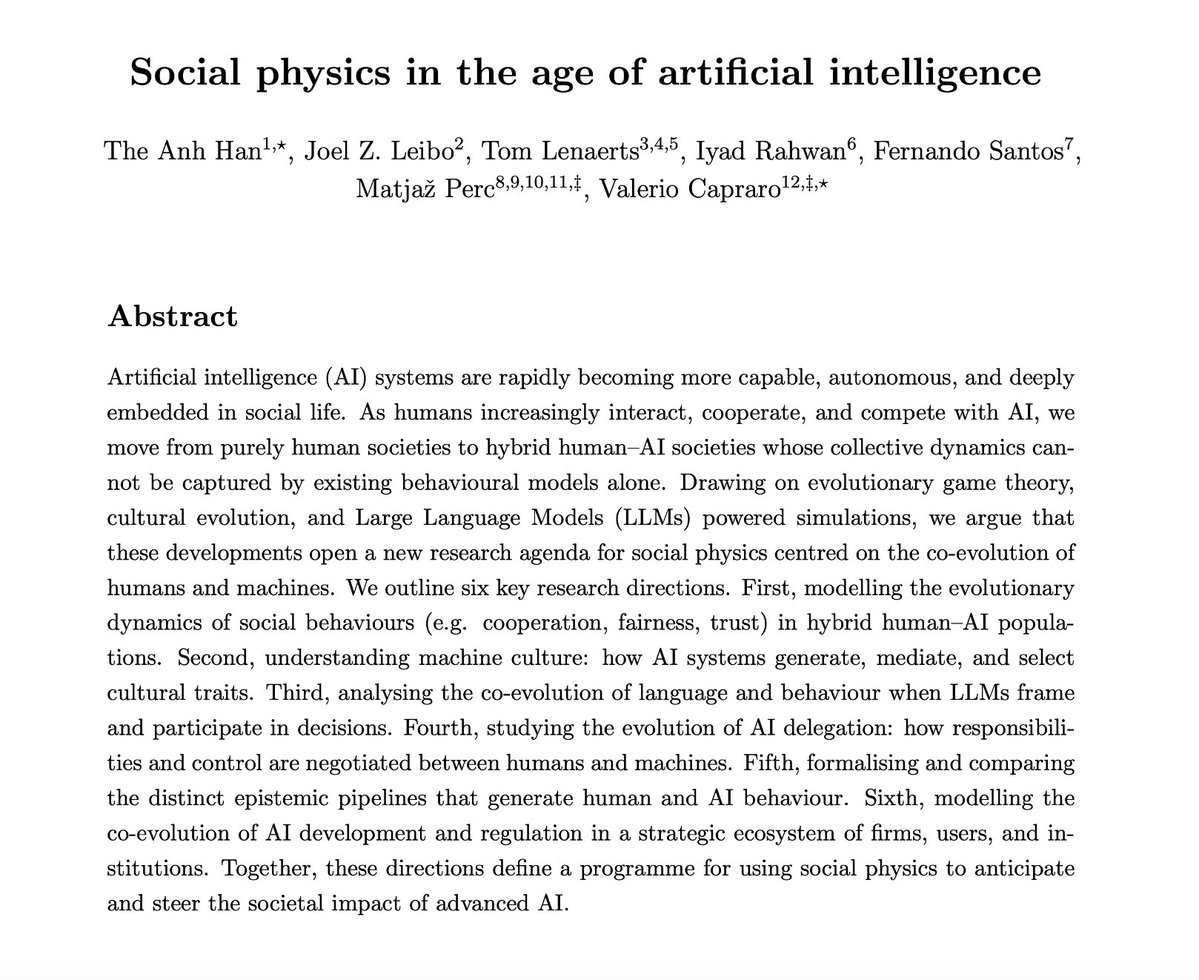
We are no longer living in a purely human society. We are entering a hybrid system where humans and machines continuously interact and influence each other. Where does this system evolve? In a new perspective piece, we brought together leading experts to address this using the lens of evolutionary game theory. We outline six core research directions: 1) Evolution of social behaviour. How cooperation, fairness, and trust evolve in mixed human–AI populations. 2) Machine culture. How AI systems generate, transmit, and select cultural traits. 3) Language–behaviour co-evolution. How LLMs, by framing decisions, reshape preferences, norms, and actions. 4) Delegation dynamics. How control, responsibility, and agency shift between humans and machines. 5) Epistemic pipelines. How different cognitive processes generate human vs AI judgments, and how these co-evolve. 6) AI–regulation co-evolution. How firms, institutions, and users strategically shape—and are shaped by—AI development. We hope this framework sparks new work at the intersection of AI, behaviour, and society. * Paper in the first reply Joint with @T_A_Han, @jzl86, Tom Lenaerts, @iyadrahwan, @fernandopsantos, @matjazperc
Valerio Capraro tweet media
English
22
47
196
9.9K
Felipe Parodi retweetledi
Augmental
Augmental@augmentaltech·
8.51 bits per second. No implant. No surgery. Tomás hit 8.51 BPS in a 60-second MouthPad^ benchmark using head-tracking + tongue clicks. Personal Best: 9.98 BPS. That rivals the best BCIs — at a fraction of the cost. From Tomás: "The mouthpad's a game-changer. It totally revolutionized how I use my computer."
English
5
6
67
11.1K
Felipe Parodi retweetledi
Jitendra MALIK
Jitendra MALIK@JitendraMalikCV·
With Emmanuel Dupoux scp.net/persons/dupoux/ and Yann LeCun @ylecun, we consider a cognitive science inspired AI. We analyse how autonomous learning works in living organisms, and propose a roadmap for reproducing it in artificial systems. lnkd.in/eNWDmuqT
English
8
78
445
60.1K
Felipe Parodi retweetledi
Fabricio Nicola
Fabricio Nicola@nicola_fabricio·
Mammals have hundreds of joints and muscles. Controlling them individually would be nearly impossible. How does the nervous system organize such complexity into coherent actions? Our new study explores this question through a natural behavior: jumping. 1/15 🧵
English
6
59
245
25.7K
Felipe Parodi retweetledi
alphaXiv
alphaXiv@askalphaxiv·
If doomscrolling X is part of your research workflow, we built something for you. Introducing Paperscrolling 🚀 Get the most trending research with key ideas, figures, and audio explanations from alphaXiv Briefs
English
63
126
1.4K
82.1K
Felipe Parodi retweetledi
Steven Wu
Steven Wu@zstevenwu·
There's growing evidence that LLMs can p-hack. That should worry us. But p-hacking also points to something bigger: a data science multiverse of defensible analytical choices. LLMs make it cheap to search that space for favorable results. In our paper, joint work with excellent collaborators: Martin Bertran and Riccardo Fogliato, we build a pipeline that uses LLM agents to systematically map this multiverse. We believe our experiments could inform what future scientific transparency should look like. 🧵
English
9
23
167
26.5K
Felipe Parodi retweetledi
MMitchell
MMitchell@mmitchell_ai·
"AI" is not a stochastic parrot.🦜 I wrote this piece a couple weeks ago, but it was hard for me to finish up given AI's role in society and war over the past few weeks. I should share it at some point though. Not perfect, but here it is. @margarmitchell/no-ai-is-not-a-stochastic-parrot-a99e57766bed" target="_blank" rel="nofollow noopener">medium.com/@margarmitchel
English
11
26
160
33.1K
Felipe Parodi retweetledi
Micah G. Allen
Micah G. Allen@micahgallen·
"Behavioral hierarchy without a hierarchical brain". New preprint argues behavioral hierarchy does not require a hierarchically organized brain; instead, it emerges from the dimensional organization of localized cortical dynamics. biorxiv.org/content/10.648…
English
0
5
42
2.3K
Felipe Parodi retweetledi
Ariel Zeleznikow-Johnston
Ariel Zeleznikow-Johnston@ariel_zj·
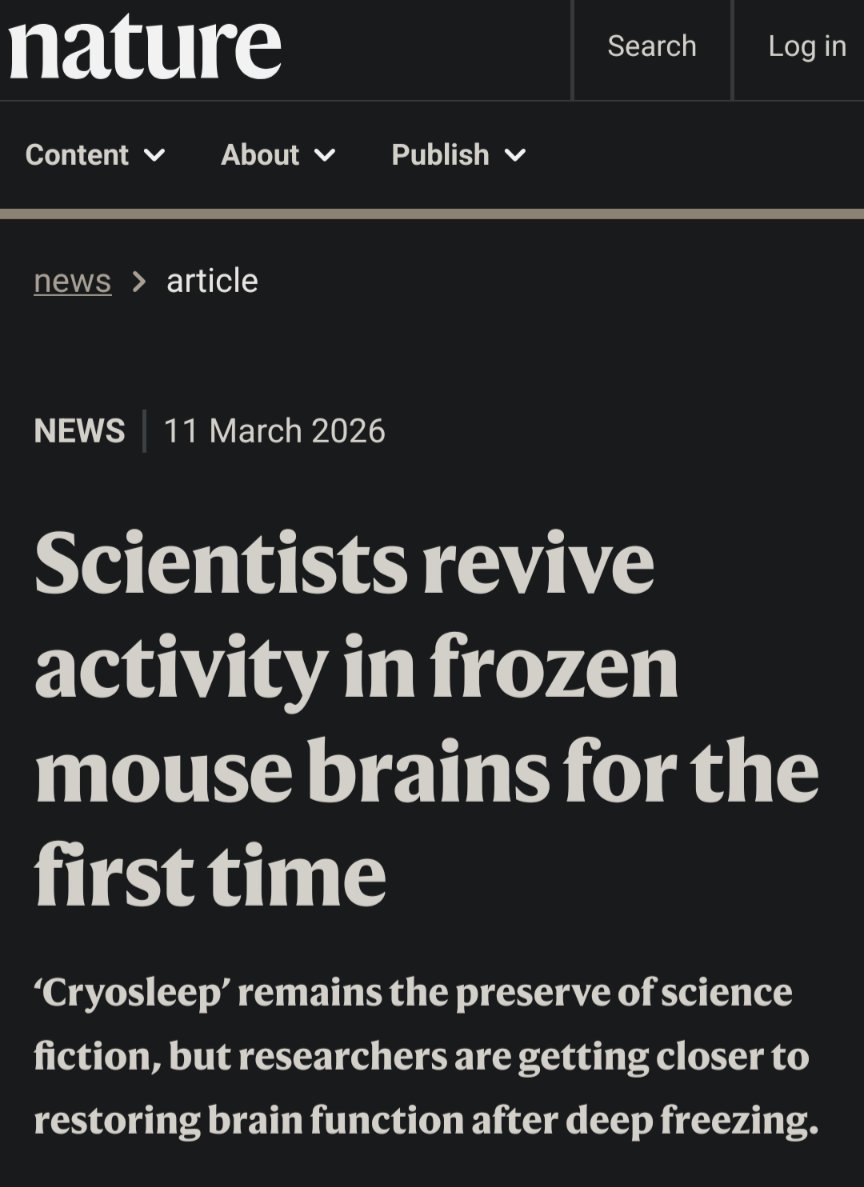
Congrats to my friend Alex German for making headlines with his recent work to show restoration of electrophysiology after vitrifying entire mouse brains to -150c and then rewarming them 1/3
Ariel Zeleznikow-Johnston tweet media
English
7
36
229
22.8K
Felipe Parodi retweetledi
Kenneth Hayworth
Kenneth Hayworth@KennethHayworth·
Private advisor... and my most important (unheeded) advice was NOT to declare that you "uploaded a fly" unless you had damn good evidence. Because otherwise you would piss off the Drosophila research community. I take uploading seriously, so please point me to the publication that offers such good evidence.
English
3
5
69
12.3K
Felipe Parodi retweetledi
David Klindt
David Klindt@klindt_david·
Wow, I did not expect that DINOv3's global [CLS] token linearly represents the continuous geometric latents of dSprites (size & X/Y position) 🤯 It only took me 3.5 years to finally run this experiment 😂 I'm looking to do more of this MechInterp work, dissecting foundation models like biological artifacts and building theory. If you want to collaborate (especially students looking for a fun project) reach out! 🔬🤖
David Klindt@klindt_david

If there were an image input, I would be curious to show it some DSprites examples and ask: what are the independent factors of variation in that data 🤓

English
24
85
1.1K
93.1K
Felipe Parodi retweetledi
Aran Nayebi
Aran Nayebi@aran_nayebi·
Does anyone know how this virtual fly moves *without* RL, given that the actual motor neurons weren't traced out (because the body wasn't scanned)? @Leokoz8 @michaelandregg @oh_that_hat @eonsys @alexwg @Philip_Shiu @AdamMarblestone
Hattie Zhou@oh_that_hat

There's a fruit fly walking around right now that was never born. @eonsys just released a video where they took a real fly's connectome — the wiring diagram of its brain — and simulated it. Dropped it into a virtual body. It started walking. Grooming. Feeding. Doing what flies do. Nobody taught it to walk. No training data, no gradient descent toward fly-like behavior. This is the opposite of how AI works. They rebuilt the mind from the inside, neuron by neuron, and behavior just... emerged. It's the first time a biological organism has been recreated not by modeling what it does, but by modeling what it is. A human brain is 6 OOM more neurons. That's a scaling problem, something we've gotten very good at solving. So what happens when we have a working copy of the human mind?

English
14
16
162
42.4K
Felipe Parodi retweetledi
Doris Tsao
Doris Tsao@doristsao·
My thoughts on connectomics and upload: 1) there is zero question connectomes are invaluable, and we need to get them for mouse, monkey, and human 2) the human, or even monkey, connectome seems a long ways off given costs (roughly $1/neuron). The projectome (map of all the axons) seems eminently reachable and should be a top priority imho 3) but even having the full connectome would only tell you numbers of synapses, not actual synaptic weights, and the two can be hugely divergent (eg only 5% of synapses onto V1 layer 4 neurons come from thalamus, even though this is the major driving input) 4) given #2 & #3, I think we can get to upload in the sense of building a functionally equivalent organism much faster through understanding the algorithms of the primate brain than through blind copying 5) in putting together something as complex as the human brain we would definitely want to check that the various pieces work as we go, which we can only do if we understand these pieces 6) I don't think upload in the sense of blindly creating a digital copy is the path to the abundant transhumanist future--actual understanding of brain structures so we can intelligently interface with them, and emulate their function in code without copying all the details, is. All to say, we need functional understanding to go hand in hand with anatomical mapping!
Adam Marblestone@AdamMarblestone

You may have noticed some "holy $%@#" tweets on fly brain emulation. So is this a game-changer or a nothing-burger? Read on to find out...

English
23
48
305
58.6K
Felipe Parodi retweetledi
Adam Marblestone
Adam Marblestone@AdamMarblestone·
You may have noticed some "holy $%@#" tweets on fly brain emulation. So is this a game-changer or a nothing-burger? Read on to find out...
GIF
English
9
56
278
67.9K
Felipe Parodi retweetledi
Andrew Lampinen
Andrew Lampinen@AndrewLampinen·
Short post on what I call the "no-magic approach to understanding intelligent systems" — the philosophy I think of as motivating our work on understanding intelligence without resorting to magical thinking about AI or humans! Link below:
Andrew Lampinen tweet media
English
9
57
387
26.8K
Felipe Parodi retweetledi
🎭
🎭@deepfates·
gm
🎭 tweet media
18
31
789
18.4K
Felipe Parodi retweetledi