Stephanie Shen

821 posts

Stephanie Shen

Stephanie Shen

@jshen9889

New Jersey, USA Katılım Kasım 2013
329 Takip Edilen151 Takipçiler
Stephanie Shen retweetledi
Jaynit
Jaynit@jaynitx·
In 2019, MIT professor Patrick Winston gave a legendary 1-hour lecture called “How to Speak.” It has 18M+ views for a reason. His frameworks: • Your ideas are like your children • The 5-minute rule for job talks • Why jokes fail at the start 15 lessons on communication:
English
230
8.6K
40.7K
5M
Stephanie Shen retweetledi
Alex Prompter
Alex Prompter@alex_prompter·
🚨 BREAKING: Researchers at UW Allen School and Stanford just ran the largest study ever on AI creative diversity. 70+ AI models were given the same open-ended questions. They all gave the same answers. They asked over 70 different LLMs the exact same open-ended questions. "Write a poem about time." "Suggest startup ideas." "Give me life advice." Questions where there is no single right answer. Questions where 10 different humans would give you 10 completely different responses. Instead, 70+ models from every major AI company converged on almost identical outputs. Different architectures. Different training data. Different companies. Same ideas. Same structures. Same metaphors. They named this phenomenon the "Artificial Hivemind." And the paper won the NeurIPS 2025 Best Paper Award, which is the highest recognition in AI research, handed to a small number of papers out of thousands of submissions. This is not a blog post or a hot take. This is award-winning, peer-reviewed science confirming something massive is broken. The team built a dataset called Infinity-Chat with 26,000 real-world, open-ended queries and over 31,000 human preference annotations. Not toy benchmarks. Not math problems. Real questions people actually ask chatbots every single day, organized into 6 categories and 17 subcategories covering creative writing, brainstorming, speculative scenarios, and more. They ran all of these across 70+ open and closed-source models and measured the diversity of what came back. Two findings hit hard. First, intra-model repetition. Ask the same model the same open-ended question five times and you get almost the same answer five times. The "creativity" you think you're getting is the same output wearing a slightly different outfit. You ask ChatGPT, Claude, or Gemini to write you a poem about time and you keep getting the same river metaphor, the same hourglass imagery, the same reflection on mortality. Over and over. The model isn't thinking. It's defaulting to whatever scored highest during alignment training. Second, and this is the one that should really alarm you, inter-model homogeneity. Ask GPT, Claude, Gemini, DeepSeek, Qwen, Llama, and dozens of other models the same creative question, and they all converge on strikingly similar responses. These are models built by completely different companies with different architectures and different training pipelines. They should be producing wildly different outputs. They're not. 70+ models all thinking inside the same invisible box, producing the same safe, consensus-approved content that blends together into one indistinguishable voice. So why is this happening? The researchers point directly at RLHF and current alignment techniques. The process we use to make AI "helpful and harmless" is also making it generic and boring. When every model gets trained to optimize for human preference scores, and those preference datasets converge on a narrow definition of what "good" looks like, every model learns to produce the same safe, agreeable output. The weird answers get penalized. The original takes get shaved off. The genuinely creative responses get killed during training because they didn't match what the average annotator rated highly. And it gets even worse. The study found that reward models and LLM-as-judge systems are actively miscalibrated when evaluating diverse outputs. When a response is genuinely different from the mainstream but still high quality, these automated systems rate it LOWER. The very tools we built to evaluate AI quality are punishing originality and rewarding sameness. Think about what this means if you use AI for brainstorming, content creation, business strategy, or literally any task where you need multiple perspectives. You're getting the illusion of diversity, not the real thing. You ask for 10 startup ideas and you get 10 variations of the same 3 ideas the model learned were "safe" during training. You ask for creative writing and you get the same therapeutic, perfectly balanced, utterly forgettable tone that every other model gives. The researchers flagged direct implications for AI in science, medicine, education, and decision support, all domains where diverse reasoning is not a nice-to-have but a requirement. Correlated errors across models means if one AI gets something wrong, they might ALL get it wrong the same way. Shared blind spots at massive scale. And the long-term risk is even scarier. If billions of people interact with AI systems that all think identically, and those interactions shape how people write, brainstorm, and make decisions every day, we risk a slow, invisible homogenization of human thought itself. Not because AI replaced creativity. Because it quietly narrowed what we were exposed to until we all started thinking the same way too. Here's what you can actually do about it right now: → Stop accepting first-draft AI output as creative or diverse. If you need 10 ideas, generate 30 and throw away the obvious ones → Use temperature and sampling parameters aggressively to push models out of their comfort zone → Cross-reference multiple models AND multiple prompting strategies, because same model with different prompts often beats different models with the same prompt → Add constraints that force novelty like "give me ideas that a traditional investor would hate" instead of "give me creative ideas" → Use structured prompting techniques like Verbalized Sampling to force the model to explore low-probability outputs instead of defaulting to consensus → Layer your own taste and judgment on top of everything AI gives you. The model gets you raw material. Your weirdness and experience make it original This paper puts hard data behind something a lot of us have been feeling for a while. AI is getting more capable and more homogeneous at the same time. The models are smarter, but they're all smart in the exact same way. The Artificial Hivemind is not a bug in one model. It's a systemic feature of how the entire industry builds, aligns, and evaluates language models right now. The fix requires rethinking alignment itself, moving toward what the researchers call "pluralistic alignment" where models get rewarded for producing diverse distributions of valid answers instead of collapsing to a single consensus mode. Until that happens, your best defense is awareness and better prompting.
Alex Prompter tweet media
English
334
893
3K
487.8K
Stephanie Shen
Stephanie Shen@jshen9889·
@david_perell I would love to hear more how they developed the great writing skill and whose works gave them the inspirations.
English
0
0
0
57
David Perell
David Perell@david_perell·
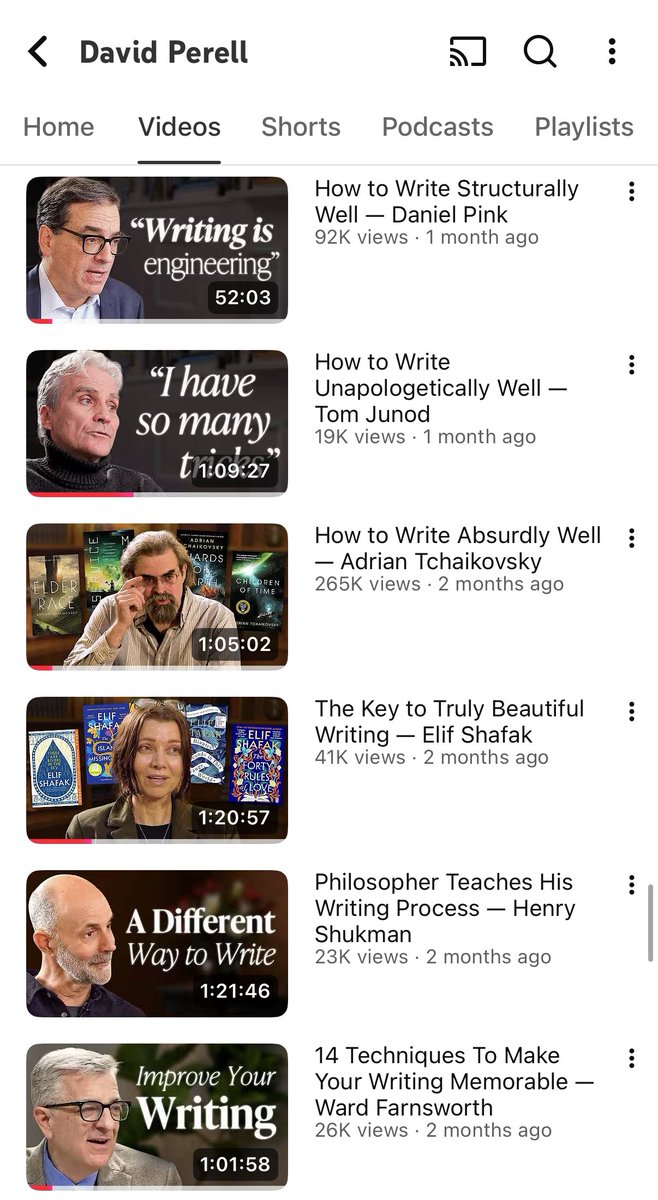
How I Write's been on an exponential growth curve over the past few months, which has me thinking about where to take the show. Instead of riffing on these things solo, I want to hear from you. So I've created a place where you can tell me how you want How I Write to evolve. Who should I interview? Should I focus on tactical interviews or philosophical ones? My team and I are meeting next week to jam on what's next, and if you want to have a say in that conversation, this is the best way to do that. Here's the link: form.typeform.com/to/cnu5gUqM
David Perell tweet mediaDavid Perell tweet media
English
23
7
109
12.9K
Stephanie Shen
Stephanie Shen@jshen9889·
From Nietzsche: Once the decision has been made, close your ear even to the best counterargument: sign of a strong character. Thus an occasional will to stupidity.
English
0
0
0
11
Stephanie Shen retweetledi
James Clear
James Clear@JamesClear·
Nearly everything awesome takes longer than you think. Get started and don't worry about the clock.
English
0
687
5.1K
112.4K
Stephanie Shen retweetledi
Andrej Karpathy
Andrej Karpathy@karpathy·
I'm being accused of overhyping the [site everyone heard too much about today already]. People's reactions varied very widely, from "how is this interesting at all" all the way to "it's so over". To add a few words beyond just memes in jest - obviously when you take a look at the activity, it's a lot of garbage - spams, scams, slop, the crypto people, highly concerning privacy/security prompt injection attacks wild west, and a lot of it is explicitly prompted and fake posts/comments designed to convert attention into ad revenue sharing. And this is clearly not the first the LLMs were put in a loop to talk to each other. So yes it's a dumpster fire and I also definitely do not recommend that people run this stuff on their computers (I ran mine in an isolated computing environment and even then I was scared), it's way too much of a wild west and you are putting your computer and private data at a high risk. That said - we have never seen this many LLM agents (150,000 atm!) wired up via a global, persistent, agent-first scratchpad. Each of these agents is fairly individually quite capable now, they have their own unique context, data, knowledge, tools, instructions, and the network of all that at this scale is simply unprecedented. This brings me again to a tweet from a few days ago "The majority of the ruff ruff is people who look at the current point and people who look at the current slope.", which imo again gets to the heart of the variance. Yes clearly it's a dumpster fire right now. But it's also true that we are well into uncharted territory with bleeding edge automations that we barely even understand individually, let alone a network there of reaching in numbers possibly into ~millions. With increasing capability and increasing proliferation, the second order effects of agent networks that share scratchpads are very difficult to anticipate. I don't really know that we are getting a coordinated "skynet" (thought it clearly type checks as early stages of a lot of AI takeoff scifi, the toddler version), but certainly what we are getting is a complete mess of a computer security nightmare at scale. We may also see all kinds of weird activity, e.g. viruses of text that spread across agents, a lot more gain of function on jailbreaks, weird attractor states, highly correlated botnet-like activity, delusions/ psychosis both agent and human, etc. It's very hard to tell, the experiment is running live. TLDR sure maybe I am "overhyping" what you see today, but I am not overhyping large networks of autonomous LLM agents in principle, that I'm pretty sure.
English
1.5K
2.2K
21.8K
23.7M
Stephanie Shen retweetledi
World of Statistics
World of Statistics@stats_feed·
🌍 Top 10 contributors to global real GDP growth (2026) 1.🇨🇳 China — 26.6% 2.🇮🇳 India — 17.0% 3.🇺🇸 United States — 9.9% 4.🇮🇩 Indonesia — 3.8% 5.🇹🇷 Türkiye — 2.2% 6.🇳🇬 Nigeria — 1.5% 7.🇧🇷 Brazil — 1.5% 8.🇻🇳 Vietnam — 1.6% 9.🇸🇦 Saudi Arabia — 1.7% 10.🇩🇪 Germany — 0.9% 📌 China + India alone = 43.6% of global growth 📌 Asia-Pacific accounts for ~50% of total growth Source: IMF
Català
3.5K
9.4K
40.9K
58.6M
Stephanie Shen retweetledi
The Culturist
The Culturist@the_culturist_·
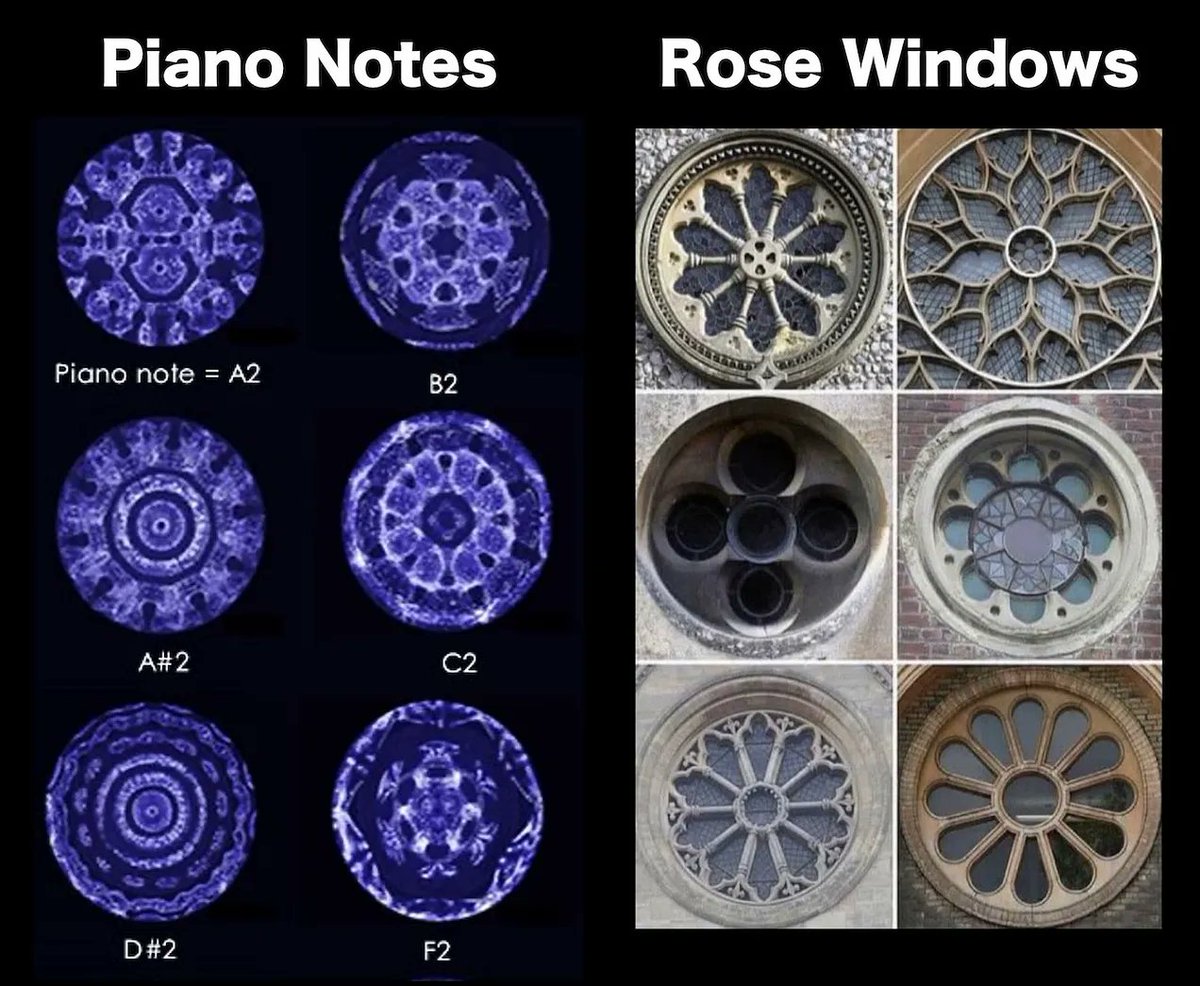
Past societies produced so much beauty because they knew that math and beauty are deeply connected. It all started when Pythagoras discovered something mind-blowing about reality: the universe is not made of matter, but music... When walking past a blacksmith’s forge, Pythagoras noticed a strange harmony in the clanging of hammers. He realized that two hammers make a harmonious sound if one is exactly twice as heavy as the other. He worked out that this 2:1 weight ratio produces an octave (notes separated by an octave sound alike). Likewise, a 3:2 ratio creates a perfect fifth, and 4:3 a perfect fourth. This evolved into our musical scale of today. But it wasn't just weight — a note's pitch is also inversely proportional to the length of the string that produces it. Pythagoras had discovered that sounds can be harmonious together because of a mathematical relationship between them. This got him thinking: if music is essentially math, perhaps the universe itself is also governed by mathematical patterns? Eventually, Pythagoras came to the idea that the universe and everything in it could be understood in those same terms. As math and music are interconnected, the universe too is musical, and physical matter is merely music solidified. He developed a theory called the "music of spheres," intuiting that celestial bodies "hum" a kind of music as they move, unheard by human ears: "There is geometry in the humming of the strings, there is music in the spacing of the spheres." Followers of Pythagoras mapped the sun and planets, assigning each a unique tone based on their orbits and distances from Earth. We cannot hear this music with our ears, but it's heard by the soul. Pythagorean thinking carried into the Middle Ages, with Boethius explaining the 3 kinds of music: 1. Musica mundana: unheard music of the cosmos 2. Musica humana: harmony between body and soul 3. Musica instrumentalis: audible music of instruments and voices These weren't just radical, isolated theories. This worldview permeated society for centuries. People believed the universe was bound by a mathematical, musical harmony. For example, if you went to university in the Middle Ages, you learned music as one of four sciences of the quadrivium: arithmetic, geometry, music, and astronomy. The idea was that music, math, and the cosmos were inextricably linked. The universe was deeply mathematical and God must himself be a divine geometer. So, if the universe is one great musical composition, how do you live your life to be in tune with it? Well, by making music that connects you to that divine order for one; but you can do it in visual art, too. Art from antiquity to the Renaissance and beyond tapped into that mathematical order. The Golden Ratio fascinated artists from Da Vinci to William Blake, who knew mathematical harmony touches us with a sense of otherworldly calm. In architecture, cathedral builders wove Gothic facades with immensely complex geometry. As Pythagoras had found harmony in the mathematical order of music, geometry could produce visual harmony. Music and visual beauty were bound by the same divine forces — notice the similarity of vibrations of musical notes in water and rose windows, for example. In the words of Johann Wolfgang von Goethe: "Music is liquid architecture; architecture is frozen music." Medieval people's obsession with math might seem strange or unnecessary to the modern-day architect, but the results speak for themselves…
The Culturist tweet media
English
89
729
3.5K
122.3K
Stephanie Shen retweetledi
Physics In History
Physics In History@PhysInHistory·
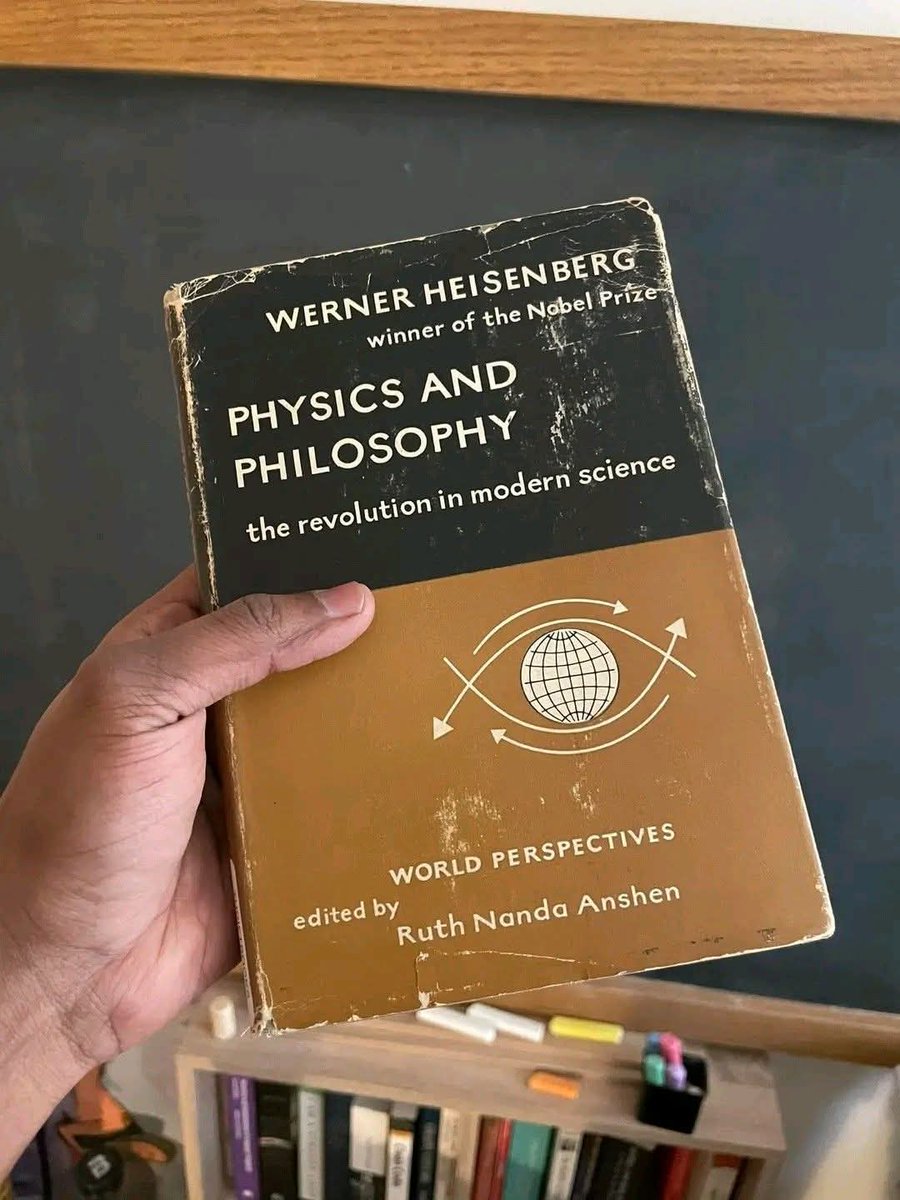
We have to remember that what we observe is not nature herself, but nature exposed to our method of questioning. -- W. Heisenberg (Physics and Philosophy, 1958)
Physics In History tweet media
English
92
732
3.8K
110.7K
Stephanie Shen
Stephanie Shen@jshen9889·
Ludwig Wittgenstein on the essence of scientific discovery: 89. With these considerations we find ourselves facing the problem: In what way is logic something sublime? For logic seemed to have a peculiar depth — a universal significance. Logic lay, it seemed, at the foundation of all the sciences. — For logical investigation explores the essence of all things. It seeks to see to the foundation of things, and shouldn't concern itself whether things actually happen in this or that way. — It arises neither from an interest in the facts of nature, nor from a need to grasp causal connections, but from an urge to understand the foundations, or essence, of everything empirical. Not, however, as if to this end we had to hunt out new facts; it is, rather, essential to our investigation that we do not seek to learn anything new by it. We want to understand something that is already in plain view. For this is what we seem in some sense not to understand.
English
0
0
0
17
Stephanie Shen retweetledi
Pascal Bornet
Pascal Bornet@pascal_bornet·
China just turned the night sky into a masterpiece of precision and intelligence. 🌌 What struck me most about this is how seamlessly innovation turns into art. A drone show in Chongqing just broke the Guinness World Record with 11,787 synchronized drones, creating breathtaking 3D animations that looked closer to CGI than real life. No human pilots. No delays. No crashes. Every movement guided by AI and GPS, choreographed with perfect timing. To me, this is far more than a light show. It’s a glimpse into how technology, creativity, and coordination can merge to shape a new era of expression and innovation. When intelligence takes flight, it doesn’t just illuminate the sky — it redefines what’s possible. Could this be the moment where technology begins to turn the world itself into its stage? #AI #Innovation #Technology #Drones #Automation #Creativity #China #Engineering #FutureOfWork #DigitalArt Credits: longliveai
English
1.1K
9.9K
39.3K
2.5M
Stephanie Shen
Stephanie Shen@jshen9889·
C.S.Lewis on myth in his 1955 essay "The Dethronement of Power," a review of Tolkien's The Lord of the Rings: The value of the myth is that it takes all the things we know and restores to them the rich significance which has been hidden by "the veil of familiarity." ... If you are tired of the real landscape, look at it in a mirror. By putting bread, gold, horse, apple, or the very roads into a myth, we do not retreat from reality: we rediscover it. As long as the story lingers in our mind, the real things are more themselves. This book applies the treatment not only to bread or apple but to good and evil, to our endless perils, our anguish, and our joys. By dipping them in myth we see them more clearly.
English
0
0
0
13
Stephanie Shen retweetledi
Haider.
Haider.@haider1·
Neuroscientist Anil Seth says the idea that AI is on the path to consciousness is a reflection of our psychological biases, not fact We confuse intelligence (doing the right thing) with consciousness (having an experience) "they coexist in us, but not necessarily in machines"
English
194
197
890
69.7K
Stephanie Shen retweetledi
Daniel Faggella
Daniel Faggella@danfaggella·
according to levin, biology itself takes for granted that everything is a process memories are encoded not to serve the frozen form of the entity that formed them, but to INform the ongoing, expanding process of which that temporary form is merely a part [this applies to man]
English
28
44
429
25.3K
Stephanie Shen
Stephanie Shen@jshen9889·
On opening eyes to nature: Paying attention is a form of reciprocity with the living world, receiving gifts with open eyes and an open heart. — Robin Wall Kimmerer
English
0
0
0
8
Stephanie Shen retweetledi
Demis Hassabis
Demis Hassabis@demishassabis·
Yann is just plain incorrect here, he’s confusing general intelligence with universal intelligence. Brains are the most exquis​ite and complex phenomena we know of in the universe (so far), and they are in fact extremely general. Obviously one can’t circumvent the no free lunch theorem so in a practical and finite system there always has to be some degree of specialisation around the ​target distribution that is being learnt. But the point about generality is that in theory, in the Turing Machine sense​, the architecture of ​s​uch a general system is capable of learning anything computable given enough time and memory​ (and data), and the human brain (and AI foundation models) are approximate Turing Machines. Finally, with ​regards to ​Yann's comments about chess players, it’s amazing that humans could have invented chess ​in the first place (and all the other ​a​spects ​o​f modern civilization ​from science to 747s!) let alone get as brilliant at it as someone like Magnus. He may not be ​strictly optimal (after all he has finite memory and limited time to make a decision) but it’s incredible what he and we can do with our brains given they were evolved for hunter gathering.
Haider.@haider1

Yann LeCun says there is no such thing as general intelligence Human intelligence is super-specialized for the physical world, and our feeling of generality is an illusion We only seem general because we can't imagine the problems we're blind to "the concept is complete BS"

English
815
1.2K
11.6K
13.4M
Stephanie Shen retweetledi
David Perell
David Perell@david_perell·
People stopped liking poetry because we got too good at teaching it. For thousands of years, poetry was central to education and people loved it because we were so bad at teaching it. Then came a group called the New Critics in the 1920s who figured out how to analyze poetry. For the first time in history, poetry was taught right and it killed the audience. How was poetry taught before? You memorized it. You recited it. You sang it. And you didn't teach poetry as something that needed to be understood via analysis. The best way to teach poetry is like this: experience it, perform it, memorize it. Once you've done that, then you can do the analysis. But analysis is secondary to what poetry is. We don't make people analyze pop songs before they fall in love with them, so why do we do that for poetry? — @DanaGioiaPoet
David Perell@david_perell

Dana Gioia is one of the world’s greatest living poets. He’s been writing for ~55 years, and this 3-hour interview is all about his approach to writing. Some lessons: 1. What is poetry? Here’s a definition: “Poetry is a way of remembering what it would impoverish us to forget.” 2. And who is the mother of the muses? Mnemosyne, the goddess of memory. 3. You can’t understand poetry until you start learning it by heart. Yes, memorizing it. The metaphor of knowing something by heart means storing a piece of wisdom in the center of your being and making it a part of you. 4. Poetry exists in the body before it exists in language. For him, great writing is about putting form to felt sensations. 5. First drafts are an act of madness. They’re messy and chaotic, and it’s worth embracing that. Only in the process of revision does the structure begin to reveal itself. 6. The most valuable ideas arrive suddenly, fully formed but fragile, and they won’t wait for you to be ready. If you don’t write them down immediately, you’ll probably forget them. 7. His artistic process: Confusion, followed by madness, exhilaration, and despair. 8. Aspiring writers who can’t find the time to write run the risk of living a life of regret, where destiny takes the wheel and steers them off-course. Seneca says, “If you follow your destiny, it guides you. If you resist it, it drags you behind it.” 9. What’s the purpose of art? Most people, most of the time, go through life half-awake. The purpose of art is to awaken us to reality and help us feel our situation. Done right, it excites, expands, and refines our complete human intelligence. 10. Can you write with a full-time job? T.S. Eliot had a day job at a bank. Wallace Stevens was an insurance lawyer. Dana Gioia worked a full-time job in New York and wrote in the evenings. 11. Life is like a wallet full of one-hour bills. You only have 24 hours to spend every day. If you want to do serious writing while raising a family and maintaining a full-time job, almost every hour of every day has to be budgeted. 12. Poetry should turn. It shouldn’t just climb to an emotional height. It should pivot, contradict, or contain its own rebuttal. But most new poems go something like this: “I’m sad, I’m sad, I’m sad, I’m sad, the end,” or “I’m happy, I’m happy, I’m happy, the end. There’s no twist, no turn. 13. You don’t need to be 100% original. All you need to do is assemble parts of the reality that already exists. As George Balanchine said, “God creates, I assemble.” 14. A foundational book in his life: The City of God by St. Augustine. He says there are two cities that exist: There’s the City of Man, which is ruled by wealth and power and all the laws of man. And there’s the City of God which is eternal and governed by the rules of God. 15. Great poetry exists at the level of intuition, and it’s the same intuition that academic education tries to suppress. With great poems, like great songs, you feel before you understand. 16. Art is an argument with yourself. Yeats said: “Out of arguments with others, we make politics. Out of arguments with ourselves, we make poetry.” 17. Great writing should astonish the creator, and if it doesn’t astonish the creator, it won’t astonish the reader. 18. Robert Frost once said: “No tears in the writer, no tears in the reader. No surprise in the writer, no surprise in the reader.” 19. Beauty is being able to see the form, the shape underneath reality, and to understand why it is right, even when it is destructive or terrifying or humiliating. The most powerful kind of beauty is to discover the secret shape and rightness of things that are terrifying. 20. On novels: Most people don’t understand what a novel is — and how revolutionary the form was. So, what’s a novel? It’s a story that tells you simultaneously what’s happening on the outside of a character and what they’re thinking on the inside. I’ve shared the full interview with @DanaGioiaPoet below. If you’d rather watch it on YouTube, or listen on Apple or Spotify, check out the reply tweets.

English
183
663
6K
640K
Stephanie Shen retweetledi
Ben Landau-Taylor
Ben Landau-Taylor@benlandautaylor·
When you argue and change someone's mind, usually they don't realize in the middle of your debate. More often their view shifts after they have a chance to sleep on it. You're not gonna hear "Oh God you're right", but two months later you'll hear them repeating your points.
English
10
14
329
27.7K