jsonparser 2.0 retweetledi
jsonparser 2.0
7.5K posts


jsonparser 2.0
@jsonparse13
The sky is NOT the limit, the ground is! 😉 Stak Juels not Satoshis!
linkland Katılım Eylül 2015
824 Takip Edilen535 Takipçiler


jsonparser 2.0 retweetledi

jsonparser 2.0 retweetledi

The flight to safety continues 🕊️
Kraken is officially deprecating @LayerZero_Core and migrating to @Chainlink CCIP as the exclusive cross-chain infra for all Kraken Wrapped Assets 🤝
After a security review, @krakenfx chose CCIP as it offers enterprise-grade infra with strict security & risk management
The migration starts with migrating $260,000,000 in Kraken Wrapped Bitcoin (kBTC) away from LayerZero/OFT and over to the CCIP/CTT standard
Kraken is one of the oldest and largest U.S. crypto exchanges, founded in 2011, trusted by 10M+ users with $665B in annual trading volume

Kraken@krakenfx
Kraken is deprecating its existing cross-chain provider and migrating to @Chainlink CCIP as its exclusive cross-chain infra to secure Kraken Wrapped Bitcoin (kBTC) & all future Kraken Wrapped Assets. Kraken chose Chainlink CCIP because it offers enterprise-grade infrastructure with strict security & risk management requirements, including: • ISO 27001 and SOC 2 Type 2 certifications • Secure by default architecture • 16 independent nodes • Native rate limits, and more. Together, Chainlink and Kraken can help accelerate the global adoption of crypto by unlocking utility and distribution for all Kraken Wrapped Assets across DeFi. For kBTC customers, no action is required. More details on the migration process to follow on official Kraken channels.
English
jsonparser 2.0 retweetledi

jsonparser 2.0 retweetledi

Today we announced progress toward our goal of advancing 24/7 collateral mobility. DTCC’s Collateral AppChain, a shared infrastructure platform for collateral, will leverage the Chainlink Runtime Environment (CRE) and @chainlink data standard to enable near real-time collateral management across financial markets and blockchains.
The integration will enable the seamless pairing of asset prices, valuations, and movement, with the aim of overhauling how market risk is managed globally and unlock greater capital efficiency.
This milestone reflects our broader vision to enable 24/7, near real-time collateral management across the global financial system.
Read the full announcement: dtcc.com/news/2026/may/…

English

The COVID panic crash brought Bitcoin down to around $3,800
However, the money printer kicked in and the price skyrocketed from $3.8k to $69k
Now imagine the impact if another global virus narrative prompts central banks to print money again.

English

🇲🇽 A fiery explosion tore through the Salina Cruz refinery in Mexico, one of the key refining facilities, injuring at least 6 people.
Every incident like this chips away at a production capacity the country can't afford to lose.
Mario Nawfal@MarioNawfal
🇲🇽 A kitchen fire at a restaurant inside a mall in Los Mochis, Mexico, tore through the building and killed at least 5 people, injuring 46 others. Video shows a panicked crowd as parts of the building collapse… scary.
English
jsonparser 2.0 retweetledi
This Sergey video aged like fine wine, very prophetic
“The consequences of an oracle failure as shown by history is getting completely wrecked”
Bridges are just cross-chain oracles where another blockchain is the data source
Just use Chainlink
English

If you haven't taken self-custody yet, now is the best time with Jade Core.
✅ $99, free worldwide shipping
✅ Pairs with the @Blockstream app
✅ USB-C + Bluetooth
✅ 100% open-source firmware and hardware
✅ Genuine Check cryptographic proof
Get your Bitcoin and @Liquid_BTC into self-custody:
store.blockstream.com/products/block…
English
jsonparser 2.0 retweetledi

So @LayerZero_Core caused this whole mess, then waited for every affected party to voluntarily contribute to cover it, including a industry wide crowdfunding campaign, and only after the hole was fully plugged they decided to contribute last minute with 5k eth
Lol, lmao even
English
@cryptofergani Trotzdem muss das geliehene geld zurückgezahlt werden das fehlt leider in dieser gleichung
Deutsch

Imagine a father who secures $100,000 in spot Bitcoin.
He holds the asset until the valuation hits a massive $5,000,000.
Liquidating the position directly triggers devastating taxes on $4,900,000 of pure profit.
So he executes the perfect institutional maneuver instead.
He locks the Bitcoin in a legal trust, takes out a collateralized loan against the stack, and lives off the borrowed liquidity.
Because he never executed a sale, his tax liability remains at absolute zero.
Upon his death, the heirs receive the Bitcoin with a brand new cost basis set exactly at $5,000,000.
The government cannot legally touch a single cent of the accumulated gain.
This is exactly how generational wealth is permanently secured.
English
jsonparser 2.0 retweetledi
jsonparser 2.0 retweetledi

Why does Chainlink's SOC 2 certification matter?
@andyyy: "If you're evaluating this industry at scale, you want to see this stamp of approval."
"It's validation that the largest asset managers can come onchain using Chainlink. Security and resiliency allow for scale. That's what puts this space forward."
@robbieklages: "They learned the language of the antiquated legacy financial world and built infrastructure that communicates with both."
English
jsonparser 2.0 retweetledi

BREAKING NEWS: Top U.S. Nuclear Chief Caught LEAKING Sensitive National Security Information to Stranger, Reveals Army Chemist Was Exposed to U.S. Chemical Nerve Agent, Confirms U.S. Strike Killed Children in Iran, Discloses U.S. Plans to ‘Kill Iran’s New Supreme Leader’
“If he [Mojtaba Khamenei] doesn't change his ways, yeah, they're [United States] going to kill him.”
“The easiest way to get intelligence…send a pretty girl, talk to the guy…I have to resist your eyes.”
“Your eyes have mesmerized me so much…Almost like you're an intelligence.”
Andrew Hugg, a U.S. Chief of Chemical Nuclear Surety, was caught on hidden camera casually revealing sensitive information to a stranger in a public restaurant. Andrew Hugg, Chief of Chemical Nuclear Surety, in charge of nuclear and chemical safety was caught on hidden camera releasing information regarding the U.S. Nuclear Information. He claims the U.S. still possesses nerve agents and says a U.S. Army chemist recently died from exposure.
He also acknowledges U.S. airstrikes have killed children in Iran, calling it “collateral damage,” and revealed to the journalist how nuclear launch decisions are made in real time.
Hugg described how the United States could assassinate Iran’s next leader if he “doesn’t change,” while admitting the U.S. has no plans to use nuclear weapons: “We’re not going to nuke anybody.”
All of this was casually revealed to an undercover journalist in a restaurant. This raises serious questions about this official's judgment, security, and what’s really happening behind closed doors.
We have reached out to the Pentagon and U.S. Army for comment and they are working on a response.
@USArmy @DeptofWar
English
jsonparser 2.0 retweetledi
@rookie_of_Ph LayerZero is a flawed architecture that does not provide any guaranteed security assurances (no security floor), resulting in the creation of insecure centralized bridges
The numbers don’t lie, centralization is a systemic problem in the LayerZero ecosystem
Zach Rynes | CLG@ChainLinkGod
The core takeaway from this rsETH bridge exploit should be that app devs and asset issuers should not be expected to be cross-chain infra security experts Protocols like LayerZero that do not provide any guaranteed security assurances (no security floor) make it far too easy to implement insecure bridges When the path of least resistance is a 1-of-1 DVN config (or 2-of-2 as is very common), a meaningful share of integrators will end up there Cross-chain infra should provide a strong minimum level of security and decentralization, while allowing optional additional layers of validation, permissioning, risk management, monitoring, and compliance on top Like @CatfishFishy stated, the modular security design for bridges offers advantages, but the spectrum should range from moderately secure to extremely secure, not zero security to extremely secure The fact that the LayerZero Labs DVN experienced an issue and led to a bridge exploit is concerning, but it really just reveals a flawed architectural design If zero security is a valid point on the spectrum with no guardrails (LayerZero protocol itself is empty scaffolding), someone will ship it and users bear the cost Unfortunately these types of exploits deteriorate public trust in DeFi as a whole, as it’s difficult for retail to discern what is or isn’t secure Referring to centralized node operators as “decentralized verifier networks (DVNs)” only gives a false sense of security to both devs and retail, muddying the waters further A messy situation all around, hoping the recovery goes smoothly
English
jsonparser 2.0 retweetledi
It's simply undeniable just how much the U.S. regulatory environment has shifted in Chainlink's favor lately:
✅ U.S. SEC and CFTC issue joint statement classifying $LINK as a digital commodity
✅ @Grayscale LINK ETF launched (1.2% of circ supply accumulated)
✅ @Bitwise LINK ETF launched (0.27% of circ supply accumulated)
✅ @CMEGroup LINK futures launched on largest CFTC regulated derivatives exchange
✅ Sergey Nazarov appointed to @CFTC Innovation Advisory Committee, launched by @MichaelSelig
✅ Former Chainlink Labs Deputy General Counsel appointed to @SECGov Crypto Task Force, led by @HesterPeirce
✅ Chainlink and CCIP highlighted prominently in White House digital asset report
✅ Sergey and CLL regularly in D.C. meeting with U.S. regulators, legislators, & policy makers
✅ Chainlink chosen by U.S. Department of Commerce (@CommerceGov) to bring macroeconomic data onchain
✅ @Anchorage Digital and Chainlink join Blockchain Leadership Fund as founding members (new crypto PAC)
✅ Chainlink joins @BlockchainAssn & @DigitalChamber lobbying groups
✅ Sergey gives public remarks at White House Digital Asset Summit
✅ SEC issues interpretive guidance based technical recommendations provided during six in-depth briefings with Chainlink
This opportunity is being very much seized! The sum is much greater than its parts, now let's let Clarity passed
Chainlink@chainlink
Chainlink’s role at the center of international digital asset policy continues to rapidly accelerate: 🗓️ Just this week, Chainlink: • Engaged with leaders at the International Monetary Fund (@IMFNews) and @WorldBankGroup Spring Meetings on the emerging role of tokenized assets in global markets • Joined the @AtlanticCouncil to examine the latest shifts in U.S. crypto policy and their implications for global markets • Took part in engagements at the National Institute of Standards and Technology (@NIST) and on Capitol Hill aimed at advancing the understanding of blockchain technology The latest U.S. and international momentum 🧵⬇️
English
jsonparser 2.0 retweetledi

jsonparser 2.0 retweetledi

JUST IN: Swift completes major digital asset interoperability milestone with Chainlink, enabling tokenized bond transactions across blockchains and traditional banking systems


English
jsonparser 2.0 retweetledi

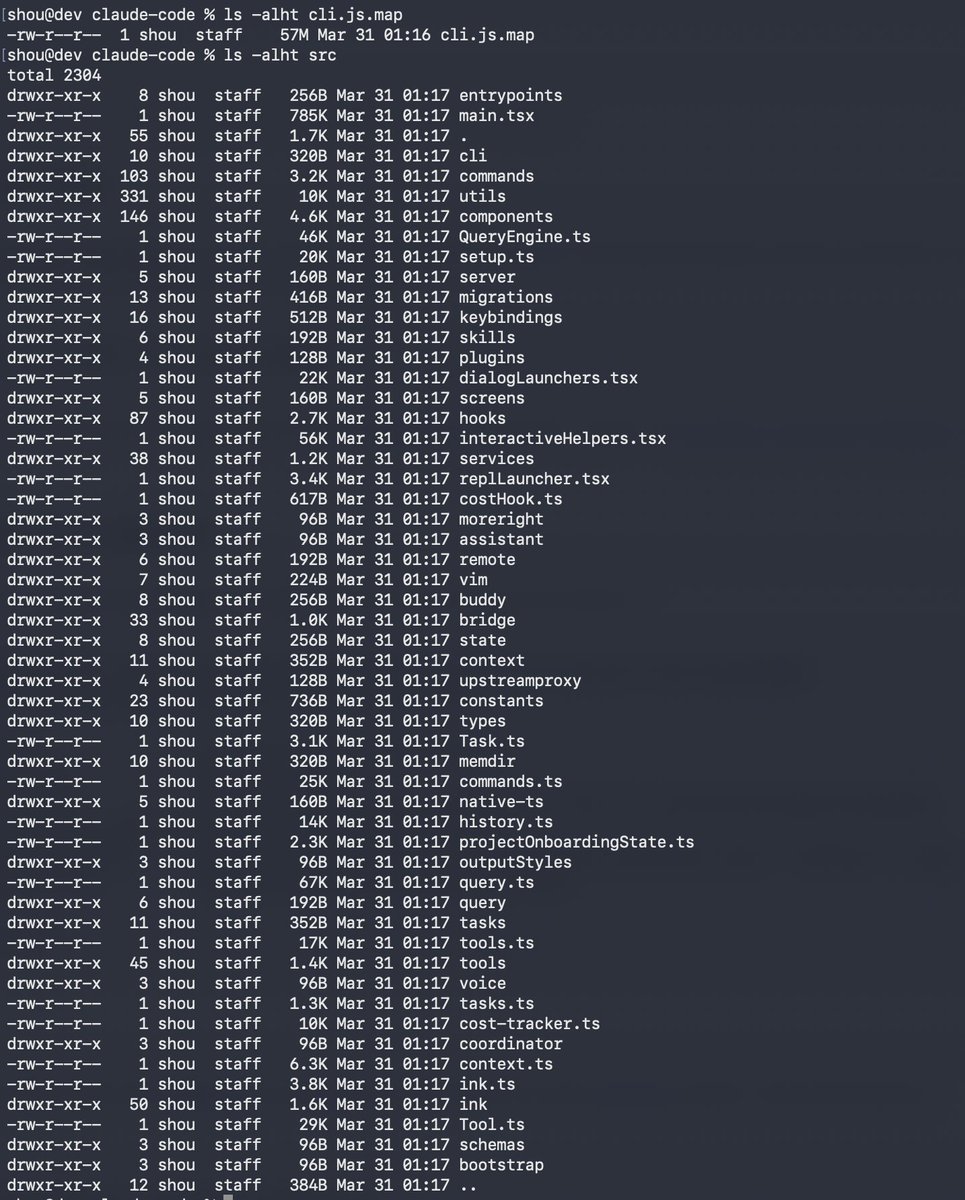
Claude code source code has been leaked via a map file in their npm registry!
Code: …a8527898604c1bbb12468b1581d95e.r2.dev/src.zip
English
jsonparser 2.0 retweetledi