Kaustuv Sen

315 posts

Kaustuv Sen

Kaustuv Sen

@kaustuvs

Investor. Healthcare. Tech Enabled Services. Emerging Markets. Arts Aficianado.

San Francisco, CA Katılım Şubat 2010
342 Takip Edilen106 Takipçiler
Kaustuv Sen
Kaustuv Sen@kaustuvs·
@RhysSullivan Exactly, for most of their examples, intelligence or cognitive work is not really the barrier to entry or the moat or the basis of the current friction. Few things in the economy are purely constrained by cognitive capacity.
English
0
0
0
155
Rhys
Rhys@RhysSullivan·
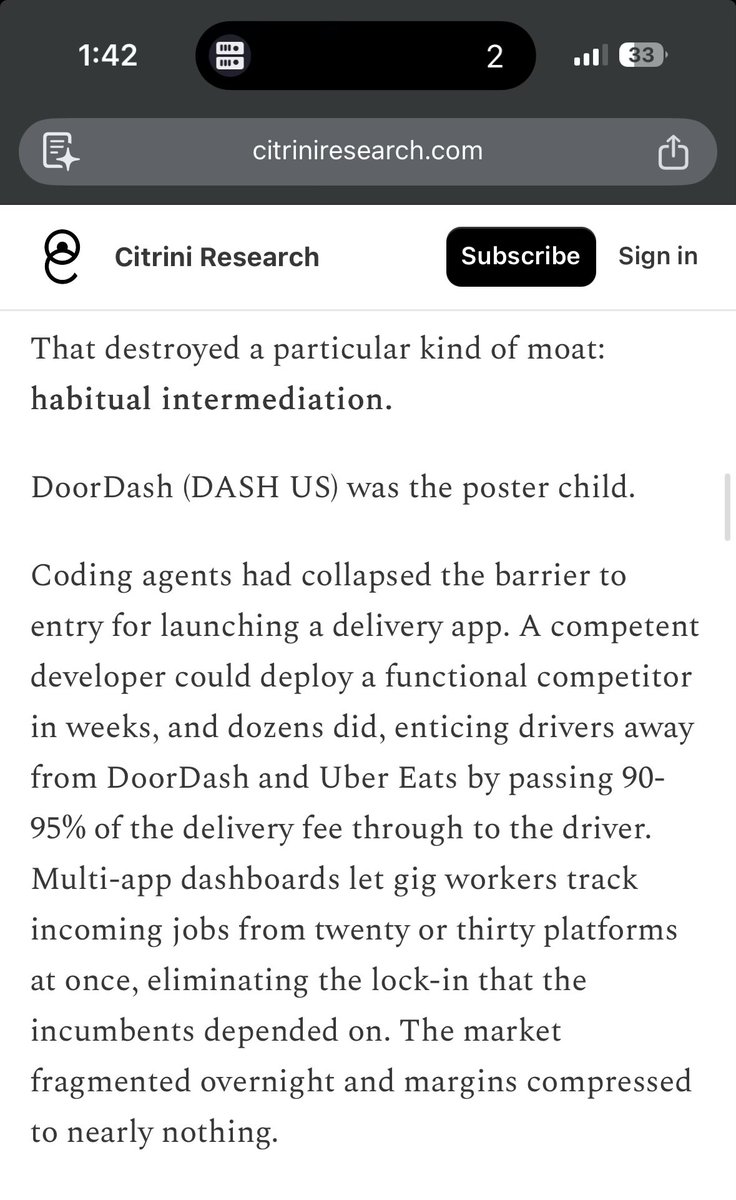
Out of every example they could’ve chosen, they went with DoorDash? The barrier to entry for launching a delivery app is not and has never been software, it’s distribution, restaurant adoption, user adoption Who is believing this stuff
Rhys tweet media
Citrini@citrini

JUNE 2028. The S&P is down 38% from its highs. Unemployment just printed 10.2%. Private credit is unraveling. Prime mortgages are cracking. AI didn’t disappoint. It exceeded every expectation. What happened?​​​​​​​​​​​​​​​​ citriniresearch.com/p/2028gic

English
149
67
1.9K
294K
Kaustuv Sen
Kaustuv Sen@kaustuvs·
@Citrini7 If it were, why isn’t there clean water throughout South Asia and Africa? The cognitive load of figuring that out was resolved decades ago. Now apply that thinking to every use case you go through. Less than 10% have intelligence / cognitive capacity as the binding constraint
English
0
0
0
14
Kaustuv Sen
Kaustuv Sen@kaustuvs·
@Citrini7 Nice piece. However, for 90% of these use cases, intelligence isn’t the rate limiting factor causing the friction. Never has been
English
1
0
1
242
Citrini
Citrini@citrini·
JUNE 2028. The S&P is down 38% from its highs. Unemployment just printed 10.2%. Private credit is unraveling. Prime mortgages are cracking. AI didn’t disappoint. It exceeded every expectation. What happened?​​​​​​​​​​​​​​​​ citriniresearch.com/p/2028gic
English
1.9K
4.2K
27.7K
28.6M
Kaustuv Sen
Kaustuv Sen@kaustuvs·
No need to conjecture. Here’s the data on top 30 most visited countries by Americans last year. Note that the numbers fall off precipitously down the list e.g. Mexico had 35 to 37 million American visits but China had only 1 - 1.5 million. Grok: Here is a straight bullet list of the top 30 countries most visited by Americans, based on the most recent comprehensive data from the U.S. National Travel and Tourism Office (NTTO) and related reports (primarily for 2023-2024, as full 2025 data is not yet available). - Mexico - Canada - United Kingdom - Italy - France - Dominican Republic - Spain - Germany - Jamaica - Japan - Costa Rica - Bahamas - Ireland - Netherlands - Greece - Portugal - India - Australia - China - South Korea - Turkey - Colombia - Peru - Ecuador - Brazil - Philippines - Thailand - Vietnam - Switzerland - Austria Source: U.S. Department of Commerce, National Travel and Tourism Office (NTTO) outbound travel data and Survey of International Air Travelers (SIAT), cross-referenced with 2023-2024 reports from trade.gov/travel-and-tou… and related analyses. For the most up-to-date details, visit the NTTO site directly.
English
0
0
0
42
Kaustuv Sen
Kaustuv Sen@kaustuvs·
@balajis @mattyglesias Also I didn’t list the actual visitor numbers but they drop off precipitously further down the list. Eg 35-37 million American visitors to Mexico but only 1-1.5 million to China! That latter figure is astoundingly low given its is the #2 economy with massive trade ties to the US
English
0
0
0
14
Kaustuv Sen
Kaustuv Sen@kaustuvs·
Balaji is largely right, based on the official data on most visited countries by Americans. India makes a surprisingly high showing but likely the usual tourist destinations and not business hubs like Bangalore. Grok: Here is a straight bullet list of the top 30 countries most visited by Americans, based on the most recent comprehensive data from the U.S. National Travel and Tourism Office (NTTO) and related reports (primarily for 2023-2024, as full 2025 data is not yet available). - Mexico - Canada - United Kingdom - Italy - France - Dominican Republic - Spain - Germany - Jamaica - Japan - Costa Rica - Bahamas - Ireland - Netherlands - Greece - Portugal - India - Australia - China - South Korea - Turkey - Colombia - Peru - Ecuador - Brazil - Philippines - Thailand - Vietnam - Switzerland - Austria Source: U.S. Department of Commerce, National Travel and Tourism Office (NTTO) outbound travel data and Survey of International Air Travelers (SIAT), cross-referenced with 2023-2024 reports from trade.gov/travel-and-tou… and related analyses. For the most up-to-date details, visit the NTTO site directly.
English
1
0
0
69
Kaustuv Sen
Kaustuv Sen@kaustuvs·
@levie This is exactly the premise of our portfolio company, Veltris. Plus deep domain knowledge in specific verticals to deliver vertical AI agentic workflows. You’re right, every company can’t figure all this out *and* implement these workflows themselves @HiralChandrana
English
0
0
0
98
Aaron Levie
Aaron Levie@levie·
To get the full benefit of AI agents you often need to change your underlying workflows, and keep up with a very fast moving AI space. Because of this, there are at least 2 entirely new categories of business models that will emerge around the software companies that build agents. 1. The services firm that implements AI agents in existing companies. As enterprises look to deploy AI agents across all forms of work, it’s not possible for every company to figure out how to do this on their own. Most companies don’t have the IT teams to deliver on this, so there will be entirely new system integrators that emerge to help companies redesign their workflows, implement the tech, drive the change management, and keep the AI agents up to date for the organization. But what’s super interesting is that because AI agents span almost every single line of business, these will not just be the classic system integrators whose primary focus is on IT systems. The system integrators will have to be domain experts at many different types of job functions, from marketing and legal to healthcare and coding. 2. New agency or firm that forms from the ground up to take advantage of the leverage of agents. Lots of companies will take too long to transform themselves with AI, so there will be an all new crop of companies that start from scratch the capture the gains. These services firms and agencies will use the technology themselves to offer cheaper, faster, or better quality of service to a broader range of clients than was possible before. This will be the new law firm that uses AI to change the business model of, marketing agencies that can support high quality campaigns for smaller size companies, engineering shops that can take on bigger project work at a lower cost, and so on. In all there are going to be lots of new forms of businesses that will emerge as a result of AI agents because of how different working with agents can be.
GREG ISENBERG@gregisenberg

This feels directionally right. An agency comes in for a few weeks, maps how work actually flows, and installs claude skills/agents that handle reporting, follow-ups, checks, and coordination. That replaces work spread across a few roles that might cost $250k–$400k a year. The company pays once for the setup, keeps the system, and only brings the agency back when something needs tuning. Of course agencies don’t go away since human judgment is always needed, but a growing share of what clients pay for shifts toward skills and agents that run inside the business. I keep coming back to this idea and it keeps making more sense.


English
57
75
555
135.5K
David Scott Patterson
David Scott Patterson@davidpattersonx·
The transition to full unemployment will be fast. It will begin in 2028, and by 2030, everyone will be unemployed and receiving UBI. Starting this year, AI will start replacing human work while increasing the quantity and quality of production. This trend will accelerate through 2027. During this period, most people who become unemployed will find new jobs. However, some individuals who see what's coming will choose to retire early rather than seek new employment. The economic growth during this period will enable governments to begin raising tax revenue to support the unemployed once unemployment starts to rise. By 2028, jobs will be replaced faster than new ones can be created, and the unemployment rate will climb. During this phase, UBI must be made available to those who become unemployed. The sales tax rate used to fund UBI will need to increase rapidly to support the growing number of people becoming unemployed. Some people will still have jobs during this transition period. Initially, UBI will only be available to those who have lost their jobs. By 2030, nearly everyone who was employed before the transition began will be unemployed and receiving UBI. Production will have increased so dramatically that prices will have dropped by about tenfold since the transition began. By 2032, UBI will be extended to all adults. This will be supported by the continued rapid economic growth driven by the use of AI and robots in industry. Beyond 2032, without the limits imposed by the quantity and quality of human labor, growth in economic output will continue up to the limit of consumer demand.
English
412
294
2.1K
377.3K
Kaustuv Sen
Kaustuv Sen@kaustuvs·
@paulg Bingo. . . the adoption of intelligence is limited by the intelligence of the human, not of the higher intelligence of the AI. This is obvious from studying human adoption of better intelligence from other humans, e.g. think of why malaria is not solved indeveloping countries
English
0
0
0
31
Paul Graham
Paul Graham@paulg·
A few decades from now, when we really understand AI, what about our current understanding of it will seem quaintly rooted in past ideas? I hope the answer is not the assumption that our understanding of AI is what matters, rather than AI's understanding of AI.
English
61
11
407
59.8K
Paul Graham
Paul Graham@paulg·
When a big new thing appears, we tend to think of it initially in terms of the old thing. For example, people thought of cars and trains as mechanized carriages initially, before starting to see them as their own thing. How are we doing this with AI?
Paul Graham tweet media
English
612
258
3.5K
492.5K
Kaustuv Sen
Kaustuv Sen@kaustuvs·
@bindureddy There will be more consultants and researchers, not less, as a result of this. Like Excel created an explosion of financial analysts and FP&A planners and tax analysts / planners, or CAD/CAM led to more mechanical and civil engineers
English
0
0
1
84
Bindu Reddy
Bindu Reddy@bindureddy·
Deep Research like agents will be ubiquitous and have already made consultants obsolete over-night Coming soon to ChatLLM and Enterprise
English
25
21
244
23.3K
Kaustuv Sen
Kaustuv Sen@kaustuvs·
@lessin And if replicate institutions, well, no longer have benefits of decentralization. Most of finance *needs* centralized institutions to prevent snake oil sales on what asset is worth since involves $… unlike, say, content where ok for consumers to distribute own words, pics etc
English
0
0
0
0
Kaustuv Sen
Kaustuv Sen@kaustuvs·
@lessin #1 won't work. Core issue w pvt companies etc isn't verifying asset title or contracts, it is protecting from naive valuation: why securities laws, SEC, IPO u/writers, banks etc exist. Unless replicate all those institutions on chain, will wreck investors and self-destruct.
English
1
0
0
0
sam lessin 🏴‍☠️
The Actually Important Practical Crypto Use Cases, In One Screenshot.
sam lessin 🏴‍☠️ tweet media
English
19
27
237
0
Kaustuv Sen
Kaustuv Sen@kaustuvs·
@SahilBloom @nathanbaugh27 Actually, around 8.6% CAGR. At 8%, it would have been worth only around $100M or ~half as much. The power of compounding, where that extra 0.6% makes such a huge difference… stunning!
English
0
0
1
0
Colin Landforce 🛠
Colin Landforce 🛠@landforce·
The Twitter app sucks for writing. - No auto save - Can't organize drafts - Doesn’t sync across devices So I built my own app:
English
61
151
1.3K
0
Kaustuv Sen
Kaustuv Sen@kaustuvs·
@nytimes @DLeonhardt 1/5,000 every day is about 7.3% annually, a rate barely lower than ALL Americans since the beginning of the pandemic, unvaxxed for most of that that period. How is this good?
English
0
0
0
0
The New York Times
The New York Times@nytimes·
“How small are the chances of the average vaccinated American contracting Covid?” @DLeonhardt writes in The Morning newsletter. “Probably about one in 5,000 per day.” Read more about the likelihood of breakthrough infections. nyti.ms/3n9gsQJ
English
280
376
978
0
Kaustuv Sen
Kaustuv Sen@kaustuvs·
@MonicaGandhi9 1/5,000 every day is about 7.3% annually, a rate barely lower than ALL Americans since the beginning of the pandemic, unvaxxed for most of that that period. How is this good?
English
0
0
0
0
Monica Gandhi MD, MPH
Monica Gandhi MD, MPH@MonicaGandhi9·
oh and acknowledge everyone's risk tolerance after vaccination different & respect differences in your friends. Public health's job? To prevent severe disease; we would never have heard of COVID-19 if it didn't cause severe disease (or developed a vax) nytimes.com/2021/09/07/bri…
English
8
8
59
0
Monica Gandhi MD, MPH
Monica Gandhi MD, MPH@MonicaGandhi9·
HOW MUCH CAN VACCINATED PERSON TRANSMIT WITH DELTA? Answer is - we don't know, but most certainly less than unvaccinated person and good to be humble and say "I don't know'. Why did we universally mask early in the pandemic (April 3 CDC guidelines?) ncbi.nlm.nih.gov/pmc/articles/P…
English
129
132
577
0
Kaustuv Sen
Kaustuv Sen@kaustuvs·
@krishnanrohit One of the strengths imo is precisely the lack of mental investment in one business model/ecosystem; & pattern recognition across hundreds. Avoids tunnel vision. Answers here, for example, replete with startup ecosystem biases (eg startup folks are the smartest), often misplaced
English
0
1
1
0
rohit
rohit@krishnanrohit·
The biggest lesson I had from my time at McKinsey was that a 23yo with zero knowledge of an industry can walk into a company and can, surprisingly often, make it better.
English
145
494
7K
0
Kaustuv Sen
Kaustuv Sen@kaustuvs·
@david_kochman @BradSpellberg @mugecevik Also plenty of data from Qatar and PHE in the UK supports same conclusion… so it’s not just Israel. US has not tracked breakthrough infections so really impossible to answer statistically here other than through small studies like the Mayo Clinic one (which broadly supports)
English
0
0
0
0
Brad Spellberg
Brad Spellberg@BradSpellberg·
Are we over-reading Israel's experience? Iceland & Denmark haven't had severe COVID return. And in LA, 8 months into vaccination, at the 2 public hospitals I'm currently CMO at, 693+ tests since July: 90% of all tests in unvaccinated 98% all admissions due to COVID unvaccinated
English
109
236
1.4K
0