
Linqing Liu

106 posts

Linqing Liu banner
Linqing Liu

Linqing Liu

@likicode

Applied AI @Databricks | PhD @ucl_nlp | ex-Research Scientist intern @GoogleDeepMind @SFResearch

Katılım Ekim 2015
470 Takip Edilen873 Takipçiler
Linqing Liu retweetledi
Ying Sheng
Ying Sheng@ying11231·
Congrats @radixark ! From SGLang @lmsysorg to Miles, and to future products, RadixArk is dedicated to building a crucible capable of repeatedly producing cutting-edge AI, bringing the best of AI into every household. We believe in a future of AI diversity and hope to drive the integration of AI into every aspect of production and daily life. In the future we envision, AI will become a partner to many companies and individuals, finding ways to self-evolve—in production, in daily companionship, and within virtual worlds. Everything we have experienced and will continue to experience in the SGLang and Miles open-source communities is unforgettable and highly anticipated. It has been both demanding and exhilarating, allowing us to see friendship, the world, and the boundaries. Over the past six months, I have witnessed for the first time how a united team moves forward hand in hand, and how deeply passionate they are about creation. Each of us has taken on our respective roles and numerous new tasks for the first time; we are all stepping out of our comfort zones, growing, and creating at a rapid pace. "It’s the step-by-step journey of a thousand miles that has carried us here today, and the same relentless march that will lead us into the tens of thousands of miles yet to come." In an era where AI has made ordinary productivity cheaper, relentless, day-to-day refinement has increasingly become the rare key that drives innovation and the future. We hope this will forever remain the soul of RadixArk's culture: focused, uncompromising, humble, and fearless. The underlying logic of creation is not the deliberate pursuit of novelty, but rather independent thinking that remains unswayed by temptation, paired with a meticulous drive for perfection.
RadixArk@radixark

Today, we are thrilled to officially launch RadixArk with $100M in Seed funding at a $400M valuation. The round was led by @Accel and co-led by @sparkcapital. RadixArk exists to make frontier AI infrastructure open and accessible to everyone. Today, the systems behind the most capable AI models are concentrated in a small number of companies. As a result, most AI teams are forced to rebuild training and inference stacks from scratch, duplicating the same infrastructure work instead of focusing on new models, products, and ideas. RadixArk was founded to change that. We are building an AI platform that makes it easier for teams to train and serve the best models at scale. RadixArk comes from the open-source community. We started with SGLang, where many of us are core developers and maintainers, and expanded our work to Miles for large-scale RL and post-training. We will continue contributing to both projects and working with the community to make them the strongest open-source infrastructure foundations for frontier AI. We would like to thank our long-term partners, contributors, and the broader SGLang community for believing in this mission. We're also grateful to @Accel and @sparkcapital, NVentures (Venture capital arm of @nvidia), Salience Capital, A&E Investment, @HOFCapital, @walden_catalyst, @AMD, LDVP, WTT Fubon Family, @MediaTek, Vocal Ventures, @Sky9Capital and our angel investors @ibab, @LipBuTan1, Hock Tan, @johnschulman2, @soumithchintala, @lilianweng, @oliveur, @Thom_Wolf, @LiamFedus, @robertnishihara, @ericzelikman, @OfficialLoganK, and @multiply_matrix among others. Thanks for the exclusive interview with @MeghanBobrowsky at @WSJ about our vision.


English
18
26
171
11.8K
Linqing Liu
Linqing Liu@likicode·
@ibab Wishing you all the best on your next adventures!
English
0
0
1
176
Igor Babuschkin
Igor Babuschkin@ibab·
Today was my last day at xAI, the company that I helped start with Elon Musk in 2023. I still remember the day I first met Elon, we talked for hours about AI and what the future might hold. We both felt that a new AI company with a different kind of mission was needed. Building AI that advances humanity has been my lifelong dream. My parents left the Russian Federation after the collapse of the USSR in search of a better life for their kids. Life wasn’t always easy as immigrants. Despite the hardships, my parents believed that human values were priceless: values like courage, compassion, curiosity for understanding the world. As a child, I admired scientists like Richard Feynman and Max Planck, who relentlessly pushed the frontiers of physics in order to understand the universe. As a particle physics PhD student at CERN I was excited to contribute to that mission. But the search for new physics was getting harder and harder, requiring bigger and bigger colliders, while new discoveries kept getting fewer. So I began to wonder if superintelligence, not larger colliders, could be the key to unlocking the mysteries of the universe. Could AI develop a consistent theory of quantum gravity? Could AI prove the Riemann hypothesis? In early 2023 I became convinced that we were getting close to a recipe for superintelligence. I saw the writing on the wall: very soon AI could reason beyond the level of humans. How could we ensure that this technology is used for good? Elon had warned of the dangers of powerful AI for years. Elon and I realized that we had a shared vision of AI used to benefit humanity, thus we recruited more like minded engineers and set off to build xAI. The early days of xAI were not easy. Naysayers told us that we arrived too late to the game, so starting a top AI company from scratch would be impossible. But we believed we could do the impossible. Starting a company from zero required lots of hands-on work. In the beginning I built many of the foundational tools used at the company to launch and manage training jobs. I later oversaw much of the engineering at the company, including Infrastructure, Product and Applied AI projects. xAI’s people are deeply dedicated. Through blood sweat and tears, our team’s blistering velocity built the Memphis supercluster, and shipped frontier models faster than any company in history. I learned 2 priceless lessons from Elon: #1 be fearless in rolling up your sleeves to personally dig into technical problems, #2 have a maniacal sense of urgency. xAI executes at ludicrous speed. Industry veterans told us that building the Memphis supercluster in 120 days would be impossible. But we believed we could do the impossible. Our goal was to get our training setup running at scale on the Memphis cluster ASAP. Towards the end of our 120 day deadline, we were riddled with mysterious issues with communicating over RDMA between the machines. Elon decided to fly to the datacenter, and we followed. Our infra team landed in Memphis in the middle of the night and got straight to work. After pouring through tens of thousands of lines of lspci output we finally identified a wrong BIOS setting, the root of the problem. Elon was there with us until late into the night. When the training run finally worked, Elon posted our triumph at “4:20am” causing us to laugh out loud. I will never forget the rush of adrenaline that night, and the emotional bonds that we were all in this together. We went to bed feeling like we were living through the most exhilarating time of our lives. I have enormous love for the whole family at xAI. Our team is truly special - you’re the most dedicated people I’ve ever worked with. Catching up to the frontier this quickly hasn’t been easy. It was made possible by everyone’s diehard grit and team spirit. Thank you to every single person who joined me on this adventure. I want to honor your contributions, your time, your sacrifices, which are never easy. I will always remember working together far into the nights and burning the midnight oil. I will never forget the sacrifices and contributions you’ve made. As I drive away today, I feel like a proud parent, driving away after sending their kid away to college. My heart is brimming with tears of joy, rooting for the company as it grows and matures. As I'm heading towards my next chapter, I’m inspired by how my parents immigrated to seek a better world for their children. Recently I had dinner with Max Tegmark, founder of the Future of Life Institute. He showed me a photo of his young sons, and asked me “how can we build AI safely to ensure that our children can flourish?” I was deeply moved by his question. Earlier in my career, I was a technical lead for DeepMind's Alphastar StarCraft agent, and I got to see how powerful reinforcement learning is when scaled up. As frontier models become more agentic over longer horizons and a wider range of tasks, they will take on more and more powerful capabilities, which will make it critical to study and advance AI safety. I want to continue on my mission to bring about AI that’s safe and beneficial to humanity. I’m announcing the launch of Babuschkin Ventures, which supports AI safety research and backs startups in AI and agentic systems that advance humanity and unlock the mysteries of our universe. Please reach out at ventures@babuschk.in if you want to chat. The singularity is near, but humanity’s future is bright!
English
1.4K
2K
29.2K
2.9M
Akari Asai
Akari Asai@AkariAsai·
Some updates 🚨 I finished my Ph.D at @uwcse in June 2025! After a year at AI2 as a Research Scientist, I am joining CMU @LTIatCMU & @mldcmu (courtesy) as an Assistant Professor in Fall 2026. The journey, acknowledgments & recruiting in 🧵
Akari Asai tweet mediaAkari Asai tweet media
English
122
62
1.4K
120.4K
Linqing Liu retweetledi
Andrej Karpathy
Andrej Karpathy@karpathy·
Good post from @balajis on the "verification gap". You could see it as there being two modes in creation. Borrowing GAN terminology: 1) generation and 2) discrimination. e.g. painting - you make a brush stroke (1) and then you look for a while to see if you improved the painting (2). these two stages are interspersed in pretty much all creative work. Second point. Discrimination can be computationally very hard. - images are by far the easiest. e.g. image generator teams can create giant grids of results to decide if one image is better than the other. thank you to the giant GPU in your brain built for processing images very fast. - text is much harder. it is skimmable, but you have to read, it is semantic, discrete and precise so you also have to reason (esp in e.g. code). - audio is maybe even harder still imo, because it force a time axis so it's not even skimmable. you're forced to spend serial compute and can't parallelize it at all. You could say that in coding LLMs have collapsed (1) to ~instant, but have done very little to address (2). A person still has to stare at the results and discriminate if they are good. This is my major criticism of LLM coding in that they casually spit out *way* too much code per query at arbitrary complexity, pretending there is no stage 2. Getting that much code is bad and scary. Instead, the LLM has to actively work with you to break down problems into little incremental steps, each more easily verifiable. It has to anticipate the computational work of (2) and reduce it as much as possible. It has to really care. This leads me to probably the biggest misunderstanding non-coders have about coding. They think that coding is about writing the code (1). It's not. It's about staring at the code (2). Loading it all into your working memory. Pacing back and forth. Thinking through all the edge cases. If you catch me at a random point while I'm "programming", I'm probably just staring at the screen and, if interrupted, really mad because it is so computationally strenuous. If we only get much faster 1, but we don't also reduce 2 (which is most of the time!), then clearly the overall speed of coding won't improve (see Amdahl's law).
Balaji@balajis

AI PROMPTING → AI VERIFYING AI prompting scales, because prompting is just typing. But AI verifying doesn’t scale, because verifying AI output involves much more than just typing. Sometimes you can verify by eye, which is why AI is great for frontend, images, and video. But for anything subtle, you need to read the code or text deeply — and that means knowing the topic well enough to correct the AI. Researchers are well aware of this, which is why there’s so much work on evals and hallucination. However, the concept of verification as the bottleneck for AI users is under-discussed. Yes, you can try formal verification, or critic models where one AI checks another, or other techniques. But to even be aware of the issue as a first class problem is half the battle. For users: AI verifying is as important as AI prompting.

English
134
537
4.4K
844.1K
Douwe Kiela
Douwe Kiela@douwekiela·
I’m really sad that my dear friend @FelixHill84 is no longer with us. He had many friends and colleagues all over the world - to try to ensure we reach them, his family have asked to share this webpage for the celebration of his life: pp.events/felix
Douwe Kiela tweet media
English
110
82
727
300.8K
Linqing Liu retweetledi
Demis Hassabis
Demis Hassabis@demishassabis·
Thrilled to kick off the Gemini 2.0 era with Gemini 2.0 Flash, an update to our workhorse model that outperforms even 1.5 Pro at twice the speed. It has really great multilingual skills, and can natively call tools, like Google Search. It’s the first release in the Gemini 2.0 family of models, with more to come soon. This is really just the beginning. 2025 will be the year of AI agents and Gemini 2.0 will be the generation of models that underpin our agent-based work. We’re sharing a set of prototypes made possible by 2.0 Flash’s new capabilities: including an update to Project Astra, our vision for a universal AI assistant; the new Project Mariner, which explores the future of human-agent interaction, starting with your browser; and Jules, an AI-powered code agent that can help developers. We’re also sharing a few other easter eggs, like: agents that help you navigate video games, which builds on our rich heritage of games breakthroughs in AI, and agents for robotics.
GIF
English
103
404
2.8K
311.9K
Zhengyao Jiang
Zhengyao Jiang@zhengyaojiang·
Just passed my PhD viva with no corrections yesterday! My PhD journey has been truly life-changing, and I want to express my deepest gratitude to everyone who made this possible: 🧵
Zhengyao Jiang tweet media
English
19
9
195
23K
Jimmy Lin
Jimmy Lin@lintool·
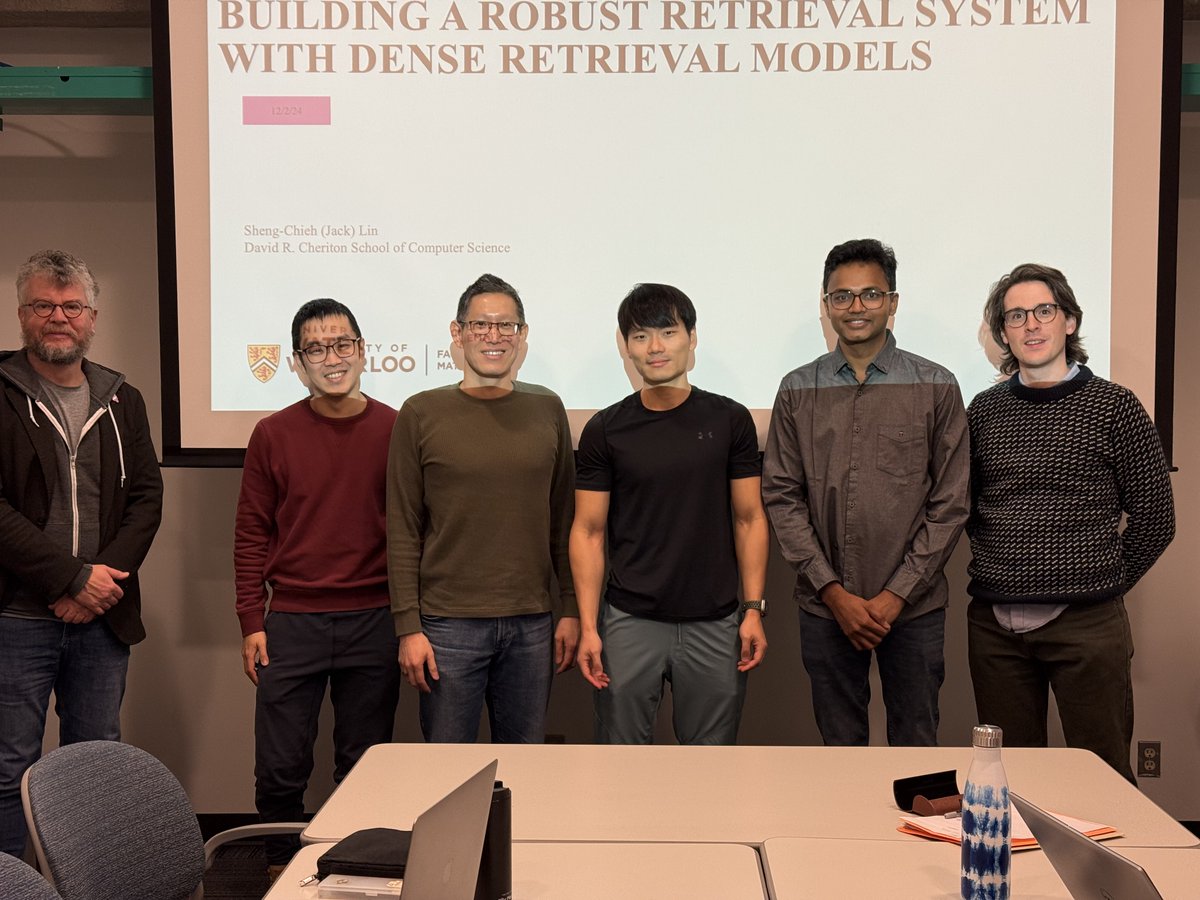
Congratulations to Dr. @jacklin_64 for successfully defending his Ph.D. thesis "Building a Robust Retrieval System with Dense Retrieval Models"! 🎉
Jimmy Lin tweet media
English
8
6
119
10.3K
Linqing Liu
Linqing Liu@likicode·
Evaluating LLMs in enterprise domains can be challenging. In this post, we share how our applied AI team synthesized high-quality code tests for specific libraries to enhance system performance. Joint work with MatthewHayes @matei_zaharia @ritendra!
Databricks@databricks

#LLMs are revolutionizing code generation, but ensuring accuracy with domain-specific tools like Spark SQL is vital. Discover how to synthesize tailored code tests for LLMs, offering a precise way to evaluate performance across any coding library. dbricks.co/3TOZery

English
0
6
22
3.8K
Linqing Liu retweetledi
Arena.ai
Arena.ai@arena·
We are thrilled to announce the milestone release of SGLang Runtime v0.2, featuring significant inference optimizations after months of hard work. It achieves up to 2.1x higher throughput compared to TRT-LLM and up to 3.8x higher throughput compared to vLLM. It consistently delivers superior performance when serving Llama-8B to 405B models on A100/H100 with FP8/BF16. SGLang is fully open-source and implemented in Python. As it matures from a prototype, we invite the community to join us in creating the next-generation efficient serving engine! Learn more at lmsys.org/blog/2024-07-2…
Arena.ai tweet media
English
12
121
515
138.3K
John Hewitt
John Hewitt@johnhewtt·
I’m joining the Columbia Computer Science faculty as an assistant professor in fall 2025, and hiring my first students this upcoming cycle!! There’s so much to understand and improve in neural systems that learn from language — come tackle this with me!
John Hewitt tweet media
English
122
52
887
100.4K
Weihua Hu
Weihua Hu@weihua916·
Update: I’ve joined @perplexity_ai last week. It’s an exciting time to explore search + LLM and build a knowledge-centric product that people love!
Weihua Hu tweet media
English
18
8
430
65.2K
Linqing Liu retweetledi
Arthur Mensch
Arthur Mensch@arthurmensch·
Official now, very proud of the team! Apache 2.0 and instructed versions for your pleasure, available today on la Plateforme mistral.ai/news/mixtral-8…
English
53
75
658
63.6K
Linqing Liu retweetledi
Mistral AI
Mistral AI@MistralAI·
magnet:?xt=urn:btih:9238b09245d0d8cd915be09927769d5f7584c1c9&dn=mixtral-8x22b&tr=udp%3A%2F%2Fopen.demonii.com%3A1337%2Fannounce&tr=http%3A%2F%https://t.co/OdtBUsbeV5%3A1337%2Fannounce
Indonesia
258
753
5.6K
1.8M
Linqing Liu retweetledi
Ali Ghodsi
Ali Ghodsi@alighodsi·
Today we released an open source model, DBRX, that beats all previous open source models on the standard benchmarks. The model itself is a Mixture of Experts (MoE), that's roughly twice the brains (132B) but half the cost (36B) of Llama2-70B. Making it both smart and cheap. Since only 36B expert parameters are used live, it's close to twice the speed (tokens/seconds) of Llama2-70B. We're excited to build custom versions of this for organizations that have proprietary data! Check it out! databricks.com/blog/announcin…
English
134
210
1.1K
216.3K
Linqing Liu retweetledi
Matei Zaharia
Matei Zaharia@matei_zaharia·
At Databricks, we've built an awesome model training and tuning stack. We now used it to release DBRX, the best open source LLM on standard benchmarks to date, exceeding GPT-3.5 while running 2x faster than Llama-70B. databricks.com/blog/introduci…
English
12
127
633
129.2K