Mathieu Baudet

957 posts

Mathieu Baudet banner
Mathieu Baudet

Mathieu Baudet

@ma2bd

Building @linera_io: real-time systems for markets that can’t wait. Ex @meta, @novi, @anssi_fr.

San Francisco, CA Katılım Eylül 2010
1.3K Takip Edilen205.3K Takipçiler
Sabitlenmiş Tweet
Mathieu Baudet
Mathieu Baudet@ma2bd·
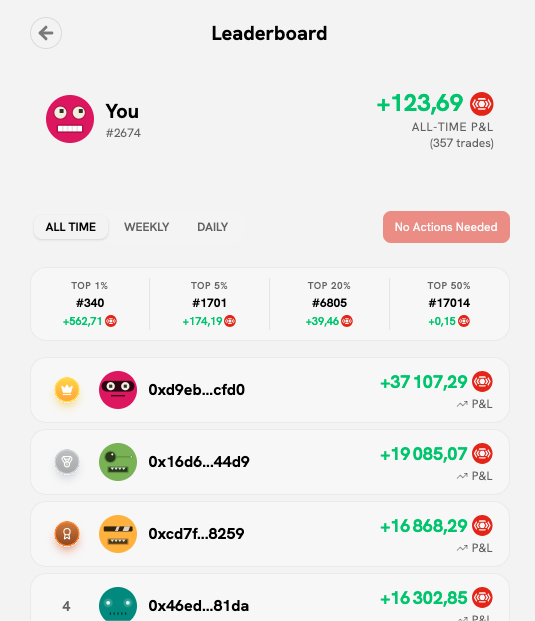
And just like that Linera Markets Beta passed 10M predictions in less than 5 weeks!
Mathieu Baudet tweet media
English
18
14
60
3.1K
Lorenzo Valente
Lorenzo Valente@LorenzoARK·
Just got back from @consensus2026 Miami. Some unfiltered thoughts on the vibes: The industry has clearly grown up. The degens are gone, the allocators are wearing suits, and your @Uniswap booth has been replaced by a JP Morgan activation with 50 year old boomers. Cautiously optimistic with a distinctly institutional aftertaste. This was not a bull market conference. Key takeaways: 1) CLARITY Act has serious momentum. Everyone at the conference basically agrees it's getting done before summer. The urgency is real, people are done waiting. And the regulatory window feels genuinely unprecedented: CLARITY Act, GENIUS Act, a CFTC chair actively engaging with the industry, this combination has never existed simultaneously before. The institutional urgency you're seeing everywhere is directly correlated to this window feeling time-limited. Miss it and you're explaining to your board why you sat on your hands during the most favorable crypto regulatory environment in history. 2) Institutions are not dabbling anymore. They are ALL IN on tokenization and terrified of missing it. No one is debating whether blockchain rails are useful. The debate is now who gets the mandate. And quietly @coinbase , @krakenfx , @RobinhoodApp and @Bullish and others are being seen more as competitors than potential partners by a lot of these TradFi players. 3) TradFi M&A is going to keep ripping. @krakenfx just grabbed Reap for $600M. Visa, Mastercard, Swift etc they can't miss the train and they're willing to overpay for the ticket. 4) Crypto VC is consolidating fast. @a16z and @katie_haun just announced $2.2B and $1B funds respectively. Meanwhile the boutique VCs are either pivoting to AI or quietly closing shop. Same playbook is happenign as traditional VC, the big platforms eat everything and the small guys scramble. Seed and pre-seed is basically a ghost town right now. Late stage and pre-IPO is where the action is. 5) Investment themes were aggressively consensus (no pun intended): Stablecoins, tokenization, vertically integrated neo-banks, regulated or permissioned DeFi. Literally everyone is trying to be a tokenization platform. Issuance, management, settlement, curation, pick your lane, slap tokenization on it, try to raise money. 6) Building in crypto is genuinely hard now. Your competition isn't some scrappy new L1 or GMX, it's @tether , @Anchorage , and @Securitize. there are now many crypto businesses running 200M+ annual Rev with serious management teams and deep pockets. The barbarians are now the establishment. New entrants are going to have a very bad time. 7) Pure token-only plays have become extremely contrarian. Controversial take but I think the biggest returns will come from a handful of tokens that can credibly signal in a compliant way that the token remains the only value accruing asset going forward. 8) A lot of teams are in a genuinely weird spot on the token/equity dynamics. Decent products, decent teams, but a complete stakeholder clusterf*** that nobody can untangle. Many of these will simply not survive. 9) The agentic finance and agentic commerce crowd was loud. The actual substance was not. A lot of big claims, very little to show for it. Feels very early and mostly vibes. Color me skeptical for now. 10) @Bullish acquiring Equinity for $4.2B was the boldest move of the conference. @ThomasFarley and @BonannoDavid now have a full-stack RWA proposition: issuance, transfer agency, tokenization, exchange and settlement under one roof. Massive move. Very positive for the industry regardless of whether you think the price or the move were right. 11) @BitMNR and @fundstrat are apparently tired of winning and has decided to let your grandma keep her ETH... for now. The pace of accumulation is slowing. Tom, we await your next allocation with bated breath. 12) DeFi apps are moving up the stack and getting smarter about it. They don't want to be the commodity infrastructure layer getting squeezed by exchanges that own distribution. Some genuinely interesting announcements, @buffalu__ at @jito_sol launching JTX being the highlight. 13) Nobody at the conference was talking about retail coming back. The entire conversation was institutional. That's either a sign of maturity or a sign that the industry has quietly given up on mainstream consumer adoption for now and is betting the next cycle gets pulled by institutional flows rather than retail FOMO. Probably both. 14) The L1 debate is officially dead. Nobody and I mean nobody was arguing SOL vs ETH or pitching their shiny new L1. The crowd that used to religiously defend their chain of choice has either grown up, cashed out, or both. Institutions don't care about your consensus mechanism. They care about settlement finality, compliance rails and liquidity. The L1 wars were fun while they lasted. RIP. 15) DATs are a mess. Had some genuinely productive conversations with a few of them but let's be honest most are an absolute clusterf*** operationally and very few are running anything resembling a legitimate business. The structure is a disaster at the stakeholder level and the governance makes your average startup cap table look clean. That said, the permanent capital vehicle concept is still genuinely compelling and I think a handful of these will turn out to be absolute home runs. The model isn't broken, most of the teams just are. Bottom line: Consensus 2026 felt like the moment crypto stopped being a movement and started being an industry. Whether that's exciting or depressing probably depends on when you got in.
English
105
126
975
251.2K
Mathieu Baudet
Mathieu Baudet@ma2bd·
And just like that Linera Markets Beta passed 10M predictions in less than 5 weeks!
Mathieu Baudet tweet media
English
18
14
60
3.1K
Mathieu Baudet
Mathieu Baudet@ma2bd·
@jonah_b Maybe tech never looks like a limiter until it is x.com/devjoshstevens…
Jonah Burian@jonah_b

A lot of the founders in my DMs pitched me a on prediction markets. I think most of them are chasing the wrong opportunity… Prediction markets are now among the most competitive categories on earth. @Polymarket and @Kalshi are raising mind-boggling numbers, and traditional players like @RobinhoodApp are building their own products. The category has incumbents with massive liquidity, strong brands, and aggressive product roadmaps. For the startups building net new prediction markets, it’s worth asking: what is the unique edge? Some pitch adding new market formats as their wedge. I don’t know if this is defensible. Every incumbent is actively expanding into new formats. Look at what @Polymarket offered just a year ago compared to today. They ship new products by the week. If the incumbents can add your market type faster than you can build distribution, the advantage evaporates. Others argue that better tech is the wedge. Tech doesn’t appear to be a limiter on @Polymarket or @Kalshi. The platforms work. Users aren’t leaving because of a tech problem. In my opinion, the more interesting opportunity is packaging prediction markets into entirely new products for underserved customers. People who would never open a @Polymarket account but have a real need to express a view on some future outcome. An outdoor concert venue might want to go long on rain for Sunday night to hedge cancellation risk. A logistics company might want to take a position on port delays. These are prediction market use cases dressed up as risk management tools, sold through channels the incumbents might not touch. And you don’t have to reinvent the wheel. You don’t need to build the market, source the liquidity, or design the matching engine. You can plug into existing prediction market APIs and focus entirely on distribution and product. There’s a fair pushback about platform risk here. But @Polymarket is onchain and open, which makes this meaningfully less risky than building on a closed platform. I’m not saying a new prediction market will never break through. In many mature categories someone always finds a way. @HyperliquidX broke into perps, one of the most competitive verticals in crypto with many well-capitalized competitors. AI gave @CoreWeave an opening in cloud. But in each case there was a specific structural reason the new entrant won. Disclosure: We are @Polymarket investors. Take the above with a grain of salt

English
0
1
7
948
Mathieu Baudet retweetledi
Lenny Rachitsky
Lenny Rachitsky@lennysan·
My biggest takeaways from Claude Code's Head of Product @_catwu: 1. Anthropic’s product development timelines have gone from six months to one month, sometimes one week, sometimes one day. Part of this acceleration is access to the latest models (i.e. Mythos). Another is shipping new products into “research preview,” making clear it's early, experimental, and might not be supported forever. Another is an evergreen "launch room "where engineers post ready features and marketing turns around announcements the next day. 2. The PM role is shifting from coordinating multi-month roadmaps to enabling teams to ship daily. As Cat puts it, “There should be less emphasis on making sure you are aligning your multi-quarter roadmaps with your partner teams and more emphasis on, OK, how can we figure out the fastest way to get something out the door?” 3. The most efficient shipping unit is an engineer with great product taste. On Cat’s team, many engineers go end-to-end—from seeing user feedback on Twitter to shipping a product by the end of the week—without a PM involved. Also, almost all the PMs on the Claude Code team have either been engineers or ship code themselves, and the designers have been front-end engineers. The roles are merging, and the most valuable skill is product taste, not job title. 4. Build products that are on the edge of working. Claude Code’s code review product failed multiple times because earlier models weren’t accurate enough. But because the prototype was already built, they could swap in Opus 4.5 and 4.6 and immediately test whether the gap was closed. Teams that wait for the model to be ready will always be a cycle behind. 5. The most underrated skill for building AI products is asking the model to introspect on its own mistakes. Cat regularly asks the model why it made an unexpected decision. The model will explain that something in the system prompt was confusing, or that it delegated verification to a subagent that didn’t check its work. This reveals what misled the model so the team can fix the harness. 6. Every model release forces their team to revisit existing products and audit their system prompt to remove features the model no longer needs. Claude Code’s to-do list was a crutch for earlier models that couldn’t track their own work. With Opus 4, the model handles it natively. Features built as scaffolding for weaker models become debt when the model catches up—so the team actively strips them. 7. Anthropic employees build custom internal tools instead of buying SaaS products. A sales team member built a web app that pulls from Salesforce, Gong, and call notes to auto-customize pitch decks—work that used to take 20 to 30 minutes now takes seconds. Their core stack is Claude Code, Cowork, and Slack. No Notion, no Linear, no Figma. 8. People underestimate how much Claude’s personality contributes to its success. As Cat describes it, “When you reflect on everyone you’ve worked with, there’s just some people where you’re like, I really like their energy, their vibe.” Claude is designed to be low-ego, positive, competent, and earnest—qualities that make it feel like a great coworker, not just a tool. This isn’t cosmetic; it’s what makes people want to use Claude for hours every day. The team has a dedicated person, Amanda, who “molds Claude’s character,” and it’s one of the hardest roles at the company because success is so subjective. 9. The future of work is managing fleets of AI agents, not doing the work yourself. Cat sees a clear progression: first, individual tasks become successful. Then people start running multiple tasks at the same time (multi-Clauding). Next, people will run 50 or 100 tasks simultaneously, which will require new infrastructure—remote execution, better interfaces for managing tasks, agents that fully verify their work, and self-improving systems that incorporate feedback. The human role shifts from doing the work to knowing which tasks to look into, verifying outputs, and giving feedback that makes the system better over time. 10. Hire people who lean into chaos and face every challenge with a smile. At Anthropic, there are weeks when a P0 on Sunday becomes a P00 by Monday and a P000 by Monday afternoon. If you get too stressed about any one thing, you’ll burn out. Their team looks for people who can look at a hard challenge and say, “Wow, that’s gonna be hard. But I’m excited to tackle it and I’m gonna do the best that I possibly can.” This mindset—optimism, resilience, and comfort with constant change—is increasingly essential as the pace of AI development accelerates. Don't miss the full conversation: youtube.com/watch?v=Pplmzl…
YouTube video
YouTube
Lenny Rachitsky@lennysan

How Anthropic’s product team moves faster than anyone else I sat down with @_catwu, Head of Product for Claude Code at @AnthropicAI, to get a peek into their unprecedented shipping pace, how AI is changing the PM role, and how to be the right amount of AGI-pilled. We discuss: 🔸 How Anthropic’s shipping cadence went from months to weeks to days 🔸 The emerging skills PMs need to develop right now 🔸 Why you should build products that don't work yet—then wait for the model to catch up 🔸 Why a 95% automation isn't really an automation 🔸 Cat’s most underrated AI skill (introspection) 🔸 What Cat actually looks for when hiring PMs now (hint: it's not traditional PM skills) Listen now 👇 youtu.be/PplmzlgE0kg

English
99
297
2.9K
839.5K
Jeff Park
Jeff Park@dgt10011·
the new product category that is most naturally adjacent to events-based contracts for prediction markets to go after is actually not perps it's 0DTE options few
English
27
9
159
31K
Mathieu Baudet retweetledi
🍓🍓🍓
🍓🍓🍓@iruletheworldmo·
a masterclass in coding agents from the head of anthropic. there’s still a tonne of leverage in knowing how to use these systems optimally and this is the best i’ve seen. make sure to bookmark so you can watch again and again chat
English
49
218
2.8K
290.4K
Mathieu Baudet
Mathieu Baudet@ma2bd·
That's despite getting our website "linera DOT market" falsely reported and to this day still banned by X, Norton, and a bunch of other platforms.
English
0
0
9
539
Mathieu Baudet retweetledi
Guy Wuollet
Guy Wuollet@guywuolletjr·
Come work with me @a16zcrypto! We are hiring an investment partner for our crypto team. We’re a small high trust group that focuses on investing in everything related to blockchains including DeFi, onchain finance, decentralized AI, and the infrastructure to support those applications. If you are an onchain degenerate arbitraging between vaults, love working with founders at an early stage, and/or feel passionate about decentralized AI, please talk to us or refer a friend. Our investment partners help identify and select the companies we invest in, thinking critically about new technologies and market trends. They also serve as mentors for the companies they invest in, helping them make progress across product, GTM, fundraising, etc We’re looking for: - Strong DeFi expertise either as a builder directly, a power user, or an investor - Interest in working with protocols and start ups at every stage - A strong network of onchain frens, especially those starting new projects If you’re interested, please send me a DM or refer a friend!
English
96
51
892
117.4K
Mathieu Baudet
Mathieu Baudet@ma2bd·
@linera_io Oh boy the website is now down for most browsers due to a false report to "Google Safe Browsing". Thanks for you patience!
English
0
0
1
608
Mathieu Baudet retweetledi
Andrej Karpathy
Andrej Karpathy@karpathy·
It is hard to communicate how much programming has changed due to AI in the last 2 months: not gradually and over time in the "progress as usual" way, but specifically this last December. There are a number of asterisks but imo coding agents basically didn’t work before December and basically work since - the models have significantly higher quality, long-term coherence and tenacity and they can power through large and long tasks, well past enough that it is extremely disruptive to the default programming workflow. Just to give an example, over the weekend I was building a local video analysis dashboard for the cameras of my home so I wrote: “Here is the local IP and username/password of my DGX Spark. Log in, set up ssh keys, set up vLLM, download and bench Qwen3-VL, set up a server endpoint to inference videos, a basic web ui dashboard, test everything, set it up with systemd, record memory notes for yourself and write up a markdown report for me”. The agent went off for ~30 minutes, ran into multiple issues, researched solutions online, resolved them one by one, wrote the code, tested it, debugged it, set up the services, and came back with the report and it was just done. I didn’t touch anything. All of this could easily have been a weekend project just 3 months ago but today it’s something you kick off and forget about for 30 minutes. As a result, programming is becoming unrecognizable. You’re not typing computer code into an editor like the way things were since computers were invented, that era is over. You're spinning up AI agents, giving them tasks *in English* and managing and reviewing their work in parallel. The biggest prize is in figuring out how you can keep ascending the layers of abstraction to set up long-running orchestrator Claws with all of the right tools, memory and instructions that productively manage multiple parallel Code instances for you. The leverage achievable via top tier "agentic engineering" feels very high right now. It’s not perfect, it needs high-level direction, judgement, taste, oversight, iteration and hints and ideas. It works a lot better in some scenarios than others (e.g. especially for tasks that are well-specified and where you can verify/test functionality). The key is to build intuition to decompose the task just right to hand off the parts that work and help out around the edges. But imo, this is nowhere near "business as usual" time in software.
English
1.6K
4.8K
37.3K
5.1M
DeCharge
DeCharge@DeCharge·
What’s NEW for DeCharge? We’re no longer just deploying chargers. We’re aggregating demand. > CPOs onboarded every week. > Retail and fleets plugged in. > Selective high yield deployments. Network effects are starting to compound! ⚡️
English
4
7
27
1.1K
Mathieu Baudet retweetledi
Christian Catalini
Christian Catalini@ccatalini·
1/ Some Simple Economics of AGI—🔥🧵 Right now, there is a low-grade panic running through the economy. Everyone is asking the same anxious question: what exactly is AI going to automate, and what will be left for us?
Christian Catalini tweet media
English
148
384
2K
618.4K
Mathieu Baudet retweetledi
Dustin Burnham
Dustin Burnham@ModernDad·
My wife calls me, panicked. The call is from her number, and her voice is unmistakable- that’s my wife. ‘Babe, our son is hurt. He got in a bike wreck. I’m at the emergency room but they won’t take our insurance and I need cash to get him help. Please send me 3000 dollars as soon as you can, he’s really not doing well.’ Me- ‘Wow, that’s scary. Tell me our passphrase and then I’ll send the money.’ Her (it) - ‘What? What passphrase? This is your wife, our son is hurt. Send the money now!!’ Me- ‘I’ll call you back. I don’t believe that this is my wife. If it is, I’m sorry, but we discussed this.’ The number? Spoofed. Easy to do and there’s no way to tell if a phone number is being spoofed aside from hanging up and calling back to confirm. The voice? AI generated. Easily done. A few seconds of audio is all it takes to create a realistic audio deepfake. What can you do? 1) Create a family safe word or passphrase. Ours is definitely not ‘Keep Going’ although we considered it. Discuss the passphrase far away from phones or any recording device. This is as analog as possible. Don’t forget that the trigger for the passphrase is just as important as the phrase itself. So instead of asking ‘what’s the safe word?’ have a separate triggering question. For example, you could say ‘I’m eating banana cream pie’ and this would trigger your spouse to respond ‘purple velvet pillows’ if that’s the safe word. Make it fun, silly, and easy to remember. And DON’T WRITE IT DOWN. 2) Cognitive security is an essential skill in 2026. Assume every image and video you see online is fake until proven otherwise. Expect scams and spammers, and be pleasantly surprised when it’s not. 3) Figure out a backup communication option with people who you absolutely need to be able to reach. Don’t just rely on a phone number for communication. Have redundant, ideally encrypted methods of communication with family. What did I miss? I think (hope) Nikita is wrong on the timeframe- agentic bots like Claude bot are impressive but not quite ready to flood the phone lines in just 90 days. But I think it’s going to be a huge problem by the end of the year. I already get dozens of increasingly realistic spam calls and texts daily- it’s only going to get more annoying. Have a plan to keep your family and your finances safe!
Nikita Bier@nikitabier

Prediction: In less than 90 days, all channels that we thought were safe from spam & automation will be so flooded that they will no longer be usable in any functional sense: iMessage, phone calls, Gmail. And we will have no way to stop it.

English
959
6.8K
32.7K
9.2M