

Michael Bruck
2.6K posts

Michael Bruck
@michaelbruck
Silicon Valley OG (Intel and Stanford Research Institute). Wall Street banker. Asia and Middle East deal maker.
Dubai, United Arab Emirates Katılım Haziran 2008
2.3K Takip Edilen722 Takipçiler
Michael Bruck retweetledi

Is GenAI causing the relative decline in early-career hiring? Our latest research finds that these effects may be conflated with another important driver: the rise of WFH arrangements (1/N)

English
Michael Bruck retweetledi

A lot of confusion about what AI means for jobs. This cuts through. The key distinction: AI replaces measurers — audit, compliance, ops, middle management — not builders or sellers. It's the middle management angle I keep coming back to. Big transition underway.
Wall Street Journal Opinion@WSJopinion
AI won’t kill all jobs. But it will change every business. AI will allow us to better measure our organizations so the humans on our teams can focus on where they create and capture value: building and selling, writes @eastdakota on.wsj.com/4uZl8Iz
English
Michael Bruck retweetledi

We’ve automated every single thing we can @every with AI agents.
And yet there’s way more human work to do than ever. We’ve gone from 4 -> 30 human employees since GPT-3.
I wrote a report on the structural reasons: how AI makes expert competence cheap, why that drives up demand for experts, and why the dynamic only intensifies as we approach AGI.
After Automation: every.to/p/after-automa…

English
Michael Bruck retweetledi

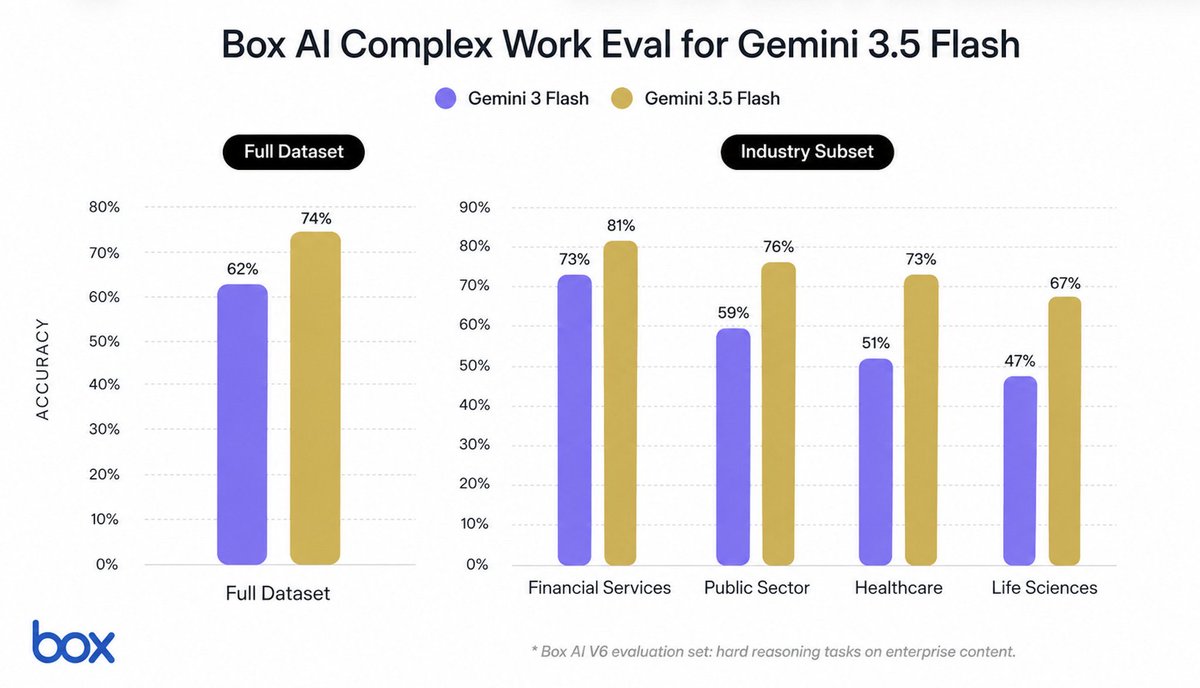
Gemini 3.5 Flash is out, and it's a major jump over Gemini 3 Flash in model capability for knowledge work. We've been evaluating it on our Box AI Complex Work Eval in early release, and the model delivers a 12 percentage point jump on complex document tasks.
For testing this model, we give the Box AI Agent (using Gemini 3.5) complex problems to solve that represent common but difficult knowledge worker tasks in banking, consulting, public sector, healthcare, and other industries. These tasks can be things like drafting reports, doing due diligence, and more, given a set of relevant documents.
In our tests, Gemini 3.5 Flash delivered jumps across every industry, including:
* Financial services: 81% vs 73% (+8pp)
* Public sector: 76% vs 59%, (+17pp)
* Healthcare: 73% vs 51%, (+22pp)
* Life Sciences: 67% vs 47%, (+20pp)
Incredible to see the continued performance gains.
Gemini 3.5 Flash will be available soon in Box AI Studio and through the Box API. The Box MCP Server will soon be available in the Gemini app with more details to come.
English
Michael Bruck retweetledi

HOLY SMOKES!
Andrej Karpathy warned about this a month ago and today he announced he's joining Anthropic.
A month ago, Karpathy said openly that if you are outside a frontier lab, your judgment will inevitably start to drift.
You lose touch with what is actually being built, how these systems work under the hood, and where the entire field is heading next.
He said being inside one of the frontier labs doing really good work for some period of time might be the only way to stay genuinely connected to what is actually happening at the cutting edge.
Today he acted on exactly that.
Andrej Karpathy just announced he’s joining Anthropic’s pre-training team, placing him directly inside the most compute-intensive and technically demanding layer of building frontier AI models.
Pre-training is where the large-scale compute runs happen, where the fundamental capabilities of a model are baked in at the deepest level and where the gap between frontier labs and everyone else is either won or lost permanently.
He will also build and lead a new team focused on using Claude itself to accelerate pre-training research meaning Anthropic is now using its own models to help design and build the next generation of its models, closing the self-improvement loop that every major lab is racing to complete.
The choice of Anthropic specifically is the signal worth paying attention to.
Karpathy co-founded OpenAI, ran AI at Tesla for years, and spent the last two years as one of the most credible and widely followed independent voices in the entire field.
He had every option available to him, OpenAI where he helped build the original research culture, Google DeepMind, xAI and he chose Anthropic.
When the person who arguably understands AI pre-training better than almost anyone alive looks at the entire landscape and decides that Anthropic is where the most important work of the next few years will happen, that is not a career decision but rather a verdict on which lab is actually winning the research race right now.
Andrej Karpathy@karpathy
Personal update: I've joined Anthropic. I think the next few years at the frontier of LLMs will be especially formative. I am very excited to join the team here and get back to R&D. I remain deeply passionate about education and plan to resume my work on it in time.
English
Michael Bruck retweetledi

Personal update: I've joined Anthropic. I think the next few years at the frontier of LLMs will be especially formative. I am very excited to join the team here and get back to R&D. I remain deeply passionate about education and plan to resume my work on it in time.
English
Michael Bruck retweetledi

Welcome to the team, Andrej!
Andrej Karpathy@karpathy
Personal update: I've joined Anthropic. I think the next few years at the frontier of LLMs will be especially formative. I am very excited to join the team here and get back to R&D. I remain deeply passionate about education and plan to resume my work on it in time.
English
Michael Bruck retweetledi
What are best practices for running Claude Code at scale?
New blog post on what we've learned from teams running it across multi-million-line monorepos, decades-old legacy systems, and distributed microservices:
claude.com/blog/how-claud…
English
Michael Bruck retweetledi

People freaking out over my AI spend. What nobody sees: Part of what excites me so much about working on OpenClaw is that I'm trying to answer the question:
How would we build software in the future if tokens don't matter?
We constant run ~100 codex in the cloud, reviewing every PR, every issue. If a fix on main lands, @clawsweeper will eventually find that 6 month old issue and close it with an exact reference.
We run codex on every commit to review for security issues (as it's far too easy to miss).
We run codex to de-duplicate issues and find clusters and send reports for the most pressing issues.
We have agents that can recreate complex setups, spin up ephemeral crabbox.sh machines, log into e.g. Telegram, make a video and post before/after fix on the PR.
There's codex that watch new issues and - if it fits our documented vision well, automatically create a PR of it. (that then another codex reviews)
We have codex running that scans comments for spam and blocks people.
We have codex instances running that verify performance benchmarks and report regressions into Discord.
We have agents that listen on our meetings and proactively start work, e.g. create PRs when we discuss new features while we discuss them.
We build clawpatch.ai to split all our projects into functional units to review and find bugs and regresssions.
We do the same split for security with Vercel's deepsec and Codex Security to find regressions and vulnerabilities.
All that automation allows us to run this project extremely lean.
English
Michael Bruck retweetledi
There will be no AI jobpocalypse.
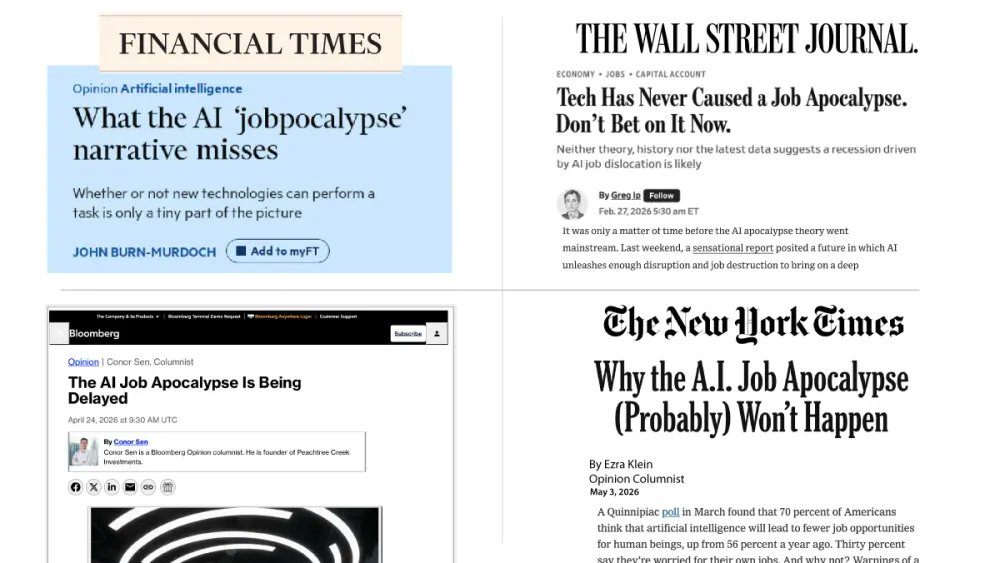
The story that AI will lead to massive unemployment is stoking unnecessary fear. AI — like any other technology — does affect jobs, but telling overblown stories of large-scale unemployment is irresponsible and damaging. Let’s put a stop to it.
I’ve expressed skepticism about the jobpocalypse in previous posts. I’m glad to see that the popular press is now pushing back on this narrative. The image below features some recent headlines.
Software engineering is the sector most affected by AI tools, as coding agents race ahead. Yet hiring of software engineers remains strong! So while there are examples of AI taking away jobs, the trends strongly suggest the net job creation is vastly greater than the job destruction — just like earlier waves of technology. Further, despite all the exciting progress in AI, the U.S. unemployment rate remains a healthy 4.3%.
Why is the AI jobpocalypse narrative so popular? For one thing, frontier AI labs have a strong incentive to tell stories that make AI technology sound more powerful. At their most extreme, they promote science-fiction scenarios of AI “taking over” and causing human extinction. If a technology can replace many employees, surely that technology must be very valuable!
Also, a lot of SaaS software companies charge around $100-$1000 per user/year. But if an AI company can replace an employee who makes $100,000 — or make them 50% more productive — then charging even $10,000 starts to look reasonable. By anchoring not to typical SaaS prices but to salaries of employees, AI companies can charge a lot more.
Additionally, businesses have a strong incentive to talk about layoffs as if they were caused by AI. After all, talking about how they’re using AI to be far more productive with fewer staff makes them look smart. This is a better message than admitting they overhired during the pandemic when capital was abundant due to low interest rates and a massive government financial stimulus.
To be clear, I recognize that AI is causing a lot of people’s work to change. This is hard. This is stressful. (And to some, it can be fun.) I empathize with everyone affected. At the same time, this is very different from predicting a collapse of the job market.
Societies are capable of telling themselves stories for years that have little basis in reality and lead to poor society-wide decision making. For example, fears over nuclear plant safety led to under-investment in nuclear power. Fears of the “population bomb” in the 1960s led countries to implement harsh policies to reduce their populations. And worries about dietary fat led governments to promote unhealthy high-sugar diets for decades.
Now that mainstream media is openly skeptical about the jobpocalypse, I hope these stories will start to lose their teeth (much like fears of AI-driven human extinction have).
Contrary to the predictions of an AI jobpocalypse, I predict the opposite: There will be an AI jobapalooza! AI will lead to a lot more good AI engineering jobs, and I’m also optimistic about the future of the overall job market. What AI engineers do will be different from traditional software engineering, and many of these jobs will be in businesses other than traditional large employers of developers. In non-AI roles, too, the skills needed will change because of AI. That makes this a good time to encourage more people to become proficient in AI, and make sure they’re ready for the different but plentiful jobs of the future!
[Original text in The Batch newsletter.]
English
Michael Bruck retweetledi

self-verification (Outcomes) + self-learning (Dreaming) are two of the most interesting new features we shared at Code With Claude last week.
a few notes + video links to the talks ...

English
Michael Bruck retweetledi

Google DeepMind just reinvented the mouse pointer.
Since Doug Engelbart's demo in 1968, the little arrow on your screen has barely changed. Until now.
The new AI pointer sees what you're pointing at, understands the context, and responds to your voice. You point at an image of a building, say "show me the route," and that's it.
No copy-paste, no chat window, no prompt gymnastics.Powered by Gemini. First demos are live in Chrome and Google AI Studio. This might be the beginning of the end for the classic chatbot interface.
really really cool! Im using wispr flow right now but this is literally the next step
Google DeepMind@GoogleDeepMind
We’re reimagining a 50-year-old interface - the mouse pointer - with AI. 🖱️ These experimental demos show how people can intuitively direct Gemini on their screens using motion, speech, and natural shorthand to get things done 🧵
English
Michael Bruck retweetledi

I turned @trq212's article into an interactive HTML! I was a markdown boy but since I started working at Microsoft I'm using HTML more and more.
Our engineers love to send AI-generated HTML to coordinate between SWE/PM on projects since it's easier to read than markdown.
Thariq@trq212
English
Michael Bruck retweetledi

People talk, listen, watch, think, and collaborate at the same time, in real time. We've designed an AI that works with people the same way.
We share our approach, early results, and a quick look at our model in action.
thinkingmachines.ai/blog/interacti…
English
Michael Bruck retweetledi
This works really well btw, at the end of your query ask your LLM to "structure your response as HTML", then view the generated file in your browser. I've also had some success asking the LLM to present its output as slideshows, etc.
More generally, imo audio is the human-preferred input to AIs but vision (images/animations/video) is the preferred output from them. Around a ~third of our brains are a massively parallel processor dedicated to vision, it is the 10-lane superhighway of information into brain. As AI improves, I think we'll see a progression that takes advantage:
1) raw text (hard/effortful to read)
2) markdown (bold, italic, headings, tables, a bit easier on the eyes) <-- current default
3) HTML (still procedural with underlying code, but a lot more flexibility on the graphics, layout, even interactivity) <-- early but forming new good default
...4,5,6,...
n) interactive neural videos/simulations
Imo the extrapolation (though the technology doesn't exist just yet) ends in some kind of interactive videos generated directly by a diffusion neural net. Many open questions as to how exact/procedural "Software 1.0" artifacts (e.g. interactive simulations) may be woven together with neural artifacts (diffusion grids), but generally something in the direction of the recently viral x.com/zan2434/status…
There are also improvements necessary and pending at the input. Audio nor text nor video alone are not enough, e.g. I feel a need to point/gesture to things on the screen, similar to all the things you would do with a person physically next to you and your computer screen.
TLDR The input/output mind meld between humans and AIs is ongoing and there is a lot of work to do and significant progress to be made, way before jumping all the way into neuralink-esque BCIs and all that. For what's worth exploring at the current stage, hot tip try ask for HTML.
Thariq@trq212
English
Michael Bruck retweetledi

Thanks @Gavriel_Cohen. You’re right. I never used an IDE. Claude Code made all edits. No @karpathy ‘vibe coding’. All I did was ‘tool assembly’ to create a utility that worked in my domain!
Gavriel Cohen@Gavriel_Cohen
Singapore's Foreign Minister published the architecture for his "second brain for a diplomat" yesterday. Architecture diagrams, design rationale, the works. A developer-style writeup of his own system. It runs on a Raspberry Pi. It connects to his WhatsApp and Gmail, transcribes voice notes locally, ingests speeches and articles, and builds up a knowledge graph over time. It answers questions, drafts speeches, condenses information. He says he doesn't dare switch it off. What @VivianBala built is one-of-one. There's no other setup like it. But what he built it from isn't. He composed four open-source pieces: - @NanoClaw_AI , the agent framework: github.com/qwibitai/nanoc… - Mnemon, the persistent memory layer: github.com/mnemon-dev/mne… - OneCLI, the credential proxy that keeps API keys out of the containers: github.com/onecli/onecli - The LLM Wiki pattern by Andrej Karpathy, the synthesis approach: x.com/karpathy/statu… None of them are his. The composition is his. And then he published the composition: gist.github.com/VivianBalakris… He didn't keep it internal as Singapore's edge. He didn't spin it into a product. He didn't gatekeep. He wrote it up and put it on GitHub. There are tens of thousands of doctors, lawyers, researchers, investors, and operators building one-of-one setups for themselves right now. Some simpler than Vivian's, some more elaborate. The impulse will be to sit on it. Treat it as your edge. Think about what product or company you could spin out of it. Resist that impulse. Vivian put it directly: "The diplomat who learns to work with AI will have a meaningful edge. I think that edge is now." The specific thing Vivian composed will be obsolete in months. His real edge isn't the system. It's his ability to build it. Being plugged in, up to speed, able to cut through the noise and connect the right pieces into something that brings real value. Sharing the blueprint doesn't give that away. It amplifies it. You become a beacon. Other people working on the same things find you. They share what they're building, suggest improvements, point at things you didn't know existed. You learn faster. You stay in the center of where things are happening. Publishing isn't giving away your edge. It's doubling down on it.
English
Michael Bruck retweetledi

Where in the world can you find a senior government leader with a personal AI stack published on GitHub?
How many would be willing to talk about it in a room full of builders?
Which is why we are so incredibly honoured to welcome Singapore’s Minister for Foreign Affairs, Dr Vivian Balakrishnan, to the lineup of speakers for @aiDotEngineer Singapore.
A few weeks ago, Minister Balakrishnan casually dropped a technical writeup of his personal AI system online.
Raspberry Pi. Claude. Local embeddings. Knowledge graphs. A full architecture breakdown.
And the global AI community noticed because it reflected something bigger: a willingness to engage with these systems directly, publicly, and practically.
To kick off AIE Singapore, Minister Balakrishnan will share his experience experimenting with open-source AI tools and building a “second brain” workflow, alongside broader reflections on how AI may reshape global dynamics, and the way people work, think, and manage information.
In a role that demands navigating enormous volumes of information and constant context-switching, his reflections will set the tone for the conference in exactly the way we hoped:
That meaningful conversations about AI should not stay abstract.
They should involve understanding its parameters through practical engagement with the technology.
And that Singapore has become the place where that kind of engagement happens seriously.

English
How it should be
Tuomas Artman@artman
Today is a hard day. I shared this note with the @linear team today: We’ve made the difficult decision to increase our workforce. This is not a cost-cutting exercise or a reflection of anyone’s performance. We’re simply reimagining every role for the agentic AI era. We’re hiring. We’re sorry about that.
English